
Final Amendments to Texas Rules of Civil Procedure


- Slides: 41
Final Amendments to Texas Rules of Civil Procedure Implemented January 1, 2021 Lauren Ottmers
OVERVIEW Discovery in Texas will look a lot more like federal court beginning 2021 Some amendments outlined in this presentation went into effect during the summer of 2020 Reason for amendments: Texas Government Code Section 22. 004(h-1) calls for a “prompt, efficient, and cost-effective resolution of civil actions”
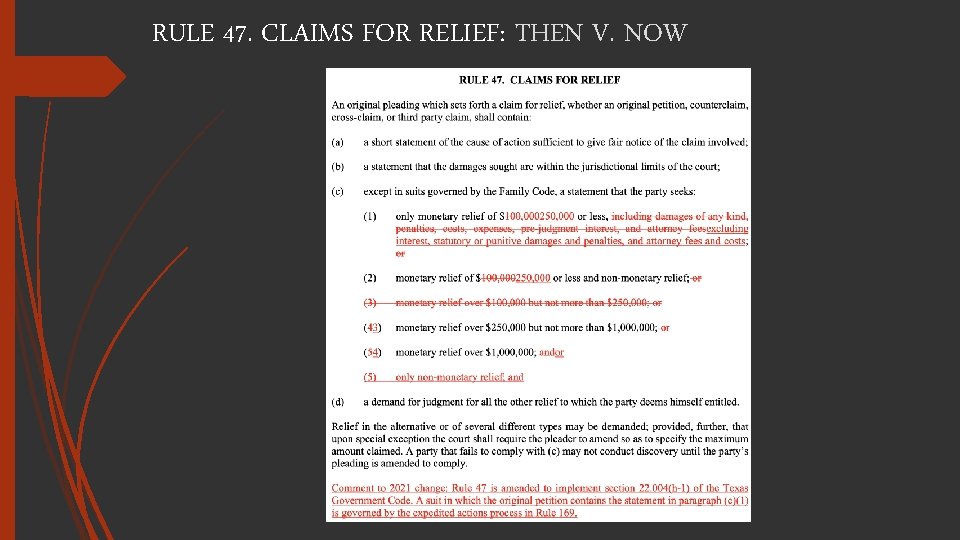
RULE 47. CLAIMS FOR RELIEF: THEN V. NOW
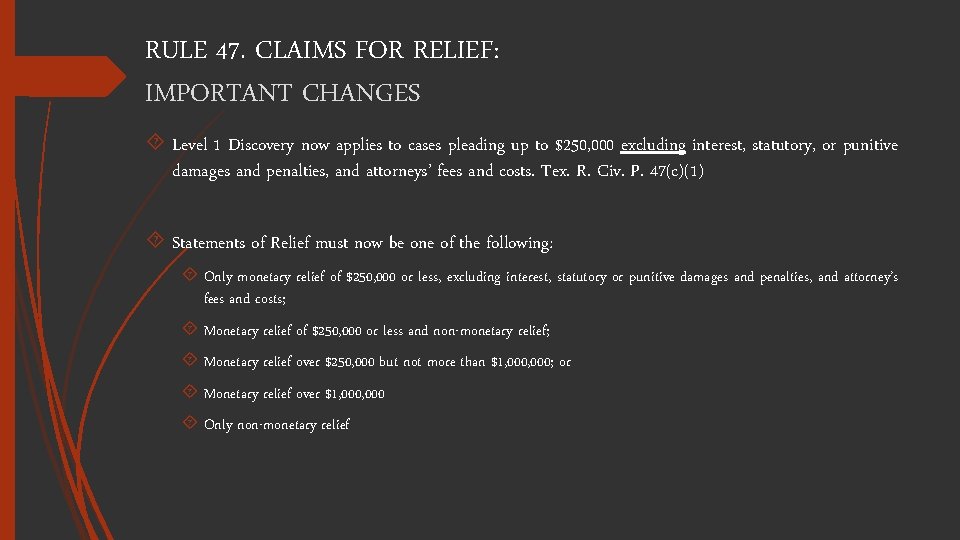
RULE 47. CLAIMS FOR RELIEF: IMPORTANT CHANGES Level 1 Discovery now applies to cases pleading up to $250, 000 excluding interest, statutory, or punitive damages and penalties, and attorneys’ fees and costs. Tex. R. Civ. P. 47(c)(1) Statements of Relief must now be one of the following: Only monetary relief of $250, 000 or less, excluding interest, statutory or punitive damages and penalties, and attorney’s fees and costs; Monetary relief of $250, 000 or less and non-monetary relief; Monetary relief over $250, 000 but not more than $1, 000; or Monetary relief over $1, 000 Only non-monetary relief
RULE 47. CLAIMS FOR RELIEF: IMPACT All civil actions claiming relief less than $250, 000, not including fees, etc. will be expedited actions This means that more cases will fall into the Level One expedited action category
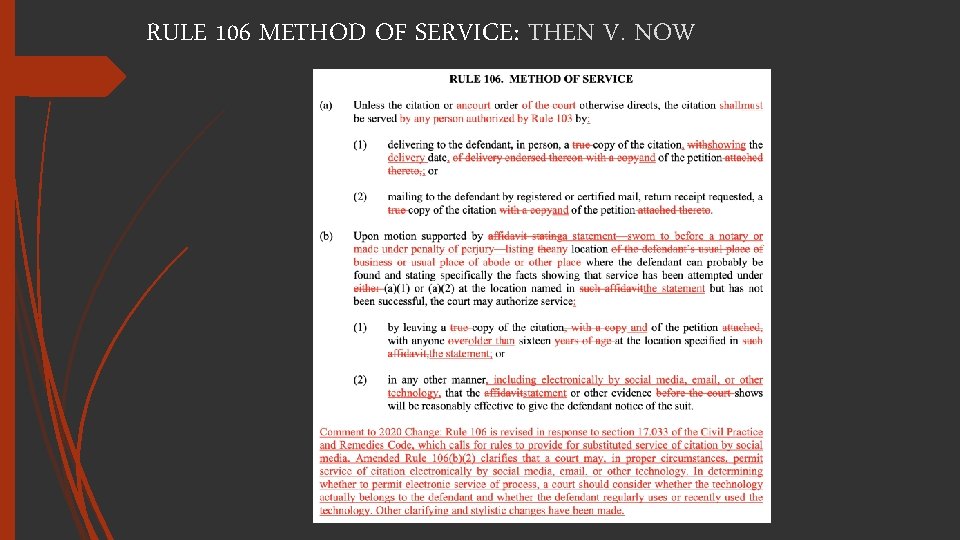
RULE 106 METHOD OF SERVICE: THEN V. NOW
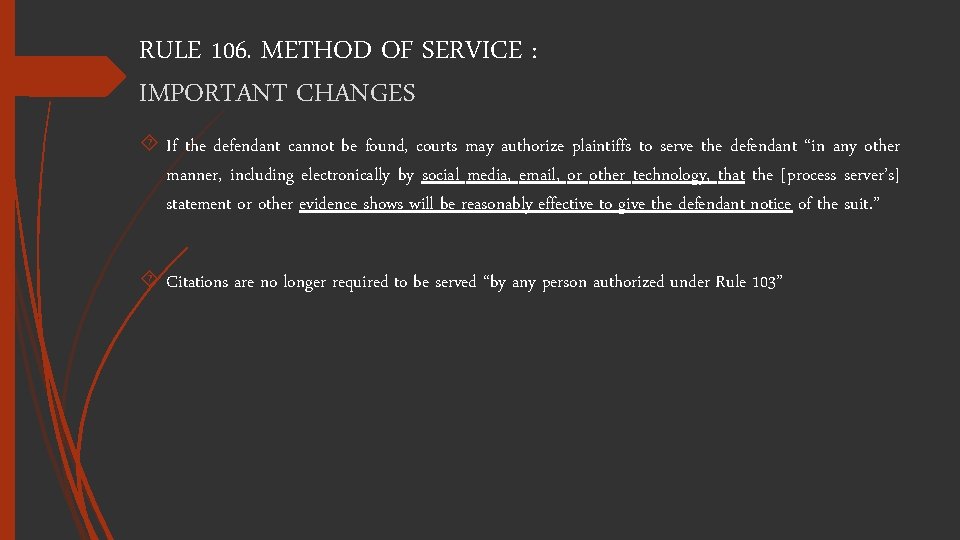
RULE 106. METHOD OF SERVICE : IMPORTANT CHANGES If the defendant cannot be found, courts may authorize plaintiffs to serve the defendant “in any other manner, including electronically by social media, email, or other technology, that the [process server’s] statement or other evidence shows will be reasonably effective to give the defendant notice of the suit. ” Citations are no longer required to be served “by any person authorized under Rule 103”
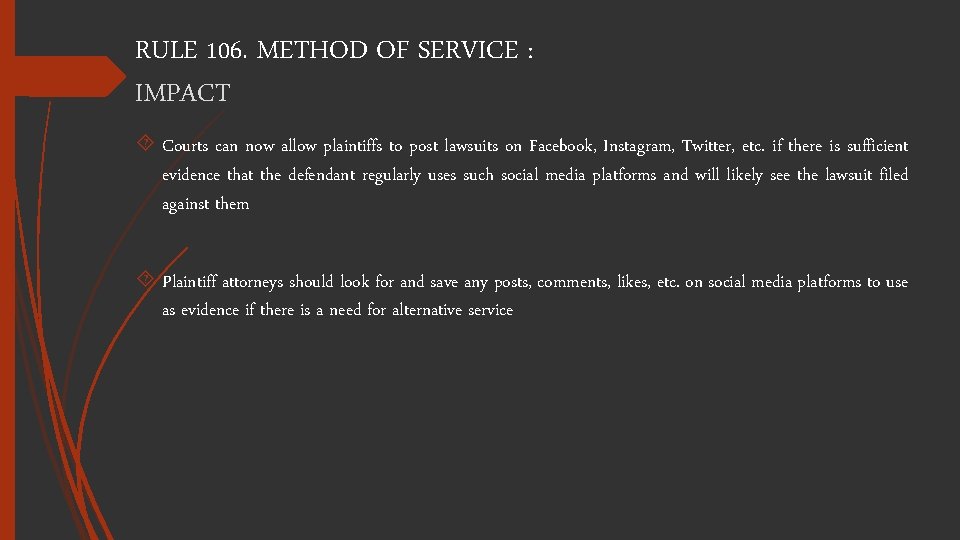
RULE 106. METHOD OF SERVICE : IMPACT Courts can now allow plaintiffs to post lawsuits on Facebook, Instagram, Twitter, etc. if there is sufficient evidence that the defendant regularly uses such social media platforms and will likely see the lawsuit filed against them Plaintiff attorneys should look for and save any posts, comments, likes, etc. on social media platforms to use as evidence if there is a need for alternative service
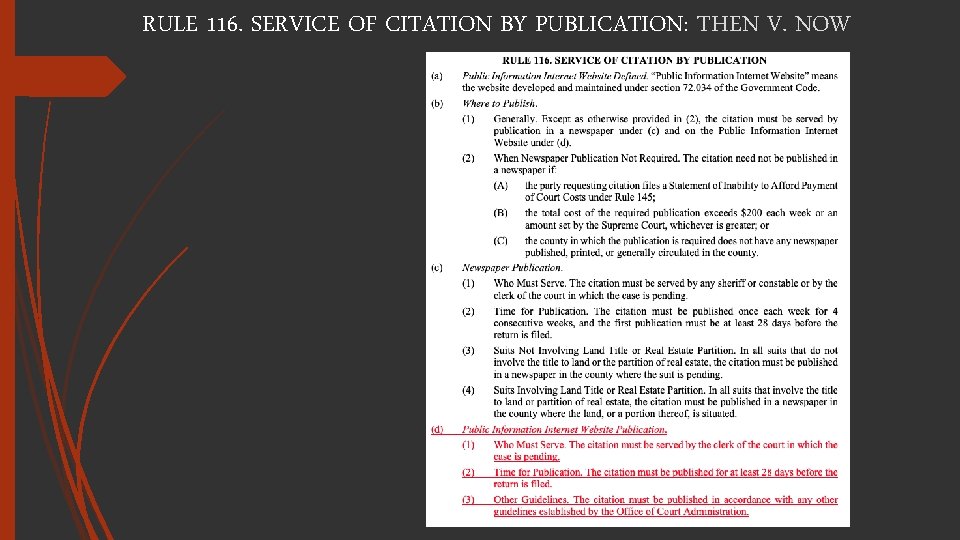
RULE 116. SERVICE OF CITATION BY PUBLICATION: THEN V. NOW
RULE 116. SERVICE OF CITATION BY PUBLICATION: IMPORTANT CHANGES The court clerk may publish a citation by posting it to a “Public Information Internet Website Publication” The citation must stay posted for at least 28 days on the website
RULE 116. SERVICE OF CITATION BY PUBLICATION: IMPACT Lawsuits may now be published on the internet in order to serve the defendant
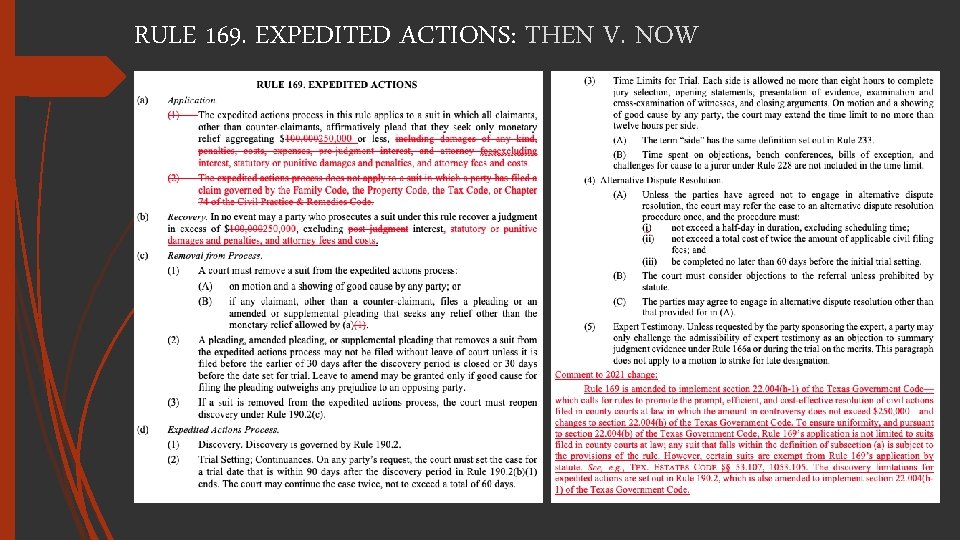
RULE 169. EXPEDITED ACTIONS: THEN V. NOW
RULE 169. EXPEDITED ACTIONS : IMPORTANT CHANGES Expedited action now applies to cases with only monetary relief of $250, 000 or less (used to be $100, 000), not including statutory damages, punitive damages, attorney’s fees and costs, or interest This cap is cumulative of all claimants’ statements of relief Cases governed by the Family Code, the Property Code, the Tax Code, or CPRC Chapter 74 are no longer excluded from he expedited actions process
RULE 169. EXPEDITED ACTIONS : IMPACT Because interest, statutory or punitive damages and penalties, and attorney fees and costs are not included, plaintiffs can plead for an amount much higher than $250, 000 and still have an expedited action with Level 1 Discovery Plaintiffs could also plead larger amounts to cross the $250, 000 line in order to have more extensive discovery
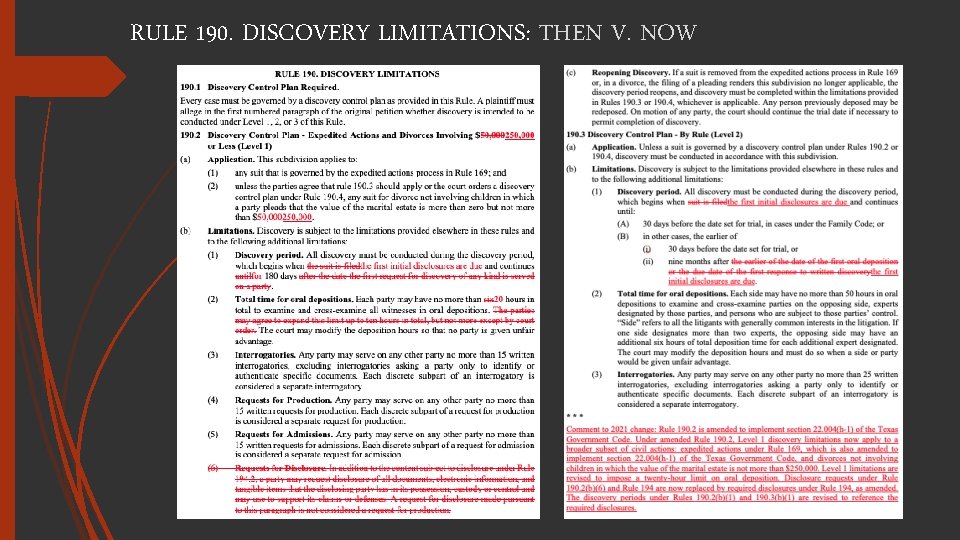
RULE 190. DISCOVERY LIMITATIONS: THEN V. NOW
RULE 190. DISCOVERY LIMITATIONS : IMPORTANT CHANGES Level 1: Expedited Actions and divorces involving $250, 000 or less Discovery begins when initial disclosures are due (discussed in Rule 194) instead of when the suit is filed and lasts 180 days 20 hours of depositions instead of six Level 2: Discovery begins when initial disclosures are due (discussed in Rule 194) instead of when the suit is filed and continues until the earlier of 30 days before the trial date, or nine months after initial disclosures are due Level 3: no changes to level 3
RULE 190. DISCOVERY LIMITATIONS : IMPACT Discovery of any kind cannot be served with the petition anymore Hours of deposition time have significantly increased for Level 1 discovery (20 hours now per side) Level 2 discovery ends either 30 days before trial or 9 months after initial disclosures are due, not the first written discovery response or oral deposition
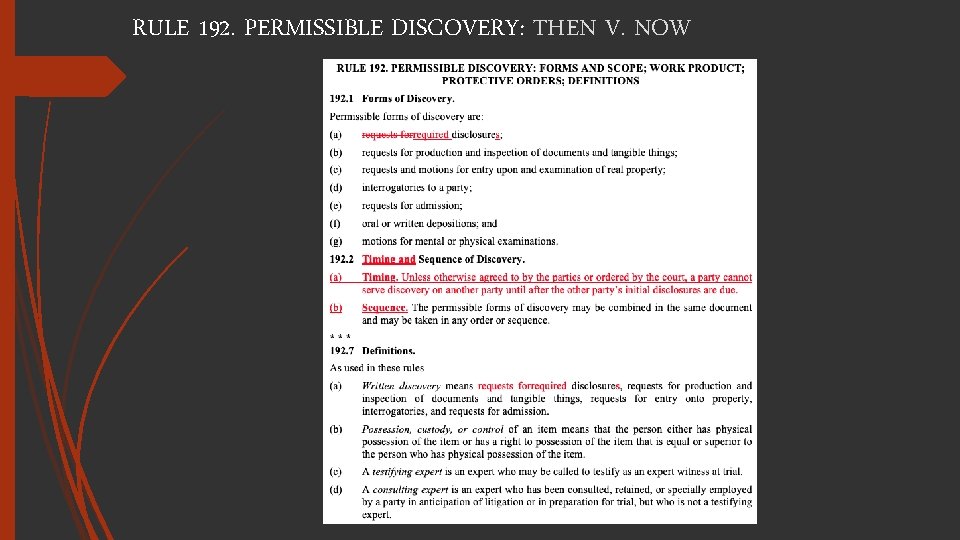
RULE 192. PERMISSIBLE DISCOVERY: THEN V. NOW
RULE 192. PERMISSIBLE DISCOVERY : IMPORTANT CHANGES Requests for disclosure are now required disclosures Unless otherwise agreed to or ordered by the court, neither party can serve discovery until the other party’s initial disclosures are due
RULE 192. PERMISSIBLE DISCOVERY : IMPACT Other party’s initial disclosures deadline must pass before you can serve discovery Disclosures are now required
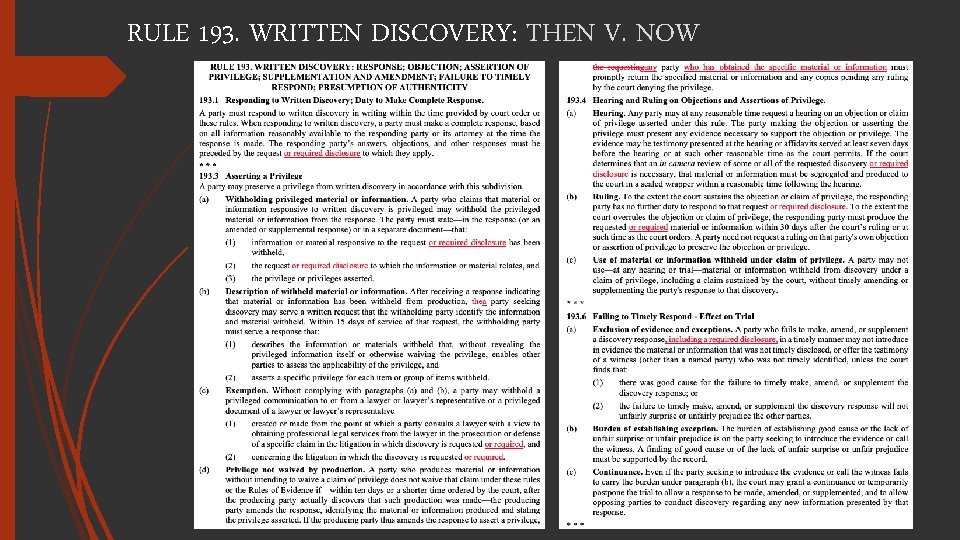
RULE 193. WRITTEN DISCOVERY: THEN V. NOW
RULE 193. WRITTEN DISCOVERY : IMPORTANT CHANGES Now, any party who has obtained privileged information or material must return it within 10 days or shorter if ordered by the court
RULE 193. WRITTEN DISCOVERY : IMPACT Privileged information must be returned no matter who received that information
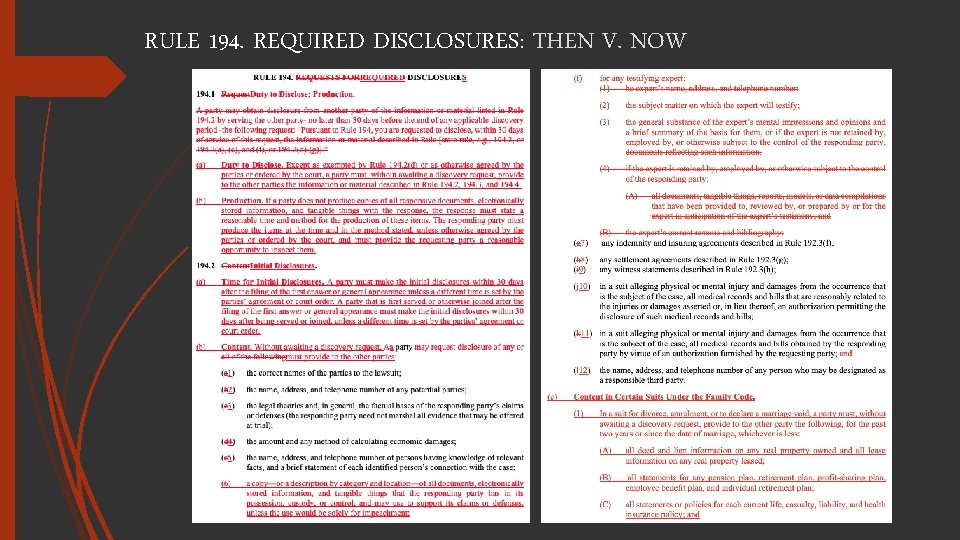
RULE 194. REQUIRED DISCLOSURES: THEN V. NOW
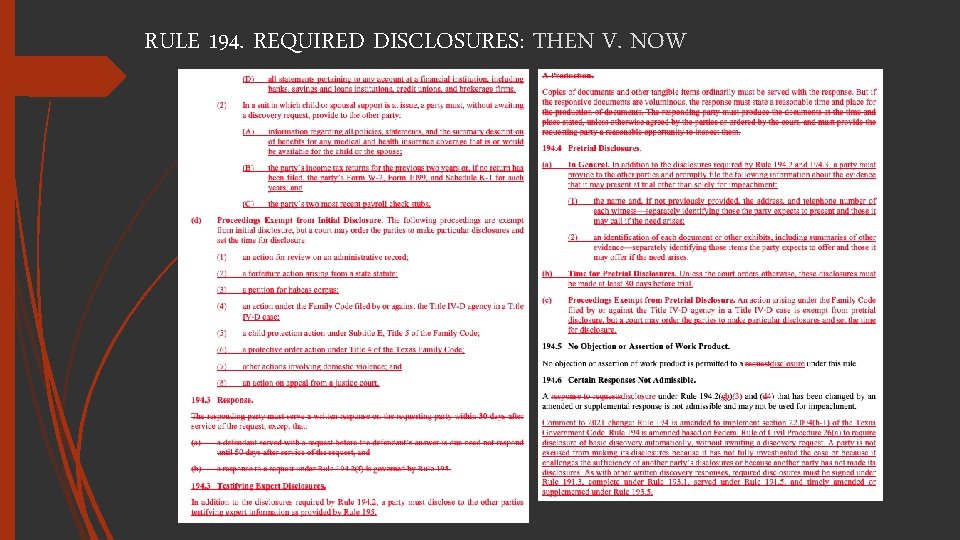
RULE 194. REQUIRED DISCLOSURES: THEN V. NOW
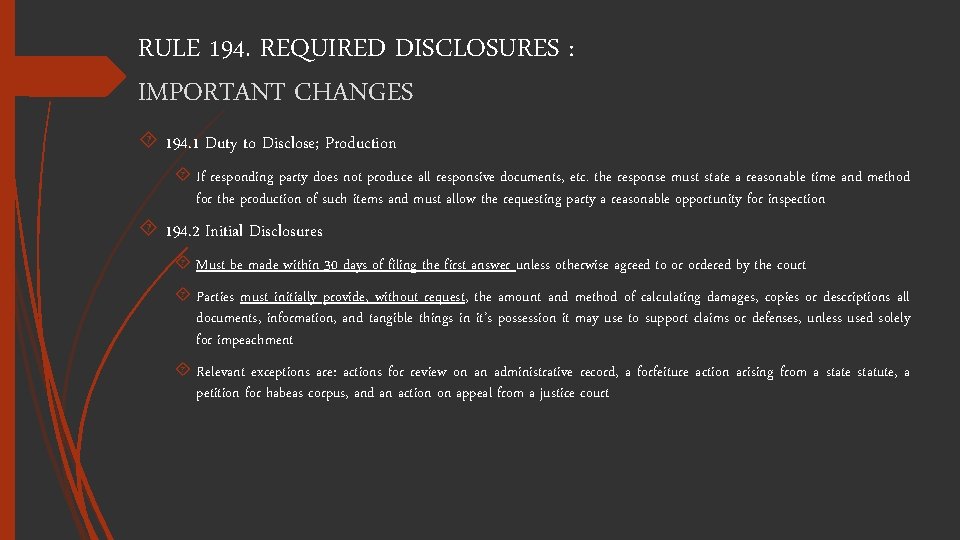
RULE 194. REQUIRED DISCLOSURES : IMPORTANT CHANGES 194. 1 Duty to Disclose; Production If responding party does not produce all responsive documents, etc. the response must state a reasonable time and method for the production of such items and must allow the requesting party a reasonable opportunity for inspection 194. 2 Initial Disclosures Must be made within 30 days of filing the first answer unless otherwise agreed to or ordered by the court Parties must initially provide, without request, the amount and method of calculating damages, copies or descriptions all documents, information, and tangible things in it’s possession it may use to support claims or defenses, unless used solely for impeachment Relevant exceptions are: actions for review on an administrative record, a forfeiture action arising from a state statute, a petition for habeas corpus, and an action on appeal from a justice court
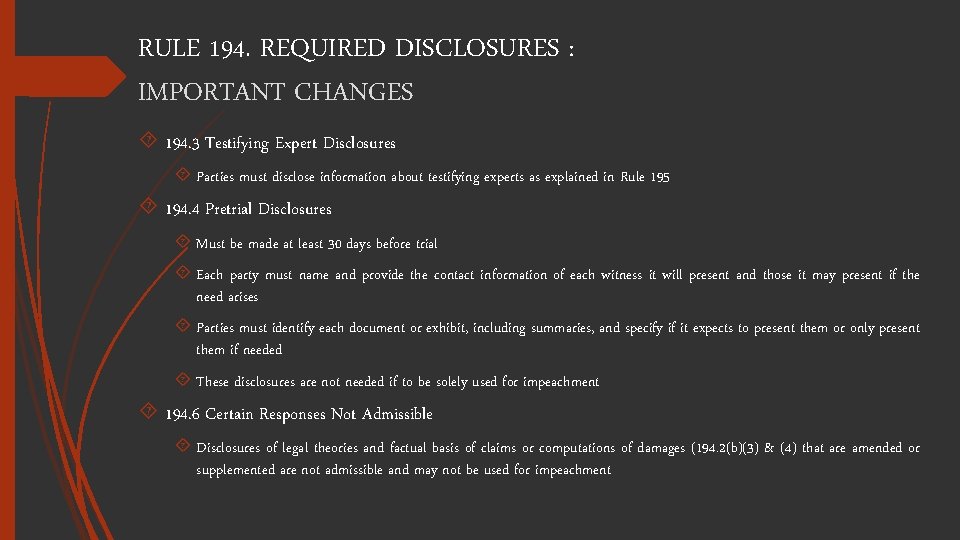
RULE 194. REQUIRED DISCLOSURES : IMPORTANT CHANGES 194. 3 Testifying Expert Disclosures Parties must disclose information about testifying experts as explained in Rule 195 194. 4 Pretrial Disclosures Must be made at least 30 days before trial Each party must name and provide the contact information of each witness it will present and those it may present if the need arises Parties must identify each document or exhibit, including summaries, and specify if it expects to present them or only present them if needed These disclosures are not needed if to be solely used for impeachment 194. 6 Certain Responses Not Admissible Disclosures of legal theories and factual basis of claims or computations of damages (194. 2(b)(3) & (4) that are amended or supplemented are not admissible and may not be used for impeachment
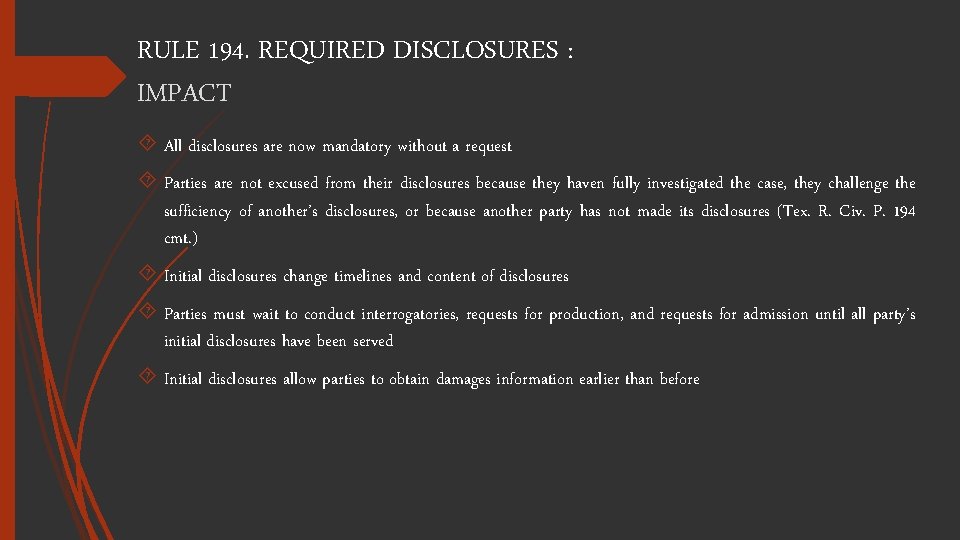
RULE 194. REQUIRED DISCLOSURES : IMPACT All disclosures are now mandatory without a request Parties are not excused from their disclosures because they haven fully investigated the case, they challenge the sufficiency of another’s disclosures, or because another party has not made its disclosures (Tex. R. Civ. P. 194 cmt. ) Initial disclosures change timelines and content of disclosures Parties must wait to conduct interrogatories, requests for production, and requests for admission until all party’s initial disclosures have been served Initial disclosures allow parties to obtain damages information earlier than before
RULE 195. DISCOVEREY REGARDING TESTIFYING EXPERT WITNESSSES: THEN V. NOW
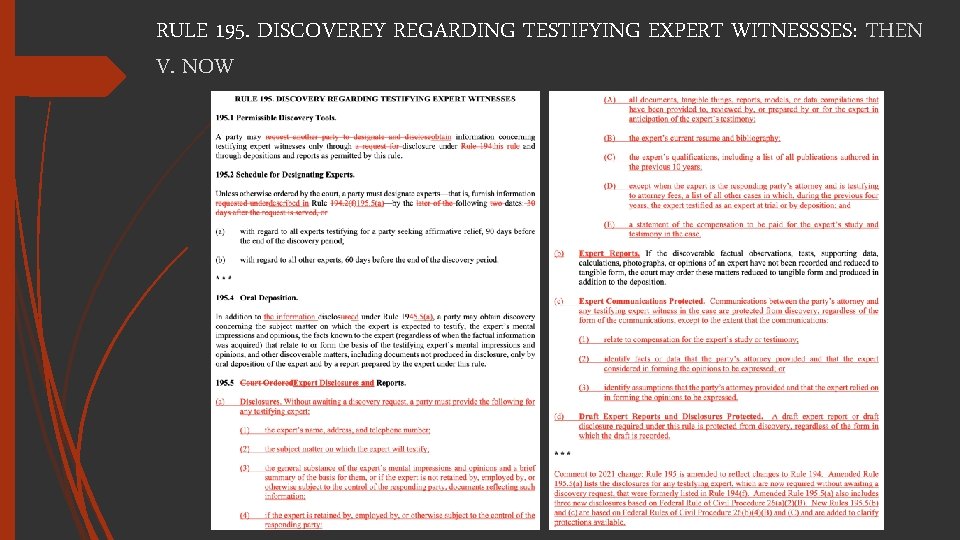
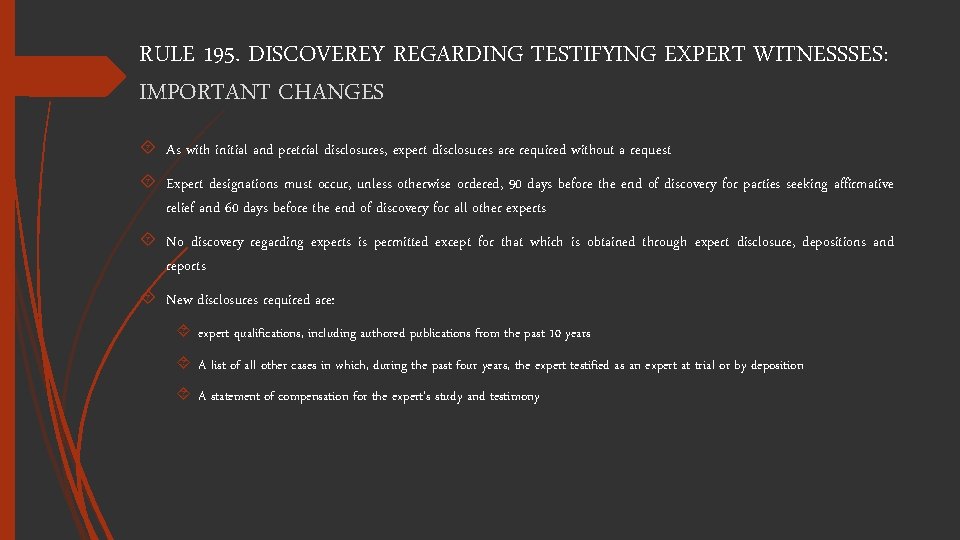
RULE 195. DISCOVEREY REGARDING TESTIFYING EXPERT WITNESSSES: IMPORTANT CHANGES As with initial and pretrial disclosures, expert disclosures are required without a request Expert designations must occur, unless otherwise ordered, 90 days before the end of discovery for parties seeking affirmative relief and 60 days before the end of discovery for all other experts No discovery regarding experts is permitted except for that which is obtained through expert disclosure, depositions and reports New disclosures required are: expert qualifications, including authored publications from the past 10 years A list of all other cases in which, during the past four years, the expert testified as an expert at trial or by deposition A statement of compensation for the expert’s study and testimony
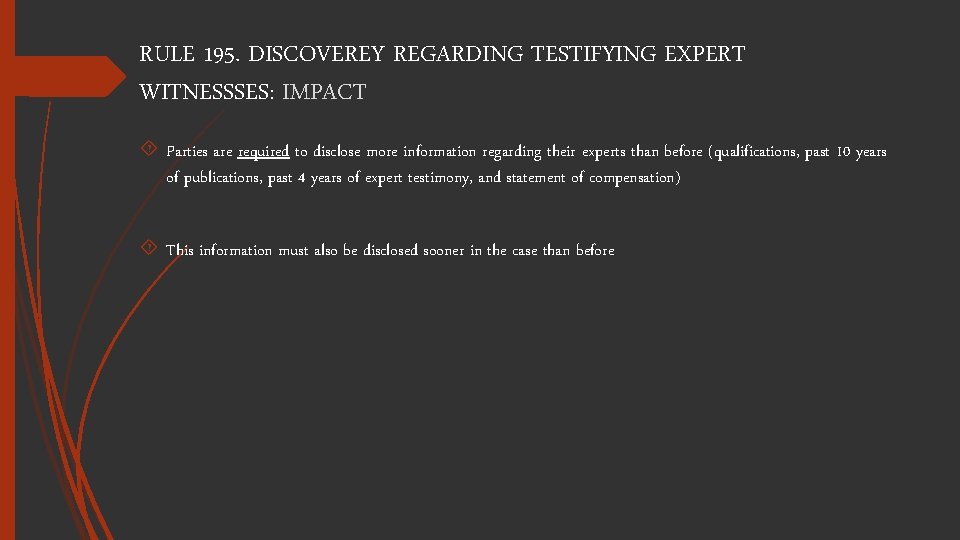
RULE 195. DISCOVEREY REGARDING TESTIFYING EXPERT WITNESSSES: IMPACT Parties are required to disclose more information regarding their experts than before (qualifications, past 10 years of publications, past 4 years of expert testimony, and statement of compensation) This information must also be disclosed sooner in the case than before
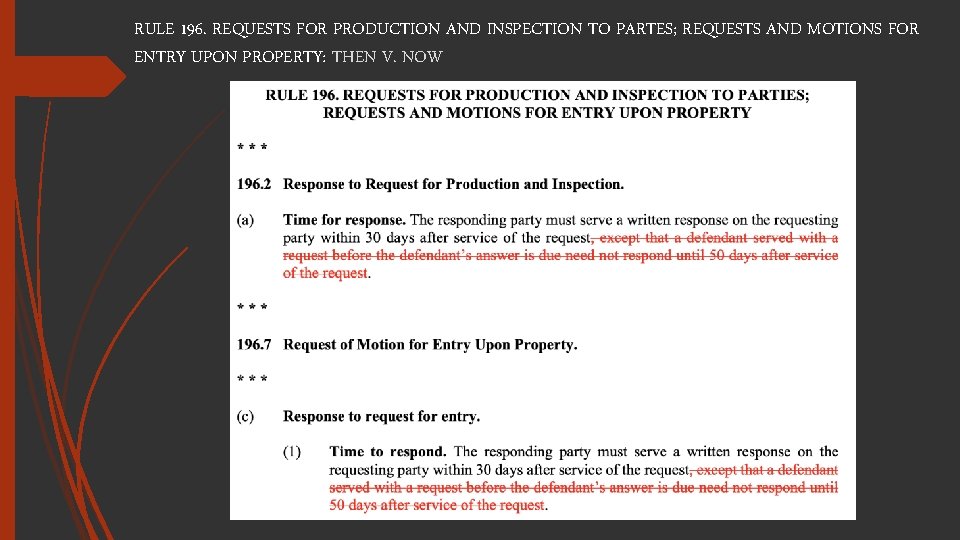
RULE 196. REQUESTS FOR PRODUCTION AND INSPECTION TO PARTES; REQUESTS AND MOTIONS FOR ENTRY UPON PROPERTY: THEN V. NOW
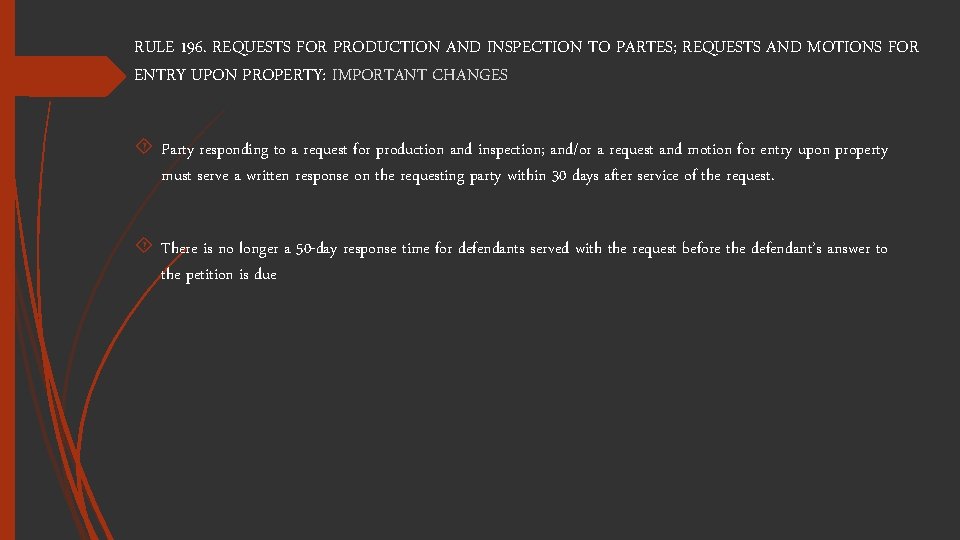
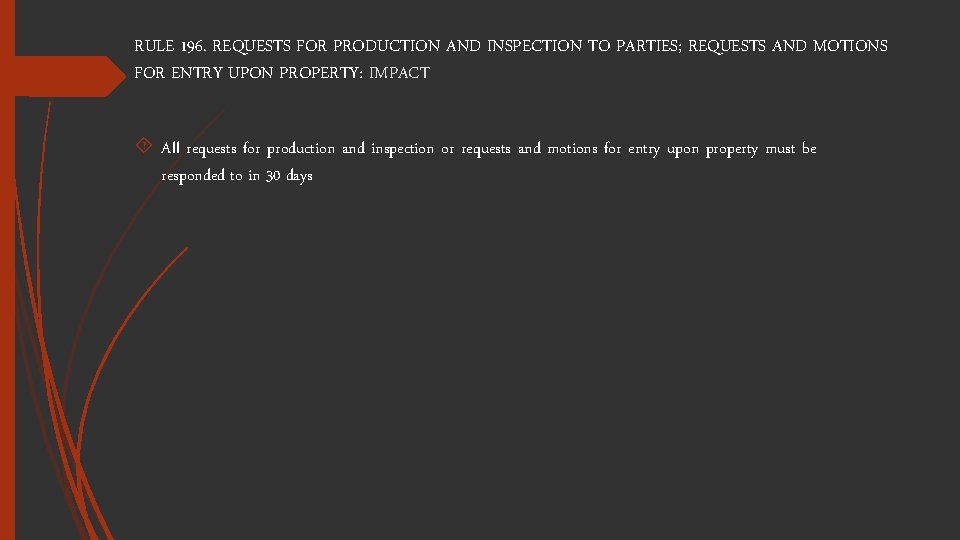
RULE 196. REQUESTS FOR PRODUCTION AND INSPECTION TO PARTES; REQUESTS AND MOTIONS FOR ENTRY UPON PROPERTY: IMPORTANT CHANGES Party responding to a request for production and inspection; and/or a request and motion for entry upon property must serve a written response on the requesting party within 30 days after service of the request. There is no longer a 50 -day response time for defendants served with the request before the defendant’s answer to the petition is due
RULE 196. REQUESTS FOR PRODUCTION AND INSPECTION TO PARTIES; REQUESTS AND MOTIONS FOR ENTRY UPON PROPERTY: IMPACT All requests for production and inspection or requests and motions for entry upon property must be responded to in 30 days
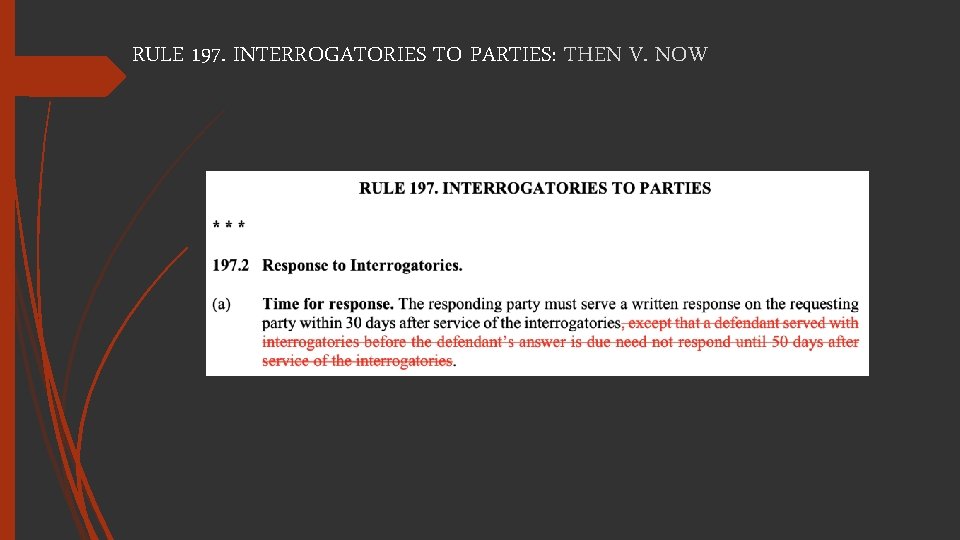
RULE 197. INTERROGATORIES TO PARTIES: THEN V. NOW
RULE 197. INTERROGATORIES TO PARTIES: IMPORTANT CHANGES Party responding to interrogatories must serve a written response on the requesting party within 30 days after service of the interrogatories There is no longer a 50 -day response time for defendants served with interrogatories before the defendant’s answer to the petition is due
RULE 197. INTERROGATORIES TO PARTIES: IMPACT All interrogatories must be responded to in 30 days
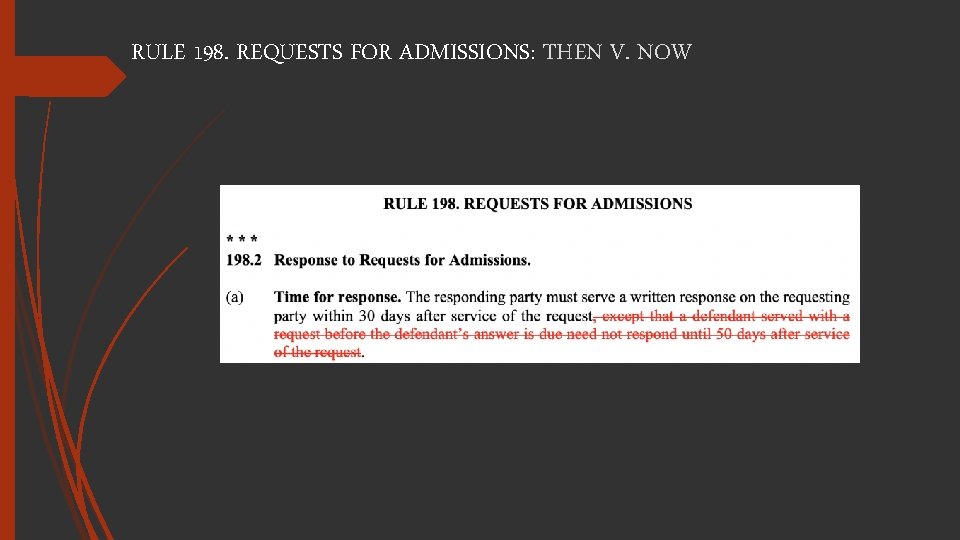
RULE 198. REQUESTS FOR ADMISSIONS: THEN V. NOW
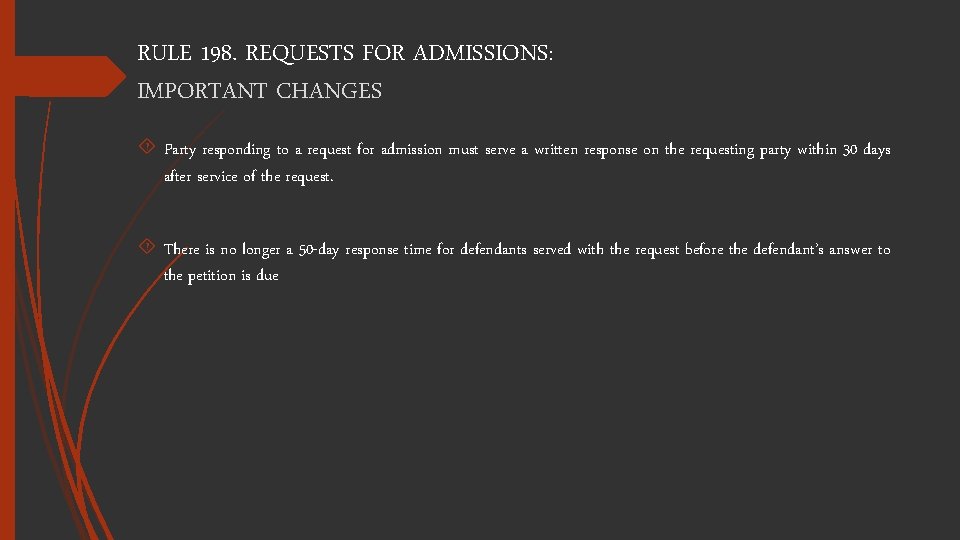
RULE 198. REQUESTS FOR ADMISSIONS: IMPORTANT CHANGES Party responding to a request for admission must serve a written response on the requesting party within 30 days after service of the request. There is no longer a 50 -day response time for defendants served with the request before the defendant’s answer to the petition is due
RULE 198. REQUESTS FOR ADMISSIONS: IMPACT All requests for admission must be responded to in 30 days
REFERENCES “Alert: ‘Amendments to the Texas Rules of Civil Procedure Affect Three Key Areas of Civil Cases. ’” Porter Hedges, Porter Hedges LLP, 2 Sept. 2020, www. porterhedges. com/newsroom-publications-alert-amendments-to-the-texas-rules-of. Carter, Clayton. “Litigation Alert: Major Rule Changes Are Coming in 2021 That Will Affect All Texas Cases. ” Kane Russell Colman Logan, KRCL, 28 Oct. 2020, www. krcl. com/articles/litigation-alert-major-rule-changes-are-coming-in-2021 -that-will-affect-all-texas-cases/. Collings, Scarlett. “Texas Rules of Civil Procedure – 2020 Changes to the Discovery and Service Rules. ” JD Supra, 20 Oct. 2020, www. jdsupra. com/legalnews/texas-rules-of-civil-procedure-2020 -48420/. https: //www. txcourts. gov/media/1450217/trcp-combined-effective-january-1 -2021. pdf Stanfield, Shanon. “Big Changes to the Texas Rules of Civil Procedure. ” Amini & Conant, 25 Aug. 2020, aminiconant. com/big-new-changes-to-the-texas-rules-of-civil-procedure/.