
Fin Design T Tb Total heat loss qfMtanhm
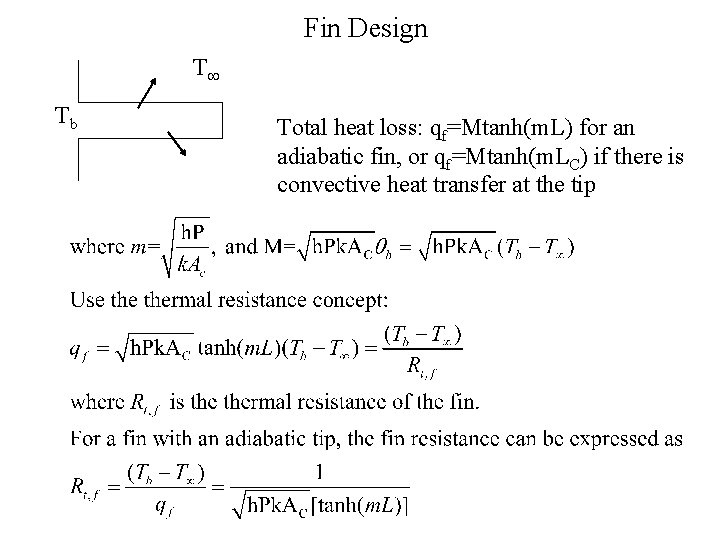
Fin Design T Tb Total heat loss: qf=Mtanh(m. L) for an adiabatic fin, or qf=Mtanh(m. LC) if there is convective heat transfer at the tip
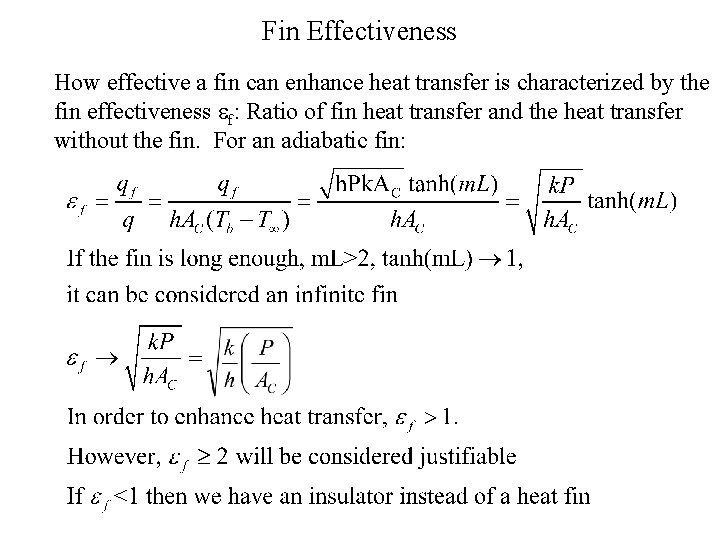
Fin Effectiveness How effective a fin can enhance heat transfer is characterized by the fin effectiveness f: Ratio of fin heat transfer and the heat transfer without the fin. For an adiabatic fin:
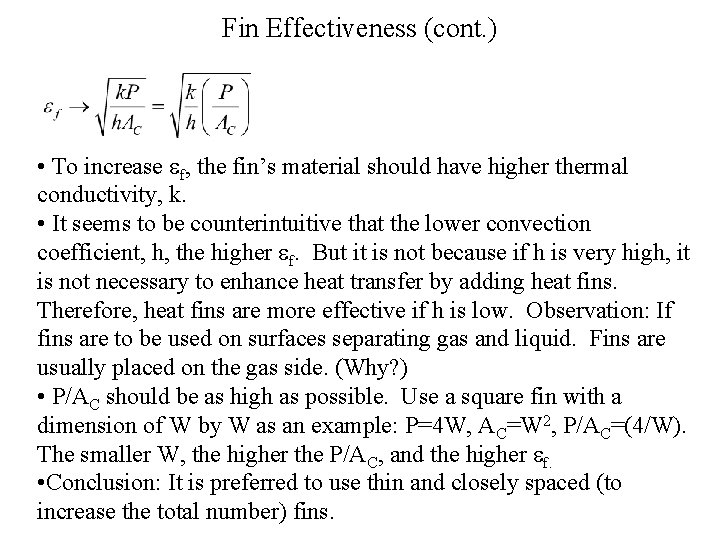
Fin Effectiveness (cont. ) • To increase f, the fin’s material should have higher thermal conductivity, k. • It seems to be counterintuitive that the lower convection coefficient, h, the higher f. But it is not because if h is very high, it is not necessary to enhance heat transfer by adding heat fins. Therefore, heat fins are more effective if h is low. Observation: If fins are to be used on surfaces separating gas and liquid. Fins are usually placed on the gas side. (Why? ) • P/AC should be as high as possible. Use a square fin with a dimension of W by W as an example: P=4 W, AC=W 2, P/AC=(4/W). The smaller W, the higher the P/AC, and the higher f. • Conclusion: It is preferred to use thin and closely spaced (to increase the total number) fins.
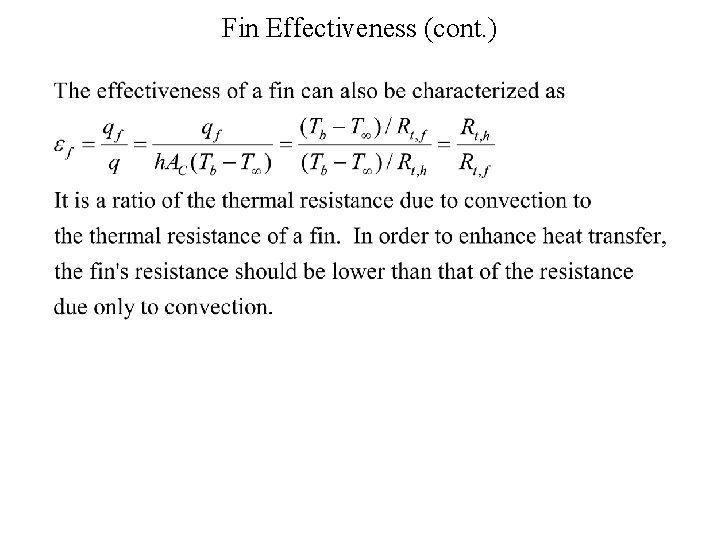
Fin Effectiveness (cont. )
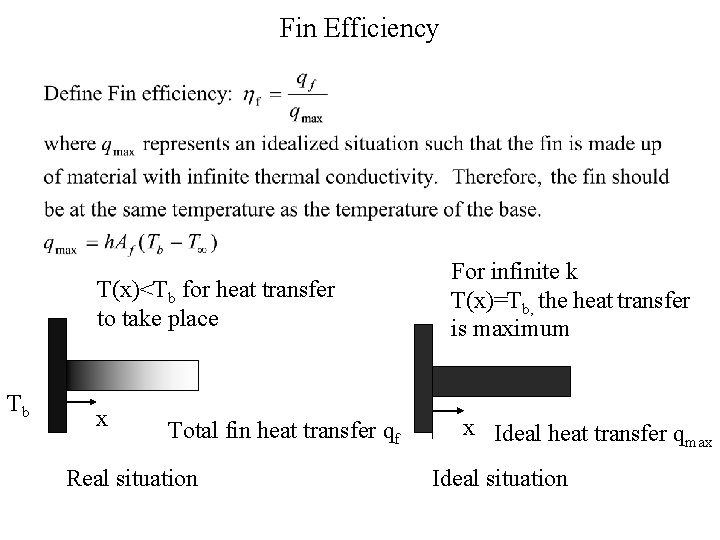
Fin Efficiency T(x)<Tb for heat transfer to take place Tb x Total fin heat transfer qf Real situation For infinite k T(x)=Tb, the heat transfer is maximum x Ideal heat transfer qmax Ideal situation
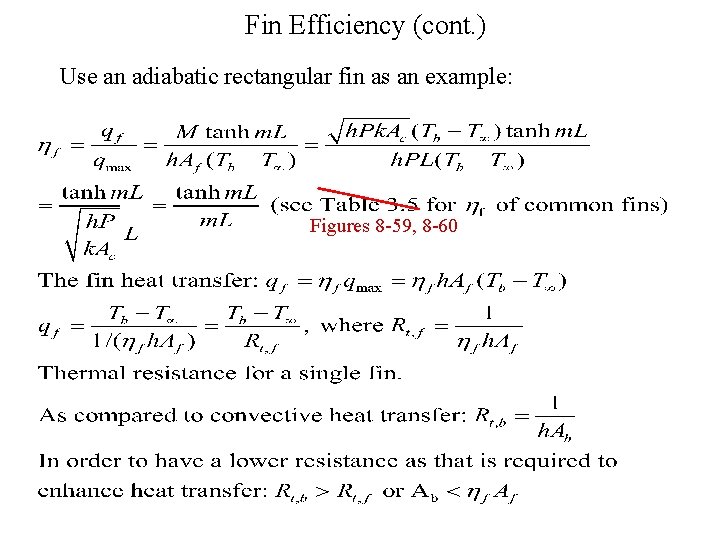
Fin Efficiency (cont. ) Use an adiabatic rectangular fin as an example: Figures 8 -59, 8 -60

Overall Fin Efficiency Overall fin efficiency for an array of fins: qf qb Define terms: Ab: base area exposed to coolant Af: surface area of a single fin At: total area including base area and total finned surface, At=Ab+NAf N: total number of fins
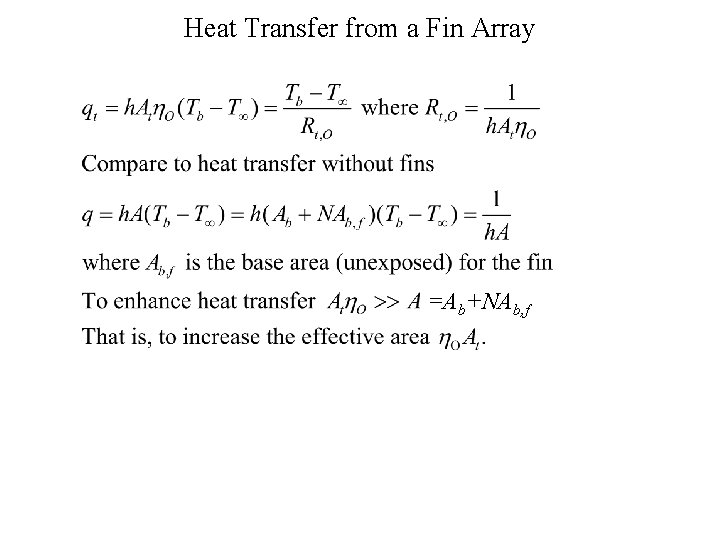
Heat Transfer from a Fin Array =Ab+NAb, f
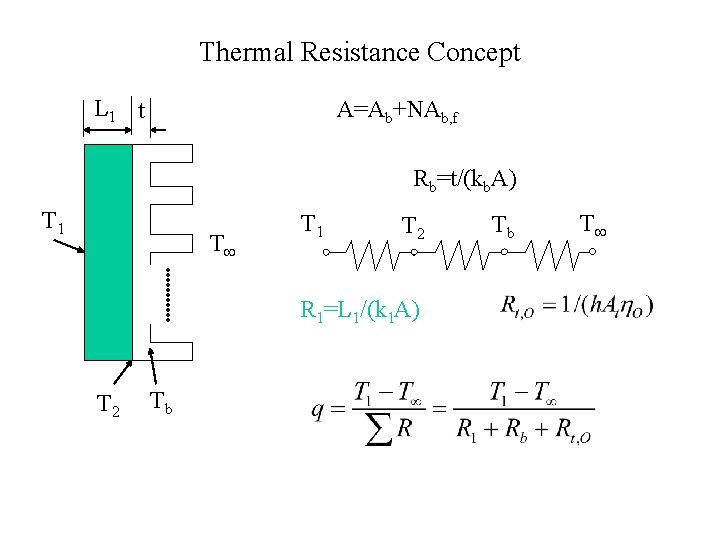
Thermal Resistance Concept L 1 t A=Ab+NAb, f Rb=t/(kb. A) T 1 T 2 R 1=L 1/(k 1 A) T 2 Tb Tb T
- Slides: 9