
Filtration Tutorial This tutorial is designed to enhance
![References n n n [1] Case Study Solution - Facility Design for Antigenic Co](https://slidetodoc.com/presentation_image_h2/22c9d1d4a4f09d5a232d75241ffba84e/image-12.jpg "References n n n [1] Case Study Solution - Facility Design for Antigenic Co")
- Slides: 12
Filtration Tutorial This tutorial is designed to enhance knowledge of the purification processes used in biotechnology. The topics covered in this tutorial are meant to provide a succinct overview of microfiltration and ultrafiltration processes. A more in-depth study will be referenced throughout the tutorial. It is recommended that an examination of the references be performed to further explain any of the concepts covered in this brief tutorial.
Overview Types of Filtration Ø Microfiltration Ø Ø How Ø it works? Ultrafiltration Ø How it works? Microfiltration vs. Ultrafiltration Ø References Ø
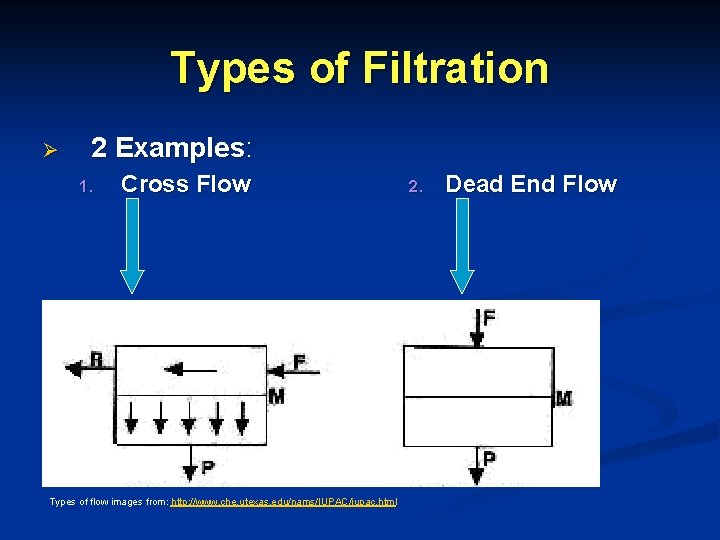
Types of Filtration Ø 2 Examples: 1. Cross Flow Types of flow images from: http: //www. che. utexas. edu/nams/IUPAC/iupac. html 2. Dead End Flow
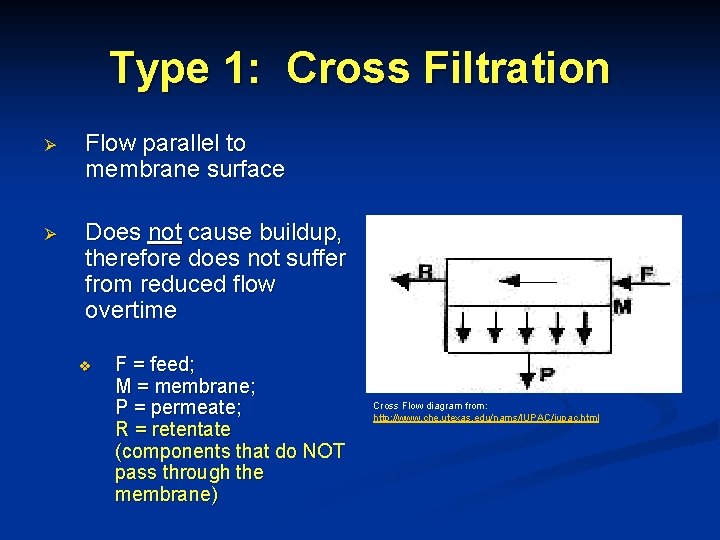
Type 1: Cross Filtration Ø Flow parallel to membrane surface Ø Does not cause buildup, therefore does not suffer from reduced flow overtime v F = feed; M = membrane; P = permeate; R = retentate (components that do NOT pass through the membrane) Cross Flow diagram from: http: //www. che. utexas. edu/nams/IUPAC/iupac. html
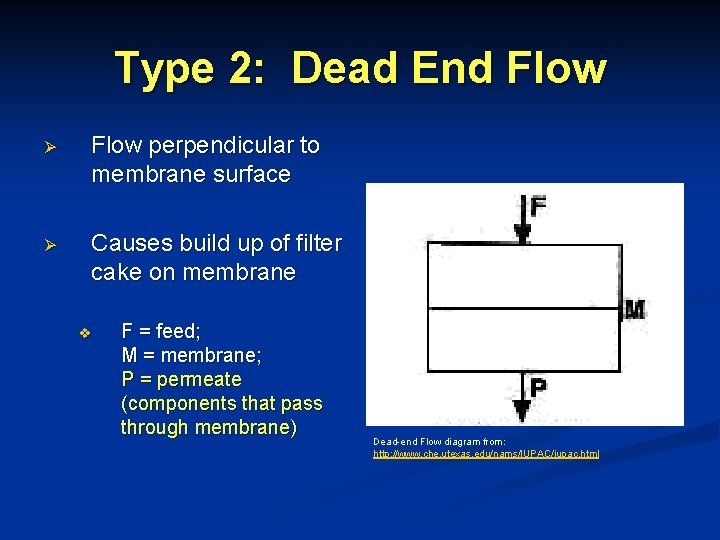
Type 2: Dead End Flow Ø Flow perpendicular to membrane surface Ø Causes build up of filter cake on membrane v F = feed; M = membrane; P = permeate (components that pass through membrane) Dead-end Flow diagram from: http: //www. che. utexas. edu/nams/IUPAC/iupac. html
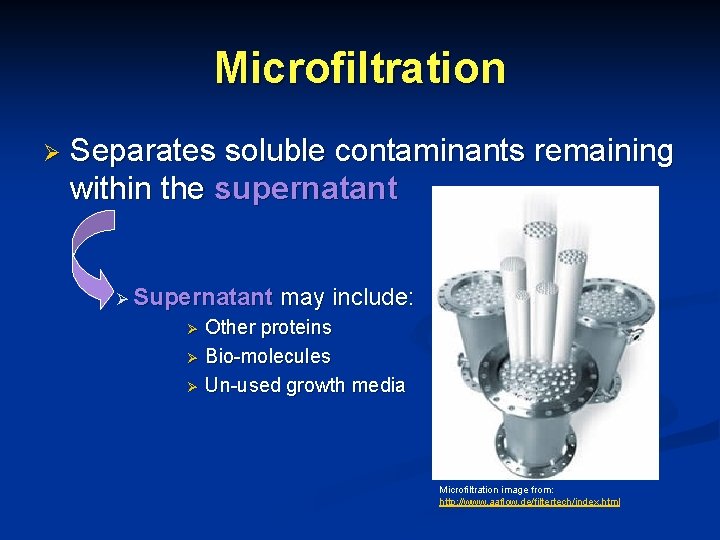
Microfiltration Ø Separates soluble contaminants remaining within the supernatant Ø Supernatant may include: Other proteins Ø Bio-molecules Ø Un-used growth media Ø Microfiltration image from: http: //www. aaflow. de/filtertech/index. html
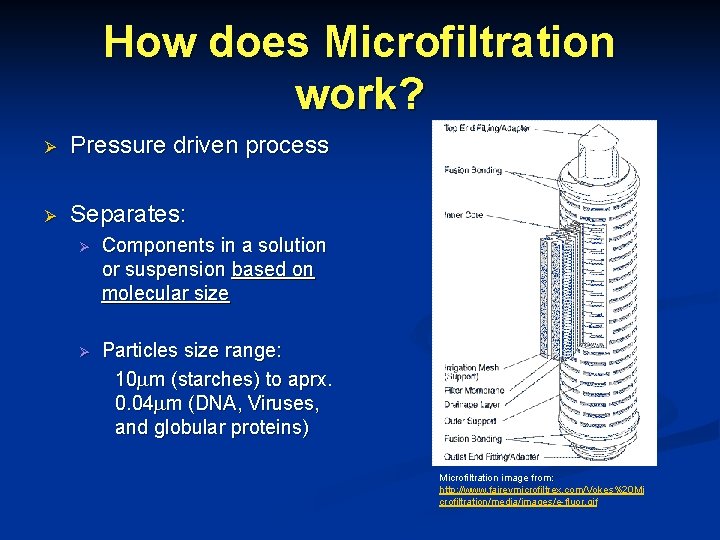
How does Microfiltration work? Ø Pressure driven process Ø Separates: Ø Components in a solution or suspension based on molecular size Ø Particles size range: 10 mm (starches) to aprx. 0. 04 mm (DNA, Viruses, and globular proteins) Microfiltration image from: http: //www. faireymicrofiltrex. com/Vokes%20 Mi crofiltration/media/images/e-fluor. gif
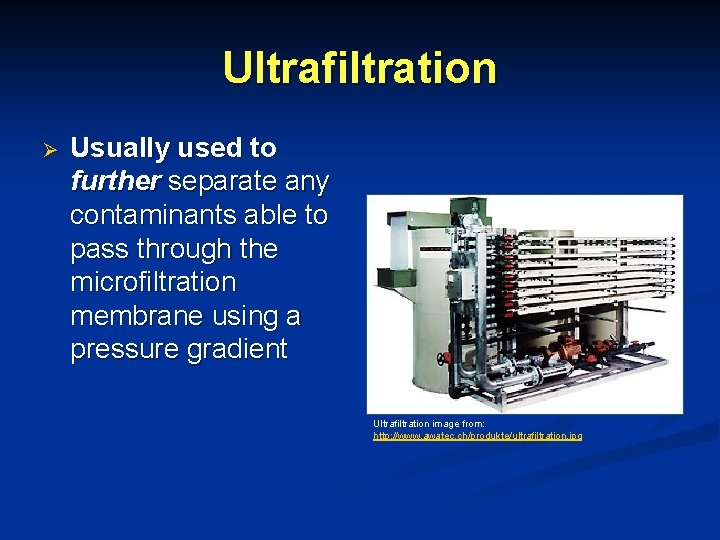
Ultrafiltration Ø Usually used to further separate any contaminants able to pass through the microfiltration membrane using a pressure gradient Ultrafiltration image from: http: //www. awatec. ch/produkte/ultrafiltration. jpg
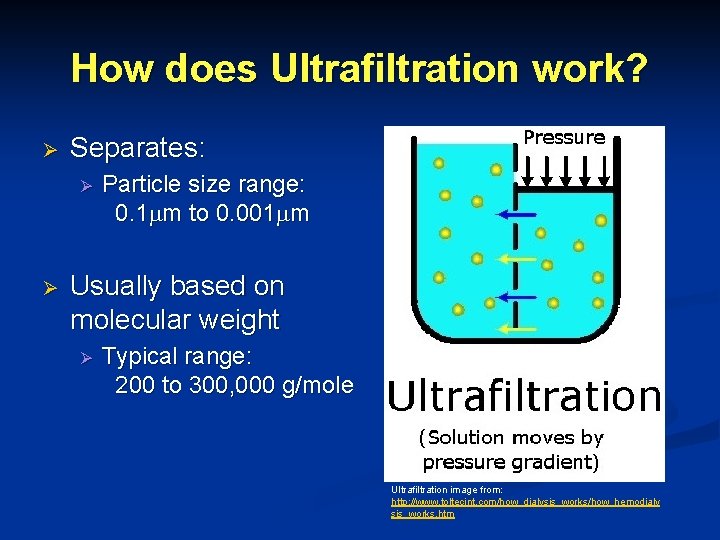
How does Ultrafiltration work? Ø Separates: Ø Ø Particle size range: 0. 1 mm to 0. 001 mm Usually based on molecular weight Ø Typical range: 200 to 300, 000 g/mole Ultrafiltration image from: http: //www. toltecint. com/how_dialysis_works/how_hemodialy sis_works. htm
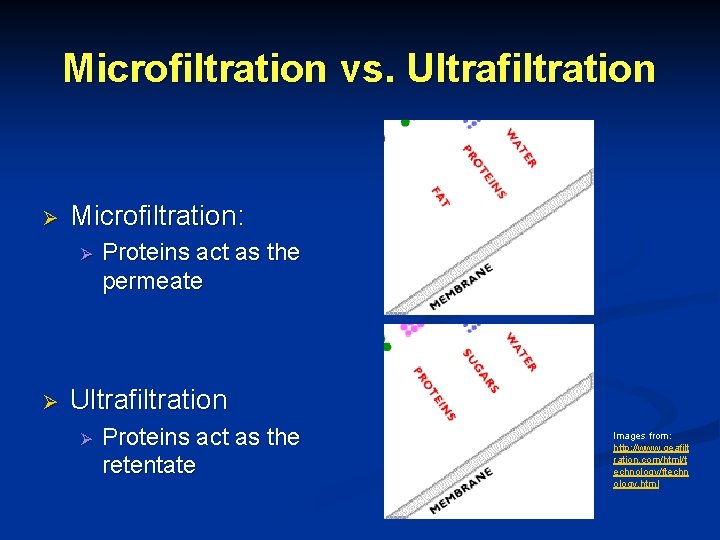
Microfiltration vs. Ultrafiltration Ø Microfiltration: Ø Ø Proteins act as the permeate Ultrafiltration Ø Proteins act as the retentate Images from: http: //www. geafilt ration. com/html/t echnology/ftechn ology. html
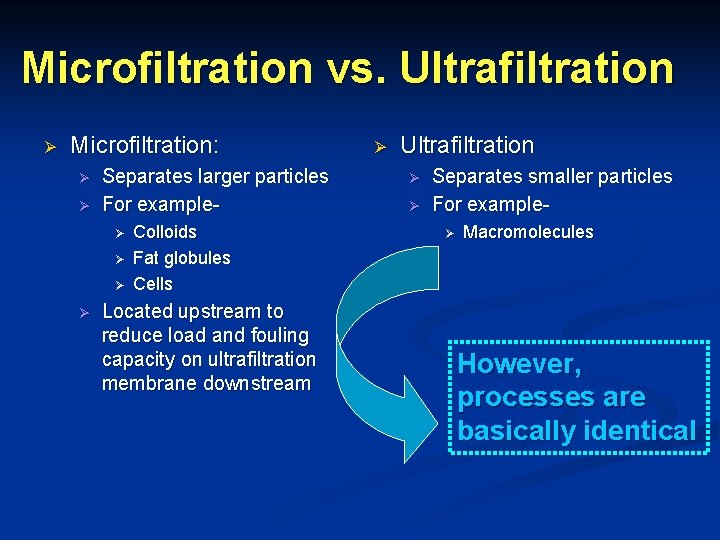
Microfiltration vs. Ultrafiltration Ø Microfiltration: Ø Ø Separates larger particles For exampleØ Ø Colloids Fat globules Cells Located upstream to reduce load and fouling capacity on ultrafiltration membrane downstream Ø Ultrafiltration Ø Ø Separates smaller particles For exampleØ Macromolecules However, processes are basically identical
References n n n [1] Case Study Solution - Facility Design for Antigenic Co -proteins (2003). CHE 451. NCSU [2] Grandison, A. S. & Lewis, M. J. (Eds. ). (1996) Separation Processes in the Food and Biotechnology Industries. Woodhead Publishing. Retrieved November 30, 2003 from Knovel Chemistry and Chemical Engineering Database. [3] Zeman, L. J. & Zydney, A. L. (1996) Microfiltration and Ultrafiltration: Principles and Applications. New York: Marcel Dekker, Inc. Available via NCSU libraries as an e. Book