
Filtration The mechanism by which granular filtration media
Filtration

• The mechanism by which granular filtration media remove solids from water are complex and are not fully understood. • Common theories suggest a number of mechanism that act simultaneously in the solids. These mechanisms are : 1. Staining Sedimentation 3. Impaction 4. Interception. 2.

1. Straining: Some particles are too large to pass through pores, these particles become trapped and are removed. 2. Sedimentation: in low velocity zone, some particles are removed by sedimentation. 3. Impaction: Some particles have too large a mass to flow sharp turns in the flow streamline, the mass of these particles carries them out of the flow stream. These particles strike the medium and are held there.
• 4. Interception: in some cases the flow streamline pass very close to a media grain. At time, the particle following these streamline will touch a media grain and become lodged.
Types of filter: Filter could be classified based on filtration rate: 1. Slow sand filter: They have a hydraulic application rate less than 10 m 3/m 2 day. An under drain system is installed under the sand bed to collect the filtered water. When the media becomes clogged, the bed is dewatered and the upper layer of the sand is removed, washed and replaced.
2. Rapid sand filter: they have a hydraulic application rate of approximately 120 – 240 m 3/m 2. day. A suitable filter media (usually sand) is used, and this media is supported by gravel bed an under- drain system which both a)collect the filtered water and b)distributes the backwash water used to clean the filter bed.
3. Pressure filter: the main difference between gravity and pressure filters are the head required to force the water through media bed (higher head) and the type of vessel used to contain the filter (enclosed steel pressure filter).

Filter media: Filters are classified as single (or mono) medium, dual media or mixed (multimedia) depending on number of filter media used. 1. Single medium filters: they utilize a single material, commonly well graded sand. In single medium filter, after backwashing, large grain settle faster than smaller grain in phenomenon called stratification which is considered as major disadvantages of the single medium filter.

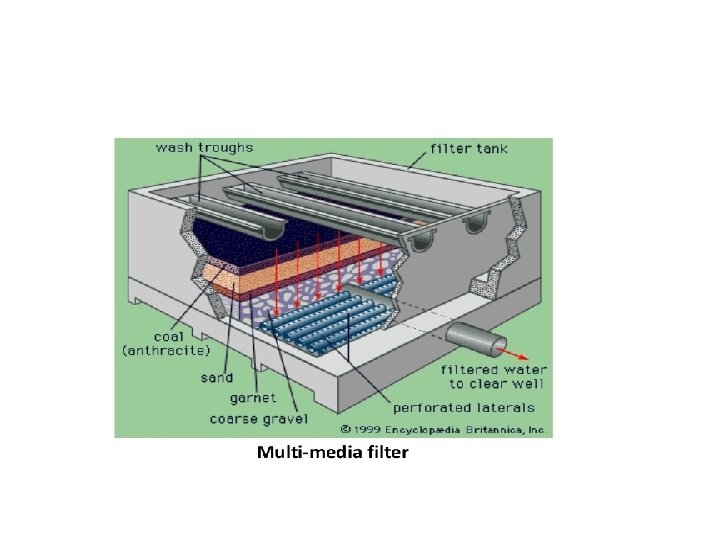
The smaller media grains at the top of the filter trap most of the particles, therefore only the top 4 -5 cm of the filter bed is utilized. 2. Dual media filters: to solve the problem of stratification, the dual media filter could be used. Typical dual media filters utilize anthracite coal and quartz sand as filter media. The anthracite with specific gravity of 1. 55 is lighter than the sand which has a specific gravity of 2. 65.
• Therefore a large anthracite grain has the same settling velocity as a much smaller sand grain, this characteristics allows anthracite grains to be placed on top of smaller sand grain to create a gradation. 3. Mixed media filters: They are similar to duel media filter except that several materials are used. Typically, three materials are used which are anthracite, sand garnet.

Filter cleaning and backwash: A filter must be cleaned when either: 1. The headloss through the filter exceed the design value. 2. Turbidity breakthrough causes the effluent quality to be less than acceptable level. 3. A pre selected maximum filter run has passed since it was last cleaned.
• Filter units are cleaned by backwashing, this involves passing water upward through the filter media at a velocity sufficient to expand the bed and washout the accumulated solids. • The vertical velocity of the water is approximately equal to the settling velocity of the media and causes the media to be partially supported by the water. This allows the smaller floc particles that have a lower settling velocity to be removed and washed out of the bed.
Usually, backwash water is returned to the head of the plant. The main concern of this method is the increment of protozoa cites concentration.
Ex: A filter units are designed at an average loading rate of 10 m 3/m 2 hr. Under a maximum day flow condition of 113500 m 3/day. The flow is distributed among seven filter units assuming that one is out of service for backwashing. Solution: Design flow for each basin = 113500/7 = 16 214 m 3/day = 676 m 3/hr.
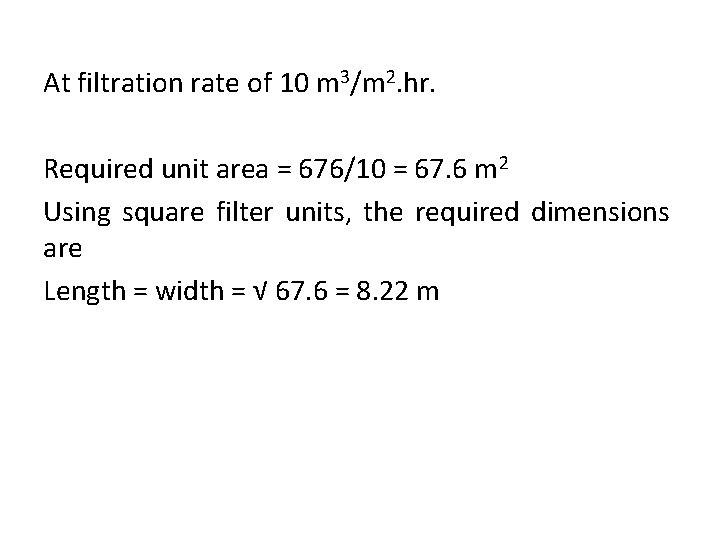
At filtration rate of 10 m 3/m 2. hr. Required unit area = 676/10 = 67. 6 m 2 Using square filter units, the required dimensions are Length = width = √ 67. 6 = 8. 22 m
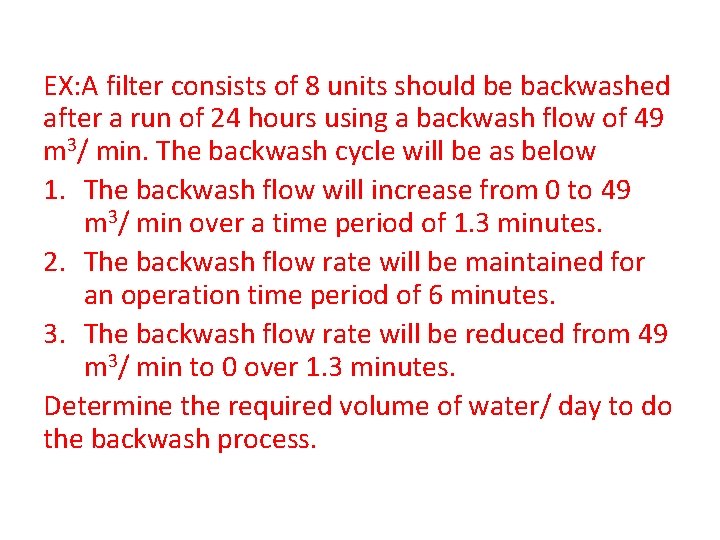
EX: A filter consists of 8 units should be backwashed after a run of 24 hours using a backwash flow of 49 m 3/ min. The backwash cycle will be as below 1. The backwash flow will increase from 0 to 49 m 3/ min over a time period of 1. 3 minutes. 2. The backwash flow rate will be maintained for an operation time period of 6 minutes. 3. The backwash flow rate will be reduced from 49 m 3/ min to 0 over 1. 3 minutes. Determine the required volume of water/ day to do the backwash process.
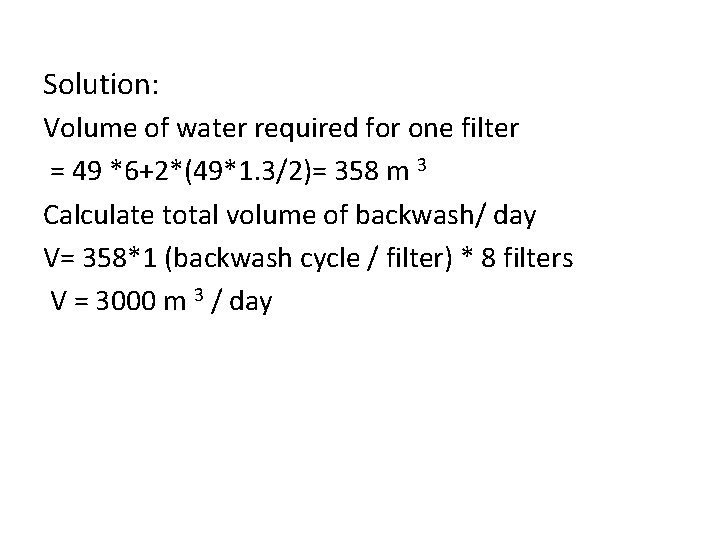
Solution: Volume of water required for one filter = 49 *6+2*(49*1. 3/2)= 358 m 3 Calculate total volume of backwash/ day V= 358*1 (backwash cycle / filter) * 8 filters V = 3000 m 3 / day
- Slides: 20