
Filtering Approaches for RealTime AntiAliasing http www iryoku

- Slides: 28
Filtering Approaches for Real-Time Anti-Aliasing http: //www. iryoku. com/aacourse/
Filtering Approaches for Real-Time Anti-Aliasing Morphological Anti-Aliasing Alexander Reshetov Intel Labs alexander. reshetov@intel. com
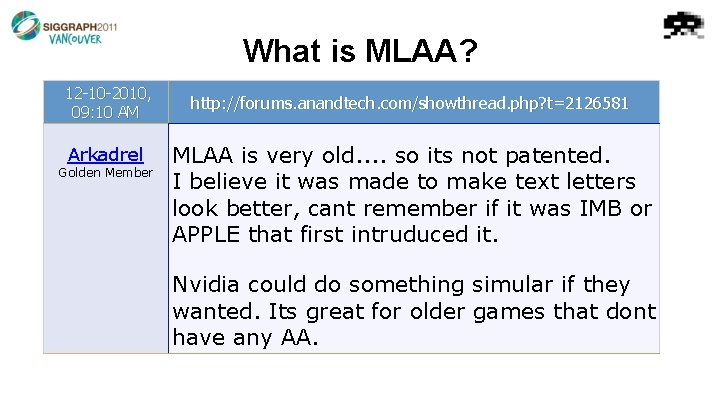
What is MLAA? 12 -10 -2010, 09: 10 AM Arkadrel Golden Member http: //forums. anandtech. com/showthread. php? t=2126581 MLAA is very old. . so its not patented. I believe it was made to make text letters look better, cant remember if it was IMB or APPLE that first intruduced it. Nvidia could do something simular if they wanted. Its great for older games that dont have any AA.
This talk: MLAA in retrospect
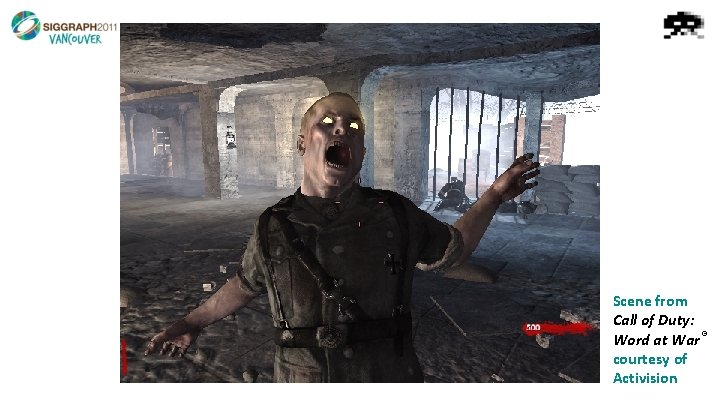
Scene from Call of Duty: Word at War ® courtesy of Activision
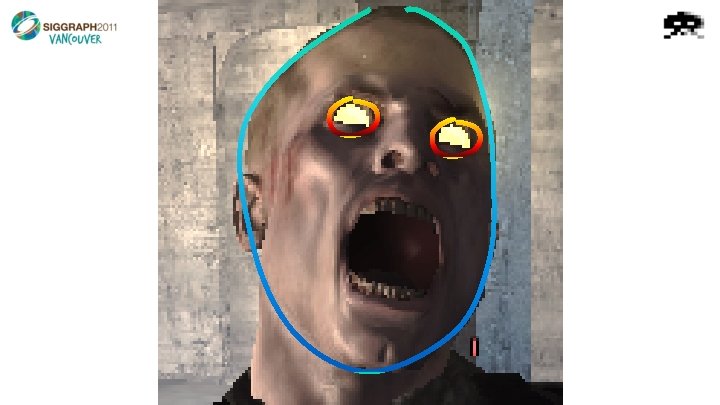
The Plan 1. Somehow find silhouettes in images (and hope that it will correspond to real objects) 2. Blend (aka filter) colors around the silhouettes
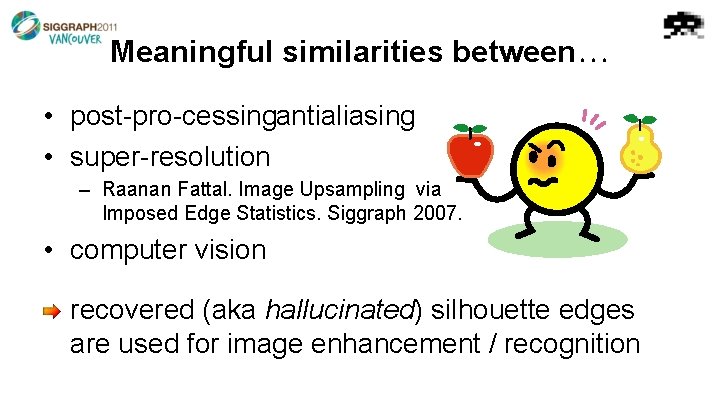
Meaningful similarities between. . . • post pro cessing antialiasing • super resolution – Raanan Fattal. Image Upsampling via Imposed Edge Statistics. Siggraph 2007. • computer vision recovered (aka hallucinated) silhouette edges are used for image enhancement / recognition
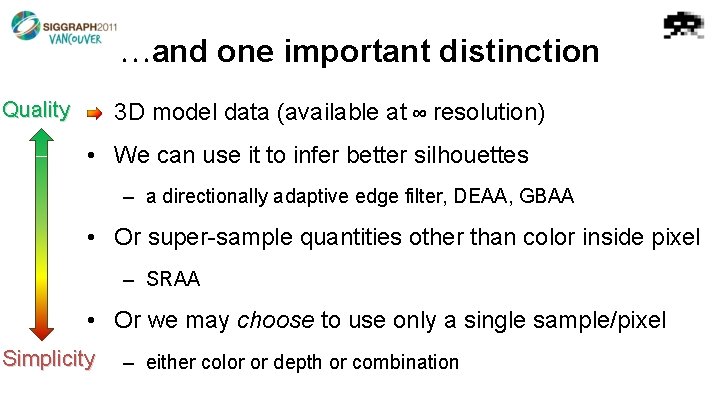
. . . Quality and one important distinction 3 D model data (available at ∞ resolution) • We can use it to infer better silhouettes – a directionally adaptive edge filter, DEAA, GBAA • Or super sample quantities other than color inside pixel – SRAA • Or we may choose to use only a single sample/pixel Simplicity – either color or depth or combination
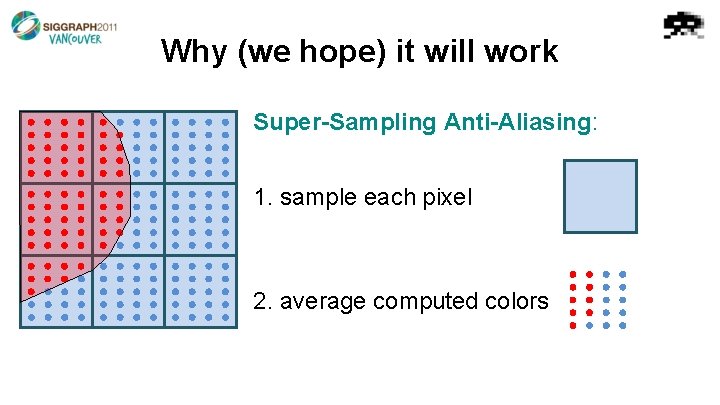
Why (we hope) it will work Super-Sampling Anti-Aliasing: 1. sample each pixel 2. average computed colors
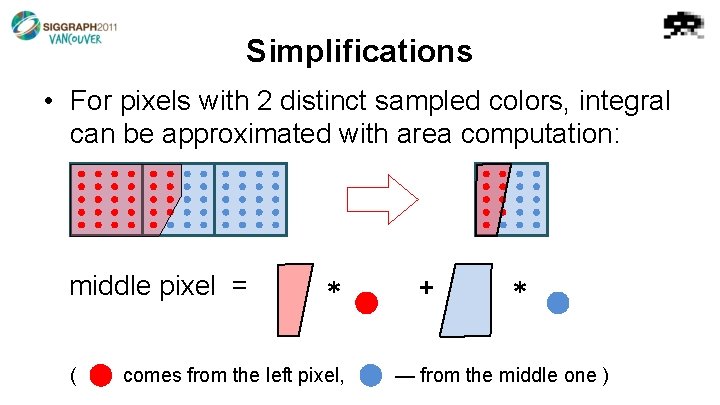
Simplifications • For pixels with 2 distinct sampled colors, integral can be approximated with area computation: middle pixel = * + * ( comes from the left pixel, — from the middle one )
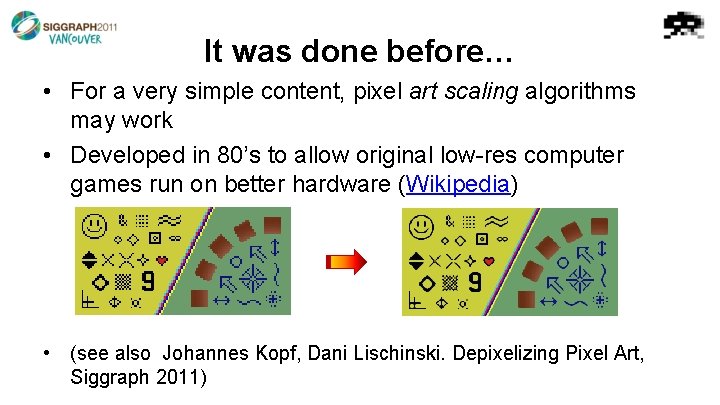
It was done before… • For a very simple content, pixel art scaling algorithms may work • Developed in 80’s to allow original low res computer games run on better hardware (Wikipedia) • (see also Johannes Kopf, Dani Lischinski. Depixelizing Pixel Art, Siggraph 2011)
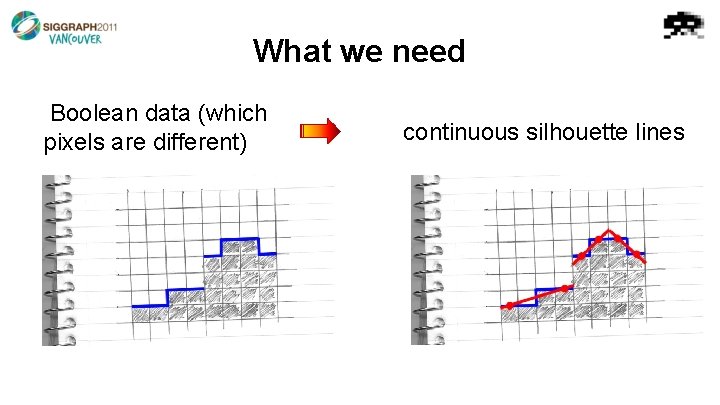
What we need Boolean data (which pixels are different) continuous silhouette lines
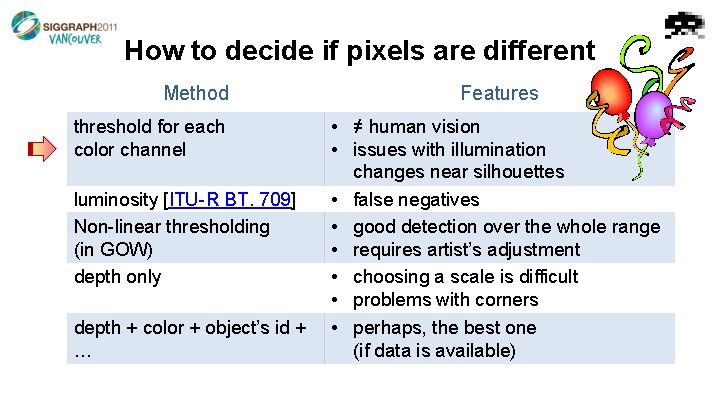
How to decide if pixels are different Method Features • ≠ human vision • issues with illumination changes near silhouettes luminosity [ITU R BT. 709] • false negatives Non linear thresholding • good detection over the whole range (in GOW) • requires artist’s adjustment depth only • choosing a scale is difficult • problems with corners depth + color + object’s id + • perhaps, the best one … (if data is available) threshold for each color channel
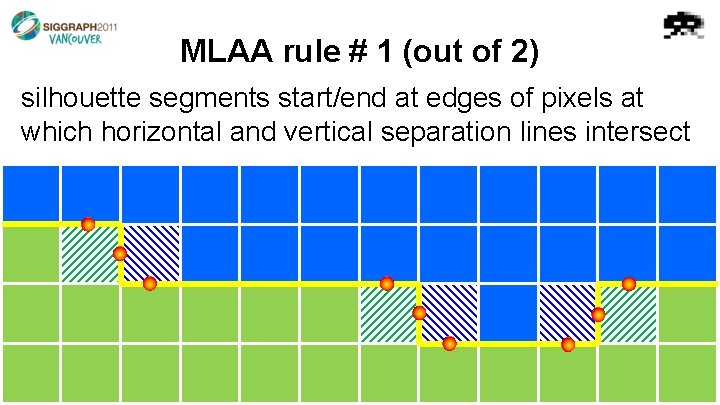
MLAA rule # 1 (out of 2) silhouette segments start/end at edges of pixels at which horizontal and vertical separation lines intersect
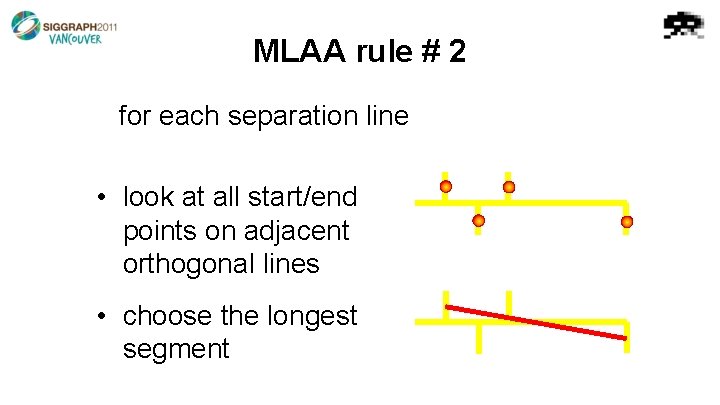
MLAA rule # 2 for each separation line • look at all start/end points on adjacent orthogonal lines • choose the longest segment
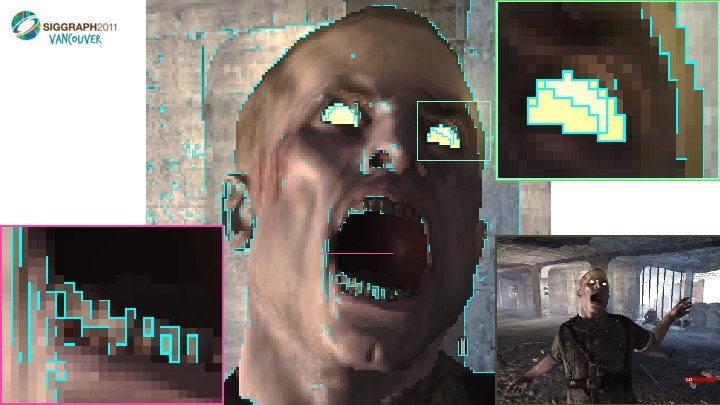
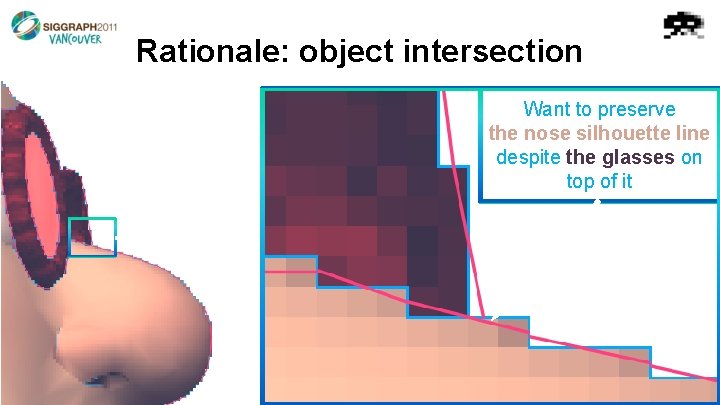
Rationale: object intersection Want to preserve the nose silhouette line despite the glasses on top of it
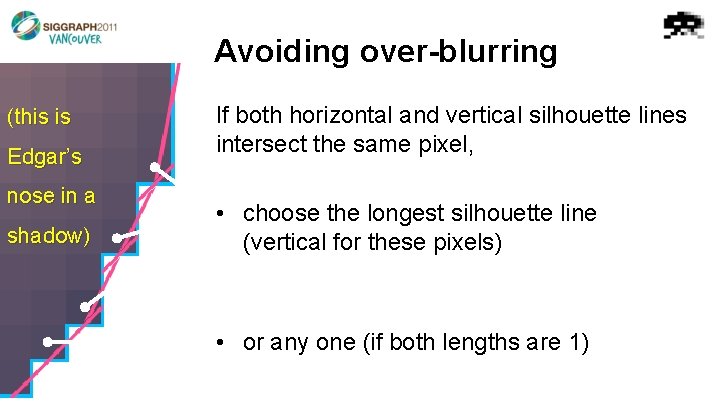
Avoiding over-blurring (this is Edgar’s nose in a shadow) If both horizontal and vertical silhouette lines intersect the same pixel, • choose the longest silhouette line (vertical for these pixels) • or any one (if both lengths are 1)
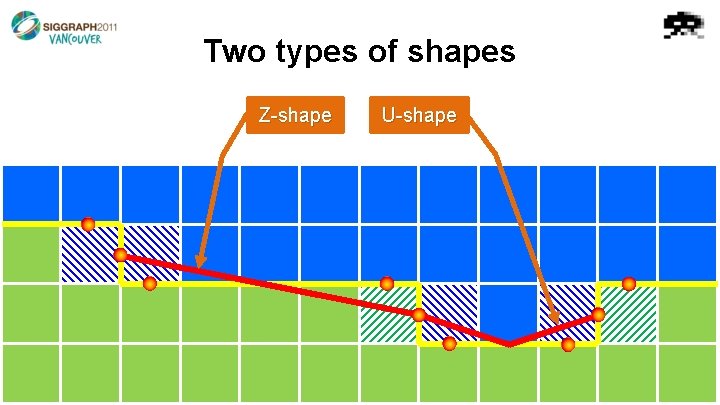
Two types of shapes Z shape U shape
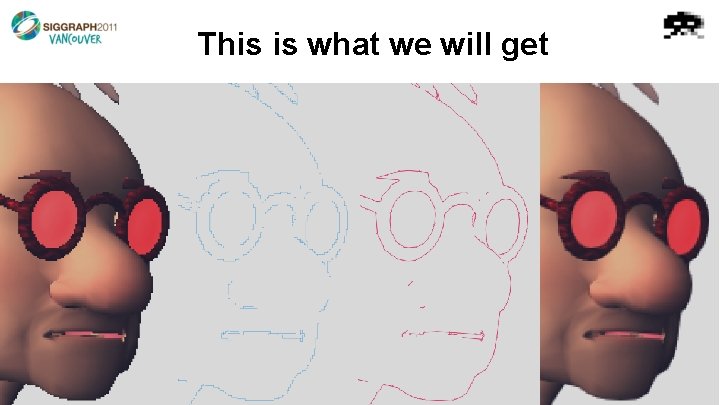
This is what we will get
MLAA in a one sentence • (1) detect all pixels that are different from neighbors to (2) approximate silhouettes and then (3) filter colors around these silhouettes • Steps 1 and 2 allow innovation and differentiation • Step 3 seems to be OK in RGB space (without gamma)
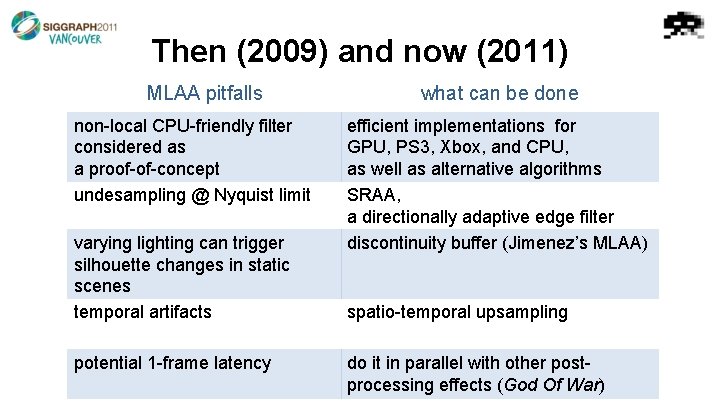
Then (2009) and now (2011) MLAA pitfalls non local CPU friendly filter considered as a proof of concept undesampling @ Nyquist limit varying lighting can trigger silhouette changes in static scenes temporal artifacts potential 1 frame latency what can be done efficient implementations for GPU, PS 3, Xbox, and CPU, as well as alternative algorithms SRAA, a directionally adaptive edge filter discontinuity buffer (Jimenez’s MLAA) spatio temporal upsampling do it in parallel with other post processing effects (God Of War)
Timeline for 2020? • AA Naming Guide on Anand. Tech: 27 entries for major variations • Historical perspective: Z buffer killed all other invisible surface removal algorithms… • Hardware AA was unable to do it (yet? )
So the question is… • Will retina displays (~300 dpi) kill all AA? – (it will be exciting) • Bottom line: it seems that post processing AA algorithms have matured in time when – resolution is good enough to alleviate certain artifacts – But not too high to forget about AA at all
So the question is… (amended) • Even 300 dpi are not enough to forget about AA – People evolved to notice discontinuities @ higher frequency than eye’s resolution (hyperacuity) • You can read more (see the course web site) – John Hable’s blog – David Luebke’s The Ultimate Display
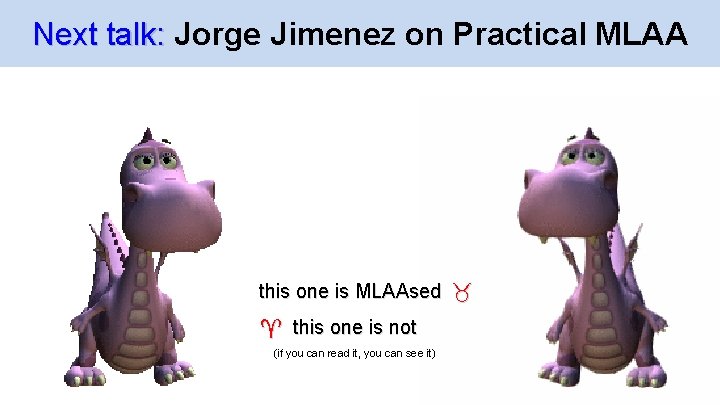
Next talk: Jorge on Practical Next talk: Finally, Jimenez some animation MLAA this one is MLAAsed _ ^ this one is not (if you can read it, you can see it)