
Filter Approximation Theory Butterworth Chebyshev and Elliptic Filters
Filter Approximation Theory Butterworth, Chebyshev, and Elliptic Filters Filter Approximation Theory
Approximation Polynomials • Every physically realizable circuit has a transfer function that is a rational polynomial in s • We want to determine classes of rational polynomials that approximate the “Ideal” low-pass filter response (high-pass band-pass and band-stop filters can be derived from a low pass design) • Four well known approximations are discussed here: – Butterworth: Steven Butterworth, "On the Theory of Filter Amplifiers", Wireless Engineer (also called Experimental Wireless and the Radio Engineer), vol. 7, 1930, pp. 536 -541 – Chebyshev: Pafnuty Lvovich Chebyshev (1821 -1894) - Russia Cyrillic alphabet - Spelled many ways – Elliptic Function: Wilhelm Cauer (1900 -1945) - Germany U. S. patents 1, 958, 742 (1934), 1, 989, 545 (1935), 2, 048, 426 (1936) – Bessel: Friedrich Wilhelm Bessel, 1784 - 1846 10/26/2021 Filter Approximation Theory 2
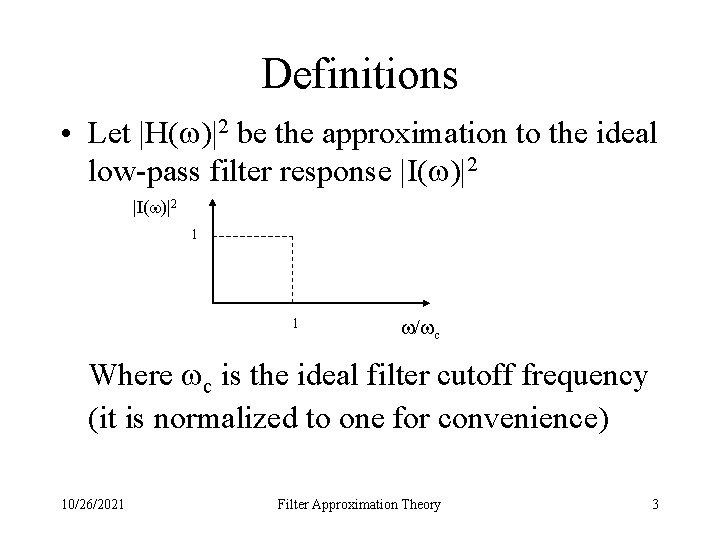
Definitions • Let |H( )|2 be the approximation to the ideal low-pass filter response |I( )|2 1 1 / c Where c is the ideal filter cutoff frequency (it is normalized to one for convenience) 10/26/2021 Filter Approximation Theory 3
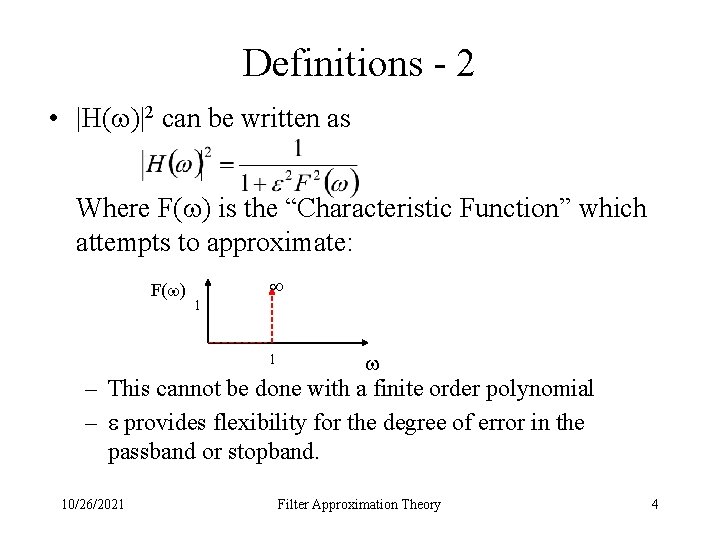
Definitions - 2 • |H( )|2 can be written as Where F( ) is the “Characteristic Function” which attempts to approximate: F( ) 1 1 – This cannot be done with a finite order polynomial – provides flexibility for the degree of error in the passband or stopband. 10/26/2021 Filter Approximation Theory 4
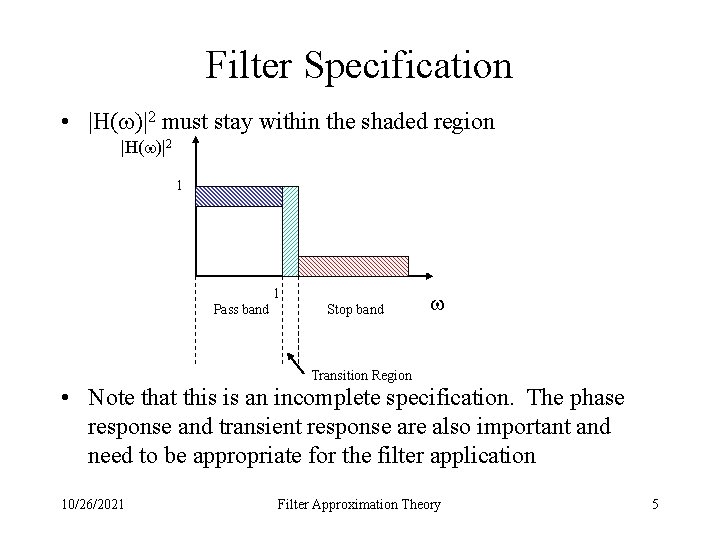
Filter Specification • |H( )|2 must stay within the shaded region |H( )|2 1 Pass band 1 Stop band Transition Region • Note that this is an incomplete specification. The phase response and transient response are also important and need to be appropriate for the filter application 10/26/2021 Filter Approximation Theory 5
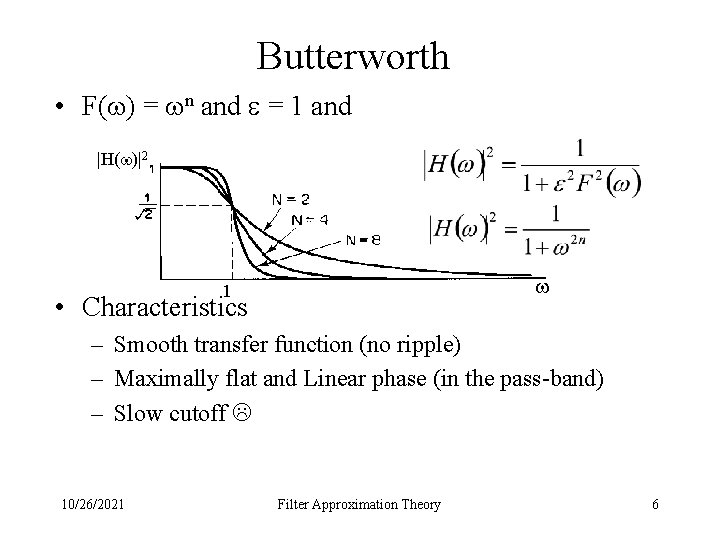
Butterworth • F( ) = n and = 1 and |H( )|2 1 • Characteristics – Smooth transfer function (no ripple) – Maximally flat and Linear phase (in the pass-band) – Slow cutoff 10/26/2021 Filter Approximation Theory 6
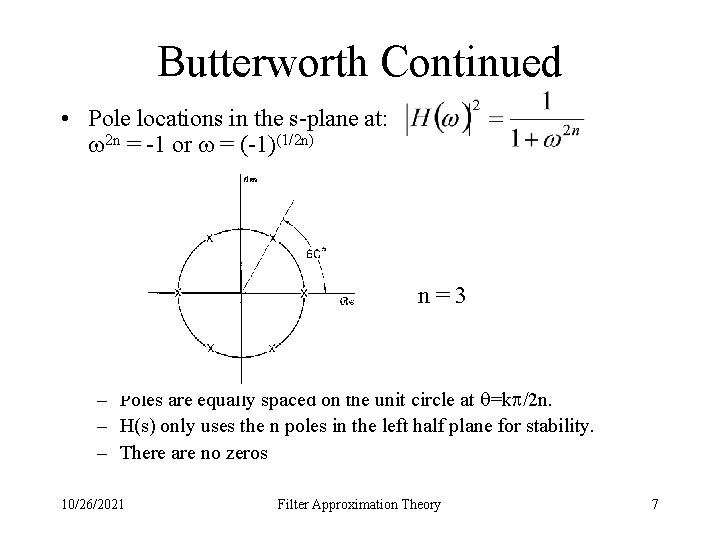
Butterworth Continued • Pole locations in the s-plane at: 2 n = -1 or = (-1)(1/2 n) n=3 – Poles are equally spaced on the unit circle at =k /2 n. – H(s) only uses the n poles in the left half plane for stability. – There are no zeros 10/26/2021 Filter Approximation Theory 7
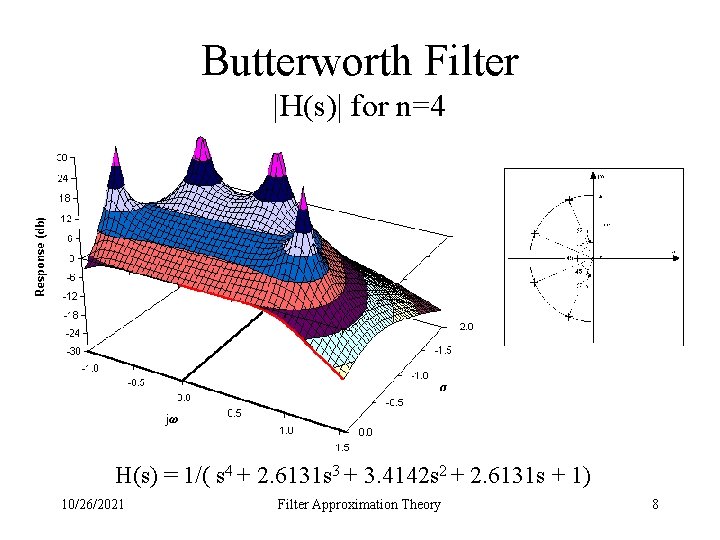
Butterworth Filter |H(s)| for n=4 H(s) = 1/( s 4 + 2. 6131 s 3 + 3. 4142 s 2 + 2. 6131 s + 1) 10/26/2021 Filter Approximation Theory 8
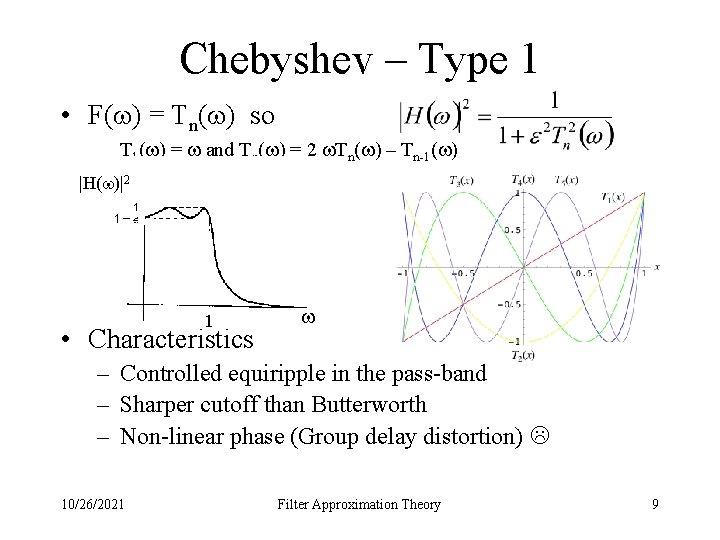
Chebyshev – Type 1 • F( ) = Tn( ) so T 1( ) = and Tn( ) = 2 Tn( ) – Tn-1( ) |H( )|2 1 • Characteristics – Controlled equiripple in the pass-band – Sharper cutoff than Butterworth – Non-linear phase (Group delay distortion) 10/26/2021 Filter Approximation Theory 9
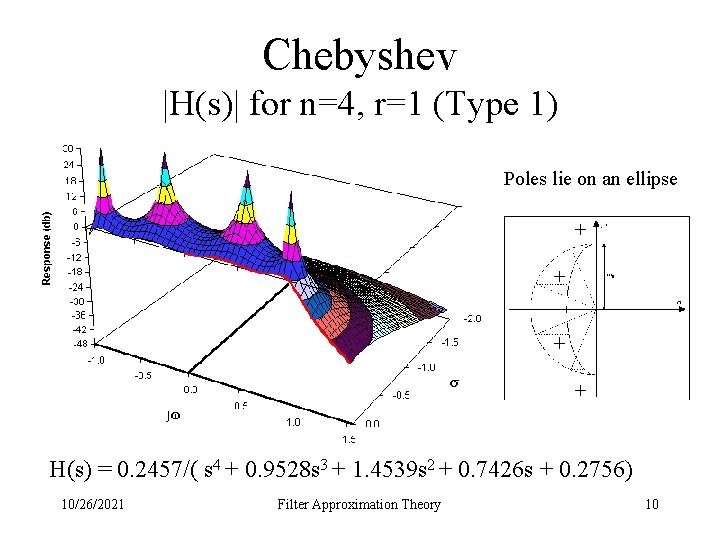
Chebyshev |H(s)| for n=4, r=1 (Type 1) Poles lie on an ellipse H(s) = 0. 2457/( s 4 + 0. 9528 s 3 + 1. 4539 s 2 + 0. 7426 s + 0. 2756) 10/26/2021 Filter Approximation Theory 10
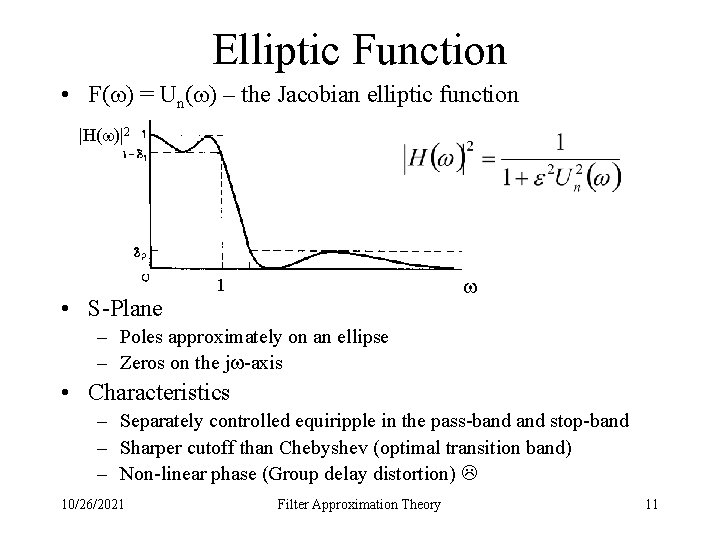
Elliptic Function • F( ) = Un( ) – the Jacobian elliptic function |H( )|2 • S-Plane 1 – Poles approximately on an ellipse – Zeros on the j -axis • Characteristics – Separately controlled equiripple in the pass-band stop-band – Sharper cutoff than Chebyshev (optimal transition band) – Non-linear phase (Group delay distortion) 10/26/2021 Filter Approximation Theory 11
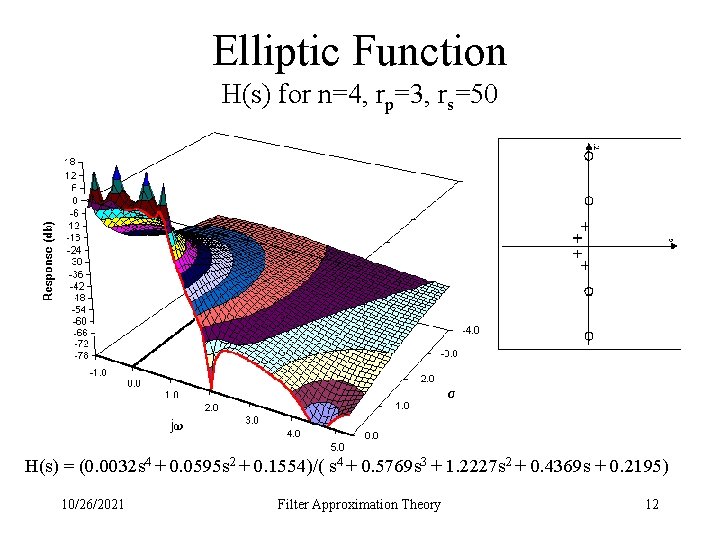
Elliptic Function H(s) for n=4, rp=3, rs=50 H(s) = (0. 0032 s 4 + 0. 0595 s 2 + 0. 1554)/( s 4 + 0. 5769 s 3 + 1. 2227 s 2 + 0. 4369 s + 0. 2195) 10/26/2021 Filter Approximation Theory 12
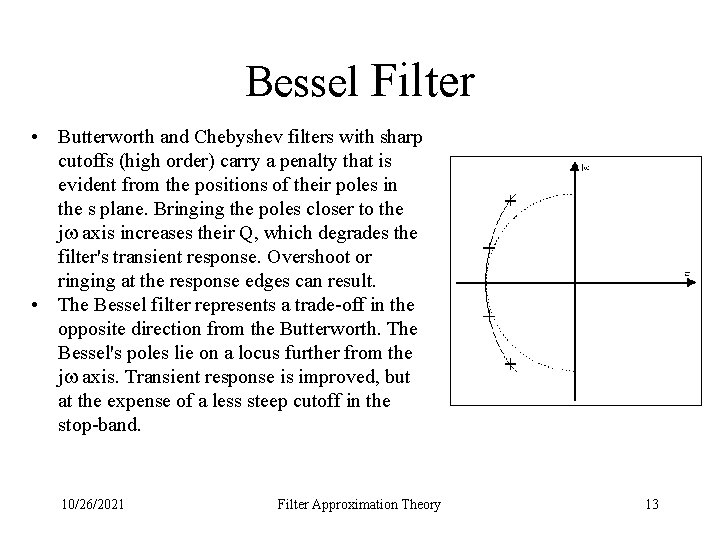
Bessel Filter • Butterworth and Chebyshev filters with sharp cutoffs (high order) carry a penalty that is evident from the positions of their poles in the s plane. Bringing the poles closer to the j axis increases their Q, which degrades the filter's transient response. Overshoot or ringing at the response edges can result. • The Bessel filter represents a trade-off in the opposite direction from the Butterworth. The Bessel's poles lie on a locus further from the j axis. Transient response is improved, but at the expense of a less steep cutoff in the stop-band. 10/26/2021 Filter Approximation Theory 13
Practical Filter Design • Use a tool to establish a prototype design – Mat. Lab is a great choice – See http: //doctord. webhop. net/courses/Topics/Matlab/index. htm for a Matlab tutorial by Dr. Bouzid Aliane; Chapter 5 is on filter design. • Check your design for ringing/overshoot. – If detrimental, increase the filter order and redesign to exceed the frequency response specifications – Move poles near the j -axis to the left to reduce their Q – Check the resulting filter against your specifications • Moving poles to the left will reduce ringing/overshoot, but degrade the transition region. 10/26/2021 Filter Approximation Theory 14
- Slides: 14