
Film studies 1 A Hollywood 1930 1990 Classical

- Slides: 56
Film studies
1 A: Hollywood (1930 -1990) • Classical Hollywood (1930 -1960): Casablanca (Michael Curtiz, 1942) • New Hollywood (1960 -1990): Blade Runner (Ridley Scott, 1982) • Auteur • Context
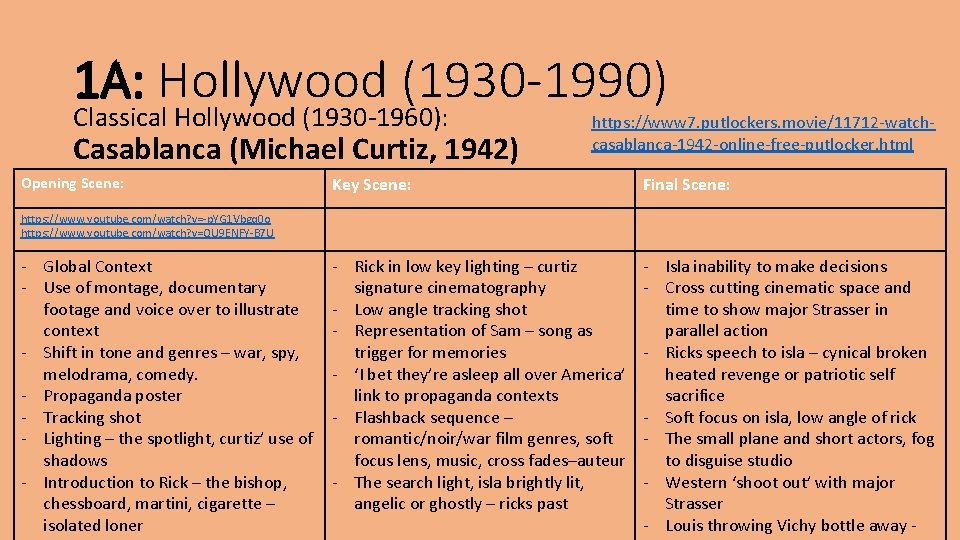
1 A: Hollywood (1930 -1990) Classical Hollywood (1930 -1960): Casablanca (Michael Curtiz, 1942) Opening Scene: https: //www 7. putlockers. movie/11712 -watchcasablanca-1942 -online-free-putlocker. html Key Scene: Final Scene: - Rick in low key lighting – curtiz signature cinematography - Low angle tracking shot - Representation of Sam – song as trigger for memories - ‘I bet they’re asleep all over America’ link to propaganda contexts - Flashback sequence – romantic/noir/war film genres, soft focus lens, music, cross fades–auteur - The search light, isla brightly lit, angelic or ghostly – ricks past - Isla inability to make decisions - Cross cutting cinematic space and time to show major Strasser in parallel action - Ricks speech to isla – cynical broken heated revenge or patriotic self sacrifice - Soft focus on isla, low angle of rick - The small plane and short actors, fog to disguise studio - Western ‘shoot out’ with major Strasser - Louis throwing Vichy bottle away - https: //www. youtube. com/watch? v=-p. YG 1 Vbgq 0 o https: //www. youtube. com/watch? v=QU 9 ENFY-B 7 U - Global Context - Use of montage, documentary footage and voice over to illustrate context - Shift in tone and genres – war, spy, melodrama, comedy. - Propaganda poster - Tracking shot - Lighting – the spotlight, curtiz’ use of shadows - Introduction to Rick – the bishop, chessboard, martini, cigarette – isolated loner
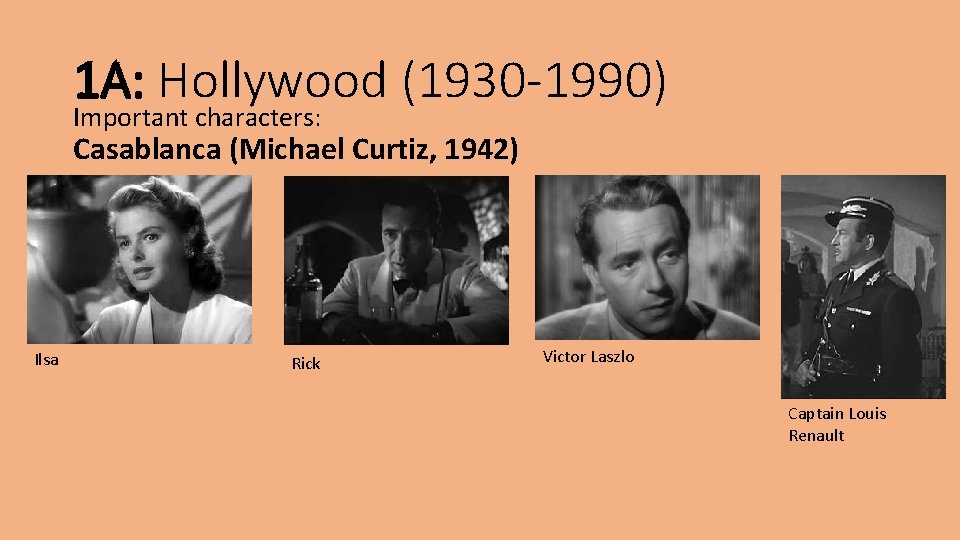
1 A: Hollywood (1930 -1990) Important characters: Casablanca (Michael Curtiz, 1942) Ilsa Rick Victor Laszlo Captain Louis Renault
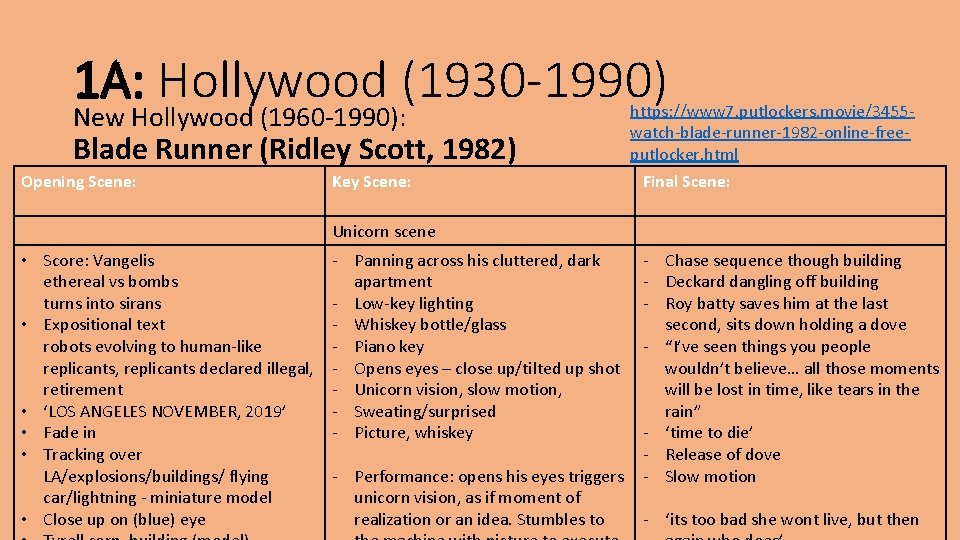
1 A: Hollywood (1930 -1990) New Hollywood (1960 -1990): Blade Runner (Ridley Scott, 1982) Opening Scene: Key Scene: https: //www 7. putlockers. movie/3455 watch-blade-runner-1982 -online-freeputlocker. html Final Scene: Unicorn scene • Score: Vangelis ethereal vs bombs turns into sirans • Expositional text robots evolving to human-like replicants, replicants declared illegal, retirement • ‘LOS ANGELES NOVEMBER, 2019’ • Fade in • Tracking over LA/explosions/buildings/ flying car/lightning - miniature model • Close up on (blue) eye - Panning across his cluttered, dark apartment - Low-key lighting - Whiskey bottle/glass - Piano key - Opens eyes – close up/tilted up shot - Unicorn vision, slow motion, - Sweating/surprised - Picture, whiskey - Chase sequence though building - Deckard dangling off building - Roy batty saves him at the last second, sits down holding a dove - “I’ve seen things you people wouldn’t believe… all those moments will be lost in time, like tears in the rain” - ‘time to die’ - Release of dove - Performance: opens his eyes triggers - Slow motion unicorn vision, as if moment of realization or an idea. Stumbles to - ‘its too bad she wont live, but then
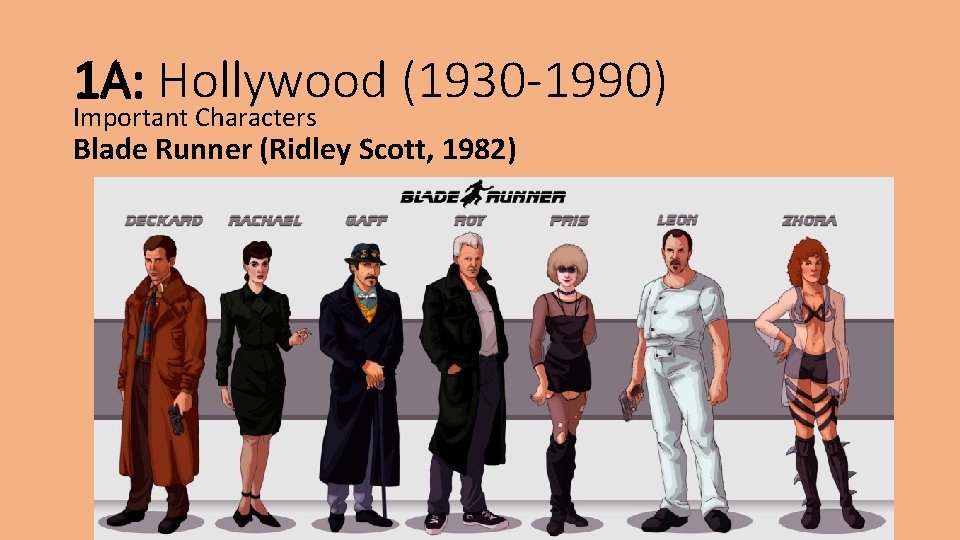
1 A: Hollywood (1930 -1990) Important Characters Blade Runner (Ridley Scott, 1982)
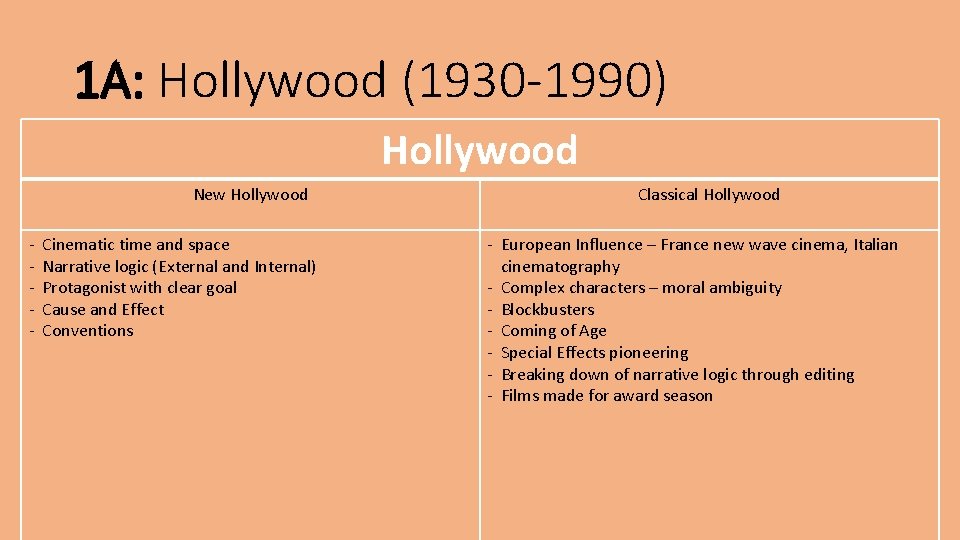
1 A: Hollywood (1930 -1990) Hollywood New Hollywood - Cinematic time and space Narrative logic (External and Internal) Protagonist with clear goal Cause and Effect Conventions Classical Hollywood - European Influence – France new wave cinema, Italian cinematography - Complex characters – moral ambiguity - Blockbusters - Coming of Age - Special Effects pioneering - Breaking down of narrative logic through editing - Films made for award season
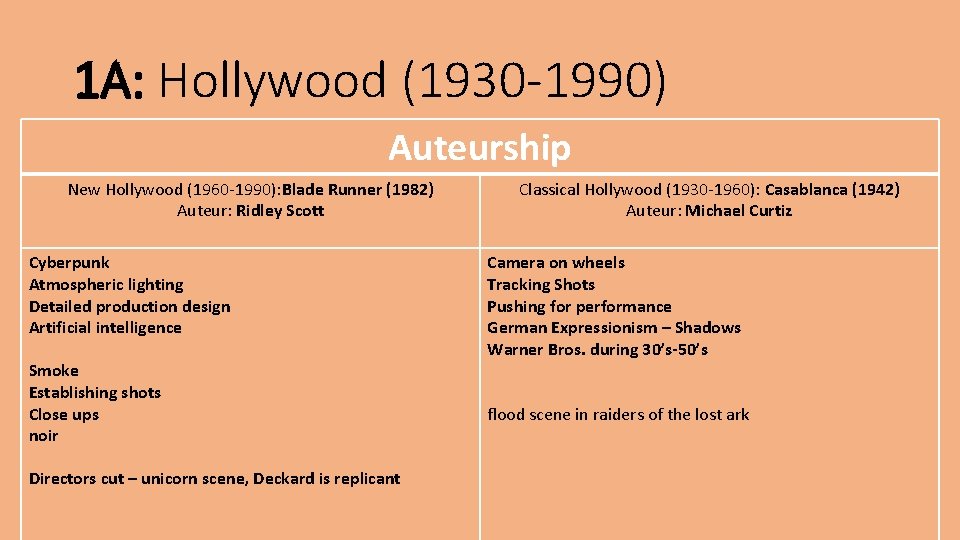
1 A: Hollywood (1930 -1990) Auteurship New Hollywood (1960 -1990): Blade Runner (1982) Auteur: Ridley Scott Cyberpunk Atmospheric lighting Detailed production design Artificial intelligence Smoke Establishing shots Close ups noir Directors cut – unicorn scene, Deckard is replicant Classical Hollywood (1930 -1960): Casablanca (1942) Auteur: Michael Curtiz Camera on wheels Tracking Shots Pushing for performance German Expressionism – Shadows Warner Bros. during 30’s-50’s flood scene in raiders of the lost ark
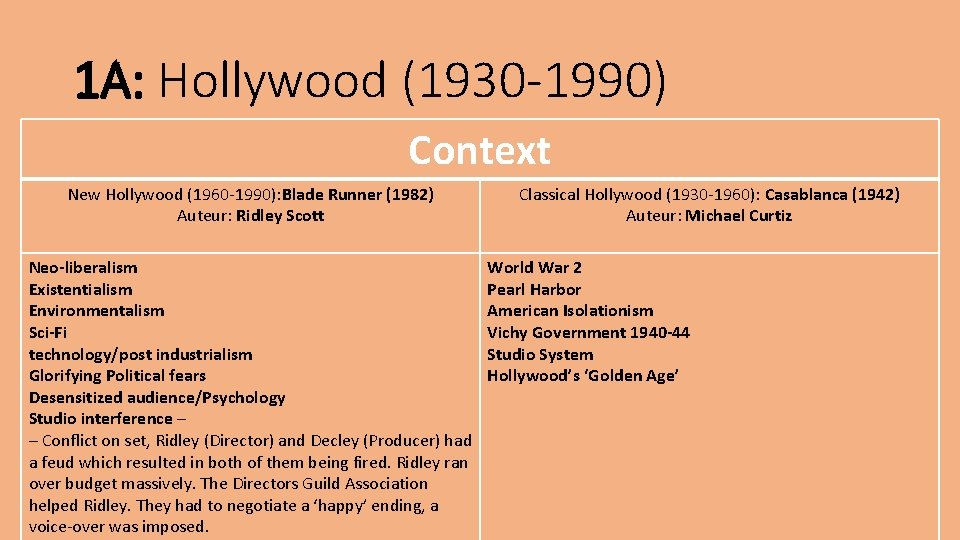
1 A: Hollywood (1930 -1990) Context New Hollywood (1960 -1990): Blade Runner (1982) Auteur: Ridley Scott Neo-liberalism Existentialism Environmentalism Sci-Fi technology/post industrialism Glorifying Political fears Desensitized audience/Psychology Studio interference – – Conflict on set, Ridley (Director) and Decley (Producer) had a feud which resulted in both of them being fired. Ridley ran over budget massively. The Directors Guild Association helped Ridley. They had to negotiate a ‘happy’ ending, a voice-over was imposed. Classical Hollywood (1930 -1960): Casablanca (1942) Auteur: Michael Curtiz World War 2 Pearl Harbor American Isolationism Vichy Government 1940 -44 Studio System Hollywood’s ‘Golden Age’
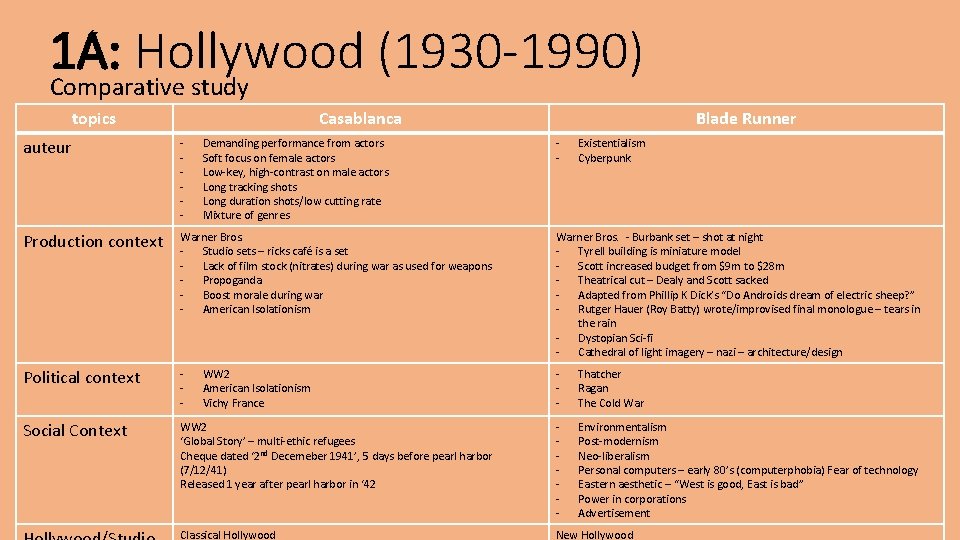
1 A: Hollywood (1930 -1990) Comparative study topics Casablanca Blade Runner auteur - Production context Warner Bros. - Studio sets – ricks café is a set - Lack of film stock (nitrates) during war as used for weapons - Propoganda - Boost morale during war - American Isolationism Warner Bros. - Burbank set – shot at night - Tyrell building is miniature model - Scott increased budget from $9 m to $28 m - Theatrical cut – Dealy and Scott sacked - Adapted from Phillip K Dick’s “Do Androids dream of electric sheep? ” - Rutger Hauer (Roy Batty) wrote/improvised final monologue – tears in the rain - Dystopian Sci-fi - Cathedral of light imagery – nazi – architecture/design Political context - - Thatcher Ragan The Cold War Social Context WW 2 ‘Global Story’ – multi-ethic refugees Cheque dated ‘ 2 nd Decemeber 1941’, 5 days before pearl harbor (7/12/41) Released 1 year after pearl harbor in ‘ 42 - Environmentalism Post-modernism Neo-liberalism Personal computers – early 80’s (computerphobia) Fear of technology Eastern aesthetic – “West is good, East is bad” Power in corporations Advertisement Classical Hollywood New Hollywood Demanding performance from actors Soft focus on female actors Low-key, high-contrast on male actors Long tracking shots Long duration shots/low cutting rate Mixture of genres WW 2 American Isolationism Vichy France - Existentialism Cyberpunk
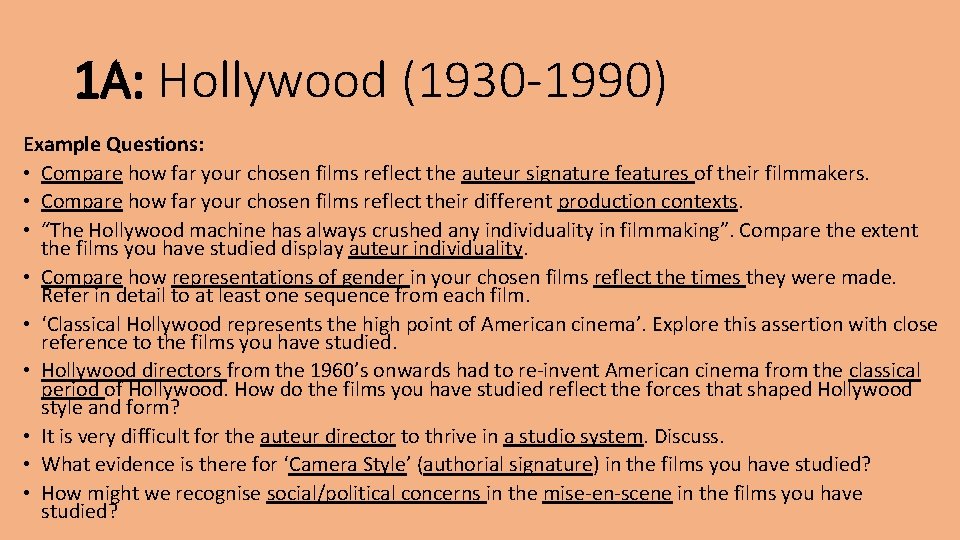
1 A: Hollywood (1930 -1990) Example Questions: • Compare how far your chosen films reflect the auteur signature features of their filmmakers. • Compare how far your chosen films reflect their different production contexts. • “The Hollywood machine has always crushed any individuality in filmmaking”. Compare the extent the films you have studied display auteur individuality. • Compare how representations of gender in your chosen films reflect the times they were made. Refer in detail to at least one sequence from each film. • ‘Classical Hollywood represents the high point of American cinema’. Explore this assertion with close reference to the films you have studied. • Hollywood directors from the 1960’s onwards had to re-invent American cinema from the classical period of Hollywood. How do the films you have studied reflect the forces that shaped Hollywood style and form? • It is very difficult for the auteur director to thrive in a studio system. Discuss. • What evidence is there for ‘Camera Style’ (authorial signature) in the films you have studied? • How might we recognise social/political concerns in the mise-en-scene in the films you have studied?
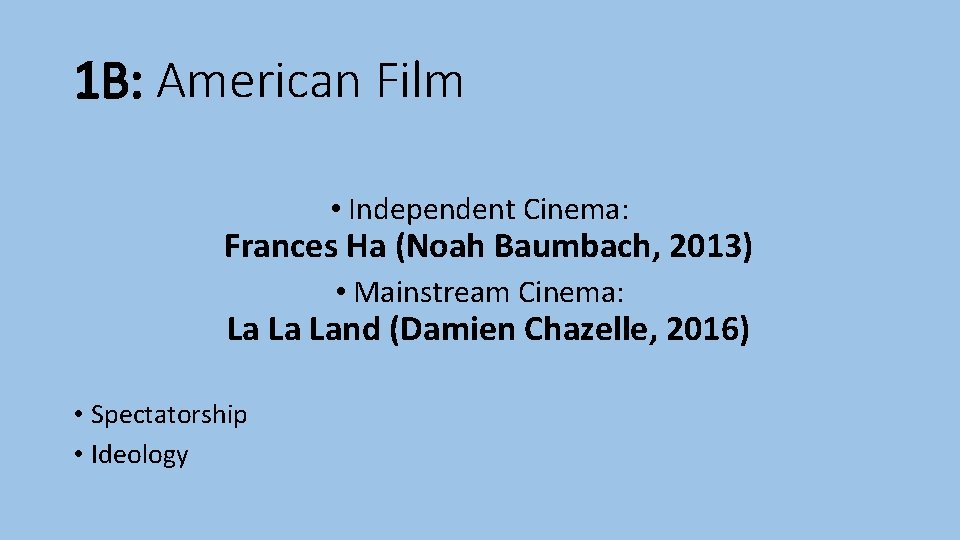
1 B: American Film • Independent Cinema: Frances Ha (Noah Baumbach, 2013) • Mainstream Cinema: La La Land (Damien Chazelle, 2016) • Spectatorship • Ideology
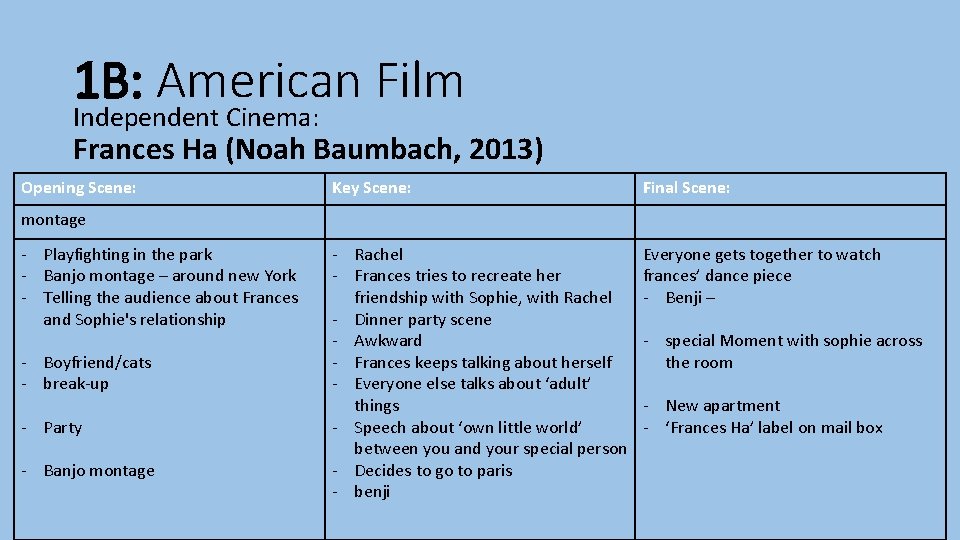
1 B: American Film Independent Cinema: Frances Ha (Noah Baumbach, 2013) Opening Scene: Key Scene: Final Scene: - Rachel - Frances tries to recreate her friendship with Sophie, with Rachel - Dinner party scene - Awkward - Frances keeps talking about herself - Everyone else talks about ‘adult’ things - Speech about ‘own little world’ between you and your special person - Decides to go to paris - benji Everyone gets together to watch frances’ dance piece - Benji – montage - Playfighting in the park - Banjo montage – around new York - Telling the audience about Frances and Sophie's relationship - Boyfriend/cats - break-up - Party - Banjo montage - special Moment with sophie across the room - New apartment - ‘Frances Ha’ label on mail box
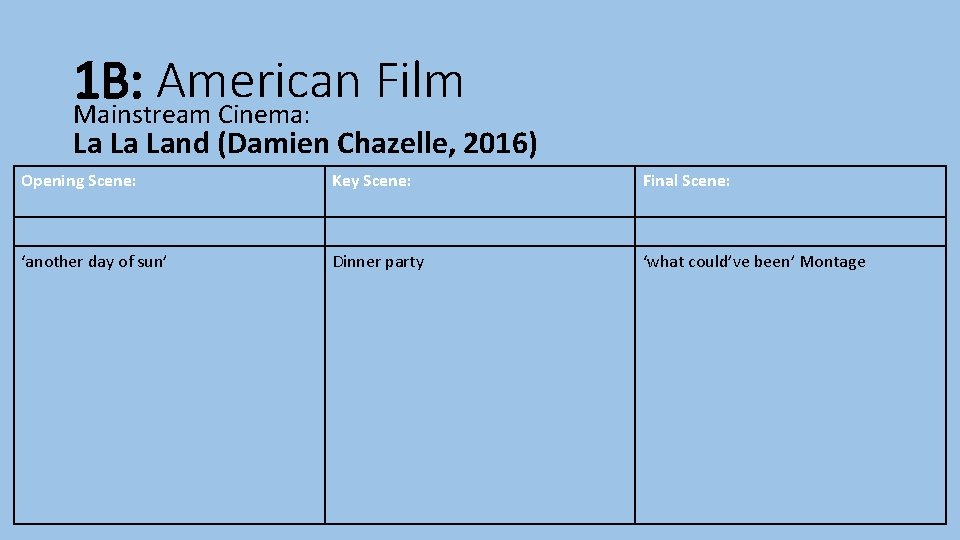
1 B: American Film Mainstream Cinema: La La Land (Damien Chazelle, 2016) Opening Scene: Key Scene: Final Scene: ‘another day of sun’ Dinner party ‘what could’ve been’ Montage
1 B: American Film Spectatorship https: //siantaylorfilmworthingcol. wordpress. com/2018/10/04/ la-la-land-spectatorship-essay/ https: //siantaylorfilmworthingcol. wordpress. com/2018/03/27/ american-independent-film-and-spectatorship-frances-ha 2013/
1 B: American Film Ideology
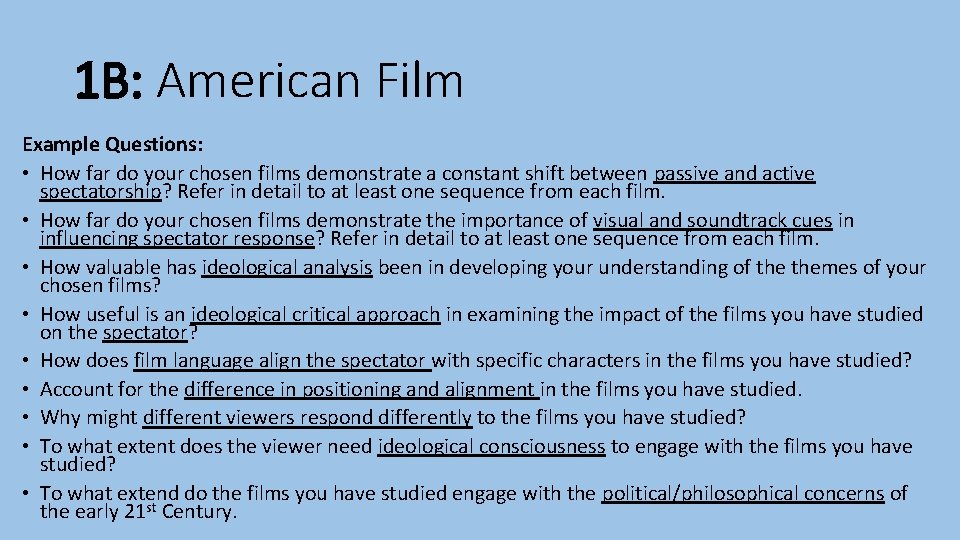
1 B: American Film Example Questions: • How far do your chosen films demonstrate a constant shift between passive and active spectatorship? Refer in detail to at least one sequence from each film. • How far do your chosen films demonstrate the importance of visual and soundtrack cues in influencing spectator response? Refer in detail to at least one sequence from each film. • How valuable has ideological analysis been in developing your understanding of themes of your chosen films? • How useful is an ideological critical approach in examining the impact of the films you have studied on the spectator? • How does film language align the spectator with specific characters in the films you have studied? • Account for the difference in positioning and alignment in the films you have studied. • Why might different viewers respond differently to the films you have studied? • To what extent does the viewer need ideological consciousness to engage with the films you have studied? • To what extend do the films you have studied engage with the political/philosophical concerns of the early 21 st Century.
1 C: British Film (Since 2005) • Moon (Duncan Jones, 2009) • Under the Skin (Jonathan Glazer, 2013) • Narrative • Ideology
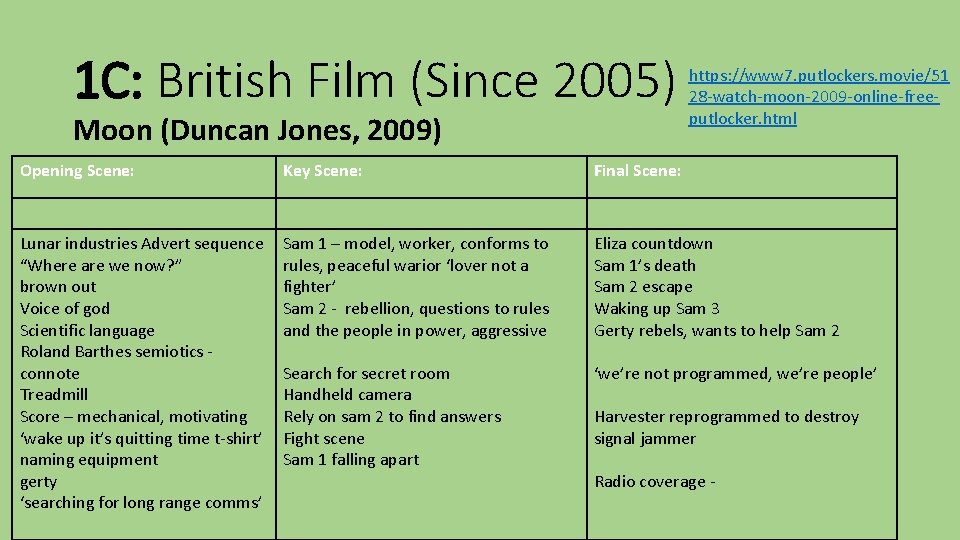
1 C: British Film (Since 2005) Moon (Duncan Jones, 2009) https: //www 7. putlockers. movie/51 28 -watch-moon-2009 -online-freeputlocker. html Opening Scene: Key Scene: Final Scene: Lunar industries Advert sequence “Where are we now? ” brown out Voice of god Scientific language Roland Barthes semiotics - connote Treadmill Score – mechanical, motivating ‘wake up it’s quitting time t-shirt’ naming equipment gerty ‘searching for long range comms’ Sam 1 – model, worker, conforms to rules, peaceful warior ‘lover not a fighter’ Sam 2 - rebellion, questions to rules and the people in power, aggressive Search for secret room Handheld camera Rely on sam 2 to find answers Fight scene Sam 1 falling apart Eliza countdown Sam 1’s death Sam 2 escape Waking up Sam 3 Gerty rebels, wants to help Sam 2 ‘we’re not programmed, we’re people’ Harvester reprogrammed to destroy signal jammer Radio coverage -
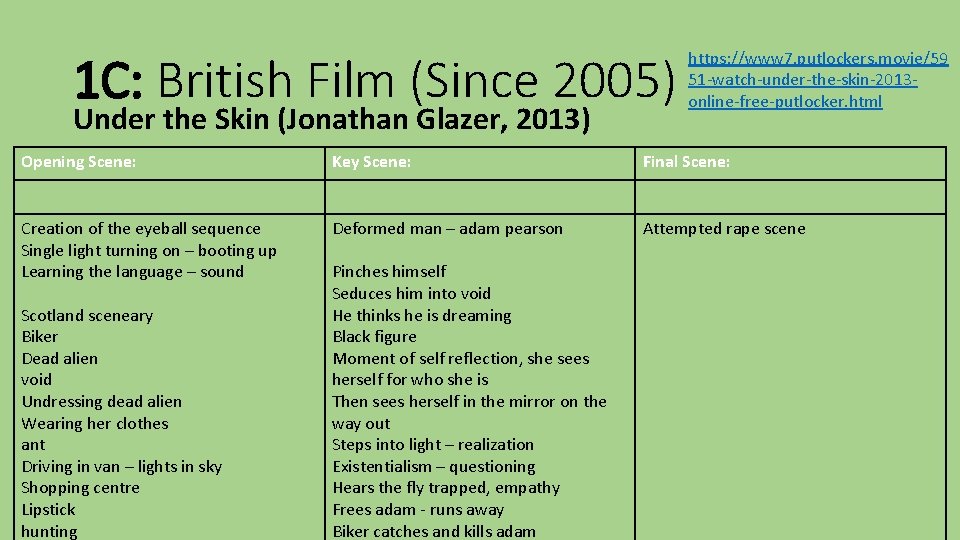
1 C: British Film (Since 2005) Under the Skin (Jonathan Glazer, 2013) https: //www 7. putlockers. movie/59 51 -watch-under-the-skin-2013 online-free-putlocker. html Opening Scene: Key Scene: Final Scene: Creation of the eyeball sequence Single light turning on – booting up Learning the language – sound Deformed man – adam pearson Attempted rape scene Scotland sceneary Biker Dead alien void Undressing dead alien Wearing her clothes ant Driving in van – lights in sky Shopping centre Lipstick hunting Pinches himself Seduces him into void He thinks he is dreaming Black figure Moment of self reflection, she sees herself for who she is Then sees herself in the mirror on the way out Steps into light – realization Existentialism – questioning Hears the fly trapped, empathy Frees adam - runs away Biker catches and kills adam
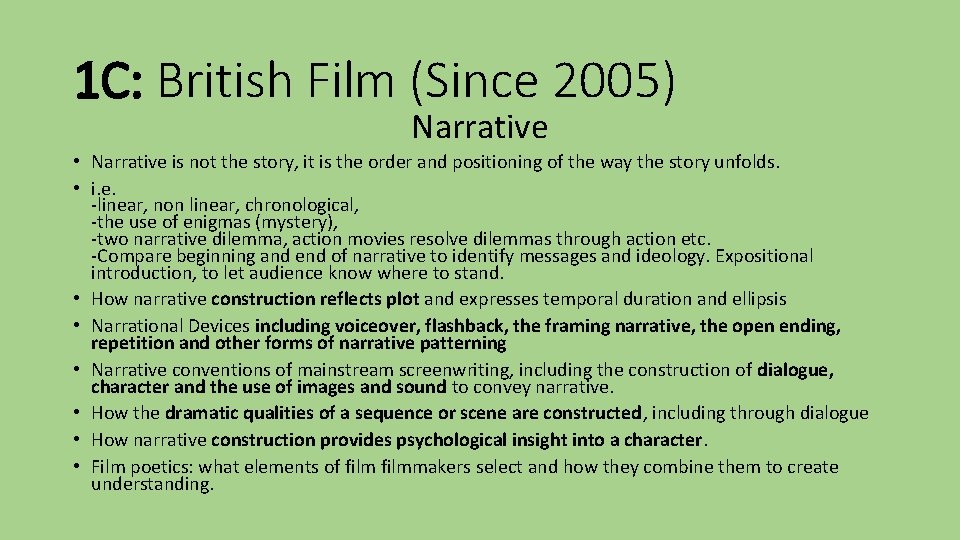
1 C: British Film (Since 2005) Narrative • Narrative is not the story, it is the order and positioning of the way the story unfolds. • i. e. -linear, non linear, chronological, -the use of enigmas (mystery), -two narrative dilemma, action movies resolve dilemmas through action etc. -Compare beginning and end of narrative to identify messages and ideology. Expositional introduction, to let audience know where to stand. • How narrative construction reflects plot and expresses temporal duration and ellipsis • Narrational Devices including voiceover, flashback, the framing narrative, the open ending, repetition and other forms of narrative patterning • Narrative conventions of mainstream screenwriting, including the construction of dialogue, character and the use of images and sound to convey narrative. • How the dramatic qualities of a sequence or scene are constructed, including through dialogue • How narrative construction provides psychological insight into a character. • Film poetics: what elements of filmmakers select and how they combine them to create understanding.
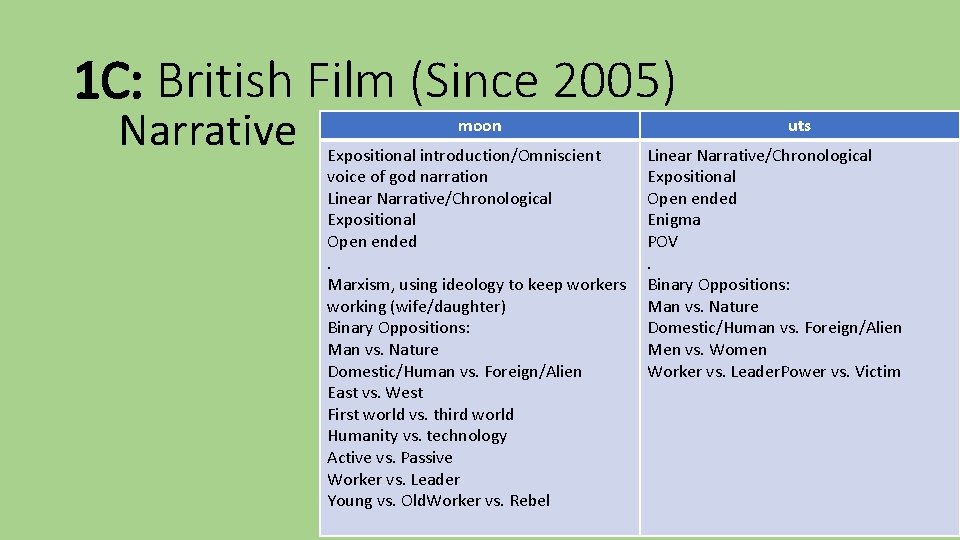
1 C: British Film (Since 2005) Narrative moon Expositional introduction/Omniscient voice of god narration Linear Narrative/Chronological Expositional Open ended. Marxism, using ideology to keep workers working (wife/daughter) Binary Oppositions: Man vs. Nature Domestic/Human vs. Foreign/Alien East vs. West First world vs. third world Humanity vs. technology Active vs. Passive Worker vs. Leader Young vs. Old. Worker vs. Rebel uts Linear Narrative/Chronological Expositional Open ended Enigma POV. Binary Oppositions: Man vs. Nature Domestic/Human vs. Foreign/Alien Men vs. Women Worker vs. Leader. Power vs. Victim
1 C: British Film (Since 2005) Ideology
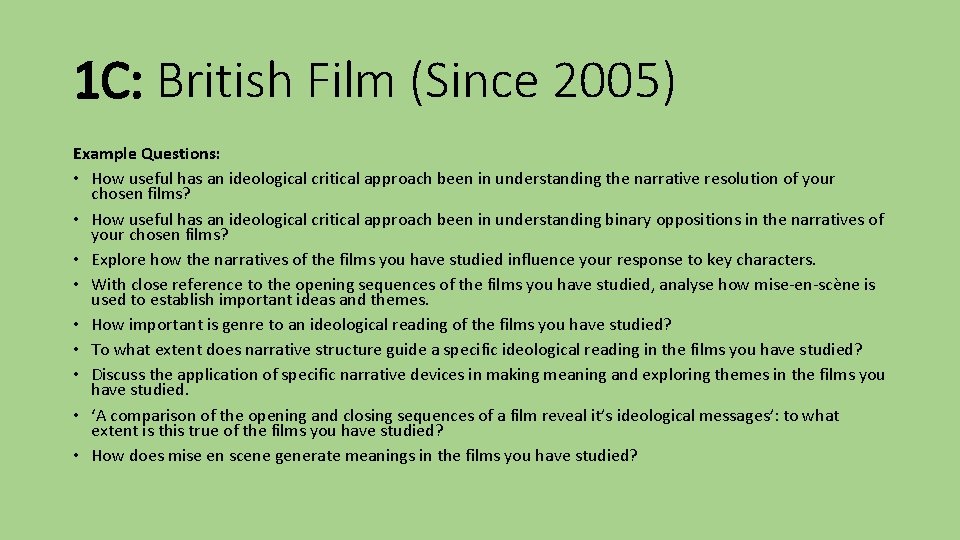
1 C: British Film (Since 2005) Example Questions: • How useful has an ideological critical approach been in understanding the narrative resolution of your chosen films? • How useful has an ideological critical approach been in understanding binary oppositions in the narratives of your chosen films? • Explore how the narratives of the films you have studied influence your response to key characters. • With close reference to the opening sequences of the films you have studied, analyse how mise-en-scène is used to establish important ideas and themes. • How important is genre to an ideological reading of the films you have studied? • To what extent does narrative structure guide a specific ideological reading in the films you have studied? • Discuss the application of specific narrative devices in making meaning and exploring themes in the films you have studied. • ‘A comparison of the opening and closing sequences of a film reveal it’s ideological messages’: to what extent is this true of the films you have studied? • How does mise en scene generate meanings in the films you have studied?
2 A: Global Film • Spain Pans Labyrinth (Guillermo Del Toro, 2006) • China & Hong Kong House of Flying Daggers (Zhang Yimou, 2004) • Core Study Areas Only file: ///Users/pos/Downloads/global-filmmaking-perspectives-film-movements-teacher-resource. pdf file: ///Users/pos/Downloads/global-filmmaking-perspectives-film-movements-student-resource. pdf file: ///Users/pos/Downloads/pans-labyrinth%20 guide. pdf file: ///Users/pos/Downloads/house-of-flying-daggers%20 guide. pdf
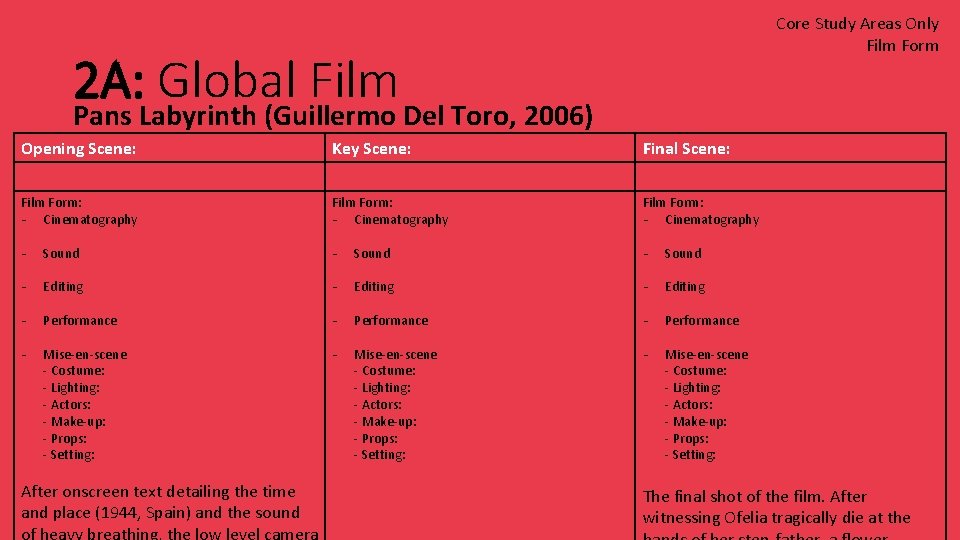
Core Study Areas Only Film Form 2 A: Global Film Pans Labyrinth (Guillermo Del Toro, 2006) Opening Scene: Key Scene: Final Scene: Film Form: - Cinematography - Sound - Editing - Performance - Mise-en-scene - Costume: - Lighting: - Actors: - Make-up: - Props: - Setting: After onscreen text detailing the time and place (1944, Spain) and the sound of heavy breathing, the low level camera The final shot of the film. After witnessing Ofelia tragically die at the
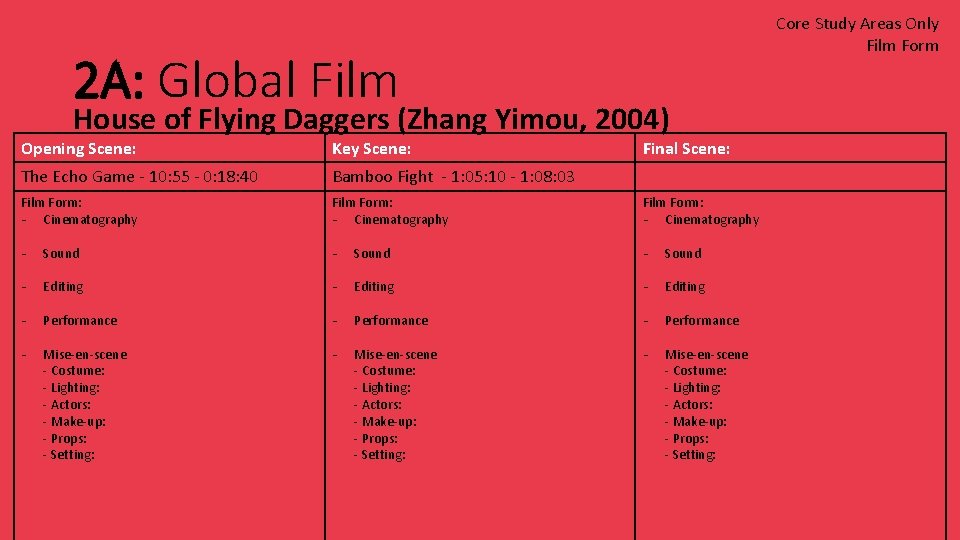
Core Study Areas Only Film Form 2 A: Global Film House of Flying Daggers (Zhang Yimou, 2004) Opening Scene: Key Scene: Final Scene: The Echo Game - 10: 55 - 0: 18: 40 Bamboo Fight - 1: 05: 10 - 1: 08: 03 Film Form: - Cinematography - Sound - Editing - Performance - Mise-en-scene - Costume: - Lighting: - Actors: - Make-up: - Props: - Setting:
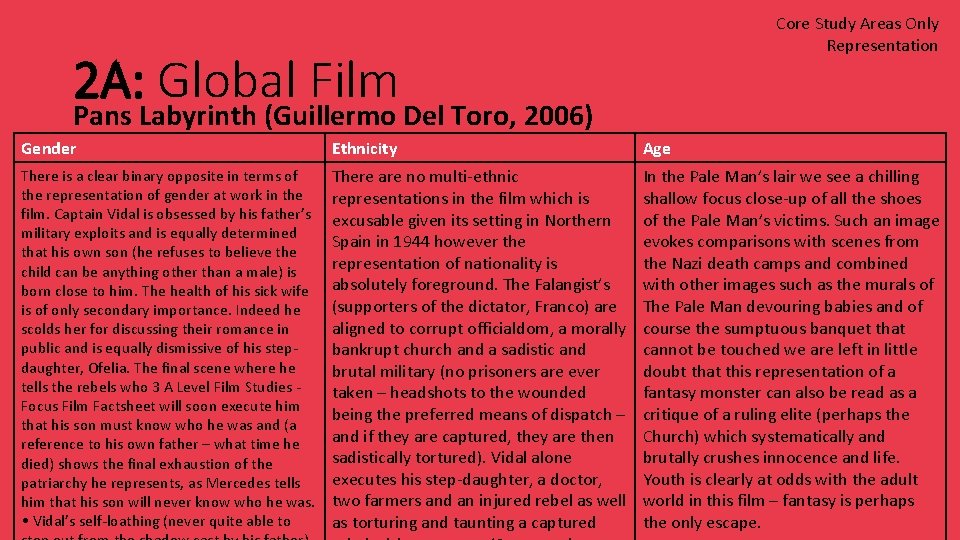
Core Study Areas Only Representation 2 A: Global Film Pans Labyrinth (Guillermo Del Toro, 2006) Gender Ethnicity Age There is a clear binary opposite in terms of the representation of gender at work in the film. Captain Vidal is obsessed by his father’s military exploits and is equally determined that his own son (he refuses to believe the child can be anything other than a male) is born close to him. The health of his sick wife is of only secondary importance. Indeed he scolds her for discussing their romance in public and is equally dismissive of his stepdaughter, Ofelia. The final scene where he tells the rebels who 3 A Level Film Studies - Focus Film Factsheet will soon execute him that his son must know who he was and (a reference to his own father – what time he died) shows the final exhaustion of the patriarchy he represents, as Mercedes tells him that his son will never know who he was. • Vidal’s self-loathing (never quite able to There are no multi-ethnic representations in the film which is excusable given its setting in Northern Spain in 1944 however the representation of nationality is absolutely foreground. The Falangist’s (supporters of the dictator, Franco) are aligned to corrupt officialdom, a morally bankrupt church and a sadistic and brutal military (no prisoners are ever taken – headshots to the wounded being the preferred means of dispatch – and if they are captured, they are then sadistically tortured). Vidal alone executes his step-daughter, a doctor, two farmers and an injured rebel as well as torturing and taunting a captured In the Pale Man’s lair we see a chilling shallow focus close-up of all the shoes of the Pale Man’s victims. Such an image evokes comparisons with scenes from the Nazi death camps and combined with other images such as the murals of The Pale Man devouring babies and of course the sumptuous banquet that cannot be touched we are left in little doubt that this representation of a fantasy monster can also be read as a critique of a ruling elite (perhaps the Church) which systematically and brutally crushes innocence and life. Youth is clearly at odds with the adult world in this film – fantasy is perhaps the only escape.
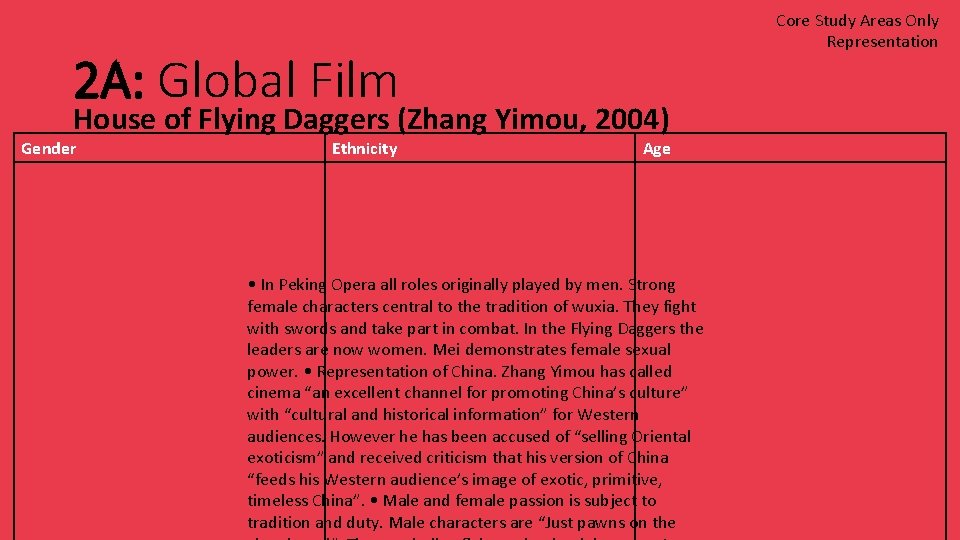
Core Study Areas Only Representation 2 A: Global Film House of Flying Daggers (Zhang Yimou, 2004) Gender Ethnicity Age • In Peking Opera all roles originally played by men. Strong female characters central to the tradition of wuxia. They fight with swords and take part in combat. In the Flying Daggers the leaders are now women. Mei demonstrates female sexual power. • Representation of China. Zhang Yimou has called cinema “an excellent channel for promoting China’s culture” with “cultural and historical information” for Western audiences. However he has been accused of “selling Oriental exoticism” and received criticism that his version of China “feeds his Western audience’s image of exotic, primitive, timeless China”. • Male and female passion is subject to tradition and duty. Male characters are “Just pawns on the
Core Study Areas Only Context 2 A: Global Film Pans Labyrinth (Guillermo Del Toro, 2006) Political Social Historical The negative depiction of Franco’s fascist forces is clearly intended to be extended to the imaginative poverty of fascism in general – in contrast to the more benign and sensitive (although hardly democratic) fairy kingdom. A more realist political representation is that of the guerrillas who are presented as resourceful and determined and egalitarian. Mercedes love of children (Ofelia and her baby brother) suggests a tenderness and a celebration of all things childish – indeed, unlike Ofelia’s weak and dismissive mother, Mercedes gives advice on the handling of fauns. The representation of women referred to above is evidence of the social problems women faced in this patriarchal and macho era. • A local priest, attending a meal held by the Captain, dismisses the possible pain felt by the rebels on theological grounds. His representation lacks humanity and is clearly a barbed commentary on an out of touch and complicit Catholic church: “God has already saved their souls. What happens to their bodies hardly matters to him. ” Del Toro uses the cinematic conceit of a banquet to heighten the corruption of the local middle classes and ruling elite. • Despite his criticisms of Catholicism as a dogma The period featured, 1944 in Spain, is intriguing to the non-specialist as it is clearly a period where the rumblings from the Spanish Civil War are still being felt despite the war itself having finished in 1939.
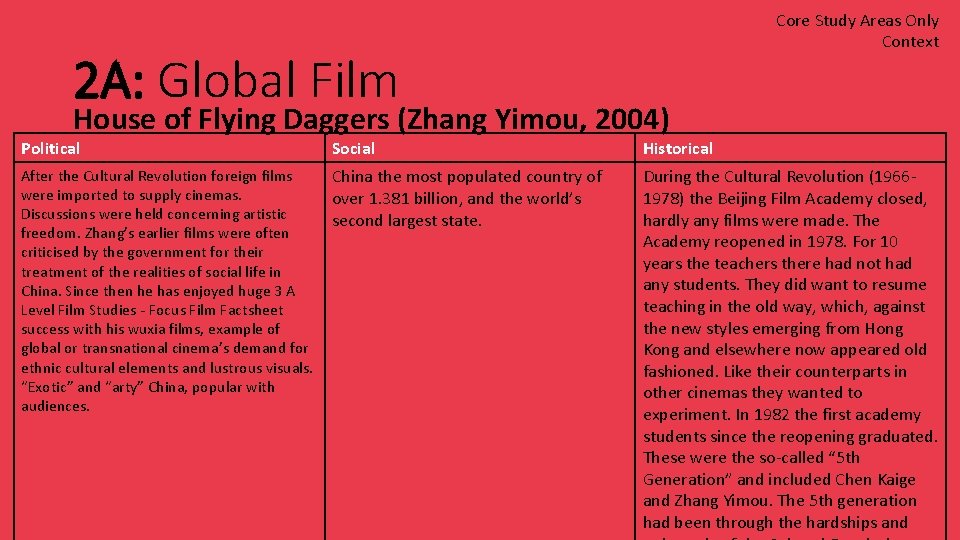
Core Study Areas Only Context 2 A: Global Film House of Flying Daggers (Zhang Yimou, 2004) Political Social After the Cultural Revolution foreign films China the most populated country of were imported to supply cinemas. over 1. 381 billion, and the world’s Discussions were held concerning artistic second largest state. freedom. Zhang’s earlier films were often criticised by the government for their treatment of the realities of social life in China. Since then he has enjoyed huge 3 A Level Film Studies - Focus Film Factsheet success with his wuxia films, example of global or transnational cinema’s demand for ethnic cultural elements and lustrous visuals. “Exotic” and “arty” China, popular with audiences. Historical During the Cultural Revolution (19661978) the Beijing Film Academy closed, hardly any films were made. The Academy reopened in 1978. For 10 years the teachers there had not had any students. They did want to resume teaching in the old way, which, against the new styles emerging from Hong Kong and elsewhere now appeared old fashioned. Like their counterparts in other cinemas they wanted to experiment. In 1982 the first academy students since the reopening graduated. These were the so-called “ 5 th Generation” and included Chen Kaige and Zhang Yimou. The 5 th generation had been through the hardships and
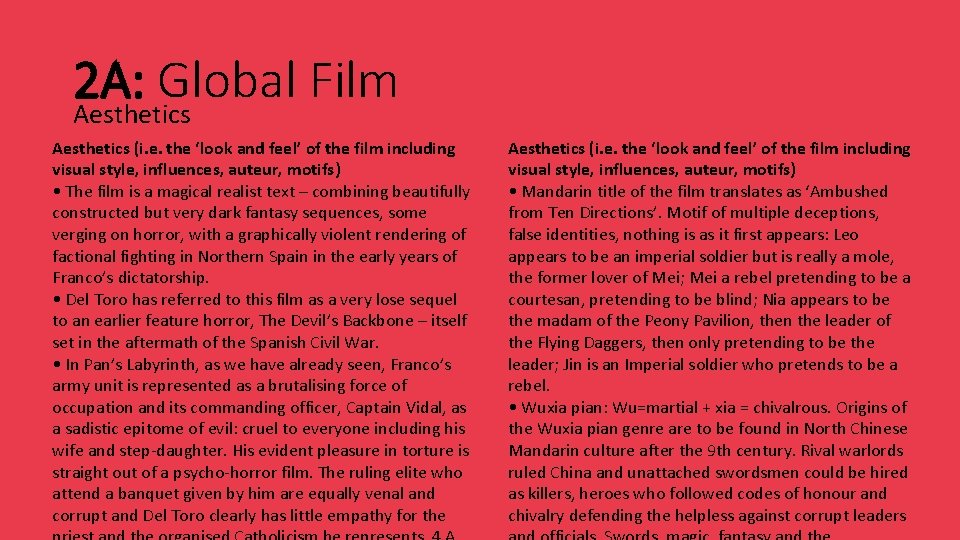
2 A: Global Film Aesthetics (i. e. the ‘look and feel’ of the film including visual style, influences, auteur, motifs) • The film is a magical realist text – combining beautifully constructed but very dark fantasy sequences, some verging on horror, with a graphically violent rendering of factional fighting in Northern Spain in the early years of Franco’s dictatorship. • Del Toro has referred to this film as a very lose sequel to an earlier feature horror, The Devil’s Backbone – itself set in the aftermath of the Spanish Civil War. • In Pan’s Labyrinth, as we have already seen, Franco’s army unit is represented as a brutalising force of occupation and its commanding officer, Captain Vidal, as a sadistic epitome of evil: cruel to everyone including his wife and step-daughter. His evident pleasure in torture is straight out of a psycho-horror film. The ruling elite who attend a banquet given by him are equally venal and corrupt and Del Toro clearly has little empathy for the Aesthetics (i. e. the ‘look and feel’ of the film including visual style, influences, auteur, motifs) • Mandarin title of the film translates as ‘Ambushed from Ten Directions’. Motif of multiple deceptions, false identities, nothing is as it first appears: Leo appears to be an imperial soldier but is really a mole, the former lover of Mei; Mei a rebel pretending to be a courtesan, pretending to be blind; Nia appears to be the madam of the Peony Pavilion, then the leader of the Flying Daggers, then only pretending to be the leader; Jin is an Imperial soldier who pretends to be a rebel. • Wuxia pian: Wu=martial + xia = chivalrous. Origins of the Wuxia pian genre are to be found in North Chinese Mandarin culture after the 9 th century. Rival warlords ruled China and unattached swordsmen could be hired as killers, heroes who followed codes of honour and chivalry defending the helpless against corrupt leaders
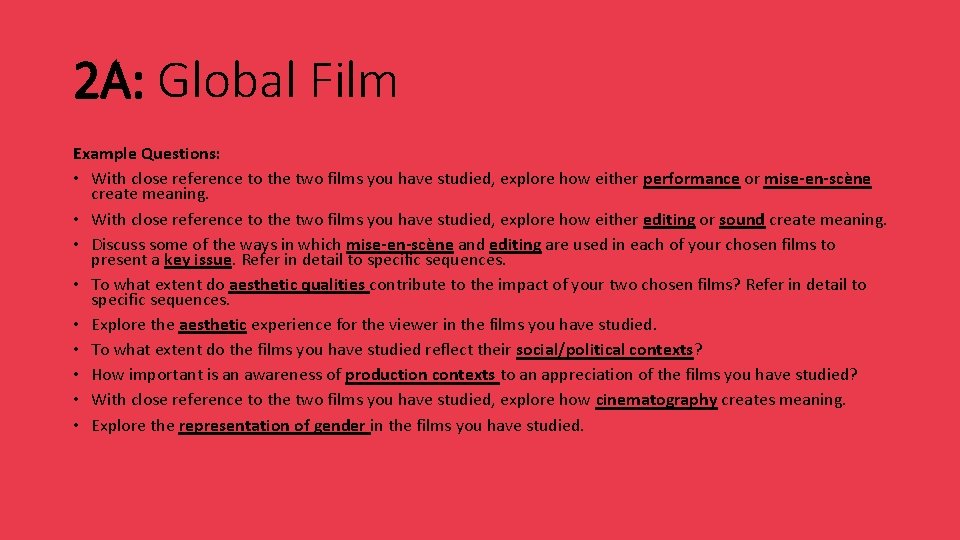
2 A: Global Film Example Questions: • With close reference to the two films you have studied, explore how either performance or mise-en-scène create meaning. • With close reference to the two films you have studied, explore how either editing or sound create meaning. • Discuss some of the ways in which mise-en-scène and editing are used in each of your chosen films to present a key issue. Refer in detail to specific sequences. • To what extent do aesthetic qualities contribute to the impact of your two chosen films? Refer in detail to specific sequences. • Explore the aesthetic experience for the viewer in the films you have studied. • To what extent do the films you have studied reflect their social/political contexts? • How important is an awareness of production contexts to an appreciation of the films you have studied? • With close reference to the two films you have studied, explore how cinematography creates meaning. • Explore the representation of gender in the films you have studied.
2 B: Documentary Film • Amy (Asif Kapadia, 2016) • Critical Debates • Filmmakers theories file: ///Users/pos/Downloads/Documentary%20 Resource%203%20 -%20 Filmmakers%20 theories. pdf file: ///Users/pos/Downloads/documenatry-resource 4_amy-case-study%20(2). pdf file: ///Users/pos/Downloads/Documentary%20 Resource%202%20 -%20 Digital%20 debates%20 in%20 documentary. pdf
2 B: Documentary Film Amy (Asif Kapadia, 2016) Opening Scene: Key Scene: Final Scene:
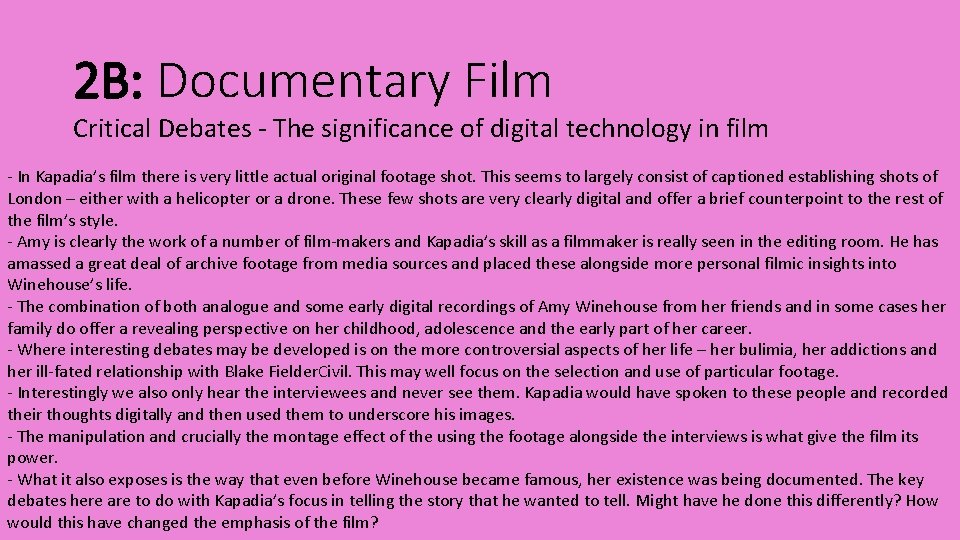
2 B: Documentary Film Critical Debates - The significance of digital technology in film - In Kapadia’s film there is very little actual original footage shot. This seems to largely consist of captioned establishing shots of London – either with a helicopter or a drone. These few shots are very clearly digital and offer a brief counterpoint to the rest of the film’s style. - Amy is clearly the work of a number of film-makers and Kapadia’s skill as a filmmaker is really seen in the editing room. He has amassed a great deal of archive footage from media sources and placed these alongside more personal filmic insights into Winehouse’s life. - The combination of both analogue and some early digital recordings of Amy Winehouse from her friends and in some cases her family do offer a revealing perspective on her childhood, adolescence and the early part of her career. - Where interesting debates may be developed is on the more controversial aspects of her life – her bulimia, her addictions and her ill-fated relationship with Blake Fielder. Civil. This may well focus on the selection and use of particular footage. - Interestingly we also only hear the interviewees and never see them. Kapadia would have spoken to these people and recorded their thoughts digitally and then used them to underscore his images. - The manipulation and crucially the montage effect of the using the footage alongside the interviews is what give the film its power. - What it also exposes is the way that even before Winehouse became famous, her existence was being documented. The key debates here are to do with Kapadia’s focus in telling the story that he wanted to tell. Might have he done this differently? How would this have changed the emphasis of the film?
2 B: Documentary Film Critical Debates - The significance of digital technology in film
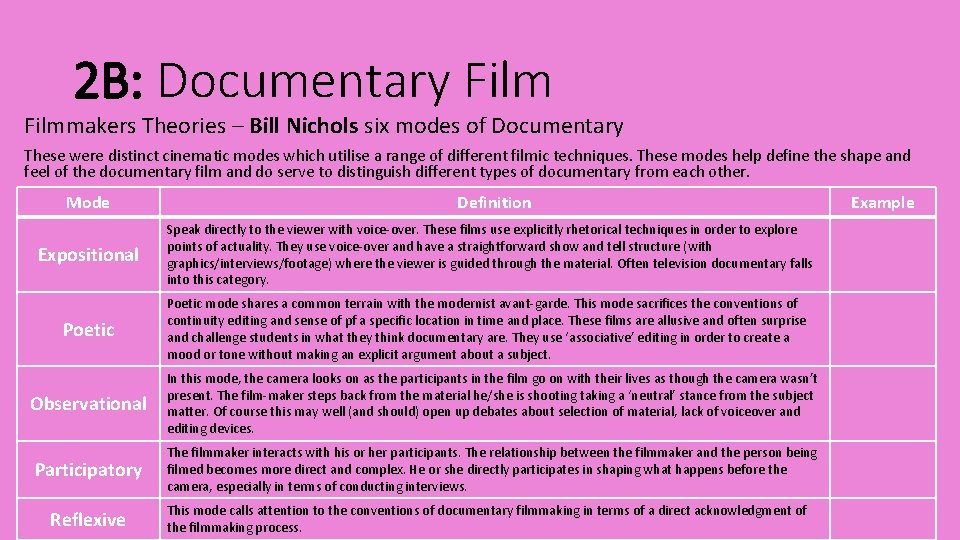
2 B: Documentary Filmmakers Theories – Bill Nichols six modes of Documentary These were distinct cinematic modes which utilise a range of different filmic techniques. These modes help define the shape and feel of the documentary film and do serve to distinguish different types of documentary from each other. Mode Definition Expositional Speak directly to the viewer with voice-over. These films use explicitly rhetorical techniques in order to explore points of actuality. They use voice-over and have a straightforward show and tell structure (with graphics/interviews/footage) where the viewer is guided through the material. Often television documentary falls into this category. Poetic mode shares a common terrain with the modernist avant-garde. This mode sacrifices the conventions of continuity editing and sense of pf a specific location in time and place. These films are allusive and often surprise and challenge students in what they think documentary are. They use ‘associative’ editing in order to create a mood or tone without making an explicit argument about a subject. Observational In this mode, the camera looks on as the participants in the film go on with their lives as though the camera wasn’t present. The film-maker steps back from the material he/she is shooting taking a ‘neutral’ stance from the subject matter. Of course this may well (and should) open up debates about selection of material, lack of voiceover and editing devices. Participatory The filmmaker interacts with his or her participants. The relationship between the filmmaker and the person being filmed becomes more direct and complex. He or she directly participates in shaping what happens before the camera, especially in terms of conducting interviews. Reflexive This mode calls attention to the conventions of documentary filmmaking in terms of a direct acknowledgment of the filmmaking process. Example
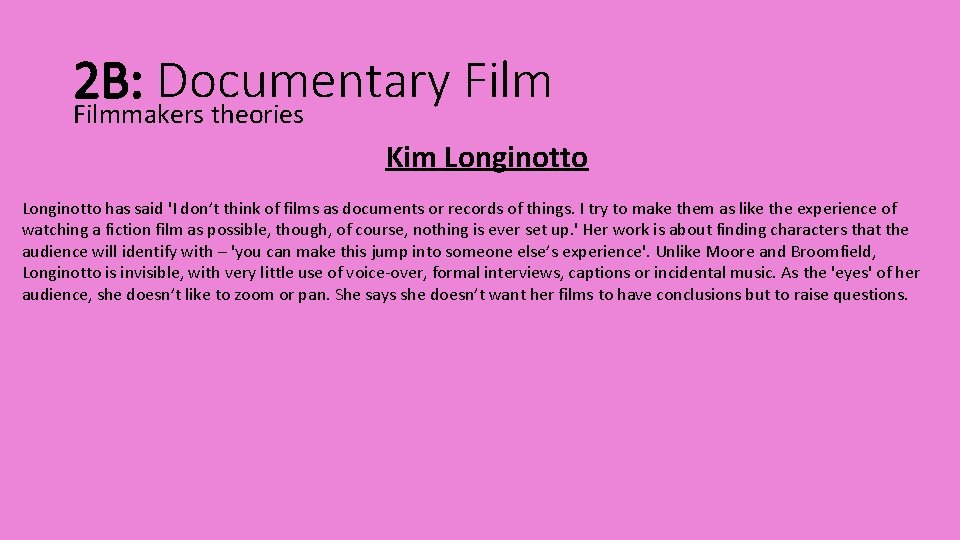
2 B: Documentary Filmmakers theories Kim Longinotto has said 'I don’t think of films as documents or records of things. I try to make them as like the experience of watching a fiction film as possible, though, of course, nothing is ever set up. ' Her work is about finding characters that the audience will identify with – 'you can make this jump into someone else’s experience'. Unlike Moore and Broomfield, Longinotto is invisible, with very little use of voice-over, formal interviews, captions or incidental music. As the 'eyes' of her audience, she doesn’t like to zoom or pan. She says she doesn’t want her films to have conclusions but to raise questions.
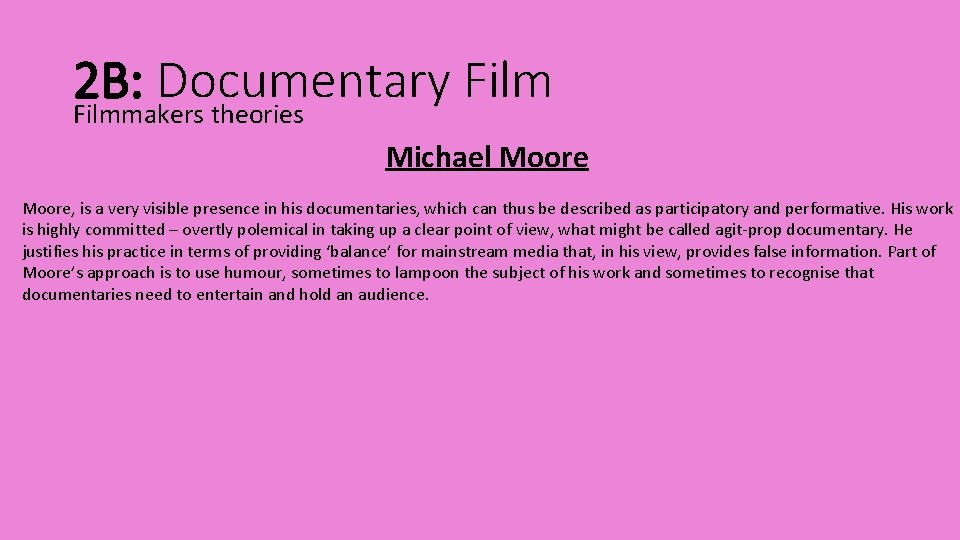
2 B: Documentary Filmmakers theories Michael Moore, is a very visible presence in his documentaries, which can thus be described as participatory and performative. His work is highly committed – overtly polemical in taking up a clear point of view, what might be called agit-prop documentary. He justifies his practice in terms of providing ‘balance’ for mainstream media that, in his view, provides false information. Part of Moore’s approach is to use humour, sometimes to lampoon the subject of his work and sometimes to recognise that documentaries need to entertain and hold an audience.
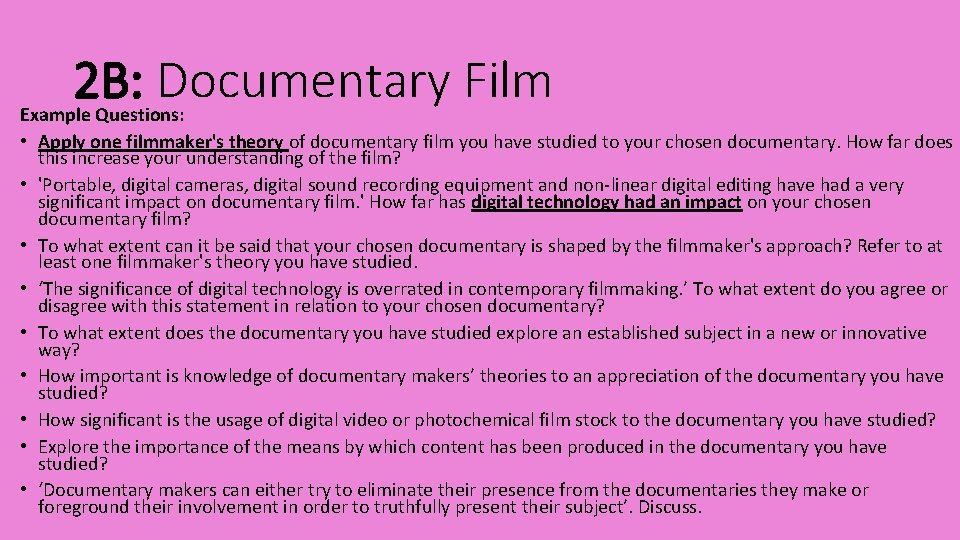
2 B: Documentary Film Example Questions: • Apply one filmmaker's theory of documentary film you have studied to your chosen documentary. How far does this increase your understanding of the film? • 'Portable, digital cameras, digital sound recording equipment and non-linear digital editing have had a very significant impact on documentary film. ' How far has digital technology had an impact on your chosen documentary film? • To what extent can it be said that your chosen documentary is shaped by the filmmaker's approach? Refer to at least one filmmaker's theory you have studied. • ‘The significance of digital technology is overrated in contemporary filmmaking. ’ To what extent do you agree or disagree with this statement in relation to your chosen documentary? • To what extent does the documentary you have studied explore an established subject in a new or innovative way? • How important is knowledge of documentary makers’ theories to an appreciation of the documentary you have studied? • How significant is the usage of digital video or photochemical film stock to the documentary you have studied? • Explore the importance of the means by which content has been produced in the documentary you have studied? • ‘Documentary makers can either try to eliminate their presence from the documentaries they make or foreground their involvement in order to truthfully present their subject’. Discuss.
2 C: Silent Cinema • Strike (Sergei Eisenstein, 1925) • Critical Debates
2 C: Silent Cinema Strike (Sergei Eisenstein, 1925) Opening Scene: Key Scene: Final Scene:
2 C: Silent Cinema Critical Debates
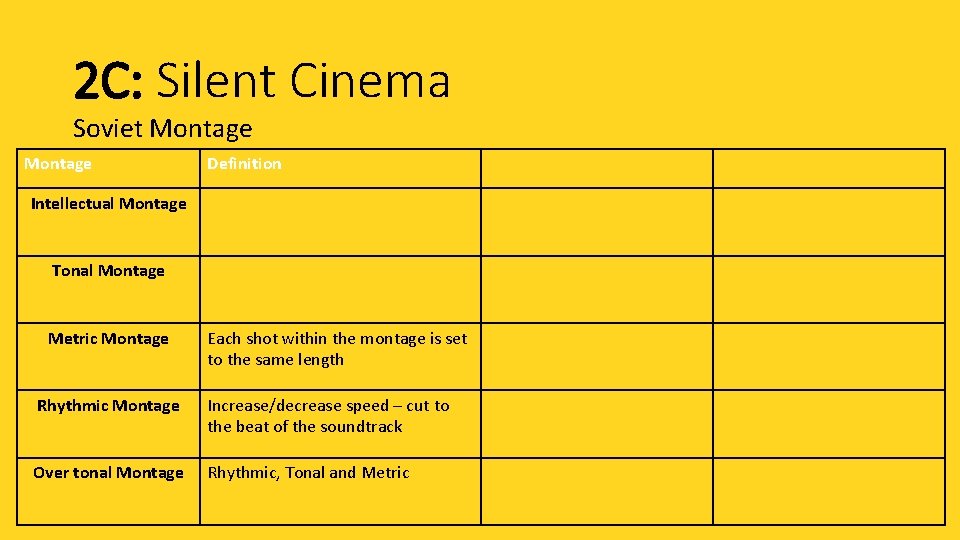
2 C: Silent Cinema Soviet Montage Definition Intellectual Montage Tonal Montage Metric Montage Each shot within the montage is set to the same length Rhythmic Montage Increase/decrease speed – cut to the beat of the soundtrack Over tonal Montage Rhythmic, Tonal and Metric
2 C: Silent Cinema Example Questions: • Discuss how far your chosen film or films reflect aesthetic qualities associated with a particular film movement. • Discuss how far your chosen film or films reflect cultural contexts associated with a particular film movement. • To what extent can it be said that your chosen film movement represents an expressionist as opposed to a realist approach to filmmaking? Make detailed reference to examples from the silent film or films you have studied. • ‘Films without recorded speech can succeed brilliantly in communicating ideas and emotions. ’ How true is this statement in relation to the silent film or films you have studied? • What is the point in studying old black and white films made with outmoded technology and style? • To what extent do the limitations of silent film restrict the engagement of the viewer in the film you have studied? • How relevant are specific cinematographic techniques to the film you have studied? • To what extent does editing shape the meaning making in the film you have studied? • Explore the idea of expressionism with close reference to the film you have studied. • To what extent is the illusion of reality relevant to an appreciation of the film you have studied?
2 D: Experimental Cinema • Fallen Angels (Wong Kar-Wai, 1995) • Narrative • Alternative forms of Narrative • Auteur
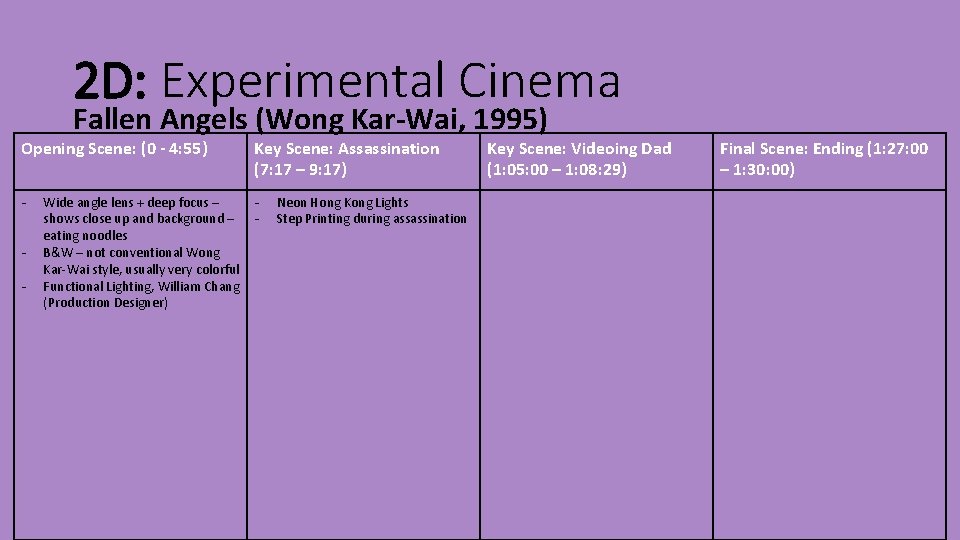
2 D: Experimental Cinema Fallen Angels (Wong Kar-Wai, 1995) Opening Scene: (0 - 4: 55) - Key Scene: Assassination (7: 17 – 9: 17) Wide angle lens + deep focus – shows close up and background – eating noodles B&W – not conventional Wong Kar-Wai style, usually very colorful Functional Lighting, William Chang (Production Designer) Neon Hong Kong Lights Step Printing during assassination Key Scene: Videoing Dad (1: 05: 00 – 1: 08: 29) Final Scene: Ending (1: 27: 00 – 1: 30: 00)
2 D: Experimental Cinema Narrative Different narrators, shift in protagonist Non-linear structure, scene at beginning used at the end Woman cleaning up the house,
2 D: Experimental Cinema Alternative forms of Narrative Much of this has been covered in the sections on aesthetics and film form in terms of the auteur status of Wong Kai Wai and the importance of viewing this film alongside Chungking Express in particular. The close working relationship between Christopher Doyle and Wong Kai Wai is also vital to understanding how the signature aesthetic is created in their collaborations. The narrative style here is interesting because once again it has parallels with Chungking Express. The way that the two strands are in opposition to each other and conversing make connections is certainly worth reflecting upon and this may well only become more apparent after another viewing of the film. Certainly it might be worth trying to represent the relationships and the temporal nature of the plot diametrically to get a sense of overlap and implicit and explicit linkage.
2 D: Experimental Cinema Context Political/Historical Social Technological Fallen Angels in many respects at a surface level makes few deliberate political or social points. Its characters certainly don’t have what we might think of as proper jobs, they have no overt political leanings and in terms of citing the film within its historical contexts – its use of pastiche and intertextuality do suggest a postmodern reading. At a deeper level however this film (and the earlier Chungking Express) and the mood created may well be implicitly linked to the status of Hong Kong at that time. The nebulous space of Hong Kong as in-between the UK and mainland China may well be seen to be reflected in the transient, dislocated status of the main protagonists. The handover in 1997 is close and there seems to be a feeling of something ending, which is returned to in this narrative a number of times. Hong Kong Perhaps one of the more touching aspects of Fallen Angels is the relationship shown between 4 A Level Film Studies - Focus Film Factsheet He Zhiwu and his widowed father whom he lives with. This is best demonstrated in the video he makes of his father at work, cooking and at one point sleeping. The father is not enamoured with his leading role in this film, but we see a sequence with him watching it and laughing when it is completed. When he dies, He Zhiwu replays the scene with his father frying a steak, pausing and rewinding it as he speaks about of his sense of loss. In a film where the vast majority of relationships are fractured Certainly the film utilises film stock in a very unique way as well as Doyle’s adaptation of wide-lens shooting. While it lacks the lavish mise-en-scène of his latter films, the combination of the various cinematic techniques fits the poetic nature of Fallen Angels perfectly. Institutional Fallen Angels was originally conceived as the third story in his previous film Chungking Express, but it didn’t fit into the overall mood of that film and subsequently took on a life of its own. Certainly Fallen Angels is a far darker film tonally and although there is a great
2 D: Experimental Cinema Auteur: Wong Kar-Wai Unfinished Scripts – Improvised Creates mood – sound, colour Emphasis on emotions over narrative Poetic/ personal – lacks narrative convention Impossible/unrequited love themes Cinematography – inspired by cityscape of Editing – Step printing = Slow Mo Recasts actors – Takeshi Kangshiro – cop in CE, Ex-con in FA. Hong Kong – no landmarks shown in the rain “Idea of no change” Popular music to set mood Themes – live and loneliness Open narratives lol
2 D: Experimental Cinema Context Narrative Auteur Inspired angles Poor box-office in Cinematographer – Christopher Doyle Fallen Angels, C. E, M 2 its as dark, oppressive, Magical William Changs – Production designer
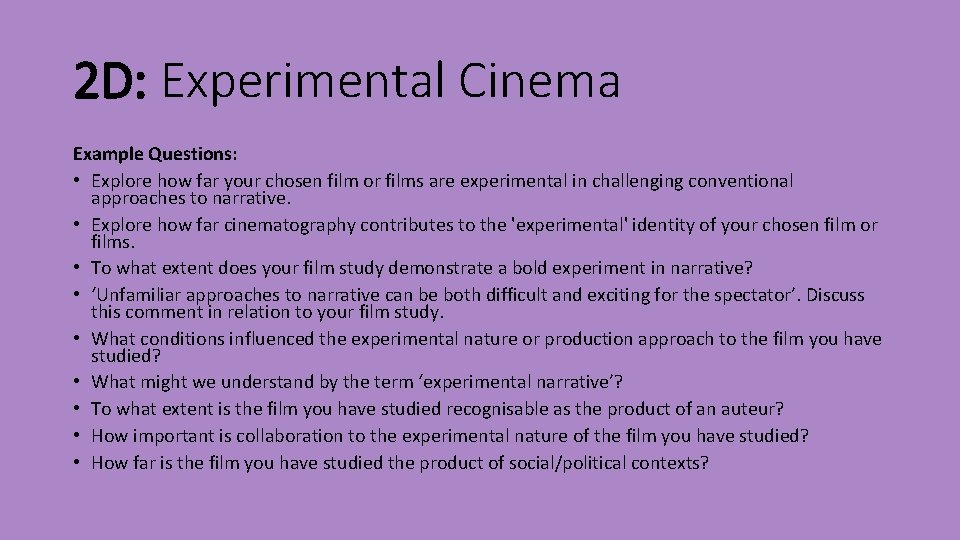
2 D: Experimental Cinema Example Questions: • Explore how far your chosen film or films are experimental in challenging conventional approaches to narrative. • Explore how far cinematography contributes to the 'experimental' identity of your chosen film or films. • To what extent does your film study demonstrate a bold experiment in narrative? • ‘Unfamiliar approaches to narrative can be both difficult and exciting for the spectator’. Discuss this comment in relation to your film study. • What conditions influenced the experimental nature or production approach to the film you have studied? • What might we understand by the term ‘experimental narrative’? • To what extent is the film you have studied recognisable as the product of an auteur? • How important is collaboration to the experimental nature of the film you have studied? • How far is the film you have studied the product of social/political contexts?
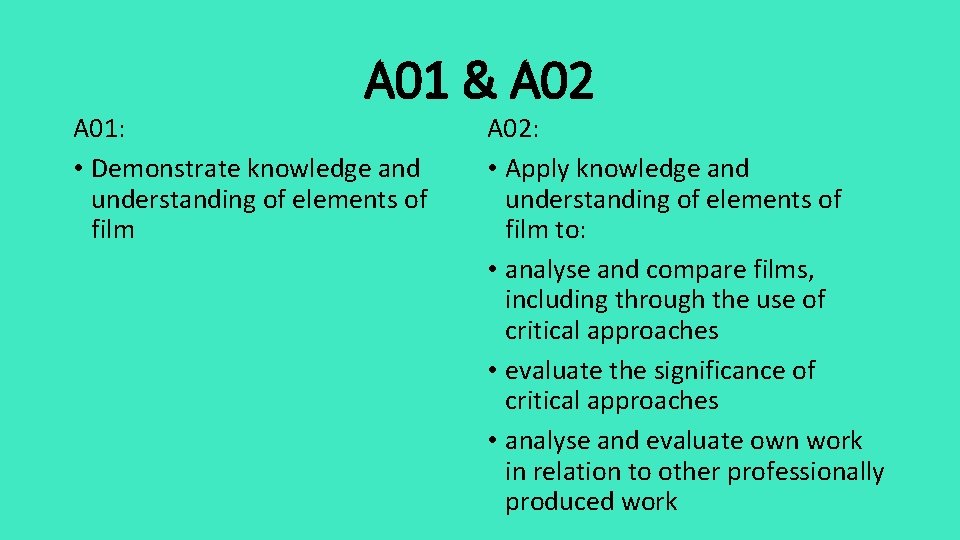
A 01 & A 02 A 01: • Demonstrate knowledge and understanding of elements of film A 02: • Apply knowledge and understanding of elements of film to: • analyse and compare films, including through the use of critical approaches • evaluate the significance of critical approaches • analyse and evaluate own work in relation to other professionally produced work
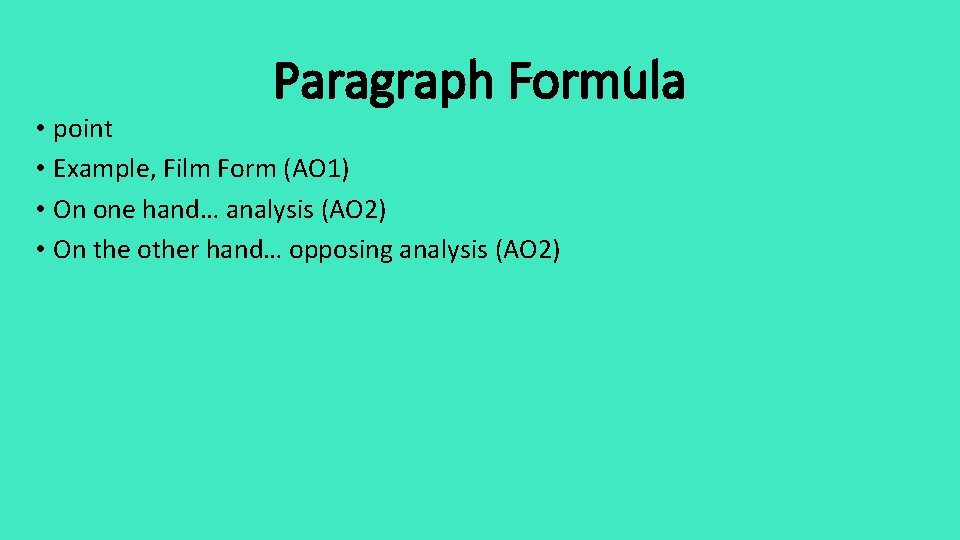
Paragraph Formula • point • Example, Film Form (AO 1) • On one hand… analysis (AO 2) • On the other hand… opposing analysis (AO 2)