
Film Foley S 3 Music Technology Unit Lesson
- Slides: 39
Film Foley S 3 Music Technology Unit
Lesson 1 Starter Think of films such as Jurassic Park and Star Wars – how do you think the sound was added to these films?
Lesson 1 Learning Intention To gain an understanding of film foley Set own target for instrument A. Success Criteria I have an understanding about what film foley is and how it is achieved. I have watched a number of short videos and have a better understanding of how foley is achieved. I am building technique on my Instrument A.
What difference does foley make? What is it about the sound in many student or amateur films that makes them sound so. . . well . . . amateur? Even if the clarity is good, there is often something hollow or thin about the sound – it lacks depth. The answer could be that the film makers did not add Foley sound effects to the soundtrack.
What is foley? Foley effects are sound effects added to the film during post production (after the shooting stops). They include sounds such as footsteps, clothes rustling, crockery clinking, paper folding, doors opening and slamming, punches hitting, glass breaking, etc. In other words, many of the sounds that the sound recordists on set did their best to avoid recording during the shoot.
How is foley made? Foley is usually performed by Foley artists. Ideally they stand on a Foley stage (an area with a variety of possible surfaces and props) in a Foley studio (a specialized sound studio), though any post production sound studio will do with a little modification. The Foley artists can clearly see a screen which displays the footage they are to add sound fx to, and they perform their sound effects while watching this screen for timing. The actions they perform can include walking, running, jostling each other, rubbing their clothing, handling props, and breaking objects, all while closely observing the screen to ensure their sound fx are appropriate to the vision.
How is foley made? Increasingly, many simple Foley sound fx are done without Foley artists - the sound effects are stored electronically and performed by the post production sound engineer on a keyboard while watching the visual. Done poorly this type of "Foley" sounds bland repetitive, and it is nowhere near as flexible as the real thing, but it is much cheaper than renting a Foley stage and paying Foley artists to create the foley sound effects.
Why do we bother? Without Foley, a film sounds empty and hollow - the actors seem to be talking in a vacuum. The sound recordist, if they did a good job, has given us the dialogue and excluded everything else, but our films needs more than this for the picture to come alive. We need to hear the little sounds of clothes, furniture, etc - but we need to control those sound effects so they don't obscure any of the dialogue.
Film Foley Examples Your teacher will now show you some short videos on film foley.
Lesson 2
Lesson 2 Think of films such as Toy Story and Monsters Inc – how do you think the sound was added to these films?
Lesson 2 Learning Intention To gain an understanding of sound in animation Set own target for instrument B. Success Criteria I have an understanding about what sound in animation is and how it is achieved. I have watched a number of short videos and have a better understanding of how sound in animation is achieved. I am building technique on my Instrument B.
Sound in Animation Sound plays a very important role in animation. Have you ever watched a film or an animated film without sound? Can you imagine how dull and boring the film or animation would be without sound? there would be no impact or no mood set in the film, you could not feel the film or animation because there is no sound.
Sound in Animation There are some films or animation that can stand alone without sound, but adding sound would give the animation more feel. Having sound in the film or animation would help us understand better of what is going on in the scenes. Sound completes and puts sense in the animation. There are few films that sound has a great impact on, an example would be Horror Films. Without sound you cannot feel the "Horror" in the horror film. Sound creates the atmosphere in the film.
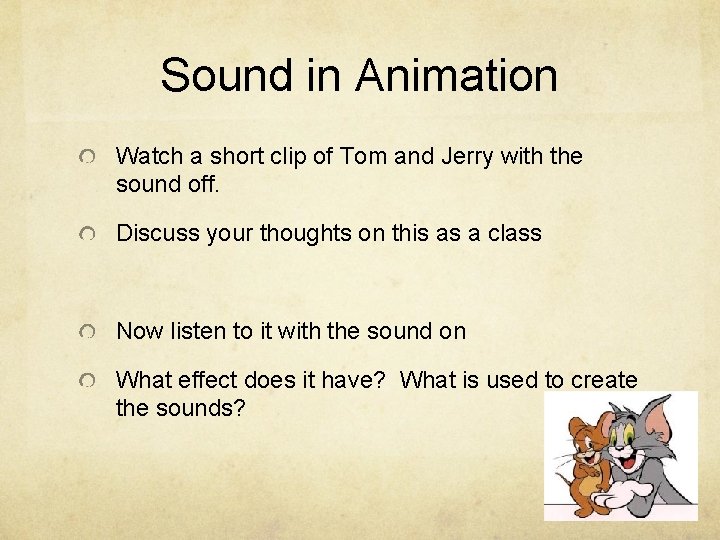
Sound in Animation Watch a short clip of Tom and Jerry with the sound off. Discuss your thoughts on this as a class Now listen to it with the sound on What effect does it have? What is used to create the sounds?
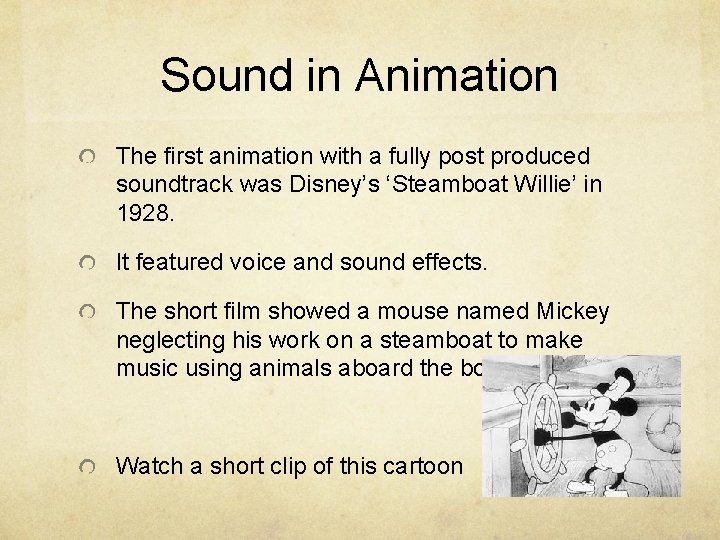
Sound in Animation The first animation with a fully post produced soundtrack was Disney’s ‘Steamboat Willie’ in 1928. It featured voice and sound effects. The short film showed a mouse named Mickey neglecting his work on a steamboat to make music using animals aboard the boat. Watch a short clip of this cartoon
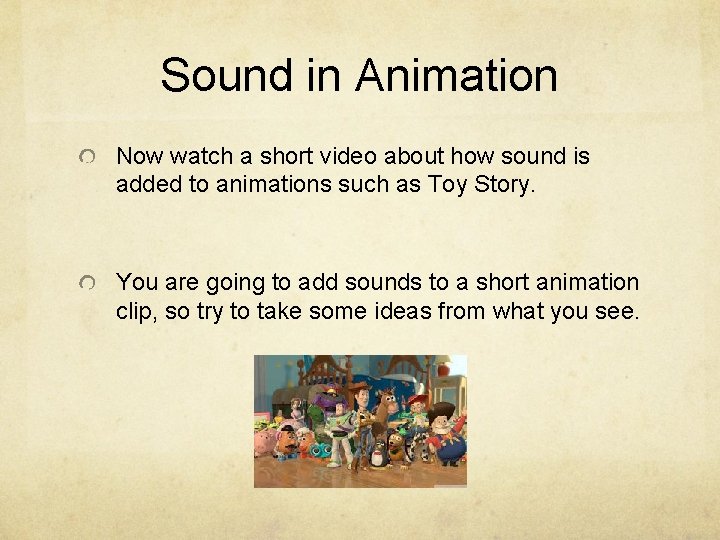
Sound in Animation Now watch a short video about how sound is added to animations such as Toy Story. You are going to add sounds to a short animation clip, so try to take some ideas from what you see.
Lesson 3 PROJECT
LESSON 3 A new concept for you: Spillage - Spillage is where one microphone picks up signals from other sources that have no business being on that track! Copy this into your WORKBOOK Can you think of an example of Sound Spillage?
LESSON 3 Learning Intention To prepare to add sound to my animation Success Criteria I can add loops using garageband I know how to record natural sounds on garageband I can use the midi keyboard to add sounds
Project Your task is to devise the sound design for a short scary film. You will need to use loops and sound effects for the scene and sequence this according to a timeline.
Project The clip you will be using is: SPECTRE IN THE WOODS As you watch, think about the type of sounds you might need to add to create the creepy, haunted feel to the clip.
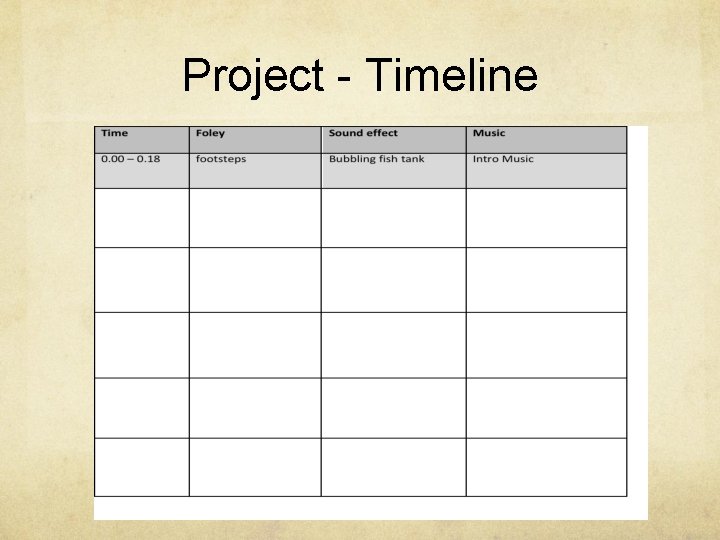
Project The first step of this project is to create a sound design map, planning out the type of sounds you will need to create your audio. In pairs, you should watch the clip a few times, taking notes on the grid on your worksheet to plan out your project. (an example of this is on the next page)
Project - Timeline
Project You should follow the clear instructions on your worksheet and record your progress and decisions you make in the Project Write up Power. Point. (Make sure you save a copy of this with your name on it and keep it up to date). YOUR TEACHER WILL NOW SHOW YOU A COMPLETED EXAMPLE…
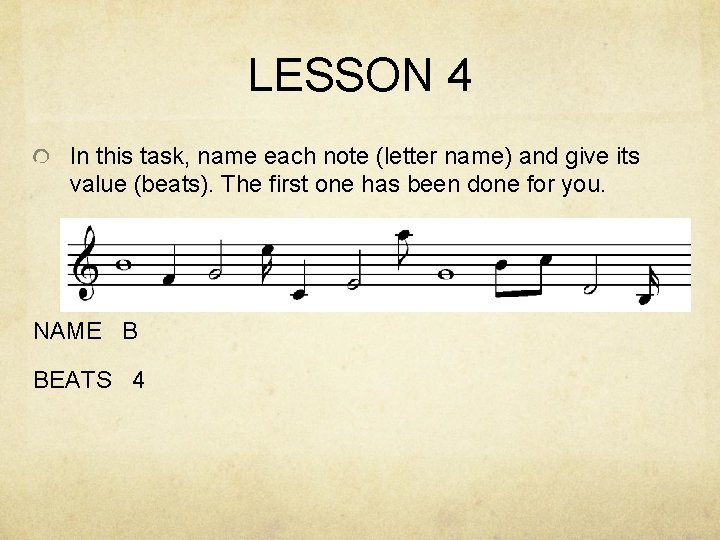
LESSON 4 In this task, name each note (letter name) and give its value (beats). The first one has been done for you. NAME B BEATS 4
LESSON 5 A new concept for you: Reverb creates the illusion that your performer was recorded somewhere else other than the studio! Reverb makes the track sound like it was recorded in a room, a hall, a stadium, a cathedral and just about anywhere you can think of that has unique acoustics.
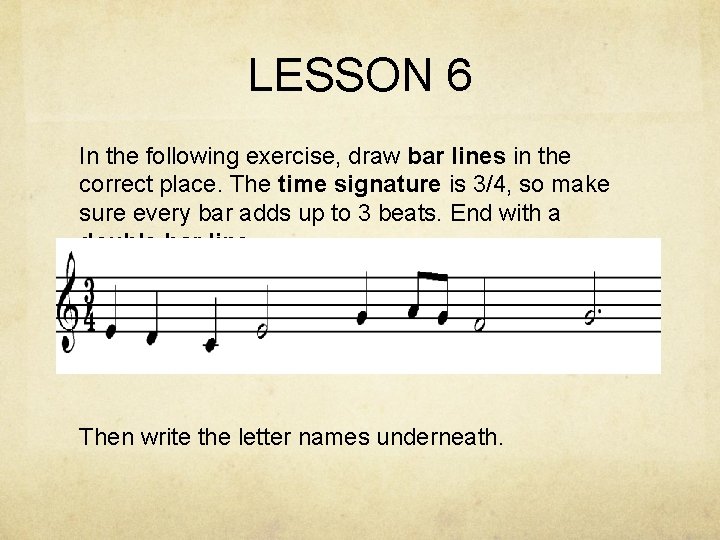
LESSON 6 In the following exercise, draw bar lines in the correct place. The time signature is 3/4, so make sure every bar adds up to 3 beats. End with a double bar line. Then write the letter names underneath.
LESSON 7 STEREO - a two channel system with the channels designated as left and right – invented because we have two ears! MONO - a single channel of audio. Copy these into your WORKBOOK Can you think of when you would use STEREO and MONO inputs?
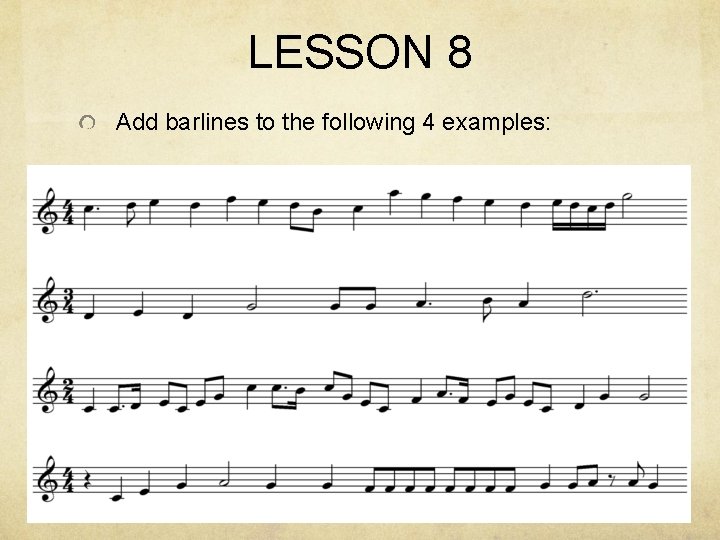
LESSON 8 Add barlines to the following 4 examples:
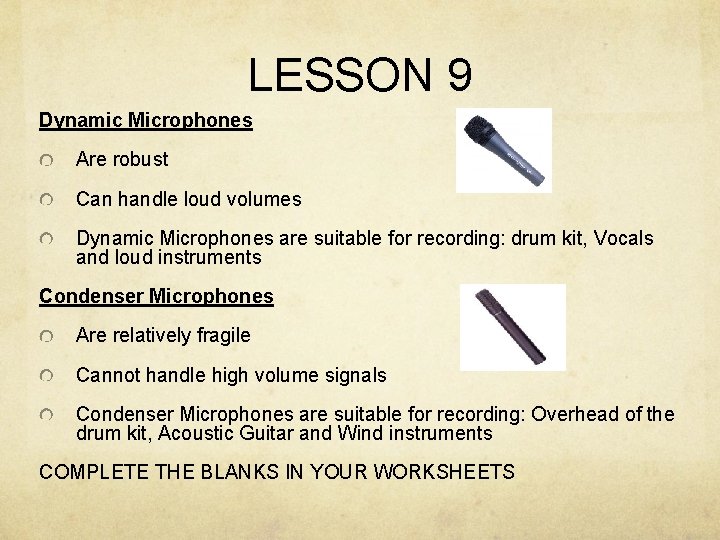
LESSON 9 Dynamic Microphones Are robust Can handle loud volumes Dynamic Microphones are suitable for recording: drum kit, Vocals and loud instruments Condenser Microphones Are relatively fragile Cannot handle high volume signals Condenser Microphones are suitable for recording: Overhead of the drum kit, Acoustic Guitar and Wind instruments COMPLETE THE BLANKS IN YOUR WORKSHEETS
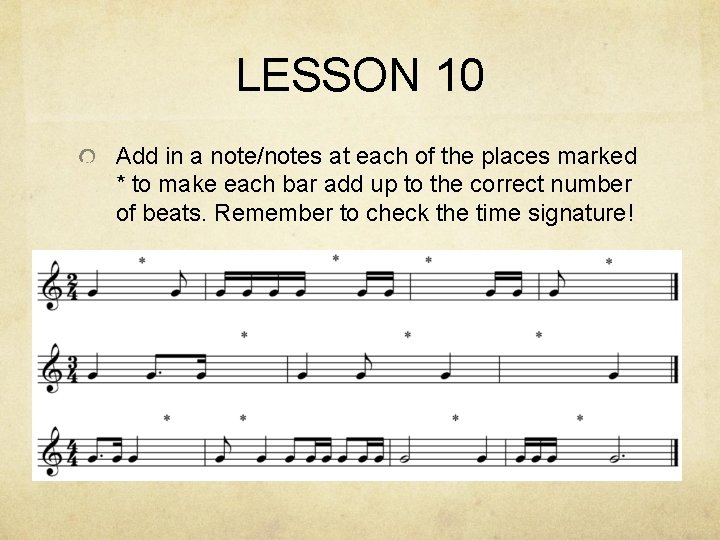
LESSON 10 Add in a note/notes at each of the places marked * to make each bar add up to the correct number of beats. Remember to check the time signature!
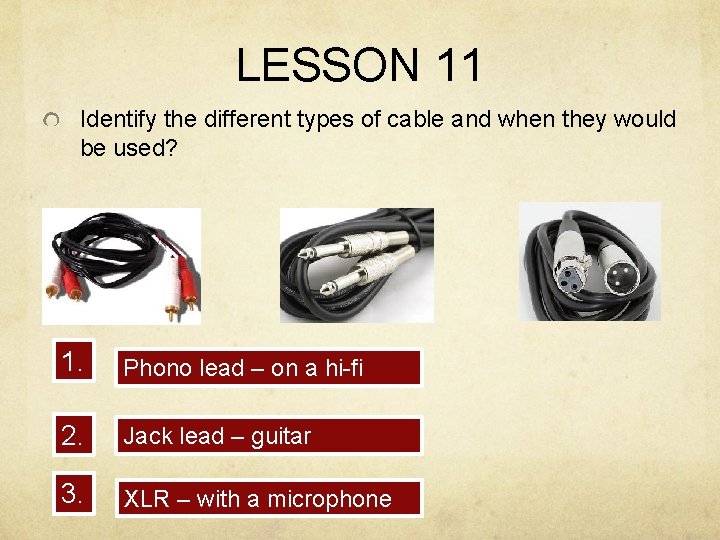
LESSON 11 Identify the different types of cable and when they would be used? 1. Phono lead – on a hi-fi 2. Jack lead – guitar 3. XLR – with a microphone
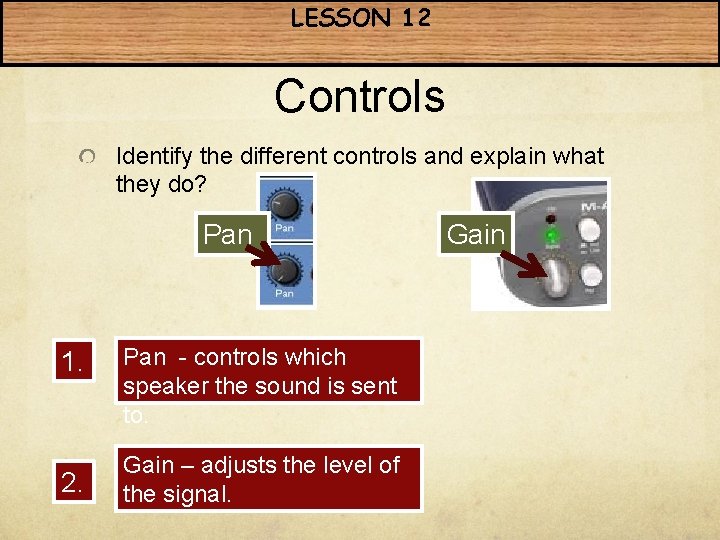
LESSON 12 Controls Identify the different controls and explain what they do? Pan 1. 2. Pan - controls which speaker the sound is sent to. Gain – adjusts the level of the signal. Gain
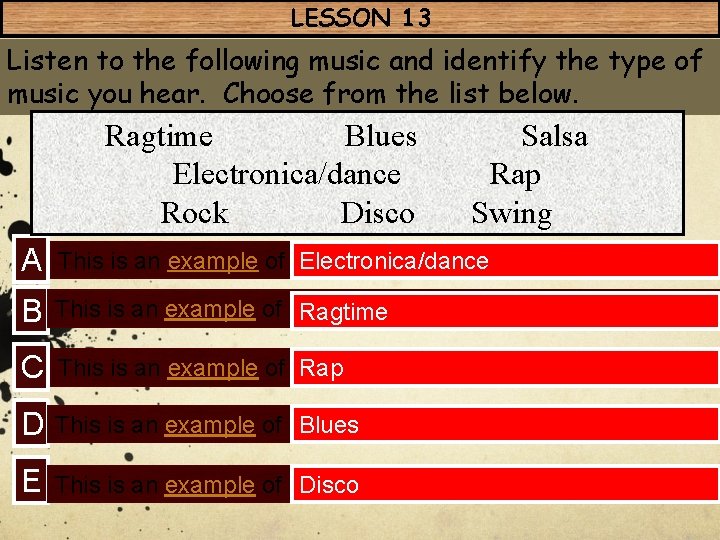
LESSON 13 Listen to the following music and identify the type of music you hear. Choose from the list below. Ragtime Blues Electronica/dance Rock Disco Salsa Rap Swing A This is an example of _____. Electronica/dance B This is an example of _____. Ragtime C This is an example of _____. Rap D This is an example of _____. Blues E This is an example of _____. Disco
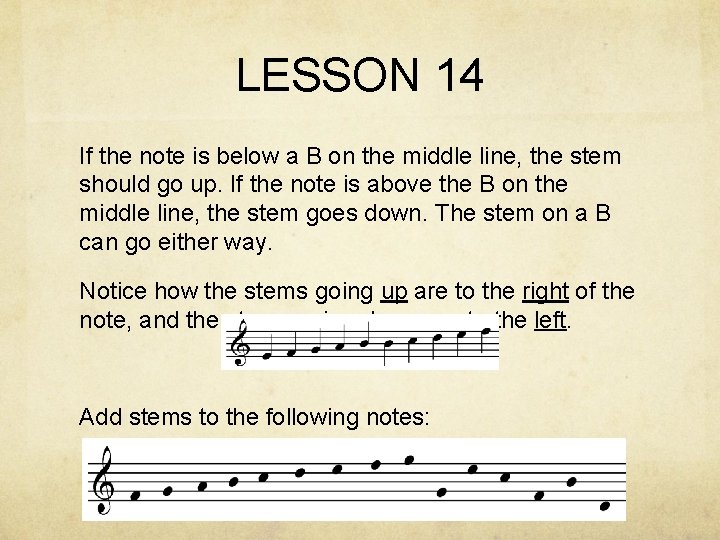
LESSON 14 If the note is below a B on the middle line, the stem should go up. If the note is above the B on the middle line, the stem goes down. The stem on a B can go either way. Notice how the stems going up are to the right of the note, and the stems going down are to the left. Add stems to the following notes:
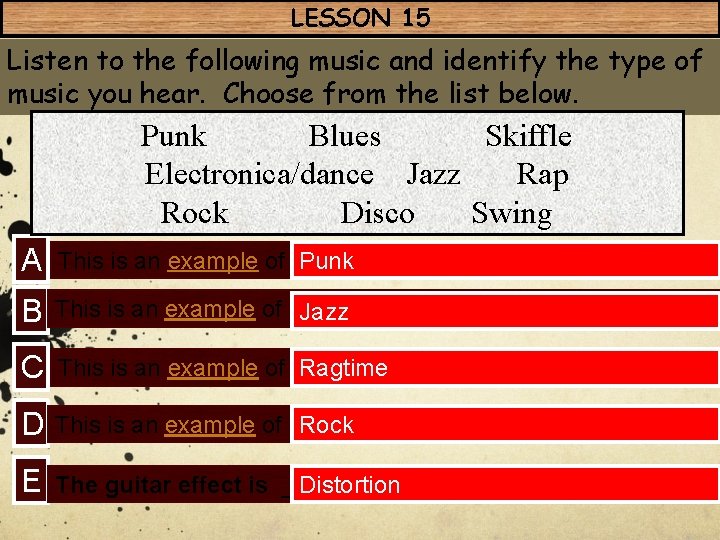
LESSON 15 Listen to the following music and identify the type of music you hear. Choose from the list below. Punk Blues Skiffle Electronica/dance Jazz Rap Rock Disco Swing A This is an example of _____. Punk B This is an example of _____. Jazz C This is an example of _____. Ragtime D This is an example of _____. Rock E The guitar effect is _____. Distortion
LESSON 15 Learning Intention To finish adding sound to my animation Success Criteria I can add loops using mixcraft I know how to record natural sounds on mixcraft I can use the midi keyboard to add sounds I am developing skills on my instrument A & B
LESSON 16