
Film Analysis Vocabulary Film Media and Drama Fall
Film Analysis Vocabulary Film, Media, and Drama Fall 2015
Plot • Aristotle believed that tragic plots should always engage the audience by building dramatic suspense in each scene. Recognition and Reversal • The two interconnected techniques that Aristotle suggested for constructing effective plots were recognition and reversal.
• Recognition (or anagorisis) – is when a tragic hero discovers a life-altering new piece of information. For example when Oedipus realizes that he has murdered his father and married his mother.
• Reversal (or peripeteia) is when the entire direction of the plot suddenly changes and the tragic hero’s life turns from triumph to disgrace. The tragic hero completely loses everything as a result of the climactic reversal.
• Aristotle thought the best tragedies were the tragedies that featured the best executed recognitions and reversals. He believed Sophocles’ version of Oedipus The King was the ideal tragedy.
Catharsis • Aristotle believed that an audience could be healed or cleansed or clarified by watching tragedies. • His theory was that if an audience felt genuine pity for the tragic hero and intense fear while watching the play, they could leave theatre refreshed and cleansed of their pity and fear. The audience could potentially be morally uplifted by watching tragedies.
Pathos • The noun “pathos” derives from an Ancient Greek word. • It can be defined as a quality which evokes pity, sadness, or tenderness. A film that has genuine pathos honestly and purely connects to the viewer’s deepest emotions. • If a critic or audience member used the word “pathos” to describe their reaction to a film, it is usually meant as a high compliment. The word often has a superlative connotation.
Neoclassical Unities • In the 1600 s and 1700 s, many writers in Europe, particularly France, believed that Aristotle was insisting that playwrights follow these three unities: 1) UNITY OF ACTION – each tragedy should have one central plot and no subplots. 2) UNITY OF TIME – Each tragedy should take place over the course of a 24 -hour period 3) UNITY OF LOCATION – Each tragedy should only have one main location.
Issues with Neoclassical unities • Aristotle was definitely advancing the importance of the unity of action. However, he only makes a brief reference to the unity of time and no explicit references to the unity of location. • Not all classic Greek tragedies follow the unities. However, it is important to recognize a unity when it occurs in a play or film.
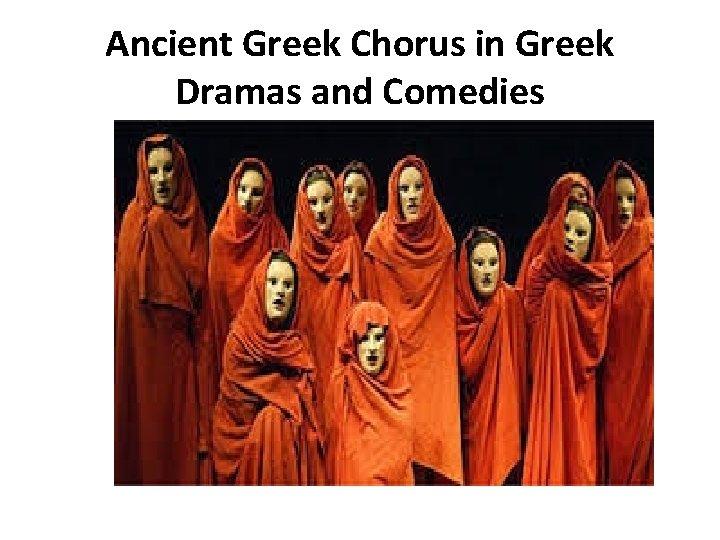
Ancient Greek Chorus in Greek Dramas and Comedies
Ancient Greek Chorus • The Greek chorus would consist of 12 to 50 players. They would usually be a separate part of the play and speak and sing long choral odes. However they would also occasionally interact with characters. • The chorus served a narrative function in Ancient Greek tragedies. • It would provide key information on the dramatic circumstances. • It would also comment and react to the dramas. The chorus can be seen as a stand-in or substitute for the audience.
Use of Greek Chorus in Film • Although the use of a specific chorus of narrators is very rare in modern cinema, characters in films can serve the function of being stand-ins for the audience. • The influence of the Greek Chorus can be seen in sections of films and TV shows that feature therapy sessions (or more general reflective scenarios) that involve a main character processing their behavioral choices. In Ancient Greek Drama, the chorus would be the sounding board for the playwright to comment on the character. • The groundbreaking HBO drama The Sopranos used Tony Soprano’s therapy sessions in a similar way to how Aeschylus used the Greek Chorus, as a device for commenting on the behavior of the tragic hero.
Stasis • Stasis – is a state where all forces balance each other resulting in no movement • The story’s world presented at a play or film’s beginning is in stasis. • Dramatic stasis occurs when things would go on the same forever if something didn’t come along and happen.
Stasis at the end of a film • Stasis comes about at the close of the film when the major forces of the play either get what they want or are forced to stop trying. • It’s useful to identify the stasis as a state of balance in the world of the film. • It’s very important to know and feel when an event breaks the stasis and creates a state of imbalance in the world of the film.
Prologue • The prologue, Greek prologos (before word), is an opening of a story that sets up the setting (or the world of the film) and provides key background details. • Generally speaking, the main function of a prologue tells some earlier story and connects it to the main story. Similarly, it is serves as a means to introduce characters of a story and clarifies the potential significance of their roles. • The film’s POINT OF ATTACK usually ends the prologue section of the film.
Epilogue • An epilogue is the section at the end of film. • An epilogue is often synonymous with the film’s resolution section so we’ll use both terms interchangeably. • Epilogue is the opposite of prologue. An epilogue is part of the main story, occurring after the climax and revealing the fates of the characters and looking towards the future of characters or the world of the film as a whole. Usually, it may be set a few hours later or far in the future where the writer speaks to the readers indirectly through the point of view of a different character. • Sometimes, a writer may employ an epilogue to tie up loose ends of his or her story. The epilogue resolves issues which were brought up by the writer in the story but were not resolved in the climax.
Protagonist and Antagonist • The protagonist is the main character of a movie. The film’s story revolves around the major desires or objectives of the protagonist. • The antagonist is the protagonist’s major rival. He or she is usually in conflict with the major desires of the protagonist.
Point of Attack • The point of attack is something that radically upsets the balance of forces in a protagonist’s life and must be dealt with in order to restore the balance. • The point of attack reveals an object of desire in the protagonist. • The point of attack is also referred to as the inciting incident.
The Unique Factor • The film’s unique factor is usually connected to the point of attack or it is the point of attack. • Simply put, the unique factor is usually an intrusion or new development that occurs early in the film and gives the plot a significant twist. • It alters the world of the film making it different from its usual stasis or balance.
Motif • In film, a motif is any repeated element that has symbolic significance in a story. Through its repetition, a motif can help produce or support other narrative elements such as theme, tone, or mood. • There are many different types of motifs that can be used in a film. • There are motifs in the screenplay, visual motifs, and sound motifs. • Any repeated element or detail can be seen as a motif.
Dramatic Event • A dramatic event is something that breaks the stasis of a scene by unleashing new forces that must be dealt with. • Anticipation is generated when viewers are held in suspense questioning whether these disrupted forces will be brought to equilibrium or not. • The dramatic event is also referred to as a dramatic incident or a plot point.
Plot • A plot or line of action is the arrangement of dramatic events as they progress from beginning (original stasis and the point of attack) to the middle (the world of the film is out of balance) to end (either the original stasis is restored or a new stasis is established). • “Line of action” or “storyline” are terms synonymous with plot.
Objective • Objective – an objective is the main goal that a character has in a scene. • The objective is behind every action performed by a character in each moment of the scene. • Objectives frequently change in response to dramatic events. • A scene is only as strong as the character with the weakest need.
Stakes • Stakes are what a character either stands to lose or gain in a scene. • The way to find out if there any important stakes in the scene is to ask if the character has a lot to lose and no easy way out. • Usually the stakes raise as the plot advances throughout a film.
Conflict • Dramatic conflict is usually tied to some type of obstacle that prevents a character from getting what he or she desires. • Conflict can frequently be identified by characters having opposing objectives in a scene. • Conflict engages an audience because it makes us anticipate and question which character will win and which character will lose.
Three Levels of Conflict • External – A character who is in conflict with external forces larger than himself or herself. • The weather or a force of nature is an external conflict. Nature is an often used source of external conflict, especially in disaster films. • Laws (civic and religious) are good examples of potential external conflicts. Moral beliefs or societal customs are also possible sources of external conflict. • Characters who are in debt to banks or the IRS suffer from external conflict, the thousands of people whose homes were damaged from Hurricane Sandy are victims of external conflict.
Internal and Interpersonal Conflict • Internal Conflict – A character who is battling opposing feelings within himself or herself. • Interpersonal Conflict – A character is conflict with another character or group of characters represented in the film.
Character Arc • Character’s arc refers to the changes in a character or his or her situation throughout the progression of the film’s plot. • The character arc also refers to how the screenwriter shaped and developed his or her main characters in the course of a film.
Four types of Conflict • Foreshadowing – Foreshadowing is a hint or preview of a greater dramatic conflict. • Foreshadowing occurs when the audience’s expectation is raised for a payoff later in the film. • Foreshadowing is often expressed as a tension that is brewing in the texture of a scene.
Rising Conflict • Rising conflict is when the action of a scene rises or escalates smoothly and progressively, action by action, throughout the course of the scene. • Rising conflict can be identified by its clear transitions that increase the scene’s dramatic conflict. • The most effective conflict in films is usually a blend of foreshadowing and rising conflict.
Jumping and Static conflict • Jumping conflict is when the scene’s conflict “jumps” abruptly without any clear transitions. Surprise robberies or violent acts, and natural disasters are usually represented through jumping conflict. • Static conflict is when the conflict of a scene does not progress but just goes around without ever rising or transitioning. Static conflict is like talking to someone who just goes from one tangent to another without ever getting to the main point of why he or she called you in the first place.
Counterpoint • Counterpoint – when a script features two contrasting elements that add layers to the characters. • A wedding or birth occurring shortly after a funeral is an example of counterpoint. • Counterpoint also provides a more complex and textured experience for the viewer. • There is a vast number of possibilities for counterpoint in a film (visual counterpoint, character counterpoint, music/visual counterpoint)
Climax • Climax – the most intense moment of dramatic conflict in the script. • Climax is also when the audience gets the strongest dramatic payoff. • This payoff results from all the built-up tension that has progressed since the film’s beginning. • The action of a climax is usually irreversible.
Resolution • Resolution – the section of the film that immediately follows the climax and continues to the ending of the film. • The resolution section is where all the dramatic fallout or unraveling from the climax occurs. • It is also the section where either the old stasis is restored or a new stasis is established.
Genre • Genre is a particular style or category of works of art; esp. a type of cinematic work characterized by a particular form, style, or purpose • Types of film genres include biographical dramas, romantic comedies, action movies, adventure films, mysteries, horror films, screwball comedies, science fiction films, fantasy films, documentaries, suspense thrillers, musicals, westerns, gangster films, anime, superhero films, courtroom dramas, war films, period dramas.
Trope • Although “trope” has a broad definition as a figurative (non-literal) figure of speech, we will use a narrower definition. • For film study, the word trope refers to common storytelling pattern or device. It can also be used in a belittling manner as a means to pointing out an overused cliché in the film’s plot or structure. • For example, revenge plots are a common trope of the action film genre.
Trope • Usually critics use the word “trope” in the context of negatively criticizing a film. • For example: “This film dredges up the most obvious tropes of the action film genre. ” • For example: “This film relies on shopworn and rancid romantic comedy tropes that are well past their expiration dates. ”
Auteur Theory • Auteur theory originated in France in the mid 1950 s and was advanced in American through the writings of influential film critic Andrew Sarris. • Auteur theory asserts that the director is the primary auteur or “author” of the film. Proponents of this theory would contend that the director is the dominant creative force and visionary in the filmmaking process. • Directors who write or co-write their films and who work with a familiar “repertory” of actors and collaborators can be considered auteur directors.
Auteur Directors • Christopher Nolan, Martin Scorcese, Francis Ford Coppola, Woody Allen, Ingmar Bergman, Jean-Luc Goddard, Francois Truffaut, Federico Fellini can be viewed as auteur directors. • The auteur theory is controversial and has been criticized by critics and artists as a devaluing of the importance of collaboration in the filmmaking process.
- Slides: 39