
Film Analysis CODES and CONVENTIONS to consider when
- Slides: 27
Film Analysis CODES and CONVENTIONS to consider when analysing film
WHAT ARE CODES? • Codes are tools that are used to construct or suggest meaning in media productions • When engaging with media, we ‘read’ its codes to be able to make sense of the messages being communicated • Codes can be technical, written or symbolic • Codes include the use of camera, acting, mise en scene, editing, lighting, sound, special effects, typography, colour, visual composition, text and graphics
WHAT ARE CONVENTIONS? • Conventions are rules or generally accepted ways of constructing meaning in media productions • Conventions tend to be established or expected patterns that have been used many times before • Conventions include ideas such as character and story arcs, cause and effect, point of view, the structuring of time, settings etc.
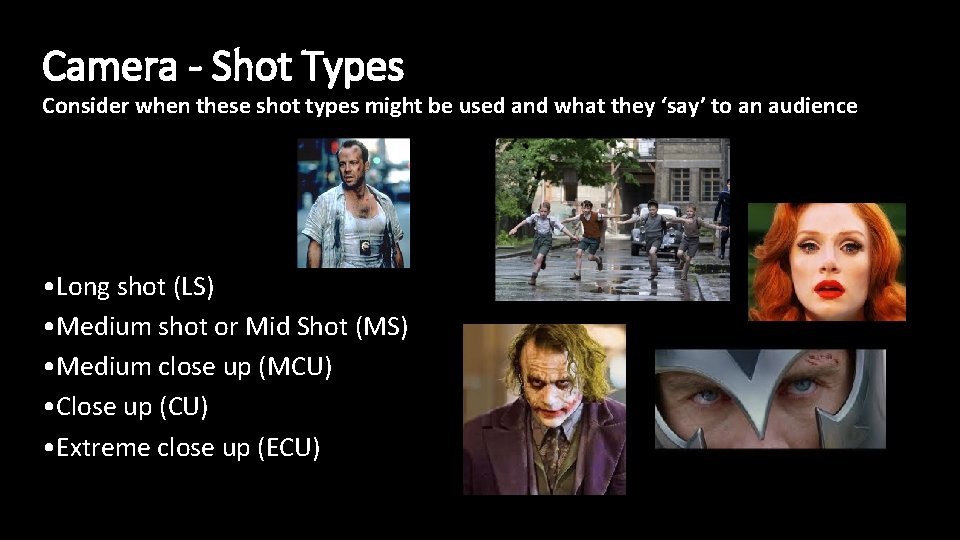
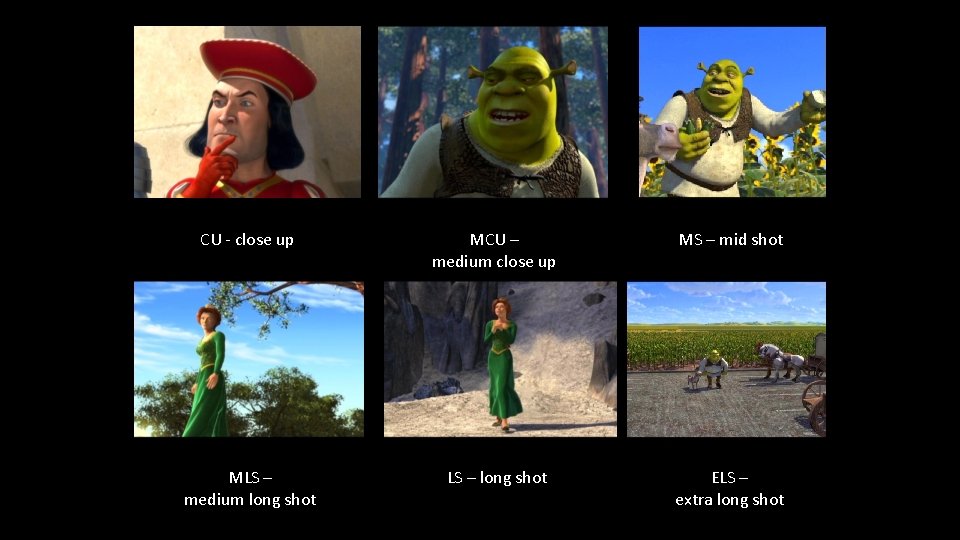
Camera - Shot Types Consider when these shot types might be used and what they ‘say’ to an audience • Long shot (LS) • Medium shot or Mid Shot (MS) • Medium close up (MCU) • Close up (CU) • Extreme close up (ECU)
CU - close up MCU – medium close up MS – mid shot MLS – medium long shot LS – long shot ELS – extra long shot
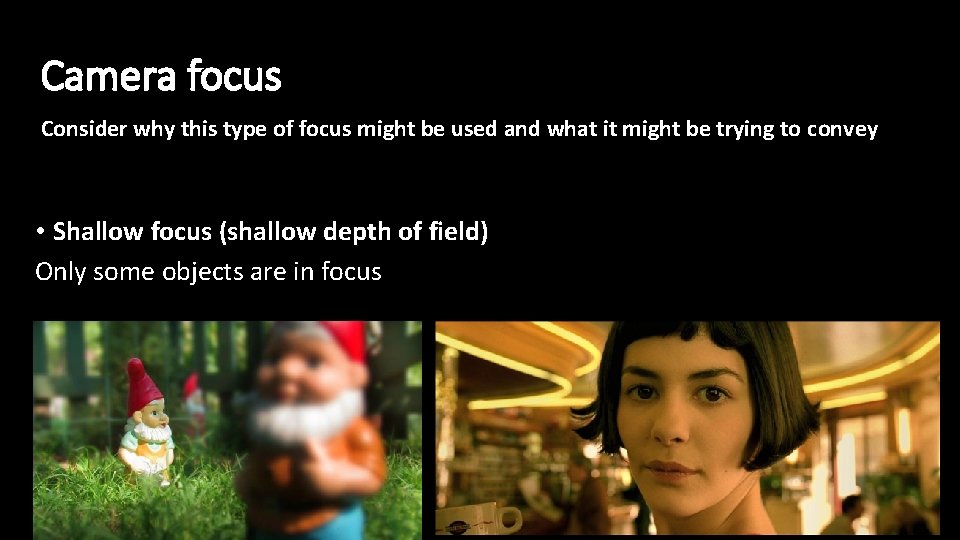
Camera focus Consider why this type of focus might be used and what it might be trying to convey • Shallow focus (shallow depth of field) Only some objects are in focus
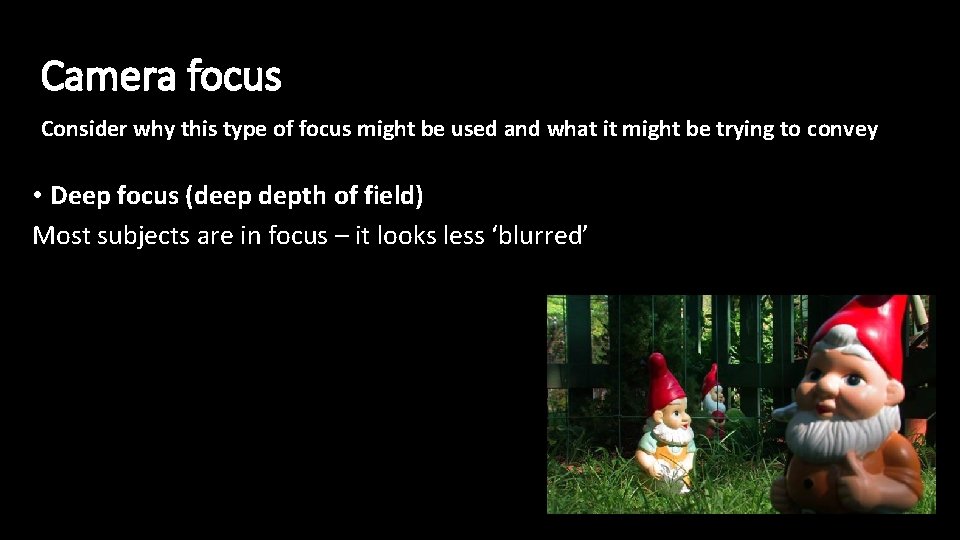
Camera focus Consider why this type of focus might be used and what it might be trying to convey • Deep focus (deep depth of field) Most subjects are in focus – it looks less ‘blurred’
Camera movement Consider what camera movement might tell us • Panning – camera stays still on tripod – moves from L to R or R to L • Tilting – camera stays still on tripod – moves UP & DOWN • Tracking/dollying – camera moves on tracks with the action, eg two people walking down the street and camera goes with them
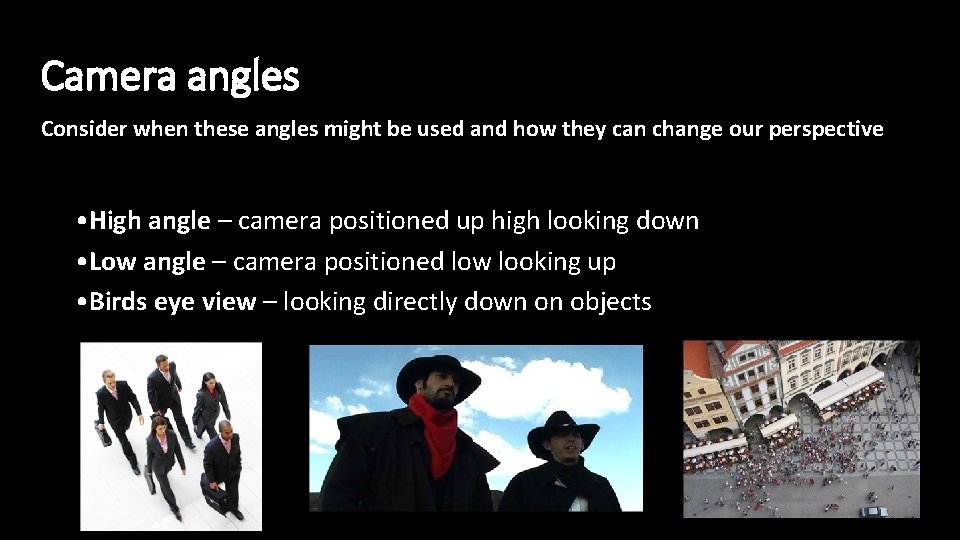
Camera angles Consider when these angles might be used and how they can change our perspective • High angle – camera positioned up high looking down • Low angle – camera positioned low looking up • Birds eye view – looking directly down on objects
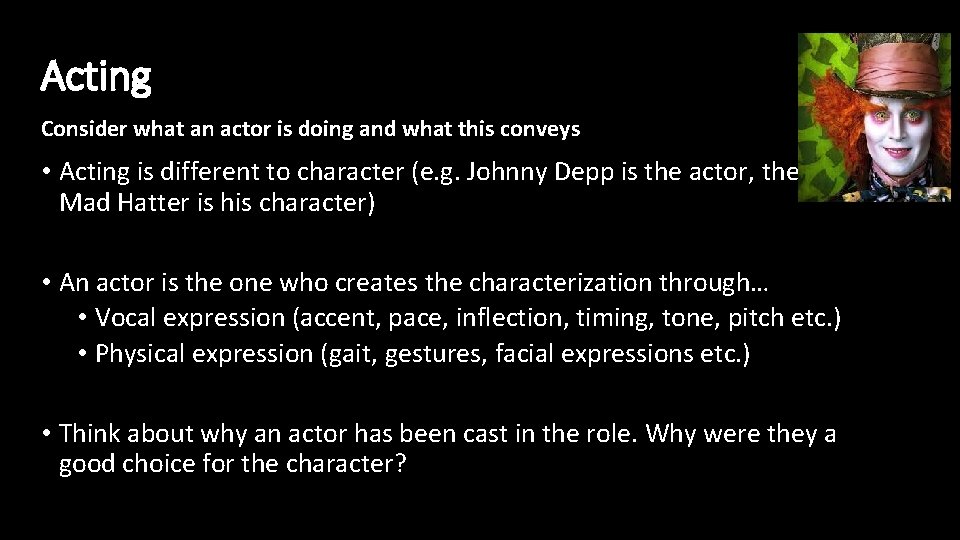
Acting Consider what an actor is doing and what this conveys • Acting is different to character (e. g. Johnny Depp is the actor, the Mad Hatter is his character) • An actor is the one who creates the characterization through… • Vocal expression (accent, pace, inflection, timing, tone, pitch etc. ) • Physical expression (gait, gestures, facial expressions etc. ) • Think about why an actor has been cast in the role. Why were they a good choice for the character?
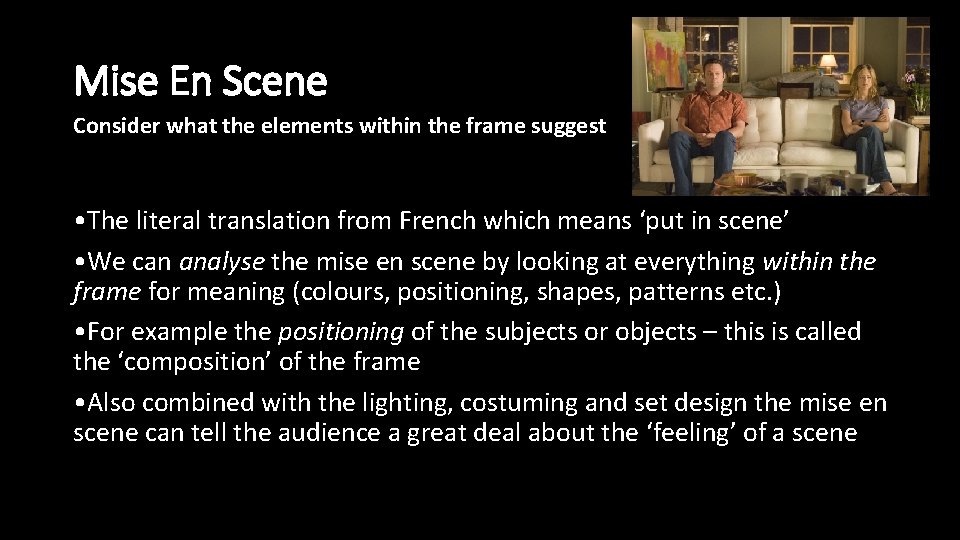
Mise En Scene Consider what the elements within the frame suggest • The literal translation from French which means ‘put in scene’ • We can analyse the mise en scene by looking at everything within the frame for meaning (colours, positioning, shapes, patterns etc. ) • For example the positioning of the subjects or objects – this is called the ‘composition’ of the frame • Also combined with the lighting, costuming and set design the mise en scene can tell the audience a great deal about the ‘feeling’ of a scene
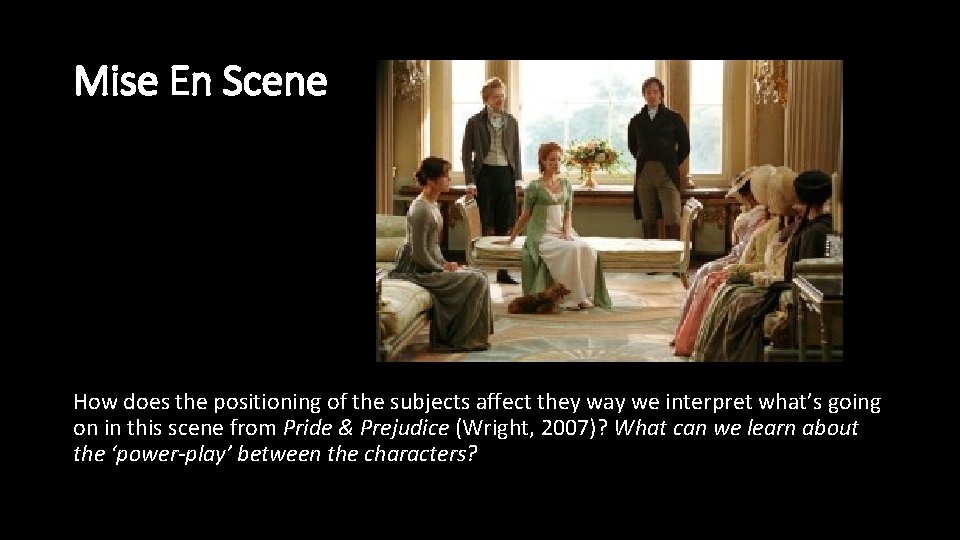
Mise En Scene How does the positioning of the subjects affect they way we interpret what’s going on in this scene from Pride & Prejudice (Wright, 2007)? What can we learn about the ‘power-play’ between the characters?
Editing Consider what the pace, cutting and arranging of vision and sound suggest • Editing is the careful selection and arrangement of vision and sound • It is done in post-production • Editing can create PACE and RHYTHM in a film – the more ‘dramatic’ the scene the ‘faster’ the edits become and the PACE increases (think about ‘action’ films vs. ‘drama’ films • Editing may involve techniques such as montage, parallel editing, cut aways, cut ins etc.
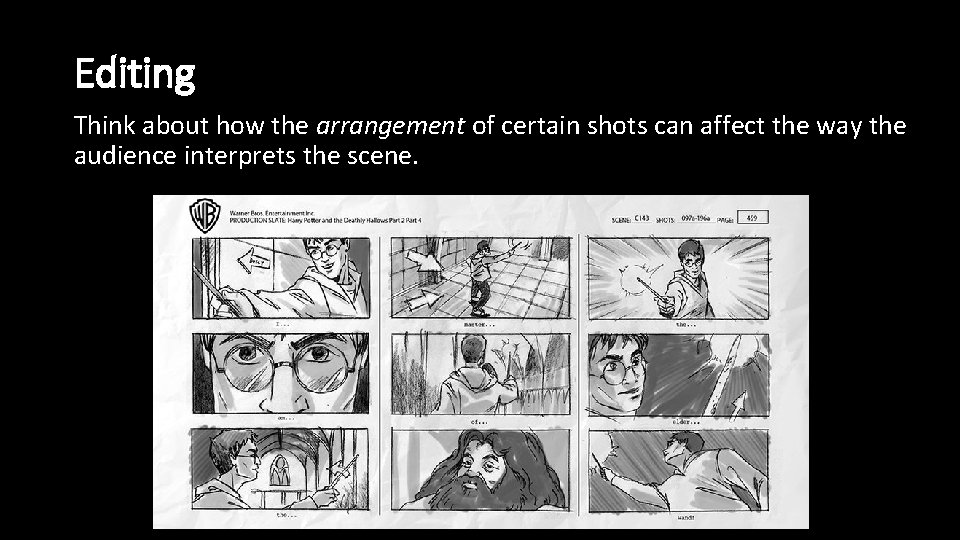
Editing Think about how the arrangement of certain shots can affect the way the audience interprets the scene.
Lighting Consider what the colour, direction, intensity and placement of light conveys • Lighting can be used to focus our attention on an object or character • It can suggest a mood through its intensity and colour • It can be bright (high intensity) or dim (low intensity) • It can be expressionistic or naturalistic
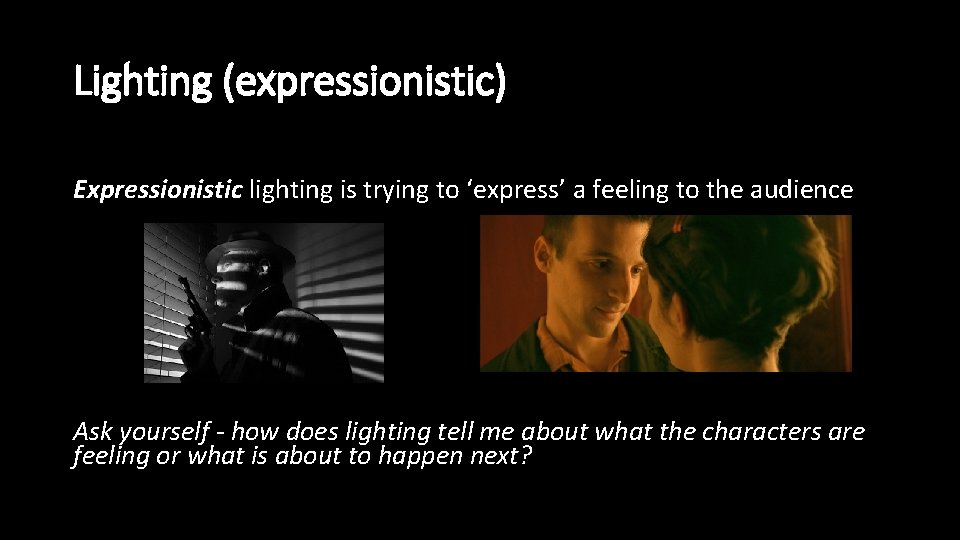
Lighting (expressionistic) Expressionistic lighting is trying to ‘express’ a feeling to the audience It can create romance through use of colours Ask yourself - how does lighting tell me about what the characters are feeling or what is about to happen next?
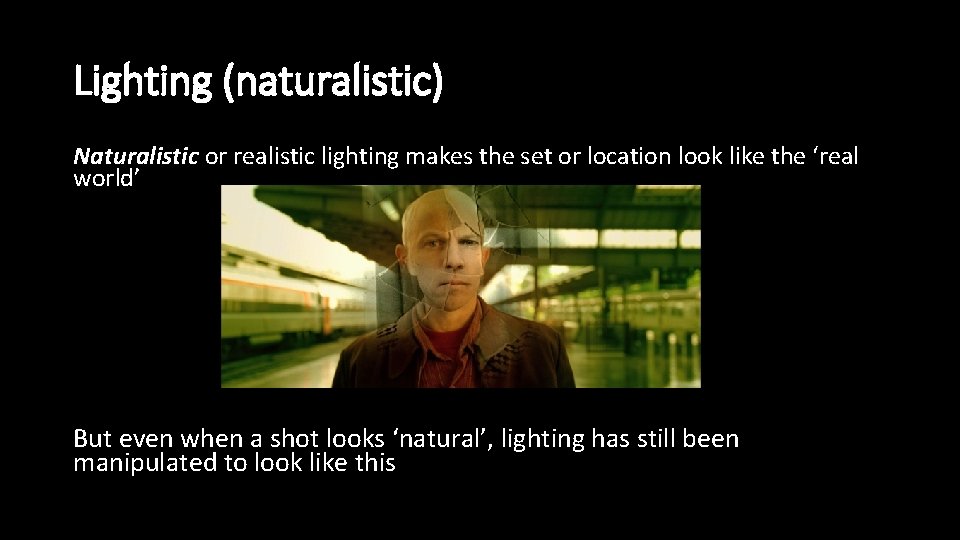
Lighting (naturalistic) Naturalistic or realistic lighting makes the set or location look like the ‘real world’ But even when a shot looks ‘natural’, lighting has still been manipulated to look like this
Sound Consider what the sounds we hear tell us, create for us or make us feel • “ 50% of the movie – but 10% of the budget!” • Often sound is forgotten, we tend to focus on what we see as the ‘most important thing’ • Sounds that exist ‘within’ the film world – as in, a character can hear it are called diegetic sounds • Sounds that exist ‘outside’ the film world – as in, only the audience can hear it are called non-diegetic sounds
Sound • DIALOGUE e. g. between characters • MUSIC e. g musical score • SOUND EFFECTS (SFX) e. g. an explosion or gun shot • THE ABSENCE OF SOUND e. g. ‘no’ sound can draw attention to certain elements on the screen – it can be unsettling for the audience
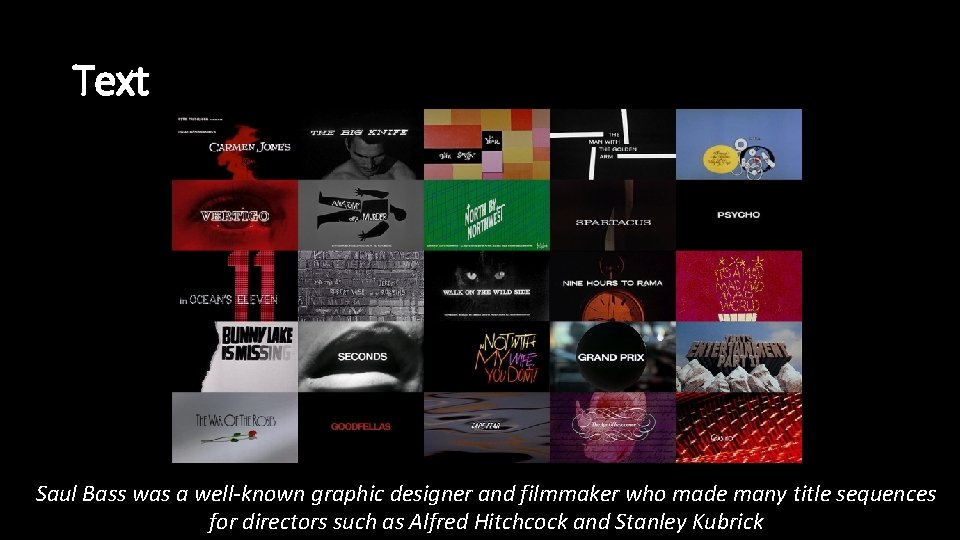
Text Consider how the words we see on screen are written and presented • Text that appears on screen also seeks to convey information • Text may include opening titles or other titles that appear in order to provide important contextual information (e. g. year and place names) • The use of font and colour may also suggest a particular mood or style of film
Text Saul Bass was a well-known graphic designer and filmmaker who made many title sequences for directors such as Alfred Hitchcock and Stanley Kubrick
Opening Sequence Consider what expectations and possibilities arise from the opening • The opening of a film introduces the audience to the ‘world’ of the story. We are introduced to: - characters – who they are and what they want to achieve - setting of the story: - both the physical location (Melbourne? Paris? A shop? ) - time period (1850? WWII? In the future? ‘Now’? ) - what might happen in the rest of the film – these are called narrative possibilities • The opening also helps inform us of the style or genre of the film
Character Consider the role of the character and what we expect to become of them • The main character(s) are usually introduced in the opening sequence, as their ‘goals’ are what drives the narrative forward • Characters may be protagonists (lead character) or antagonists (in opposition to the lead character) – this helps to set up what will happen to them • Character arc refers to how the character may evolve, change and develop as the story progresses
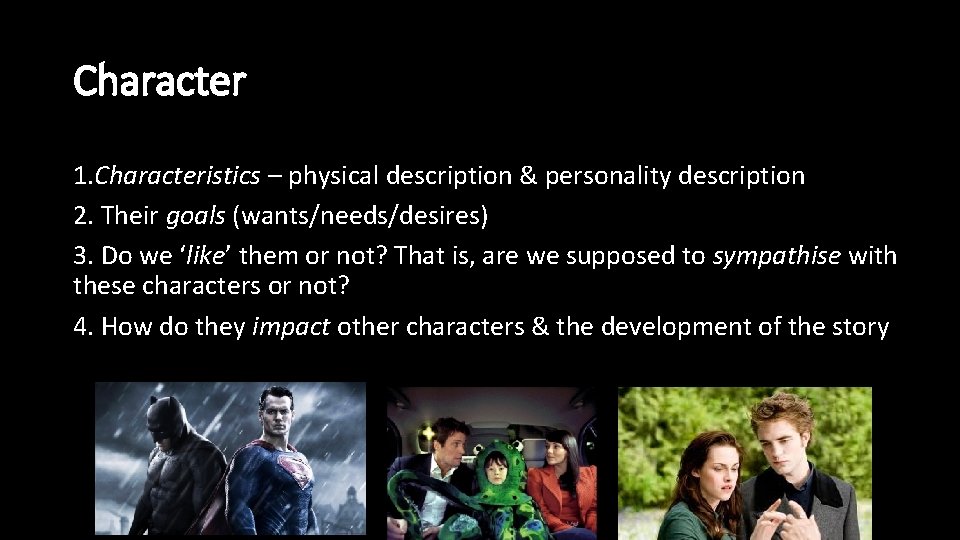
Character 1. Characteristics – physical description & personality description 2. Their goals (wants/needs/desires) 3. Do we ‘like’ them or not? That is, are we supposed to sympathise with these characters or not? 4. How do they impact other characters & the development of the story
Point of View Consider the perspective the story is told from and how ‘typical’ this is for the genre • The perspective from which the story is presented • A film can have many different points of view, not just ‘the main character’ • How do we know it is a certain character’s point of view? - usually, we are encouraged to ‘see’ and ‘feel’ what they feel - they appear in most scenes and we empathise most with them - sometimes a voiceover or camera shot (production elements) allows the audience to ‘get inside their head’
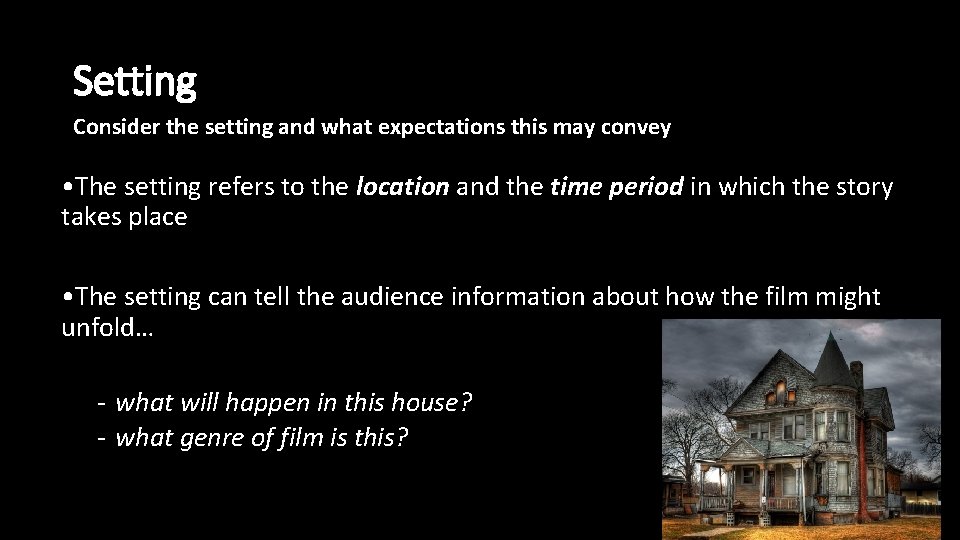
Setting Consider the setting and what expectations this may convey • The setting refers to the location and the time period in which the story takes place • The setting can tell the audience information about how the film might unfold… - what will happen in this house? - what genre of film is this?
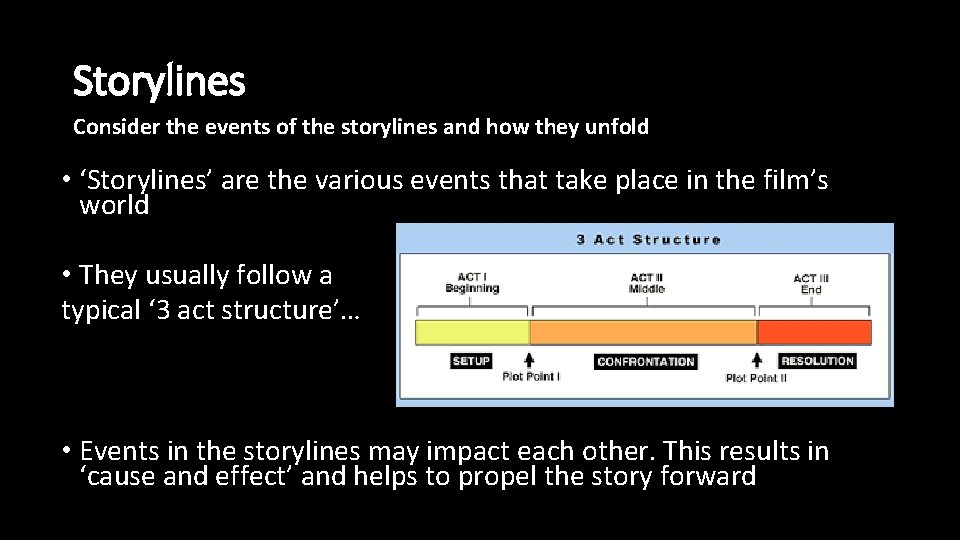
Storylines Consider the events of the storylines and how they unfold • ‘Storylines’ are the various events that take place in the film’s world • They usually follow a typical ‘ 3 act structure’… • Events in the storylines may impact each other. This results in ‘cause and effect’ and helps to propel the story forward