
Filling patterns recirculation schemes and RF stability of
Filling patterns, recirculation schemes and RF stability of ERLs R. Apsimon, S. Setiniyaz, P. Williams

Overview • How do filling patterns and recirculation schemes affect the RF system for an ERL? • How many filling pattern/recirculation scheme combinations are allowed? Why aren’t they allowed? • Beam break-up instability • Summary
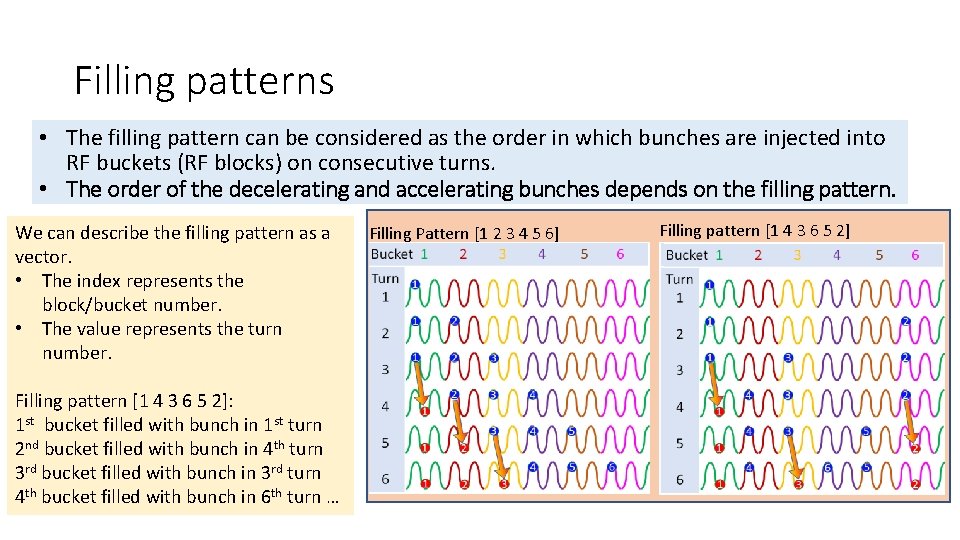
Filling patterns • The filling pattern can be considered as the order in which bunches are injected into RF buckets (RF blocks) on consecutive turns. • The order of the decelerating and accelerating bunches depends on the filling pattern. We can describe the filling pattern as a vector. • The index represents the block/bucket number. • The value represents the turn number. Filling pattern [1 4 3 6 5 2]: 1 st bucket filled with bunch in 1 st turn 2 nd bucket filled with bunch in 4 th turn 3 rd bucket filled with bunch in 3 rd turn 4 th bucket filled with bunch in 6 th turn … Filling Pattern [1 2 3 4 5 6] Filling pattern [1 4 3 6 5 2] Bucket
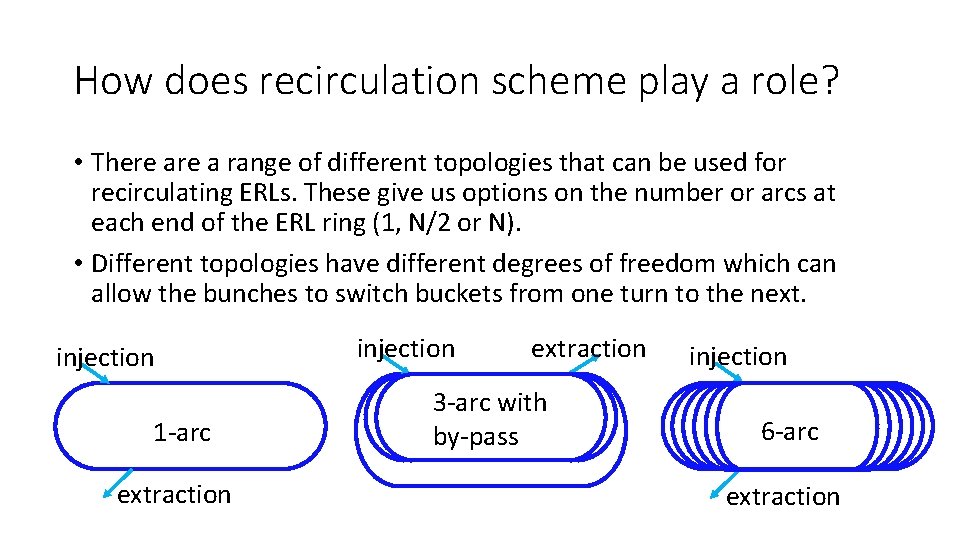
How does recirculation scheme play a role? • There a range of different topologies that can be used for recirculating ERLs. These give us options on the number or arcs at each end of the ERL ring (1, N/2 or N). • Different topologies have different degrees of freedom which can allow the bunches to switch buckets from one turn to the next. injection 1 -arc extraction injection extraction 3 -arc with by-pass injection 6 -arc extraction
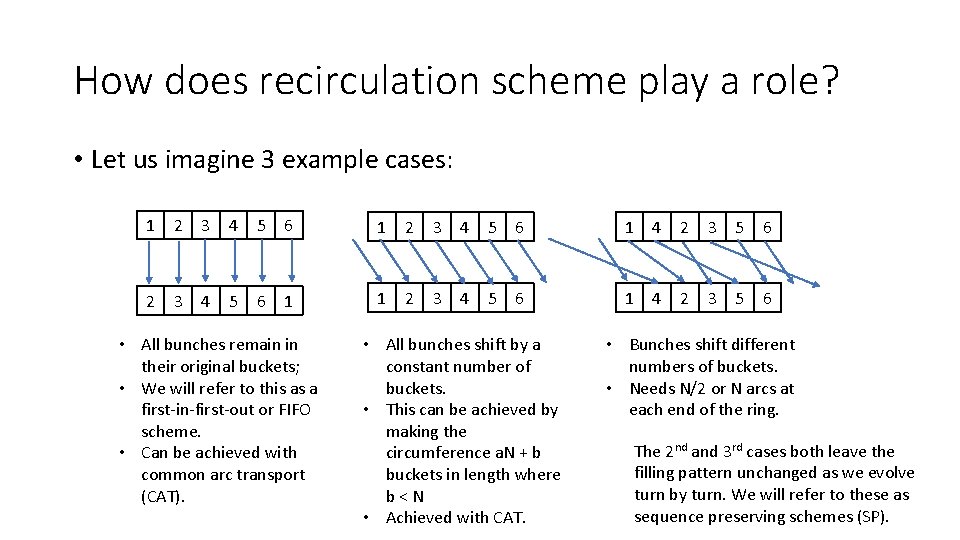
How does recirculation scheme play a role? • Let us imagine 3 example cases: 1 2 3 4 5 6 1 4 2 3 5 6 2 3 4 5 6 1 1 2 3 4 5 6 1 4 2 3 5 6 • All bunches remain in their original buckets; • We will refer to this as a first-in-first-out or FIFO scheme. • Can be achieved with common arc transport (CAT). • All bunches shift by a constant number of buckets. • This can be achieved by making the circumference a. N + b buckets in length where b<N • Achieved with CAT. • Bunches shift different numbers of buckets. • Needs N/2 or N arcs at each end of the ring. The 2 nd and 3 rd cases both leave the filling pattern unchanged as we evolve turn by turn. We will refer to these as sequence preserving schemes (SP).
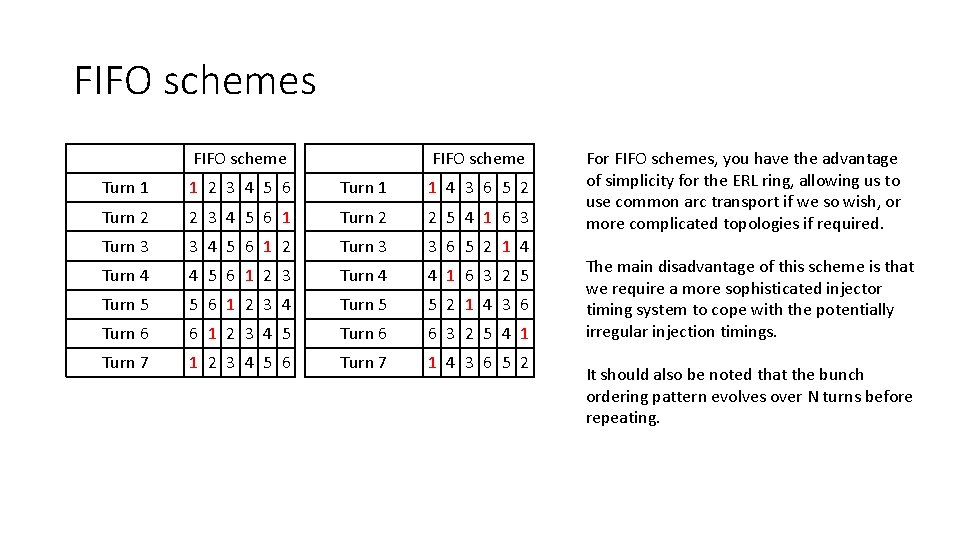
FIFO schemes FIFO scheme Turn 1 1 2 3 4 5 6 Turn 1 1 4 3 6 5 2 Turn 2 2 3 4 5 6 1 Turn 2 2 5 4 1 6 3 Turn 3 3 4 5 6 1 2 Turn 3 3 6 5 2 1 4 Turn 4 4 5 6 1 2 3 Turn 4 4 1 6 3 2 5 Turn 5 5 6 1 2 3 4 Turn 5 5 2 1 4 3 6 Turn 6 6 1 2 3 4 5 Turn 6 6 3 2 5 4 1 Turn 7 1 2 3 4 5 6 Turn 7 1 4 3 6 5 2 For FIFO schemes, you have the advantage of simplicity for the ERL ring, allowing us to use common arc transport if we so wish, or more complicated topologies if required. The main disadvantage of this scheme is that we require a more sophisticated injector timing system to cope with the potentially irregular injection timings. It should also be noted that the bunch ordering pattern evolves over N turns before repeating.
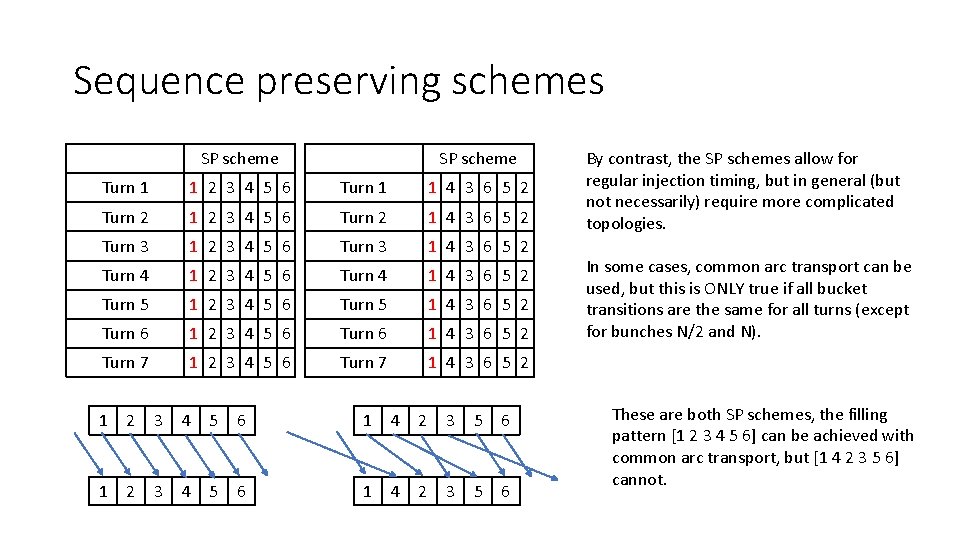
Sequence preserving schemes SP scheme Turn 1 1 2 3 4 5 6 Turn 1 1 4 3 6 5 2 Turn 2 1 2 3 4 5 6 Turn 2 1 4 3 6 5 2 Turn 3 1 2 3 4 5 6 Turn 3 1 4 3 6 5 2 Turn 4 1 2 3 4 5 6 Turn 4 1 4 3 6 5 2 Turn 5 1 2 3 4 5 6 Turn 5 1 4 3 6 5 2 Turn 6 1 2 3 4 5 6 Turn 6 1 4 3 6 5 2 Turn 7 1 2 3 4 5 6 Turn 7 1 4 3 6 5 2 1 2 3 4 5 6 1 4 2 3 5 6 By contrast, the SP schemes allow for regular injection timing, but in general (but not necessarily) require more complicated topologies. In some cases, common arc transport can be used, but this is ONLY true if all bucket transitions are the same for all turns (except for bunches N/2 and N). These are both SP schemes, the filling pattern [1 2 3 4 5 6] can be achieved with common arc transport, but [1 4 2 3 5 6] cannot.
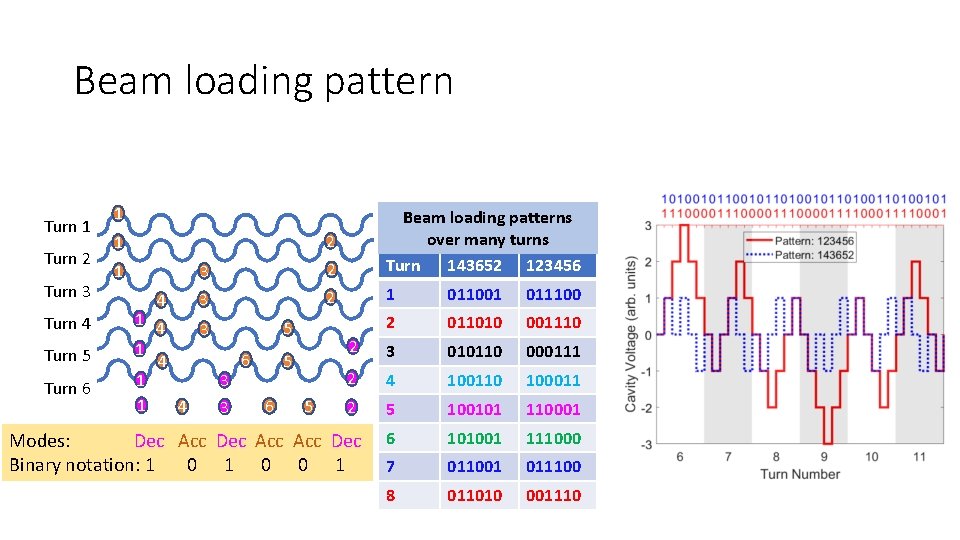
Beam loading pattern 1 3 2 Beam loading patterns over many turns Turn 143652 123456 4 3 2 1 011001 011100 4 3 2 011010 001110 2 3 010110 000111 2 4 100110 100011 2 5 100101 110001 Modes: Dec Acc Acc Dec Binary notation: 1 0 0 1 6 101001 111000 7 011001 011100 8 011010 001110 Turn 1 Turn 2 Turn 3 2 1 1 Turn 4 1 Turn 5 1 Turn 6 1 1 4 4 5 3 3 6 5
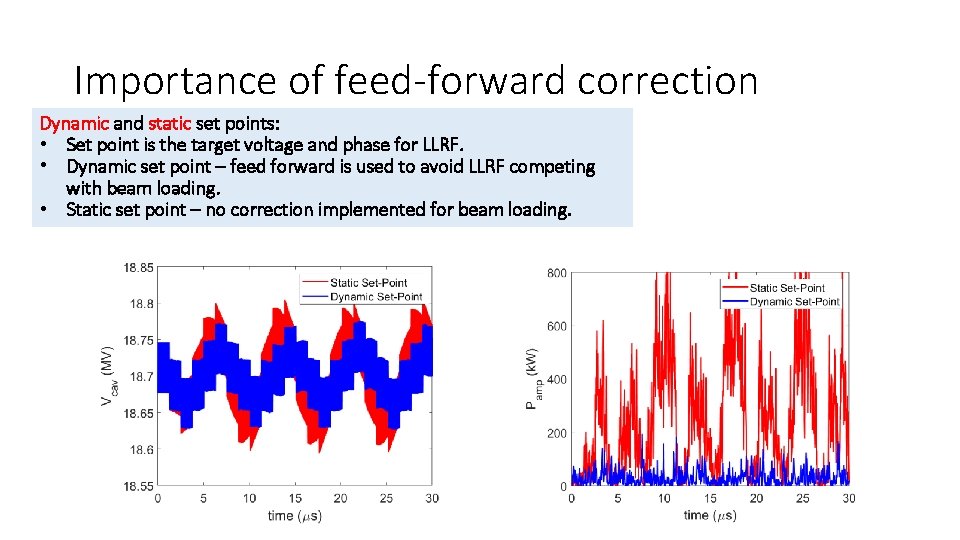
Importance of feed-forward correction Dynamic and static set points: • Set point is the target voltage and phase for LLRF. • Dynamic set point – feed forward is used to avoid LLRF competing with beam loading. • Static set point – no correction implemented for beam loading.
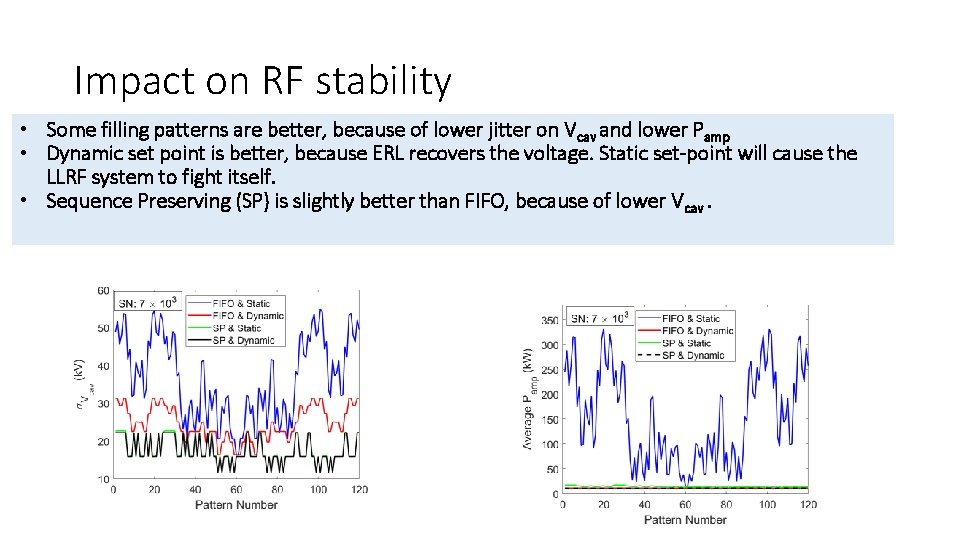
Impact on RF stability • Some filling patterns are better, because of lower jitter on Vcav and lower Pamp • Dynamic set point is better, because ERL recovers the voltage. Static set-point will cause the LLRF system to fight itself. • Sequence Preserving (SP) is slightly better than FIFO, because of lower V cav.
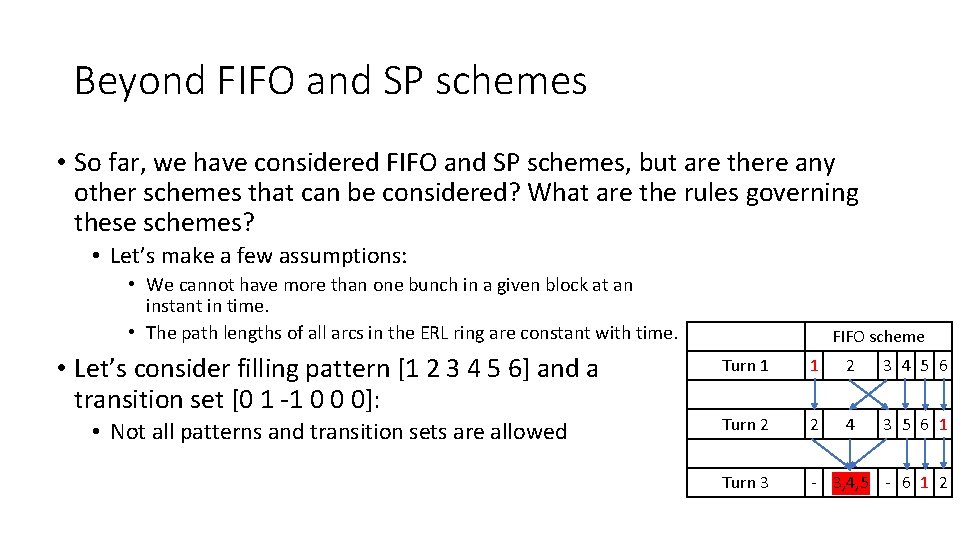
Beyond FIFO and SP schemes • So far, we have considered FIFO and SP schemes, but are there any other schemes that can be considered? What are the rules governing these schemes? • Let’s make a few assumptions: • We cannot have more than one bunch in a given block at an instant in time. • The path lengths of all arcs in the ERL ring are constant with time. • Let’s consider filling pattern [1 2 3 4 5 6] and a transition set [0 1 -1 0 0 0]: • Not all patterns and transition sets are allowed FIFO scheme Turn 1 1 2 3 4 5 6 Turn 2 2 4 3 5 6 1 Turn 3 - 3, 4, 5 - 6 1 2
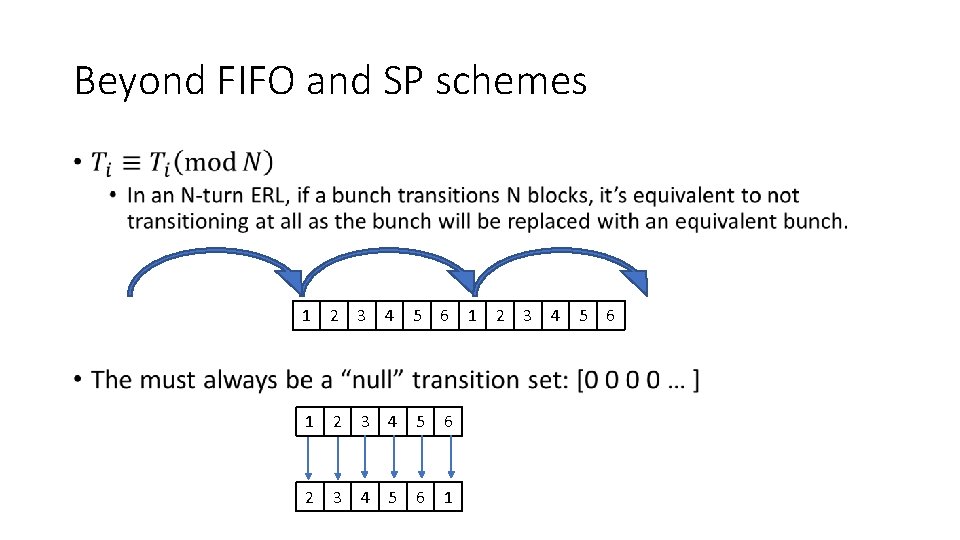
Beyond FIFO and SP schemes • 1 2 3 4 5 6 1 1 2 3 4 5 6
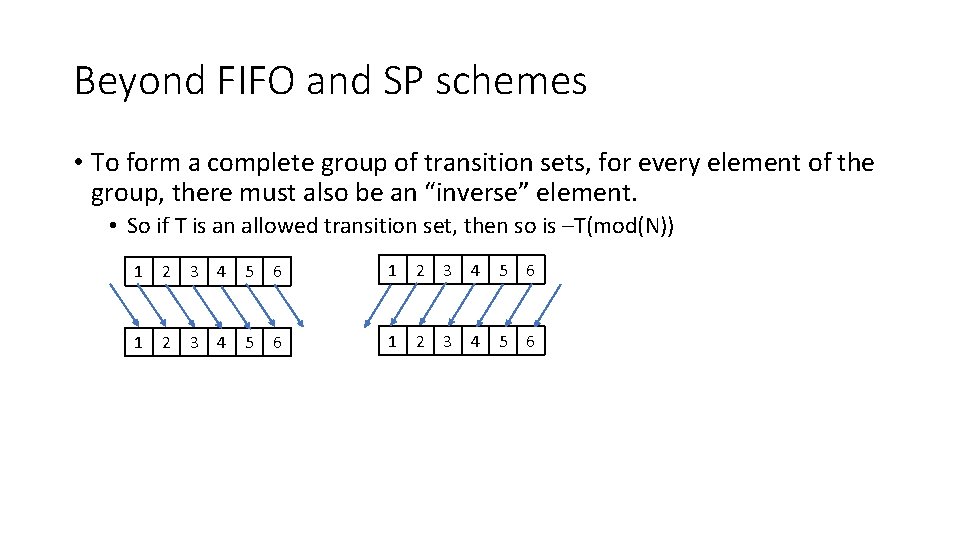
Beyond FIFO and SP schemes • To form a complete group of transition sets, for every element of the group, there must also be an “inverse” element. • So if T is an allowed transition set, then so is –T(mod(N)) 1 2 3 4 5 6
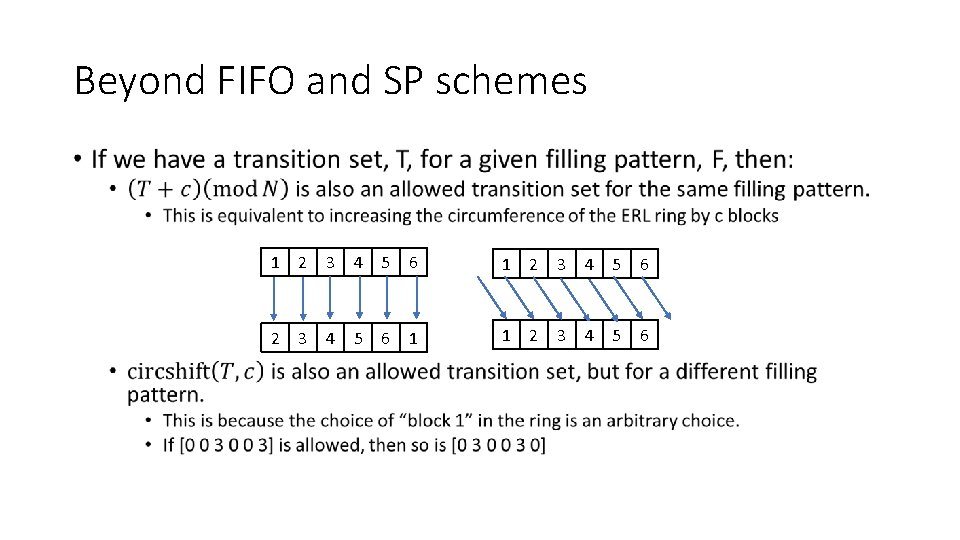
Beyond FIFO and SP schemes • 1 2 3 4 5 6 1 1 2 3 4 5 6
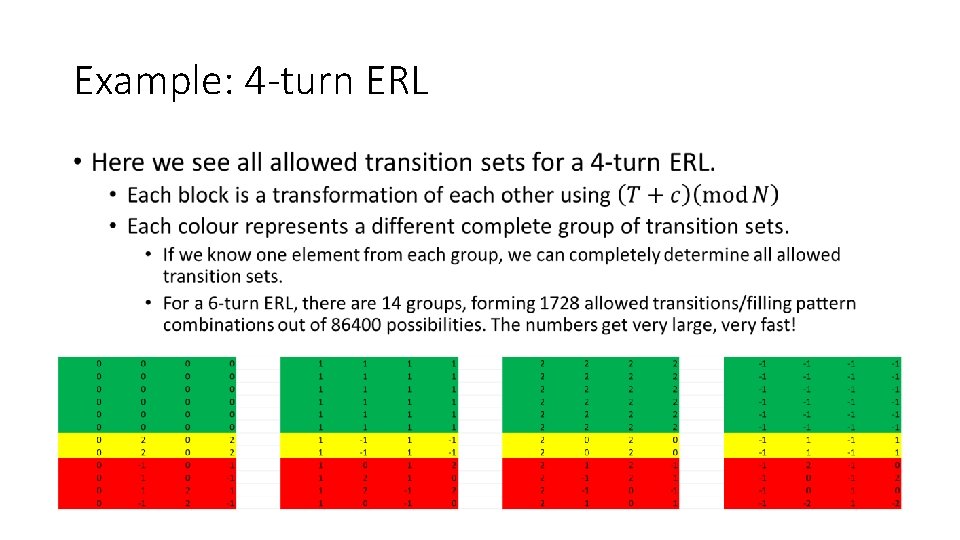
Example: 4 -turn ERL •
![Beam break-up instability • [1] Christopher D. Tennant, “STUDIES OF ENERGY RECOVERY LINACS AT](http://slidetodoc.com/presentation_image_h2/b2c345a7a1a8a6cd4833b9af05bdf93b/image-16.jpg "Beam break-up instability • [1] Christopher D. Tennant, “STUDIES OF ENERGY RECOVERY LINACS AT")
Beam break-up instability • [1] Christopher D. Tennant, “STUDIES OF ENERGY RECOVERY LINACS AT JEFFERSON LABORATORY”,
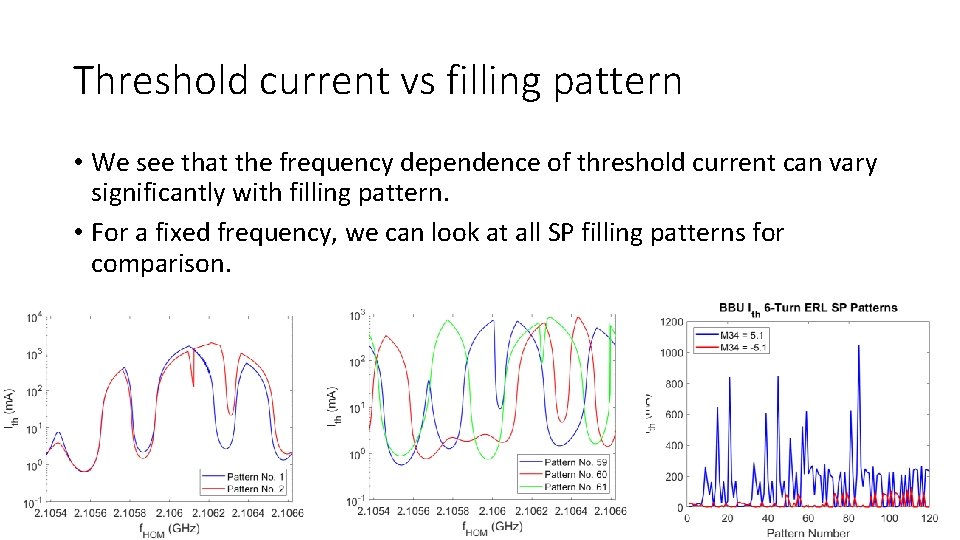
Threshold current vs filling pattern • We see that the frequency dependence of threshold current can vary significantly with filling pattern. • For a fixed frequency, we can look at all SP filling patterns for comparison.
Summary • Studies have shown how the choice of filling pattern and recirculation scheme can significantly affect RF stability for an ERL. • When considering other issues, such as BBU, as well as RF stability, it is less clear how to determine the optimum solution. • Need to determine what filling pattern and recirculation schemes are allowed in general. • This does depend on the “rules of the game” • The effect of filling pattern and recirculation scheme is less clear for BBU than for RF stability. • Plenty more to do on this topic, but its importance for future ERLs cannot be overstated

Thanks you! Any questions?
- Slides: 19