
Fill in the Blanks Symbolism Archetypes Motifs Innocents

Fill in the Blanks
Symbolism, Archetypes, Motifs
________ • Innocents destroyed by evil, the “mockingbird” comes to represent the idea of innocence • Symbolic Mockingbirds: Jem, Tom Robinson, Dill, Boo Radley, Mr. Raymond • innocents who have been injured or destroyed through contact with evil • Robinson is shot • Mr. Underwood compares his death to “the senseless slaughter of songbirds, ” • Scout thinks that hurting Boo Radley would be like “shootin’ a mockingbird. ” • Miss Maudie explains to Scout: “Mockingbirds don’t do one thing but. . . sing their hearts out for us. That’s why it’s a sin to kill a mockingbird. ” • Jem and Scout’s last name is Finch indicates that they are particularly vulnerable in the racist world of Maycomb
_________ • The children’s changing attitude toward Boo Radley is an important measurement of their development from innocence toward a grown‐up moral perspective.
__________ • The mad dog episode is usually taken, together with references to disease in the novel, to represent the racialism which is rampant in the South, and spreads like a contagion. • Atticus, by shooting Tim Johnson, sets himself up as the "hero" who will attempt to bring down racism. Note the parallel drawn with this episode by Scout when the jury gives its verdict (217).
_______ When Judge Taylor gives his verdict on Tom Robinson, and Scout goes into a kind of dream world, where she sees something “like watching Atticus walk into the street, raise a rifle to his shoulder and pull the trigger, but watching all the time knowing that the gun was empty”. Tim Johnson foreshadows ‐ is a prediction of ‐ something more abstract that had to be killed (though Atticus was unable to kill it) ‐ that is, the sick, mad, deep‐rooted prejudices of the American South. A parallel between the rapid decision of Heck Tate that the dog must die ‐ without even consulting with the owner ‐ and the rapid, thoughtless snap judgments which are typical of a prejudiced mind. The dog’s “snail’s pace” could be a reference to the slow pace of change in Alabama, and the “invisible force” which moves it the invisible but pervasive “secret court of men’s hearts” which silently dictates the law in Maycomb.
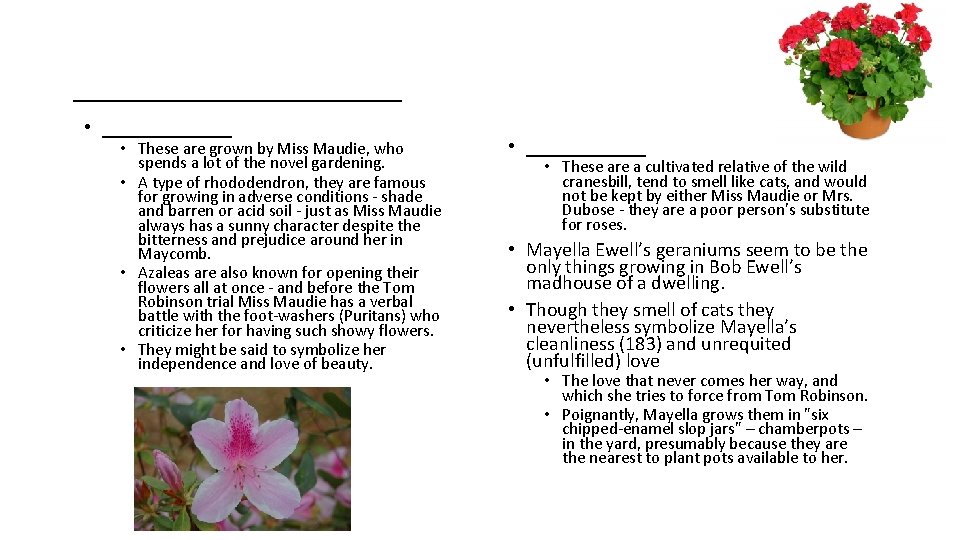
________ • _______ • These are grown by Miss Maudie, who spends a lot of the novel gardening. • A type of rhododendron, they are famous for growing in adverse conditions ‐ shade and barren or acid soil ‐ just as Miss Maudie always has a sunny character despite the bitterness and prejudice around her in Maycomb. • Azaleas are also known for opening their flowers all at once ‐ and before the Tom Robinson trial Miss Maudie has a verbal battle with the foot‐washers (Puritans) who criticize her for having such showy flowers. • They might be said to symbolize her independence and love of beauty. • ______ • These are a cultivated relative of the wild cranesbill, tend to smell like cats, and would not be kept by either Miss Maudie or Mrs. Dubose ‐ they are a poor person’s substitute for roses. • Mayella Ewell’s geraniums seem to be the only things growing in Bob Ewell’s madhouse of a dwelling. • Though they smell of cats they nevertheless symbolize Mayella’s cleanliness (183) and unrequited (unfulfilled) love • The love that never comes her way, and which she tries to force from Tom Robinson. • Poignantly, Mayella grows them in "six chipped‐enamel slop jars" – chamberpots – in the yard, presumably because they are the nearest to plant pots available to her.
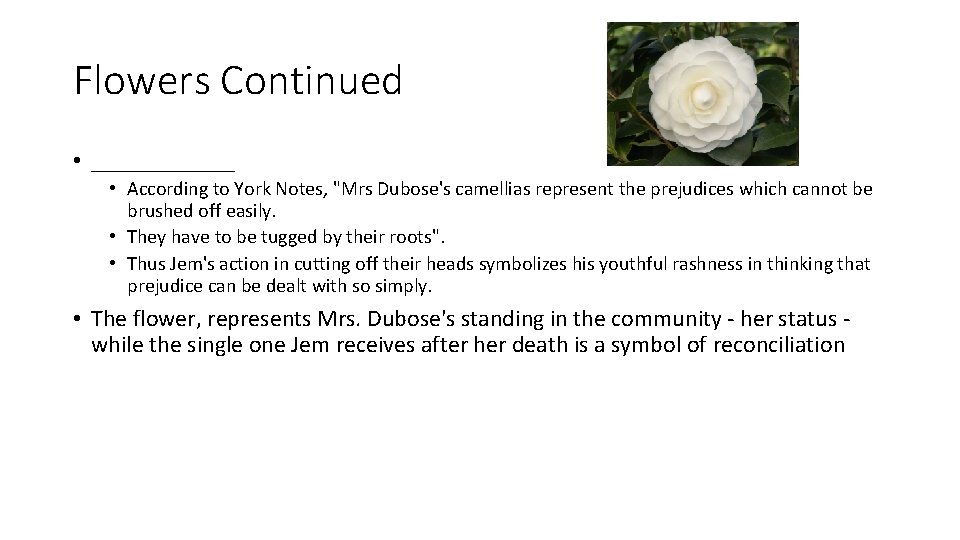
Flowers Continued • ______ • According to York Notes, "Mrs Dubose's camellias represent the prejudices which cannot be brushed off easily. • They have to be tugged by their roots". • Thus Jem's action in cutting off their heads symbolizes his youthful rashness in thinking that prejudice can be dealt with so simply. • The flower, represents Mrs. Dubose's standing in the community ‐ her status ‐ while the single one Jem receives after her death is a symbol of reconciliation
The Morphodite • Morphodite is a slang version of the word hermaphrodite (an organism that has both male and female organs). It is a comic pronunciation and is often considered offensive. The following is a definition from dictionary. reference. com of hermaphrodite: An individual in which reproductive organs of both sexes are present. • Miss Maudie describes Jem and Scout's snowman as a morphodite because it resembles both a man (Mr. Avery) and a woman (Miss Maudie). It is used again later in the book when Scout repeats the phrase she heard, and screams at Jem, "You damn morphodite, I'll kill you!". • Possible symbolism that everyone is the same on the inside so it should not matter if a person is black or white.
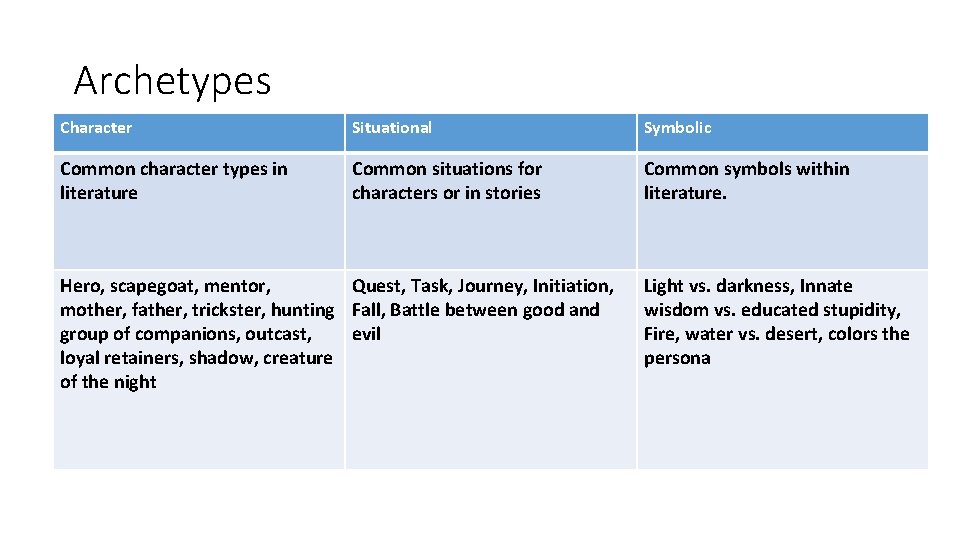
Archetypes Character Situational Symbolic Common character types in literature Common situations for characters or in stories Common symbols within literature. Hero, scapegoat, mentor, Quest, Task, Journey, Initiation, mother, father, trickster, hunting Fall, Battle between good and group of companions, outcast, evil loyal retainers, shadow, creature of the night Light vs. darkness, Innate wisdom vs. educated stupidity, Fire, water vs. desert, colors the persona
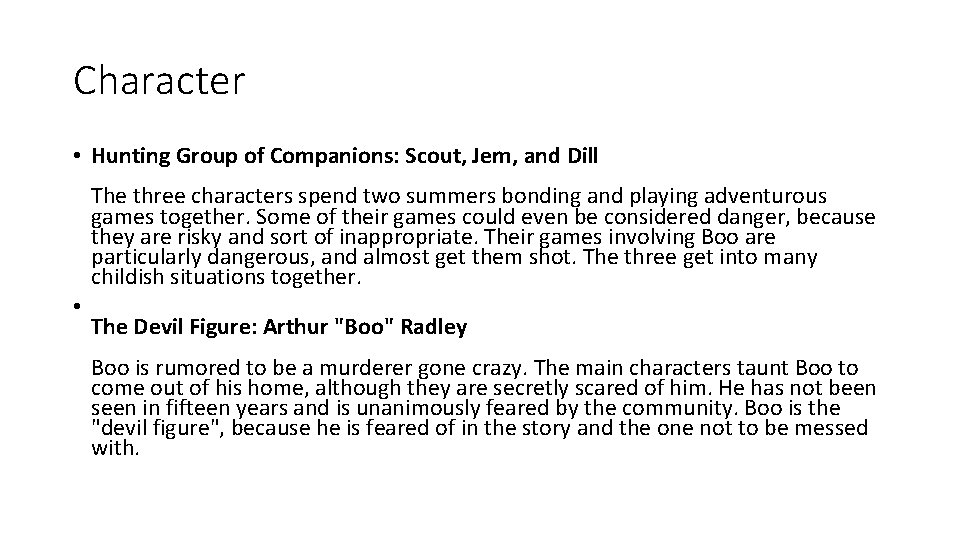
Character • Hunting Group of Companions: Scout, Jem, and Dill The three characters spend two summers bonding and playing adventurous games together. Some of their games could even be considered danger, because they are risky and sort of inappropriate. Their games involving Boo are particularly dangerous, and almost get them shot. The three get into many childish situations together. • The Devil Figure: Arthur "Boo" Radley Boo is rumored to be a murderer gone crazy. The main characters taunt Boo to come out of his home, although they are secretly scared of him. He has not been seen in fifteen years and is unanimously feared by the community. Boo is the "devil figure", because he is feared of in the story and the one not to be messed with.
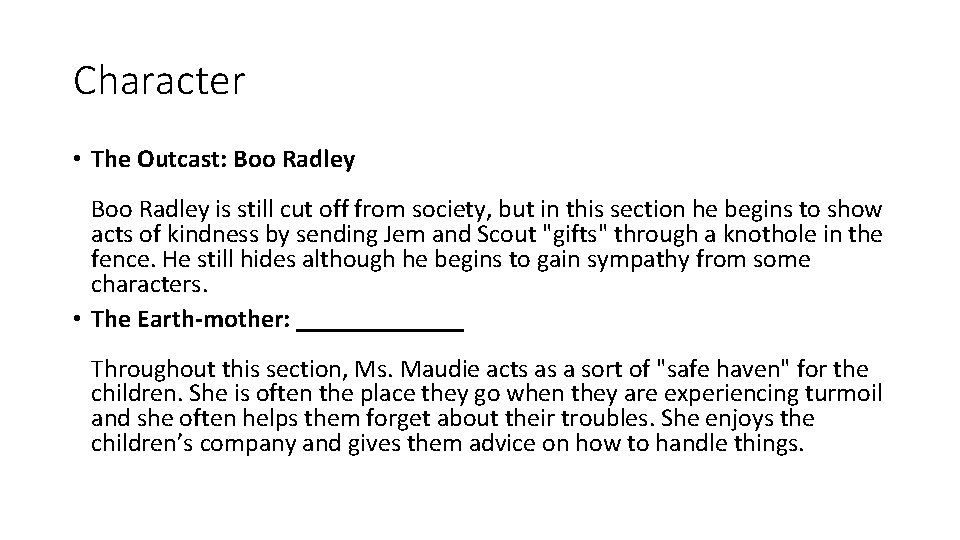
Character • The Outcast: Boo Radley is still cut off from society, but in this section he begins to show acts of kindness by sending Jem and Scout "gifts" through a knothole in the fence. He still hides although he begins to gain sympathy from some characters. • The Earth-mother: _______ Throughout this section, Ms. Maudie acts as a sort of "safe haven" for the children. She is often the place they go when they are experiencing turmoil and she often helps them forget about their troubles. She enjoys the children’s company and gives them advice on how to handle things.
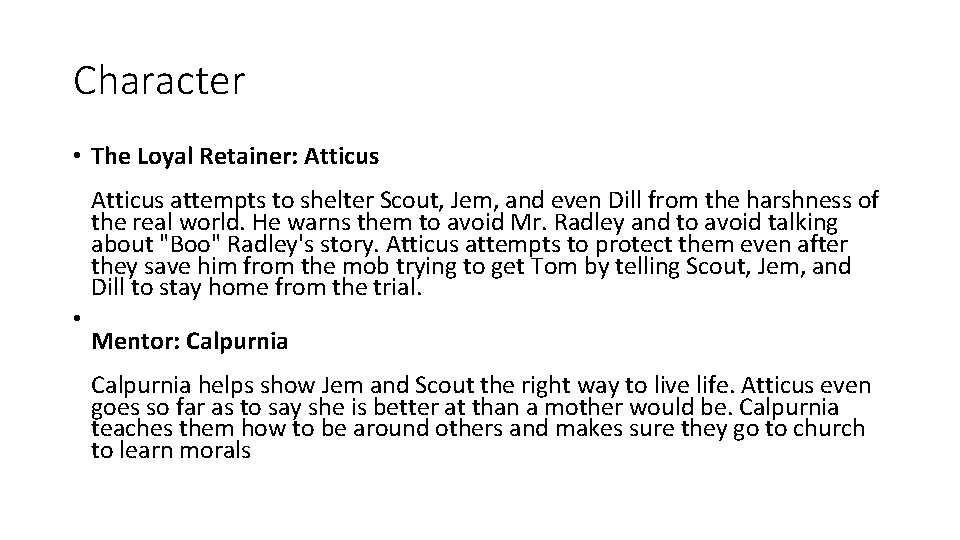
Character • The Loyal Retainer: Atticus attempts to shelter Scout, Jem, and even Dill from the harshness of the real world. He warns them to avoid Mr. Radley and to avoid talking about "Boo" Radley's story. Atticus attempts to protect them even after they save him from the mob trying to get Tom by telling Scout, Jem, and Dill to stay home from the trial. • Mentor: Calpurnia helps show Jem and Scout the right way to live life. Atticus even goes so far as to say she is better at than a mother would be. Calpurnia teaches them how to be around others and makes sure they go to church to learn morals
Situational • The Unhealable Wound: Boo Radley's with the law as a child Boo Radley's trouble with the law when he was young causes him to be condemned to house arrest by his father practically forever. He is never seen since and has been rumored to have gone crazy. Boo is never able to fully bounce back and become normal or seen socially in society after the incident happened.
Situational • The Initiation: Jem becomes an adult Jem turns 12 and begins to act more like an adult. He starts to demand that Scout quit "pestering" him and act more like a girl. People also begin treating him more like an adult as he matures
Situational • The Initiation: _______ Jem and Scout follow Atticus downtown and intervene to help Atticus against the mob. Scout talks to the mob and reminds them that they are human and then it disperses. This is Scout's "Initiation" because it teaches her life lessons about how to act towards people and a person’s true nature.
Symbolism • Fire vs. Ice: Scout vs. Miss Caroline Fisher Scout is a quick learner who is knowledgeable for her age and understands people and their situations. Miss Caroline is ignorant when it comes to teaching and her students. They have opposite personalities and views, which is why they don't necessarily get along well. Jem is the fire that is always looking to explore and learn new things and people, whereas, Miss Caroline is, in a sense, bitter and does not seem to know how to get along with children as her job. • Haven vs. Wilderness: the Finchs' Home vs. the Radleys' Home The Finchs' home is a safe, loving environment that the children are free and happy to live in. It is a typical family home full of love and security. The Radleys' home is distraught and out of balance. The family is unstable and mysterious, and no one seems to know the situation going on in their home. The Finchs' home is a safe haven for the kids to live in, whereas, the Radley's home is a mysterious wilderness they take interest in exploring and discovering secrets. • Light vs. Darkness: Scout vs. Arthur "Boo" Radley Scout is optimistic and full of life. She is mostly a spirited, lighthearted girl who is friendly and fair to everyone she encounters, no matter what. Boo Radley, on the other hand, is extremely isolated and lonely. No one has seen him for years, and he is unanimously known not to be messed with. Scout is light, because she presents herself to everyone and is outgoing. Boo is darkness, because he deducted himself from society and keeps to himself.
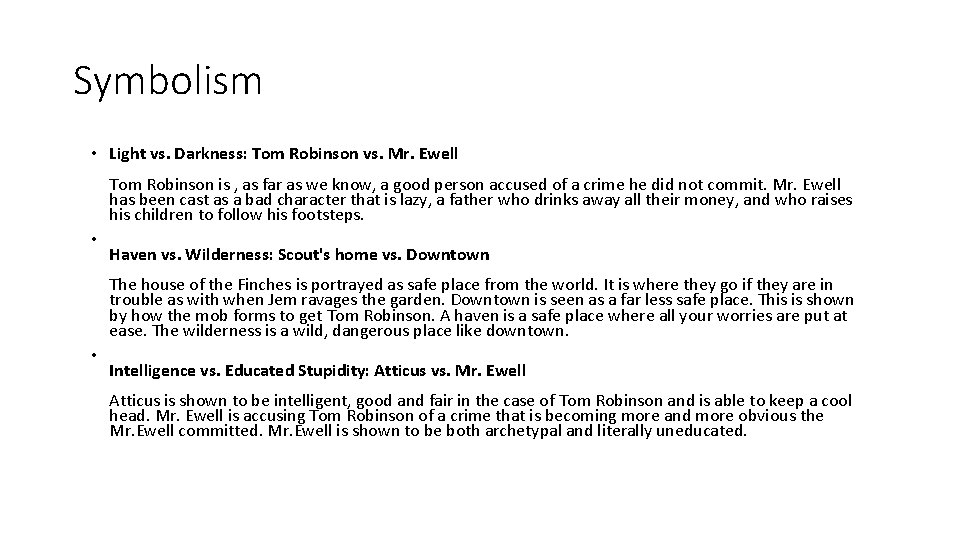
Symbolism • Light vs. Darkness: Tom Robinson vs. Mr. Ewell Tom Robinson is , as far as we know, a good person accused of a crime he did not commit. Mr. Ewell has been cast as a bad character that is lazy, a father who drinks away all their money, and who raises his children to follow his footsteps. • Haven vs. Wilderness: Scout's home vs. Downtown The house of the Finches is portrayed as safe place from the world. It is where they go if they are in trouble as with when Jem ravages the garden. Downtown is seen as a far less safe place. This is shown by how the mob forms to get Tom Robinson. A haven is a safe place where all your worries are put at ease. The wilderness is a wild, dangerous place like downtown. • Intelligence vs. Educated Stupidity: Atticus vs. Mr. Ewell Atticus is shown to be intelligent, good and fair in the case of Tom Robinson and is able to keep a cool head. Mr. Ewell is accusing Tom Robinson of a crime that is becoming more and more obvious the Mr. Ewell committed. Mr. Ewell is shown to be both archetypal and literally uneducated.
Motifs • A _______ is a recurring symbol which takes on a figurative meaning. • We see them in books, films, and poems. • In fact, almost every text commonly uses the _____ device of the motif. • A motif can be almost anything: an idea, an object, a concept, a character archetype, the weather, a color, or even a statement.

Point of View
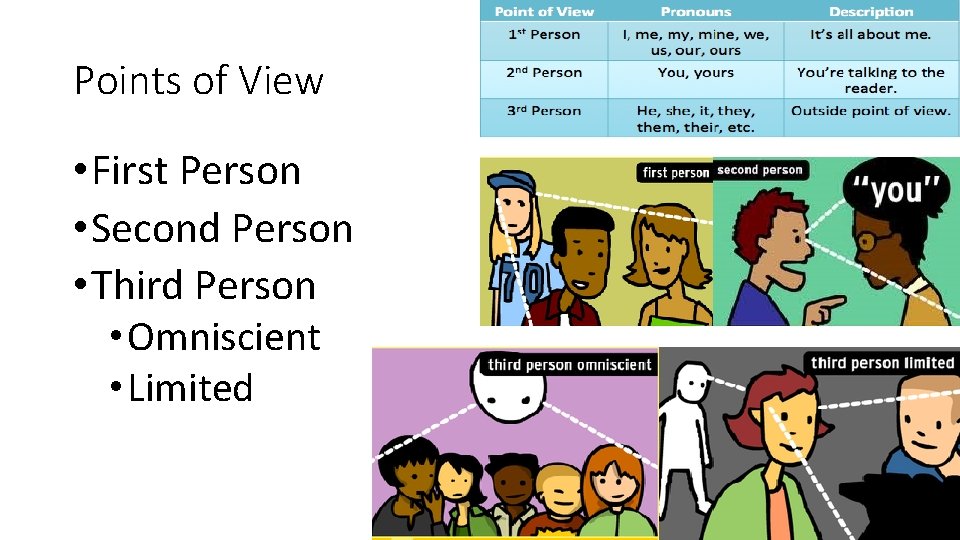
Points of View • First Person • Second Person • Third Person • Omniscient • Limited

Characterization
Character Development • The main character in a story is called the ______. He or she is always involved in the main conflict and its resolution. • The person opposing the protagonist is called the _______. • Dynamic ‐ A dynamic character is a person who changes over time, usually as a result of ______ a central conflict or facing a major crisis. • Static ‐ A static character is someone who does not change over time. • Round ‐ A rounded character is anyone who has a complex personality; he/she is often _____ as a conflicted and contradictory person. • Flat ‐ A flat character is the opposite of a round character. This person is simply one way and is usually not central to the story. • Foil‐ A character who is the _____ (in contrast) of another character
How do author’s develop characters? • Their Dialect (How they speak) • Through their physical attributes (What they look like) • Their inner thoughts (What do they think about) • Their reactions (how do they react in different situations) • When thinking about characters consider who they are as a person, who they spend time with, and what they do. • Author’s can also use setting to indirectly characterize.
Think about a Character in To Kill a Mockingbird • How does Harper Lee develop character? • What is their dialect? • What do they look like? • What do they think? • What does this say about the character?

Author’s Purpose and Style
1. ____ (Word Choice): Author’s think about the type of words they are using for both their audience and what they want their reader to take away • Writing style refers to the manner 2. Syntax (______): Author’s in which an _____ chooses to think about the type of sentences needed to write to his or her readers. make their reader understand their novel. Style 1. Some use syntax to create a specific tone for their • A style reveals both the writer's reader. personality and voice, but it also shows how he or she perceives 3. _____: An essential element of style that reveals the writer’s personality. the audience. 1. A writer’s voice can be impersonal or chatty, authoritative or reflective, objective or passionate, • The choice of a conceptual serious or funny. writing style molds the overall 4. Structure: The framework of how a story is character of the work told.
Harper Lee Wrote… • Factually • Scout's narration usually doesn't comment much on the action, just presents what happens as a series of facts. Here's an example: • Aunt Alexandra sat down in Calpurnia's chair and put her hands to her face. She sat quite still; she was so quiet I wondered if she would faint. I heard Miss Maudie breathing as if she had just climbed the steps, and in the dining room the ladies chattered happily. • I thought Aunt Alexandra was crying, but when she took her hands away from her face, she was not. She looked weary. She spoke, and her voice was flat. (24. 74)
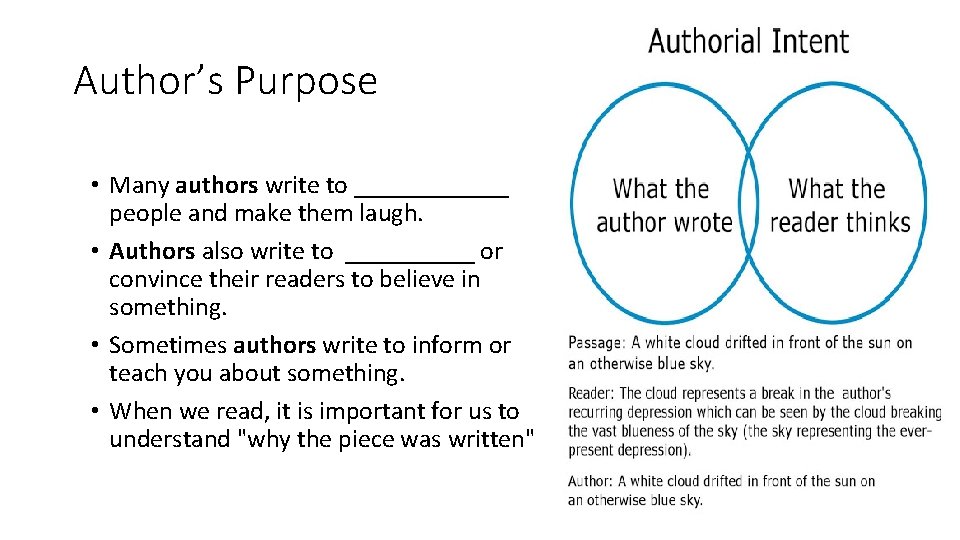
Author’s Purpose • Many authors write to ______ people and make them laugh. • Authors also write to _____ or convince their readers to believe in something. • Sometimes authors write to inform or teach you about something. • When we read, it is important for us to understand "why the piece was written"
What might have been Harper Lee’s Purpose of Writing To Kill a Mockingbird • Possible ______ Insight • Historical criticism on racism • Highlight on racial injustice and discrimination
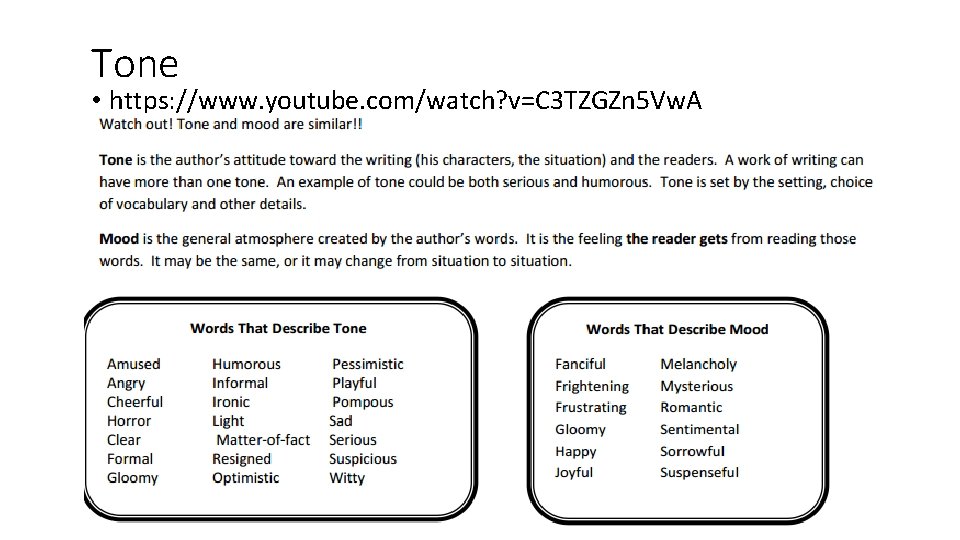
Tone • https: //www. youtube. com/watch? v=C 3 TZGZn 5 Vw. A
How might Harper Lee have felt about the following topics? • Racism • Growing up • Discrimination • Empathy • Good vs Evil
- Slides: 32