
Filipino Transnational Families in Canada 16 th National
- Slides: 11
Filipino Transnational Families in Canada 16 th National Metropolis Conference Partnering for Success: Facilitating Integration and Inclusion Hilton Lac-Leamy Gatineau, Québec Friday, March 14 th, 2014 - 11: 00 a. m to 12: 30 p. m
Transnational Families in Transition: Filipino Families, Canadian Issues Funded by the Social Sciences and Humanities Research Council (SSHRC)
Acknowledgements We wish to extend our gratitude to all of the women, men and children who shared their stories with us
Transnational Families in Transition Team Denise L. Spitzer, Ph. D: Principal Investigator, University of Ottawa Sara Torres, Ph. D: Research Coordinator, University of Ottawa Aimee Beboso: Collaborator, Carleton University Filipino Students Association Noreen Berkes: Collaborator, LINGAP Institute Caridad Bernardino, Ph. D: Collaborator, LINGAP Institute Avegaile Calzado: Collaborator, member Filipino Community of Ottawa Josephine Pallard: Collaborator, Changing Together. . . A Centre for Immigrant Women Research Assistants: Monina Febria, Emily Howard, Pascale Gagnon-Arpin
National Advisory Committee Margaret Adsett, Canadian Heritage, Ottawa Father Pedro Arana, Assumption Parish, Ottawa Susan Brigham, Ph. D, Dalhousie University, Halifax Elizabeth Casuga, Human Resources and Skills Development Canada, Ottawa Cecilia Diocsan, National Alliance of Philippine Women in Canada, Montréal Bernadette Nalzaro, member Filipino Community of Ottawa Ivon Pereira, Action for Healthy Communities, Edmonton
Objectives (1) To examine the impact of separation on the families of former livein caregivers from the Philippines now residing in two second tier Canadian cities; (2) To explore how family members renegotiate gender, parental, familial, and marital roles; (3) To situate the experiences of informants in the context of gender, globalization, identity, socioeconomic status, and the local host community; (4) To illuminate the impact of these phenomena on the health and well being of former live-in caregivers and their family members; (5) To identify supportive individual, familial and/or community coping or adaptive strategies as well as ways for governmental and nongovernmental agencies to support these efforts; and (6) To consider the implications of these findings for Canadian immigration and labour policy and society.
The study Sites Edmonton (Alberta) , Ottawa (Ontario) Methods Qualitative in-depth interviews Photo-voice projects (2) Survey (demographic information) Theoretical framework Intersectional Analysis
We talked to… 51 interviews 28 former LCP workers All women 9 spouses All men 14 children Over 70% of participants were related to another participant (i. e. part of a family grouping) Two photo-voice projects: 1 former LCP worker 3 children
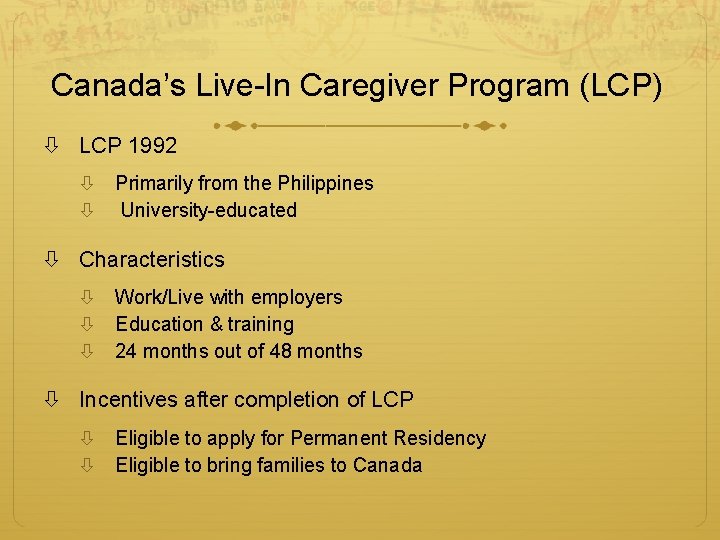
Canada’s Live-In Caregiver Program (LCP) LCP 1992 Primarily from the Philippines University-educated Characteristics Work/Live with employers Education & training 24 months out of 48 months Incentives after completion of LCP Eligible to apply for Permanent Residency Eligible to bring families to Canada
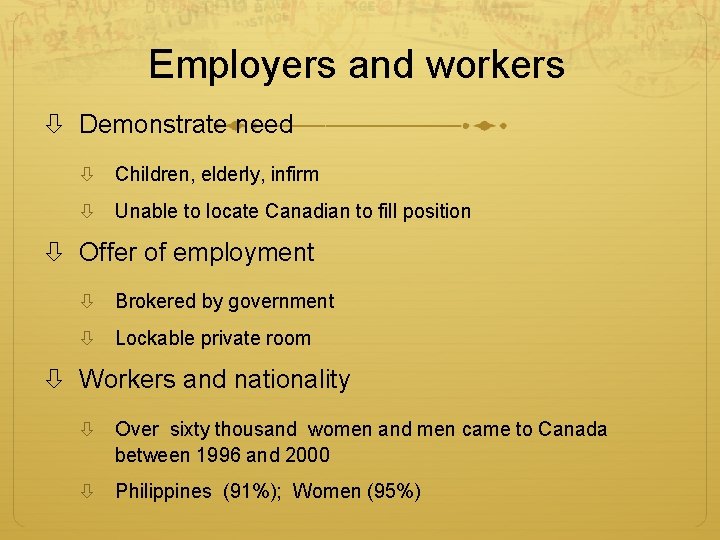
Employers and workers Demonstrate need Children, elderly, infirm Unable to locate Canadian to fill position Offer of employment Brokered by government Lockable private room Workers and nationality Over sixty thousand women and men came to Canada between 1996 and 2000 Philippines (91%); Women (95%)
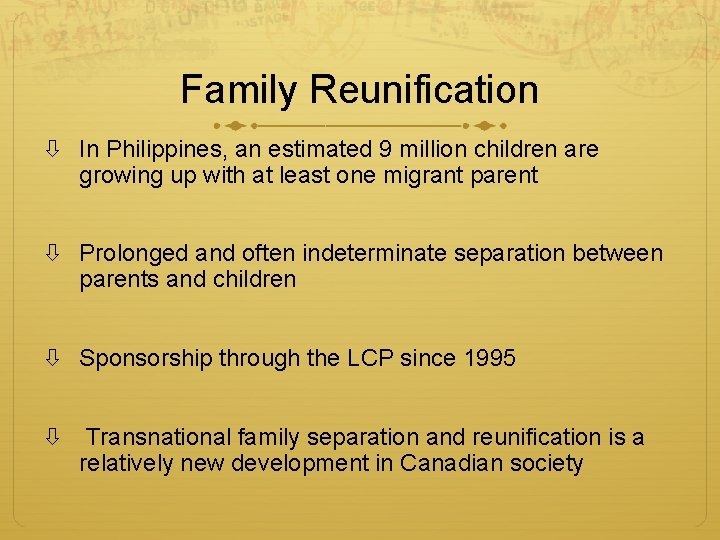
Family Reunification In Philippines, an estimated 9 million children are growing up with at least one migrant parent Prolonged and often indeterminate separation between parents and children Sponsorship through the LCP since 1995 Transnational family separation and reunification is a relatively new development in Canadian society