
File System Implementation Questions answered in this lecture
![Inode type uid rwx size blocks time ctime links_count addrs[N] Assume single level (just](https://slidetodoc.com/presentation_image_h/356e86d87ac70d30fc180a9dbbf77958/image-25.jpg "Inode type uid rwx size blocks time ctime links_count addrs[N] Assume single level (just")

- Slides: 50
File System Implementation Questions answered in this lecture: What on-disk structures to represent files and directories? Contiguous, Extents, Linked, FAT, Indexed, Multi-level indexed Which are good for different metrics? What disk operations are needed for: make directory open file write/read file close file
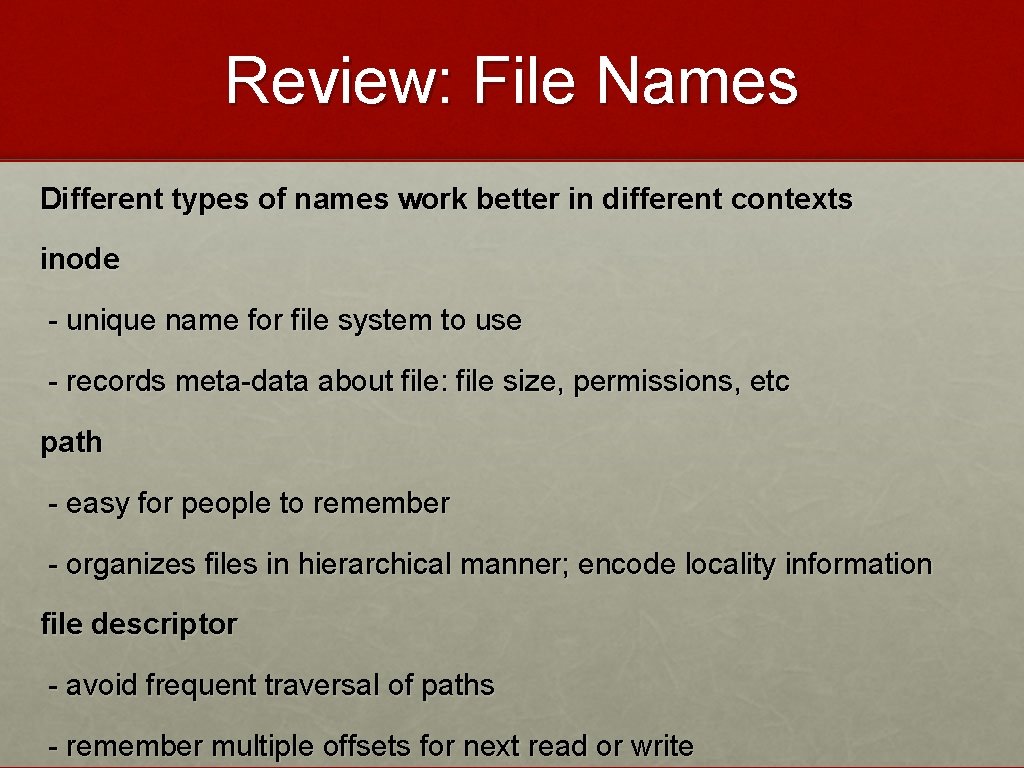
Review: File Names Different types of names work better in different contexts inode - unique name for file system to use - records meta-data about file: file size, permissions, etc path - easy for people to remember - organizes files in hierarchical manner; encode locality information file descriptor - avoid frequent traversal of paths - remember multiple offsets for next read or write
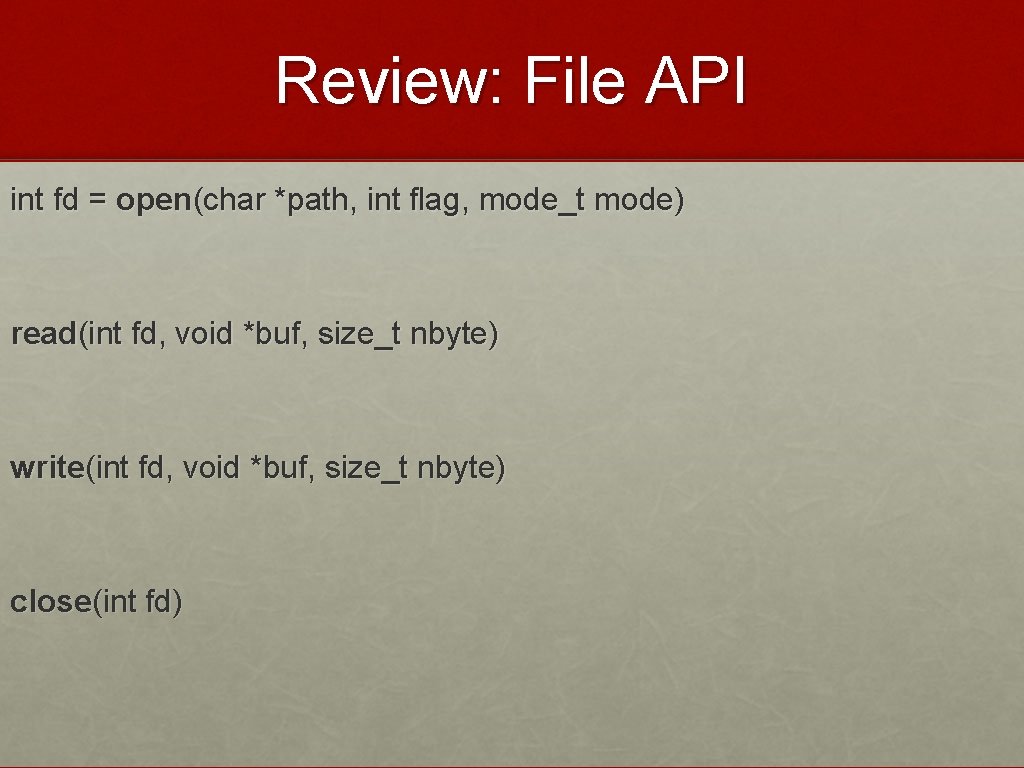
Review: File API int fd = open(char *path, int flag, mode_t mode) read(int fd, void *buf, size_t nbyte) write(int fd, void *buf, size_t nbyte) close(int fd)
Today: Implementation 1. On-disk structures - how does file system represent files, directories? 2. Access methods - what steps must reads/writes take?
Part 1: Disk Structures
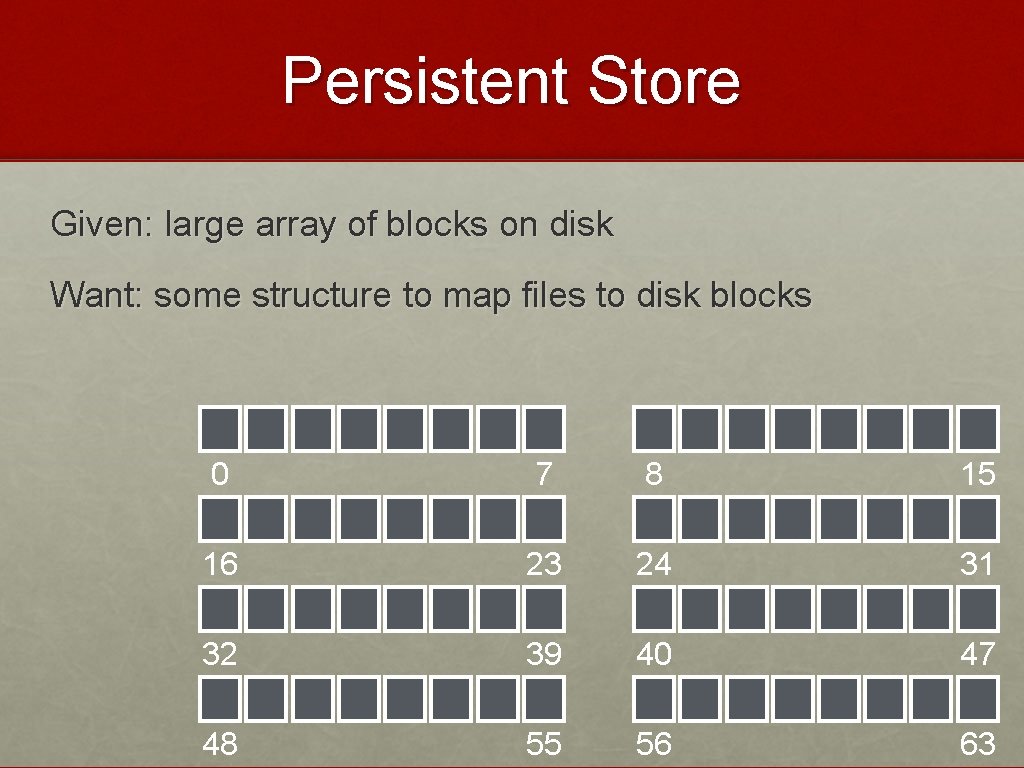
Persistent Store Given: large array of blocks on disk Want: some structure to map files to disk blocks D 0 D 16 D 32 D 48 D D D D 7 D D D D 23 D D D D 39 D D D D 55 D 8 D 24 D 40 D 56 D D D D 15 D D D D 31 D D D D 47 D D D D 63
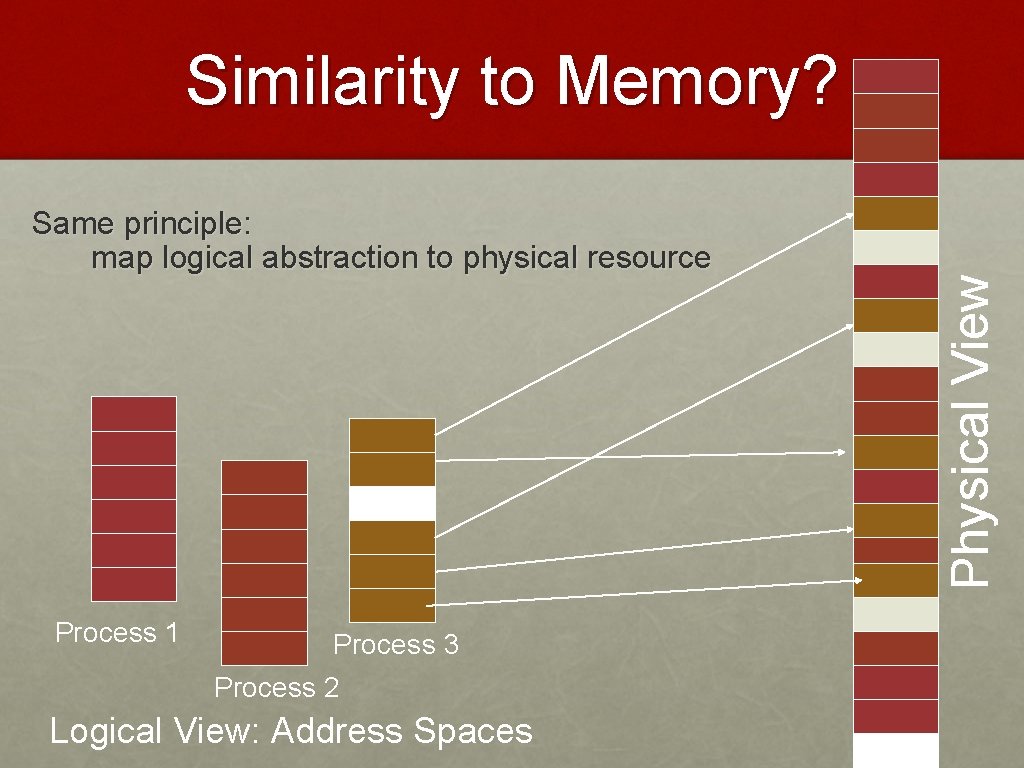
Same principle: map logical abstraction to physical resource Process 1 Process 3 Process 2 Logical View: Address Spaces Physical View Similarity to Memory?
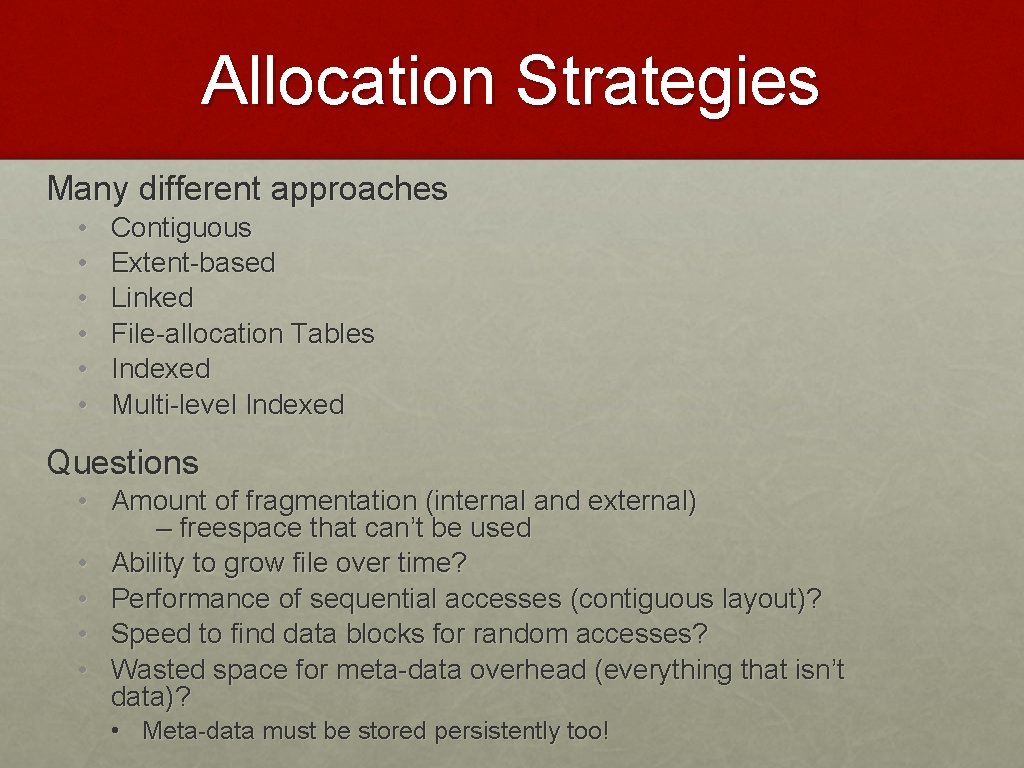
Allocation Strategies Many different approaches • • • Contiguous Extent-based Linked File-allocation Tables Indexed Multi-level Indexed Questions • Amount of fragmentation (internal and external) – freespace that can’t be used • Ability to grow file over time? • Performance of sequential accesses (contiguous layout)? • Speed to find data blocks for random accesses? • Wasted space for meta-data overhead (everything that isn’t data)? • Meta-data must be stored persistently too!
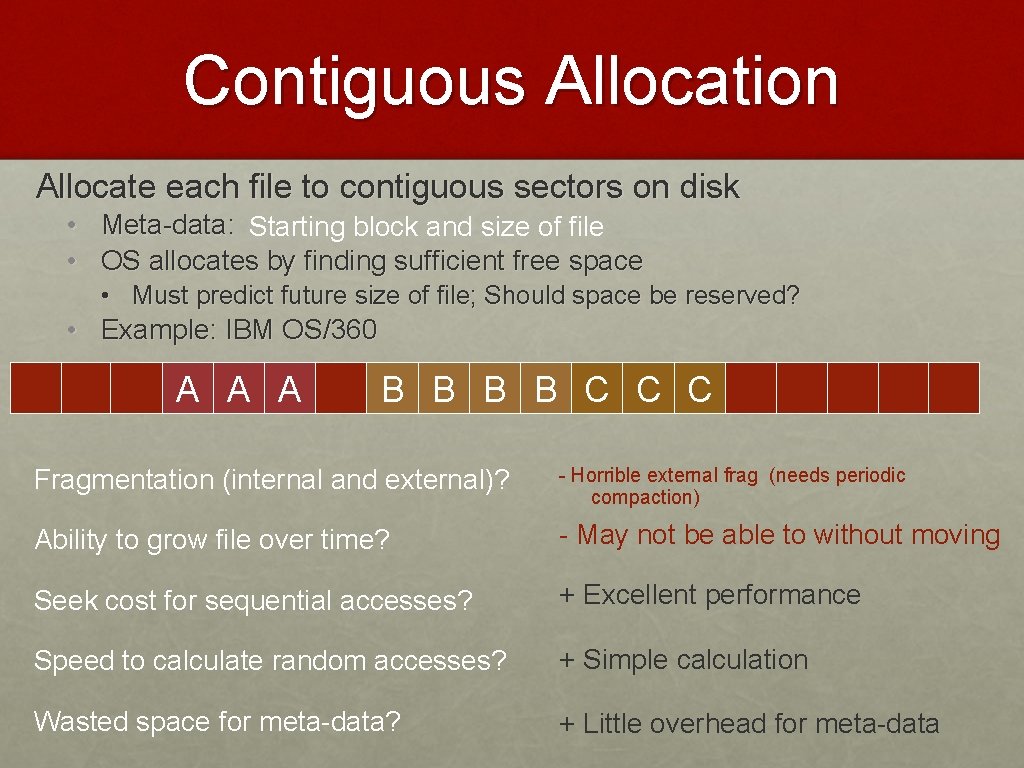
Contiguous Allocation Allocate each file to contiguous sectors on disk • Meta-data: Starting block and size of file • OS allocates by finding sufficient free space • Must predict future size of file; Should space be reserved? • Example: IBM OS/360 A A A B B C C C Fragmentation (internal and external)? - Horrible external frag (needs periodic compaction) Ability to grow file over time? - May not be able to without moving Seek cost for sequential accesses? + Excellent performance Speed to calculate random accesses? + Simple calculation Wasted space for meta-data? + Little overhead for meta-data
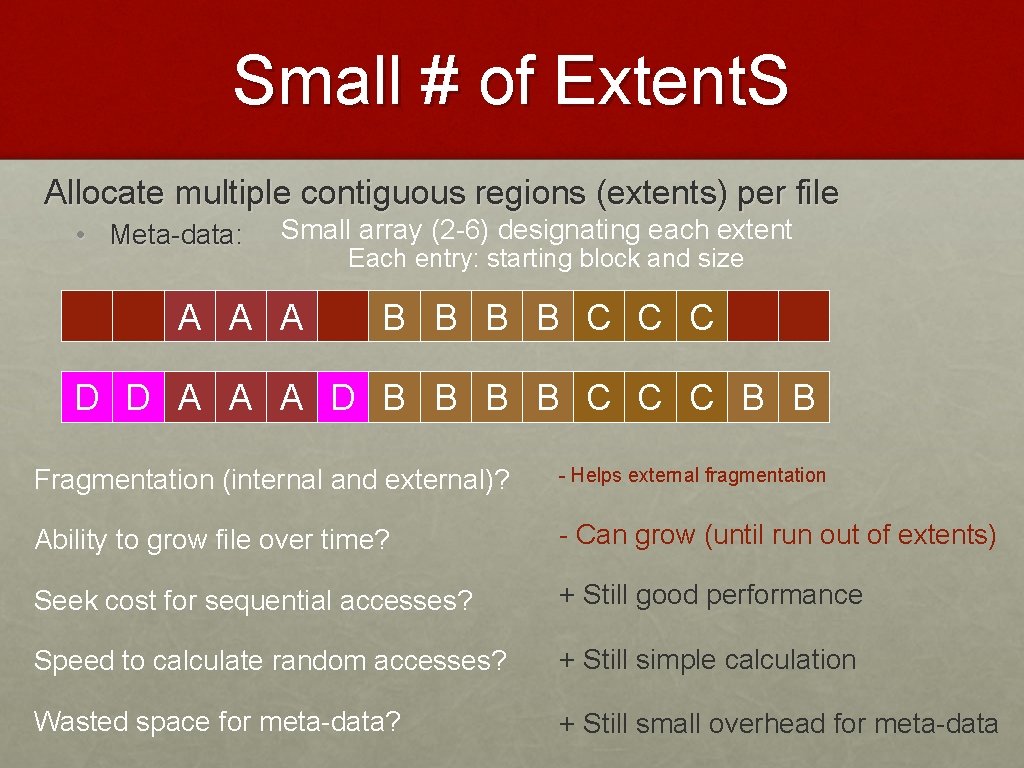
Small # of Extent. S Allocate multiple contiguous regions (extents) per file • Meta-data: Small array (2 -6) designating each extent A A A Each entry: starting block and size B B C C C D D A A A D B B C C C B B Fragmentation (internal and external)? - Helps external fragmentation Ability to grow file over time? - Can grow (until run out of extents) Seek cost for sequential accesses? + Still good performance Speed to calculate random accesses? + Still simple calculation Wasted space for meta-data? + Still small overhead for meta-data
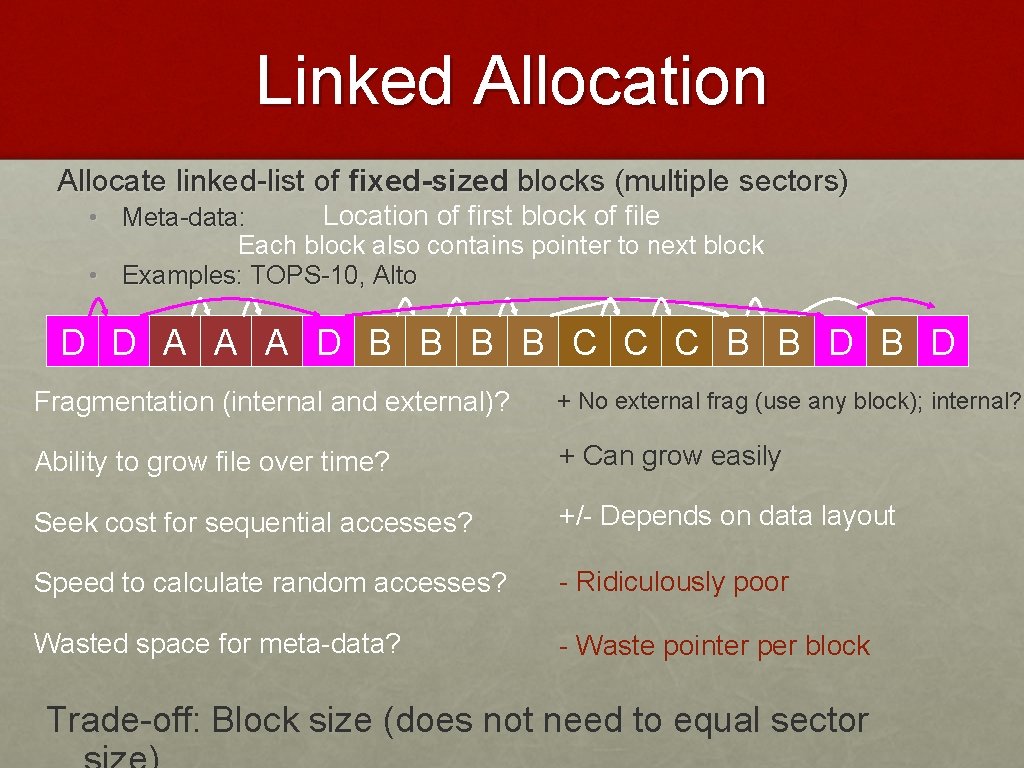
Linked Allocation Allocate linked-list of fixed-sized blocks (multiple sectors) Location of first block of file • Meta-data: Each block also contains pointer to next block • Examples: TOPS-10, Alto D D A A A D B B C C C B B D Fragmentation (internal and external)? + No external frag (use any block); internal? Ability to grow file over time? + Can grow easily Seek cost for sequential accesses? +/- Depends on data layout Speed to calculate random accesses? - Ridiculously poor Wasted space for meta-data? - Waste pointer per block Trade-off: Block size (does not need to equal sector
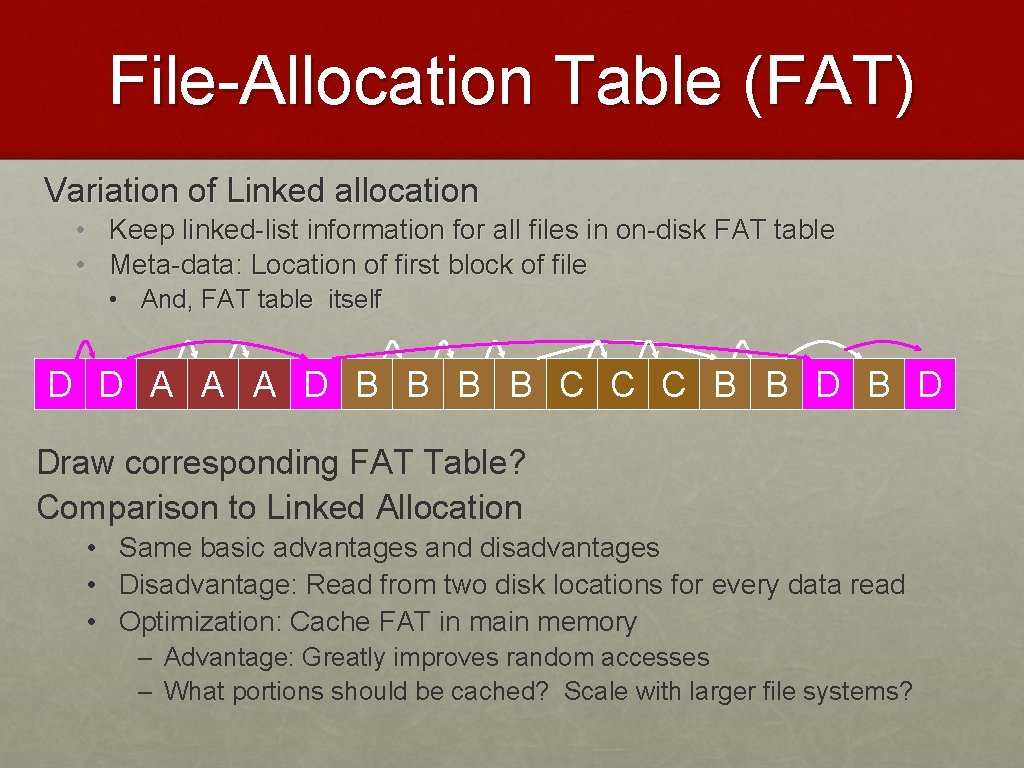
File-Allocation Table (FAT) Variation of Linked allocation • Keep linked-list information for all files in on-disk FAT table • Meta-data: Location of first block of file • And, FAT table itself D D A A A D B B C C C B B D Draw corresponding FAT Table? Comparison to Linked Allocation • Same basic advantages and disadvantages • Disadvantage: Read from two disk locations for every data read • Optimization: Cache FAT in main memory – Advantage: Greatly improves random accesses – What portions should be cached? Scale with larger file systems?
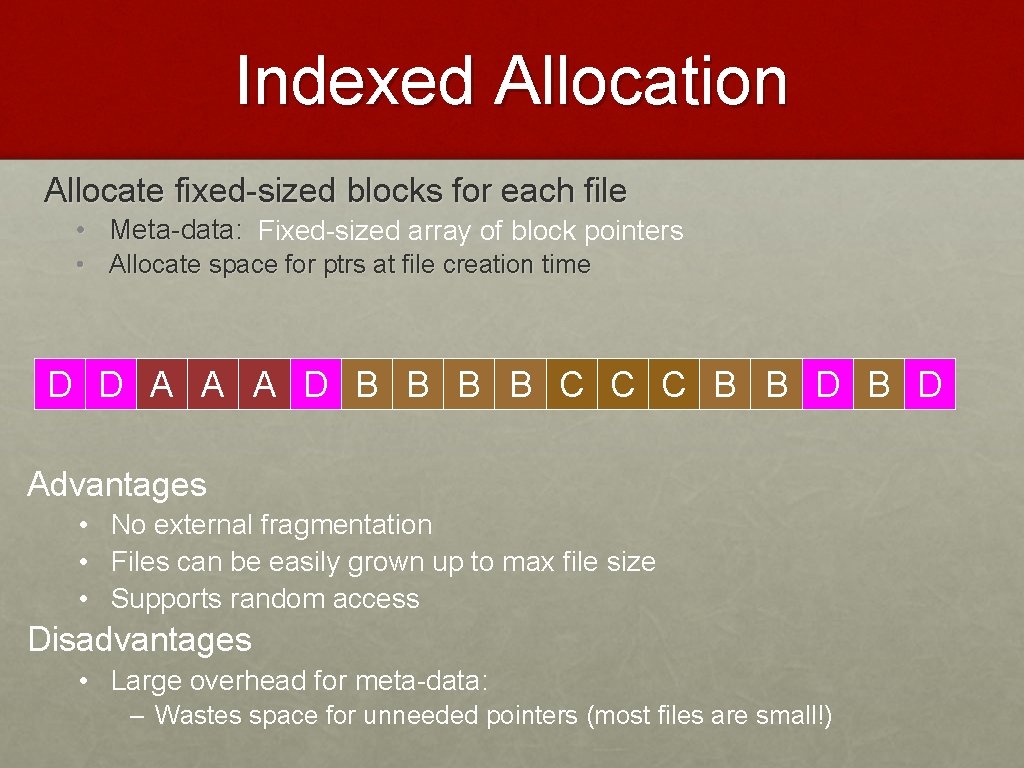
Indexed Allocation Allocate fixed-sized blocks for each file • Meta-data: Fixed-sized array of block pointers • Allocate space for ptrs at file creation time D D A A A D B B C C C B B D Advantages • No external fragmentation • Files can be easily grown up to max file size • Supports random access Disadvantages • Large overhead for meta-data: – Wastes space for unneeded pointers (most files are small!)
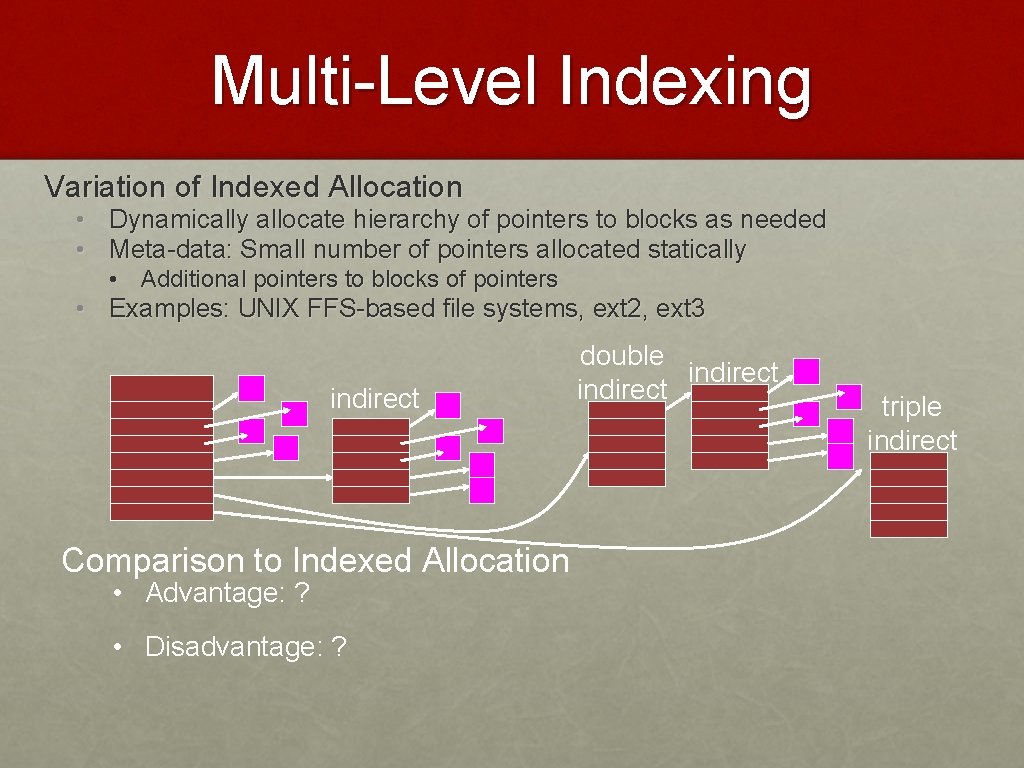
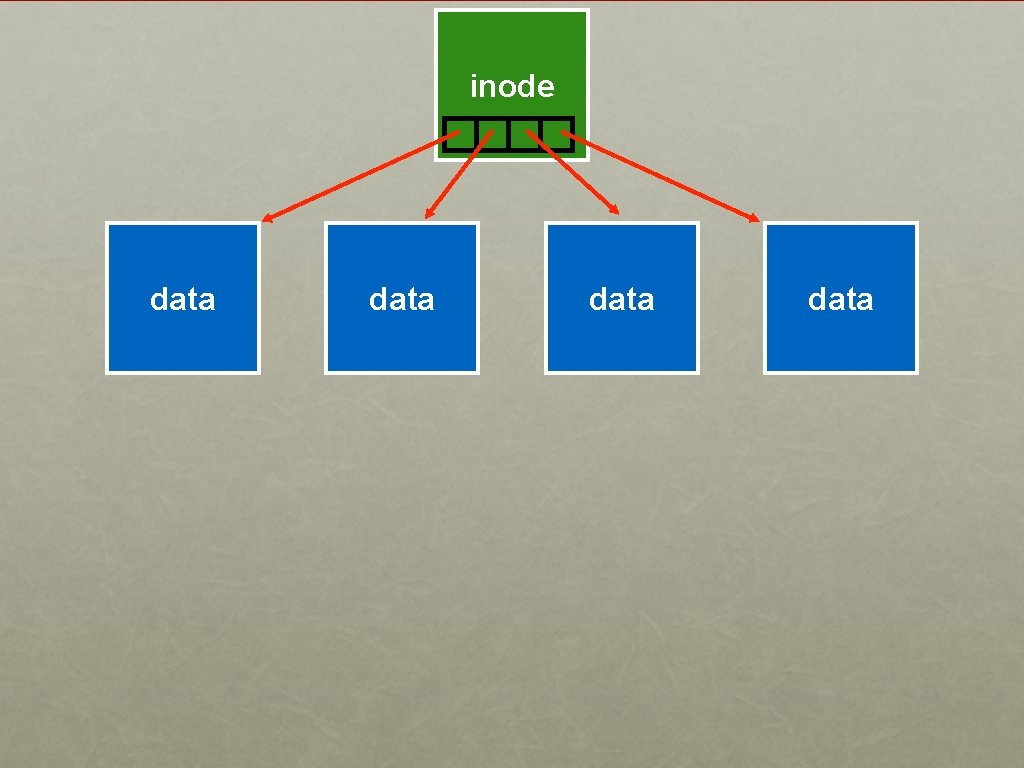
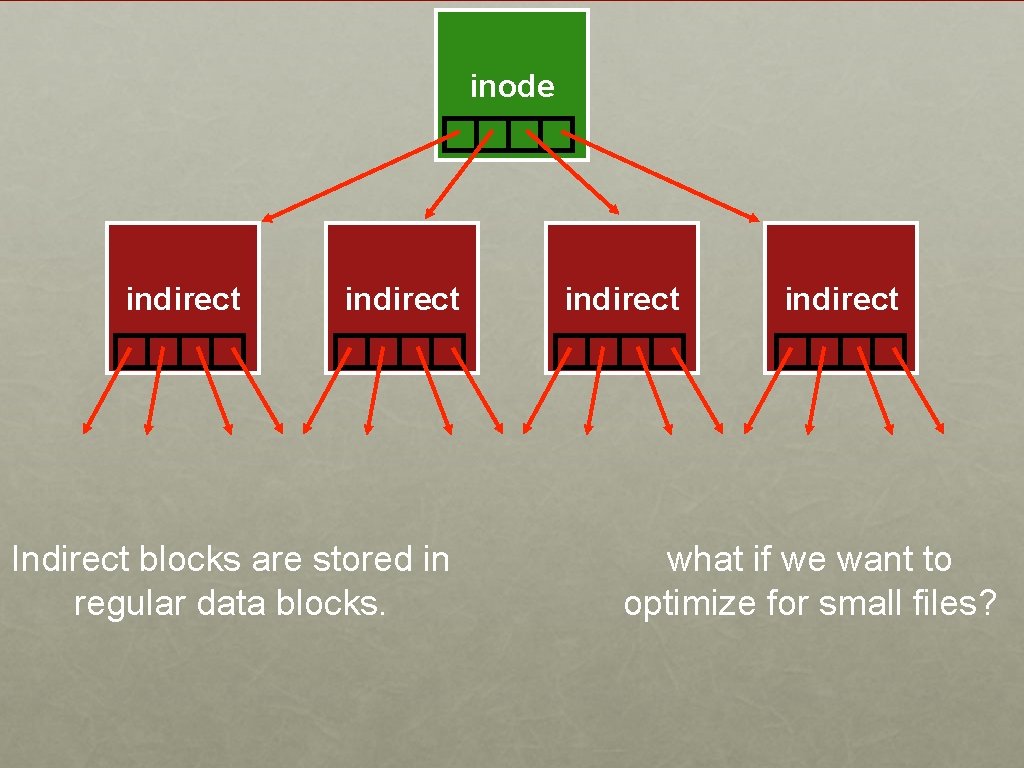
Multi-Level Indexing Variation of Indexed Allocation • Dynamically allocate hierarchy of pointers to blocks as needed • Meta-data: Small number of pointers allocated statically • Additional pointers to blocks of pointers • Examples: UNIX FFS-based file systems, ext 2, ext 3 indirect Comparison to Indexed Allocation • Advantage: ? • Disadvantage: ? double indirect triple indirect
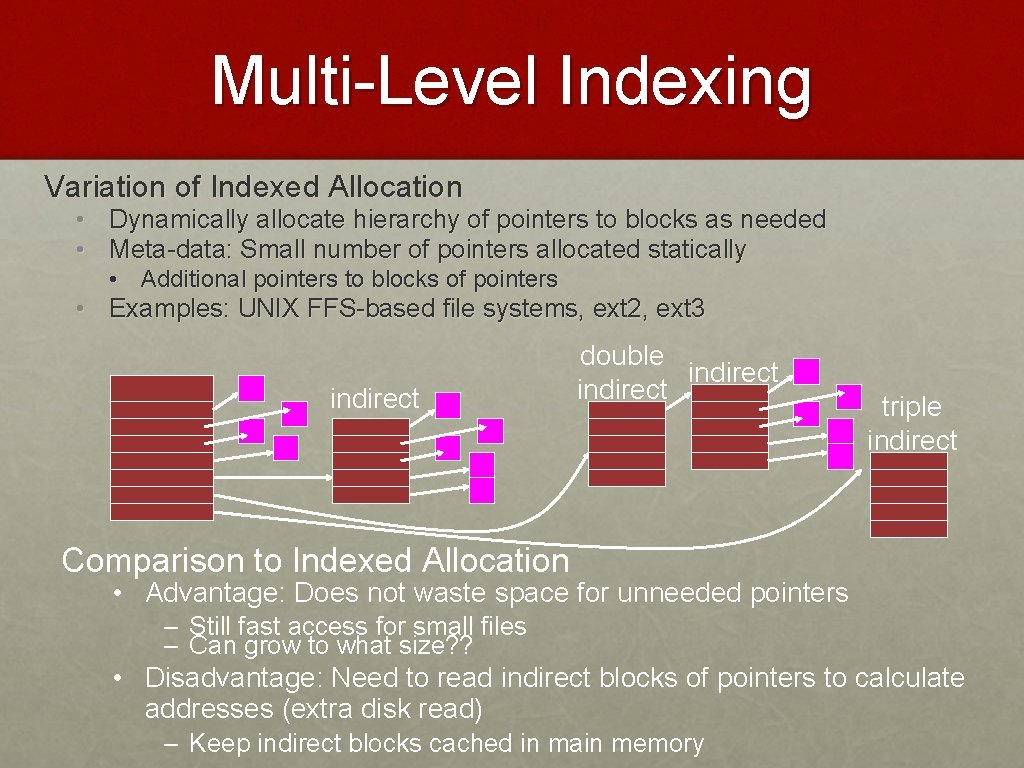
Multi-Level Indexing Variation of Indexed Allocation • Dynamically allocate hierarchy of pointers to blocks as needed • Meta-data: Small number of pointers allocated statically • Additional pointers to blocks of pointers • Examples: UNIX FFS-based file systems, ext 2, ext 3 indirect double indirect triple indirect Comparison to Indexed Allocation • Advantage: Does not waste space for unneeded pointers – Still fast access for small files – Can grow to what size? ? • Disadvantage: Need to read indirect blocks of pointers to calculate addresses (extra disk read) – Keep indirect blocks cached in main memory
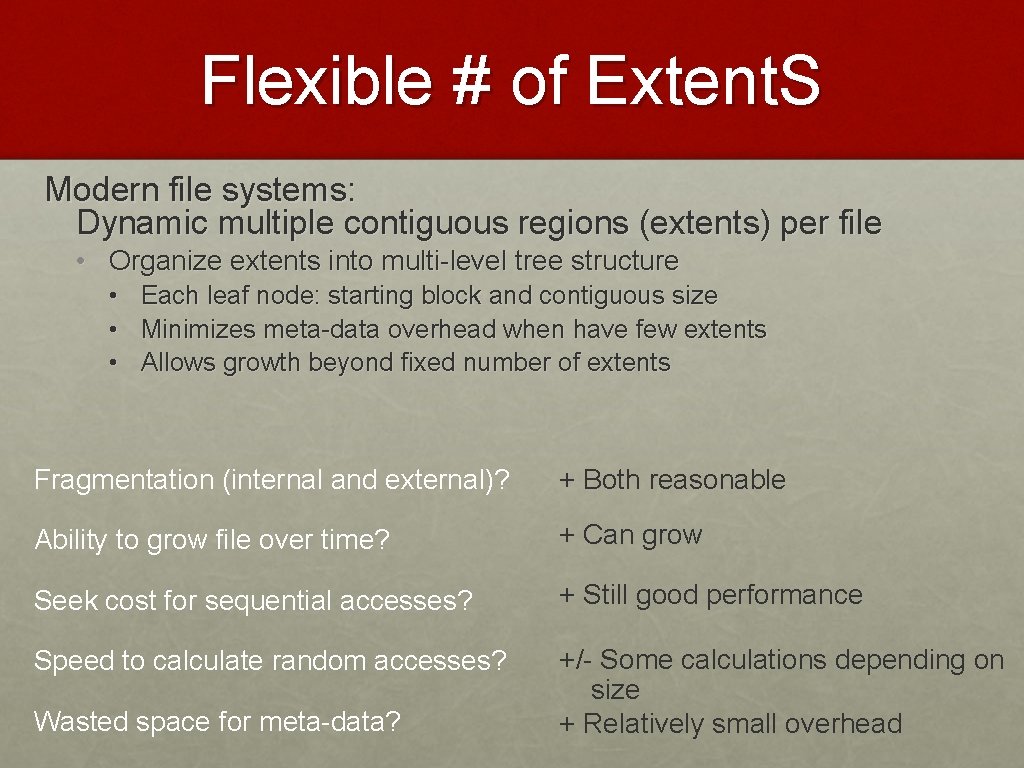
Flexible # of Extent. S Modern file systems: Dynamic multiple contiguous regions (extents) per file • Organize extents into multi-level tree structure • • • Each leaf node: starting block and contiguous size Minimizes meta-data overhead when have few extents Allows growth beyond fixed number of extents Fragmentation (internal and external)? + Both reasonable Ability to grow file over time? + Can grow Seek cost for sequential accesses? + Still good performance Speed to calculate random accesses? +/- Some calculations depending on size + Relatively small overhead Wasted space for meta-data?
Assume Multi-Level Indexing Simple approach More complex file systems build from these basic data structures
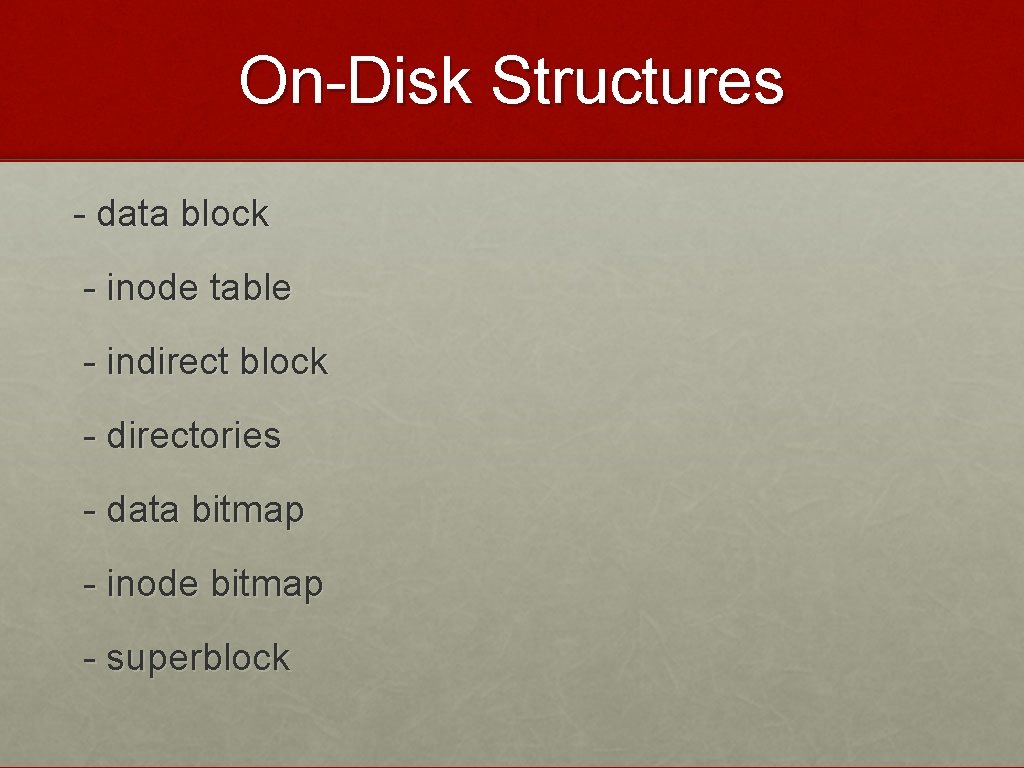
On-Disk Structures - data block - inode table - indirect block - directories - data bitmap - inode bitmap - superblock
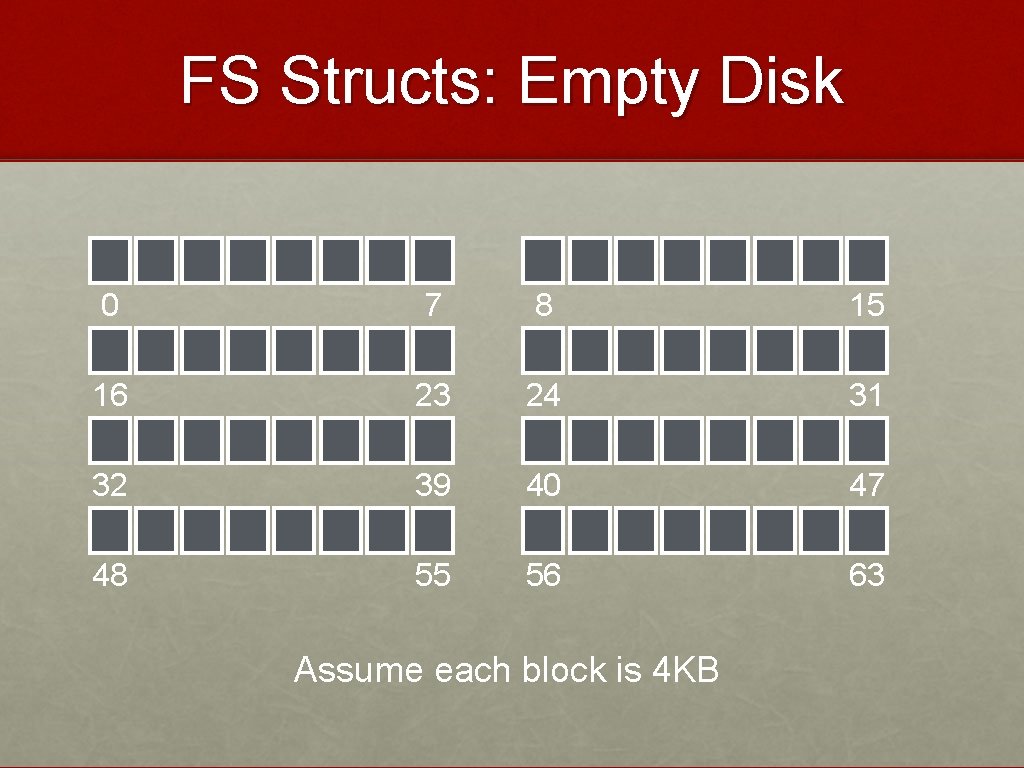
FS Structs: Empty Disk D 0 D 16 D 32 D 48 D D D D 7 D D D D 23 D D D D 39 D D D D 55 D 8 D 24 D 40 D 56 D D D D 15 D D D D 31 D D D D 47 D D D D 63 Assume each block is 4 KB
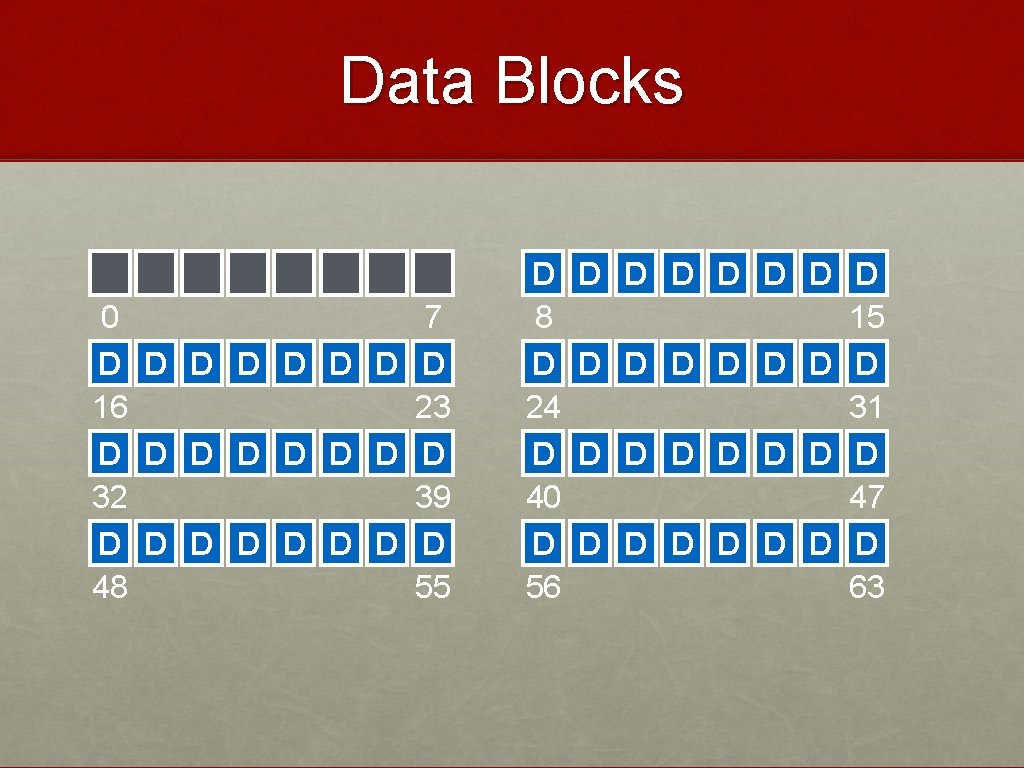
Data Blocks D 0 D 16 D 32 D 48 D D D D 7 D D D D 23 D D D D 39 D D D D 55 D 8 D 24 D 40 D 56 D D D D 15 D D D D 31 D D D D 47 D D D D 63
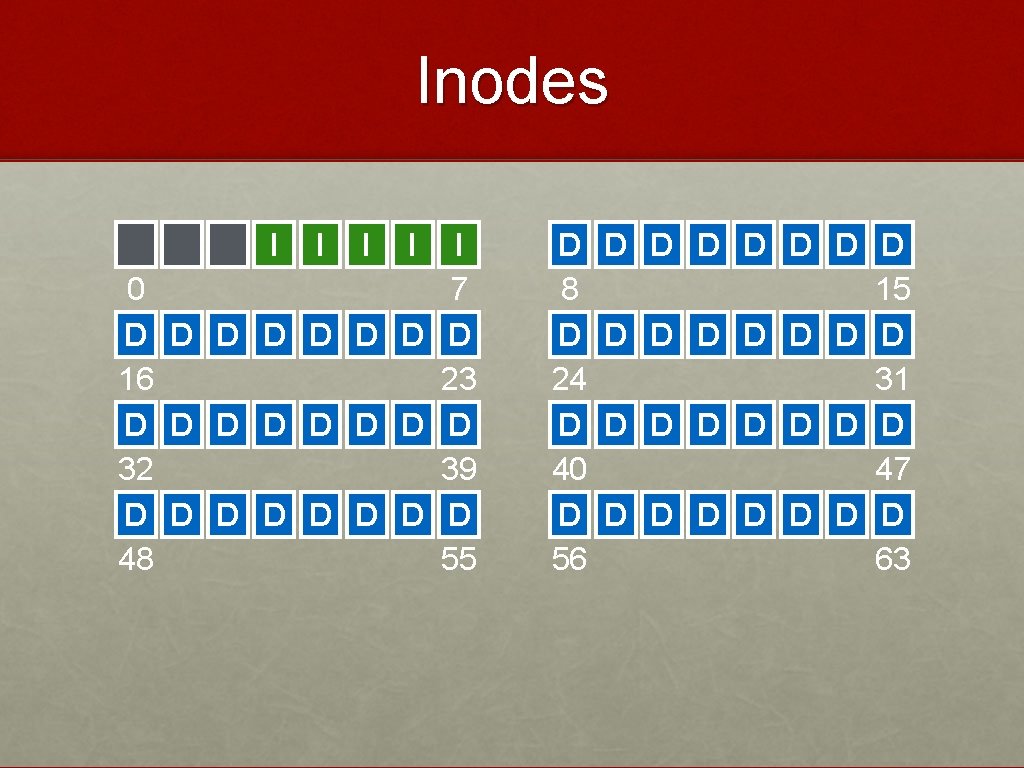
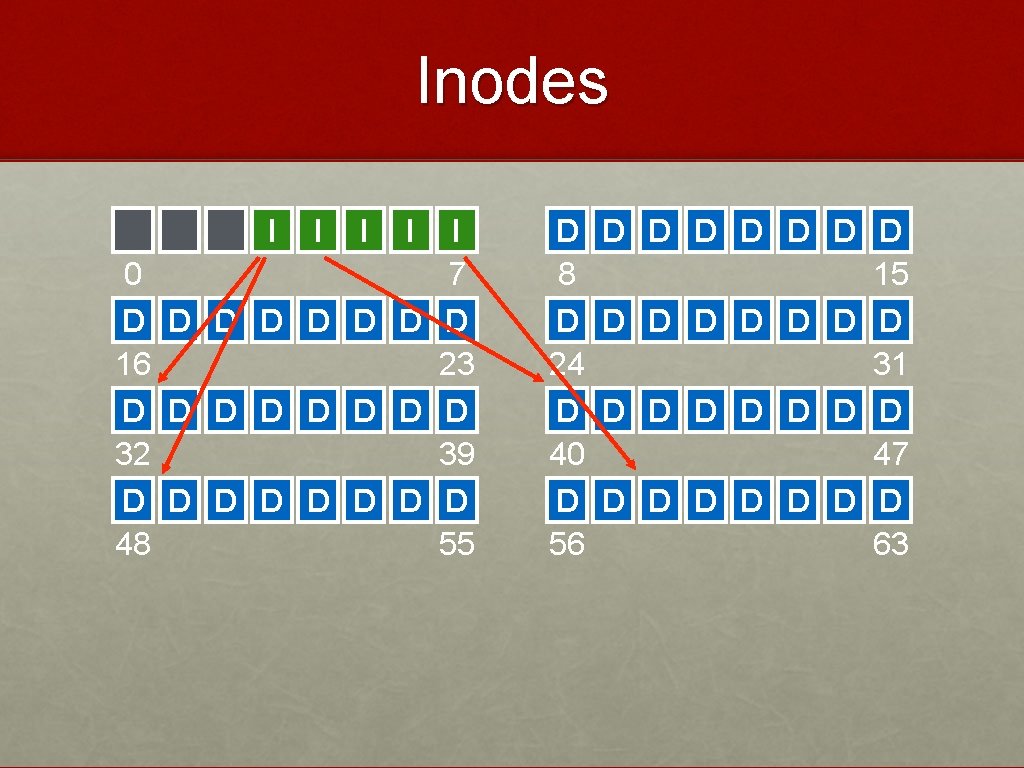
Inodes D 0 D 16 D 32 D 48 D D I I I 7 D D D D 23 D D D D 39 D D D D 55 D 8 D 24 D 40 D 56 D D D D 15 D D D D 31 D D D D 47 D D D D 63
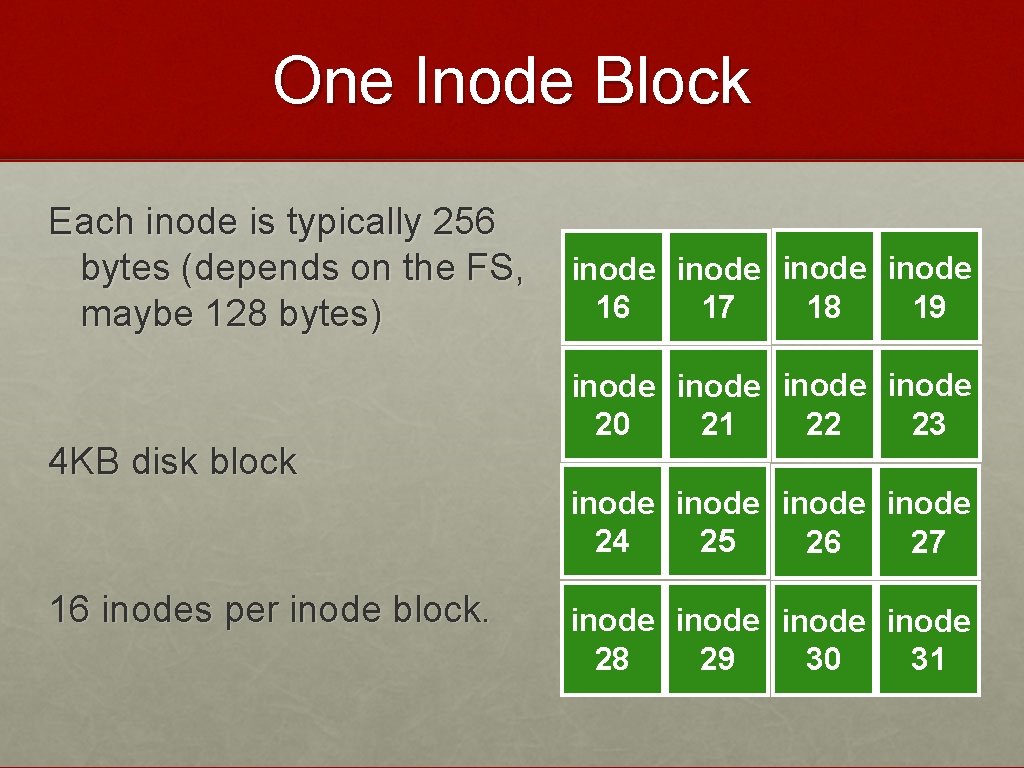
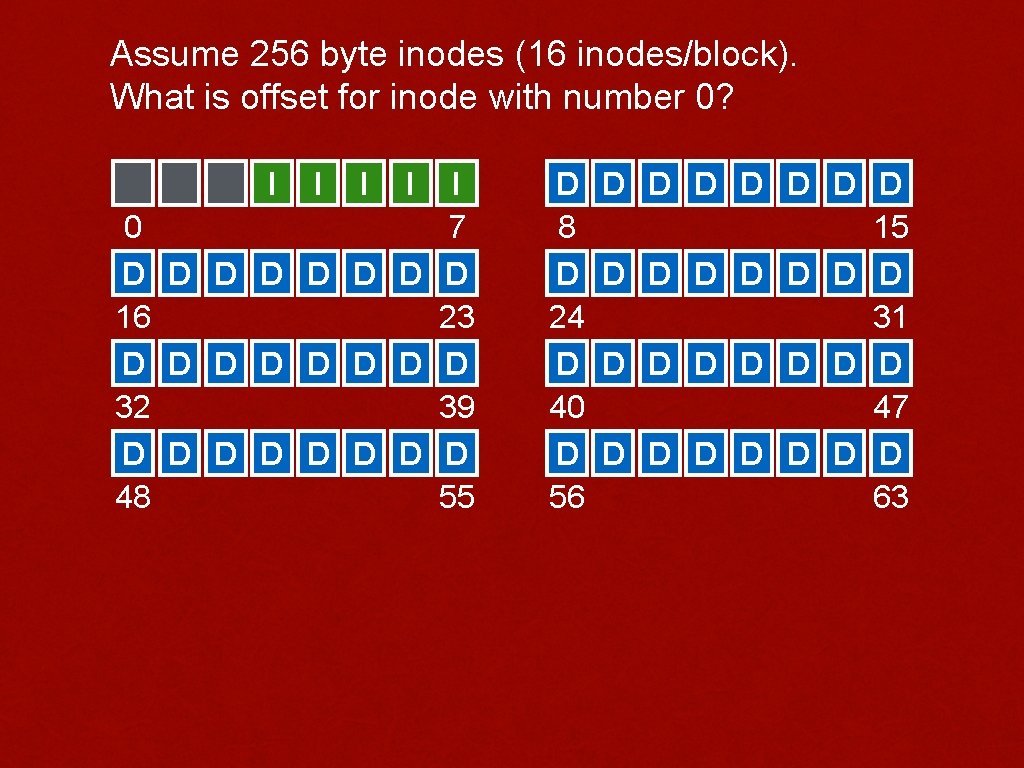
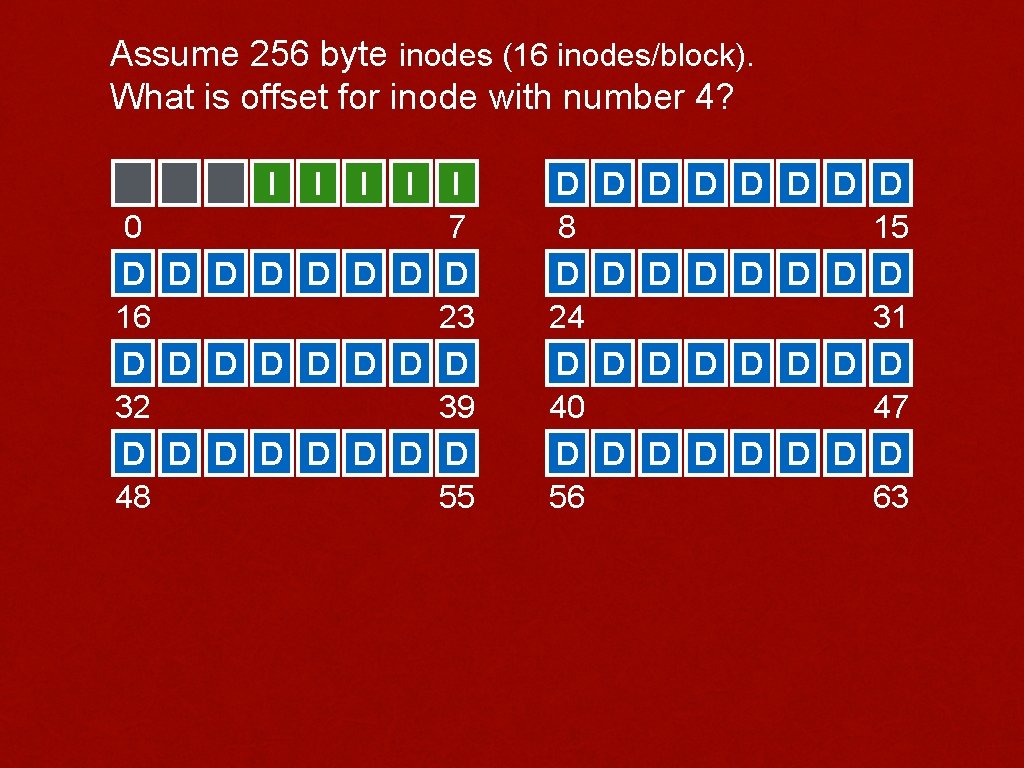
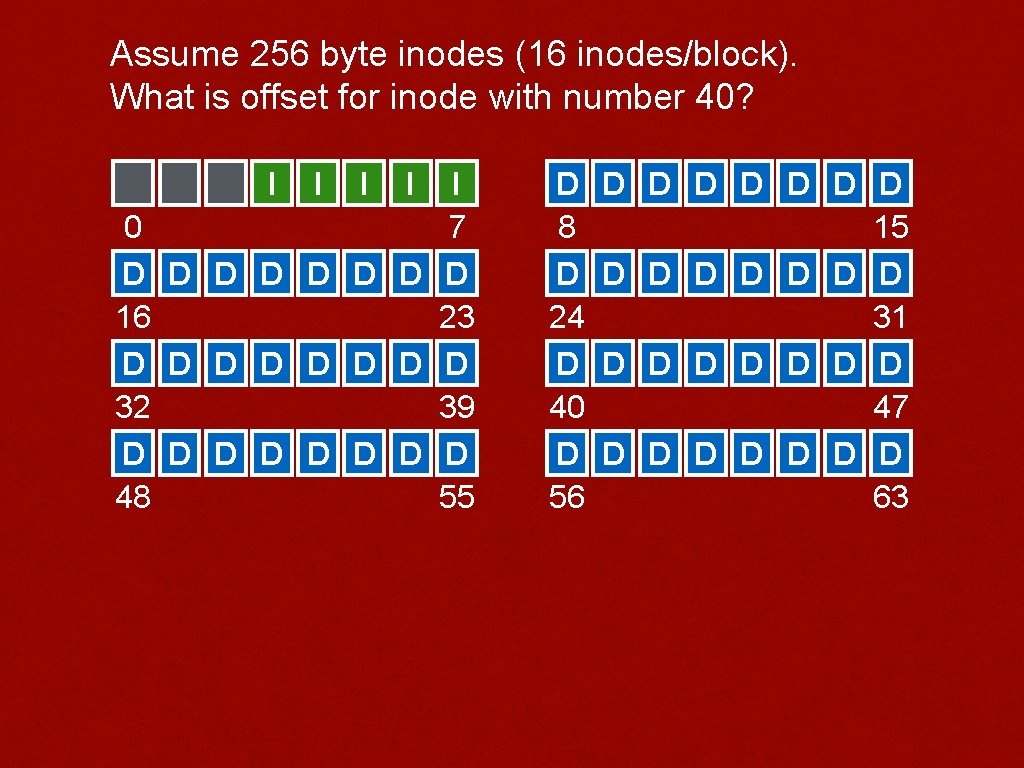
One Inode Block Each inode is typically 256 bytes (depends on the FS, maybe 128 bytes) 4 KB disk block inode 18 19 16 17 inode 22 23 20 21 inode 24 25 26 27 16 inodes per inode block. inode 28 29 30 31
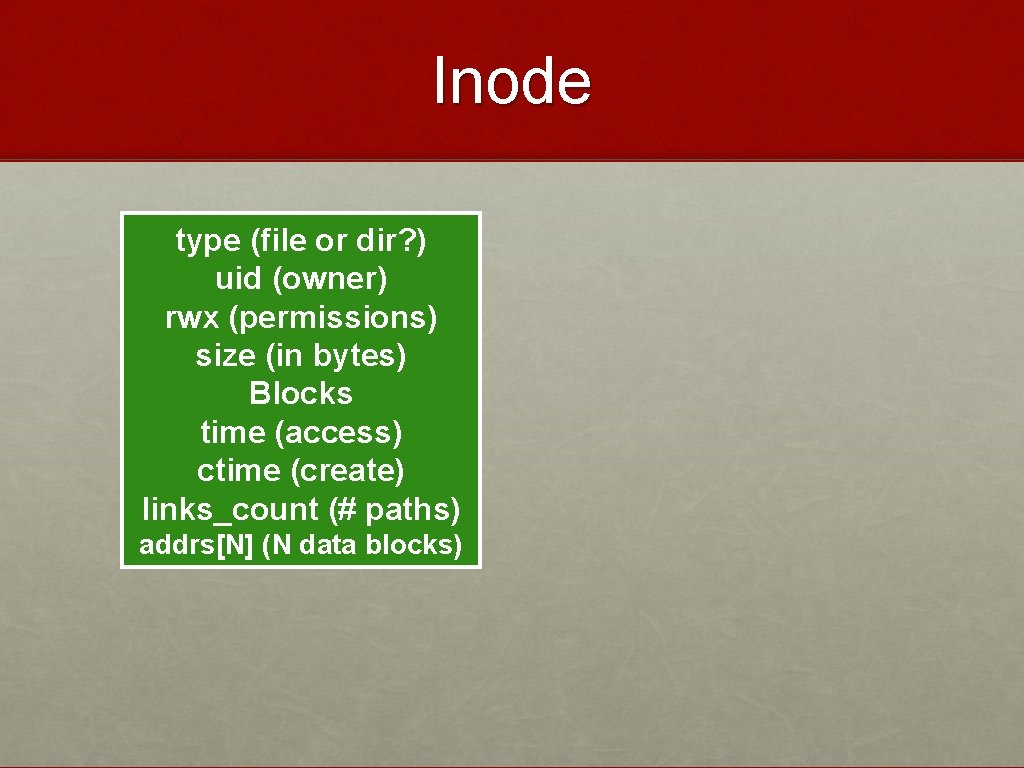
Inode type (file or dir? ) uid (owner) rwx (permissions) size (in bytes) Blocks time (access) ctime (create) links_count (# paths) addrs[N] (N data blocks)
Inodes D 0 D 16 D 32 D 48 D D I I I 7 D D D D 23 D D D D 39 D D D D 55 D 8 D 24 D 40 D 56 D D D D 15 D D D D 31 D D D D 47 D D D D 63
Inode type uid rwx size blocks time ctime links_count addrs[N] Assume single level (just pointers to data blocks) What is max file size? Assume 256 -byte inodes (all can be used for pointers) Assume 4 -byte addrs How to get larger files? 256 / 4 = 64 64 * 4 K = 256 KB!
inode data
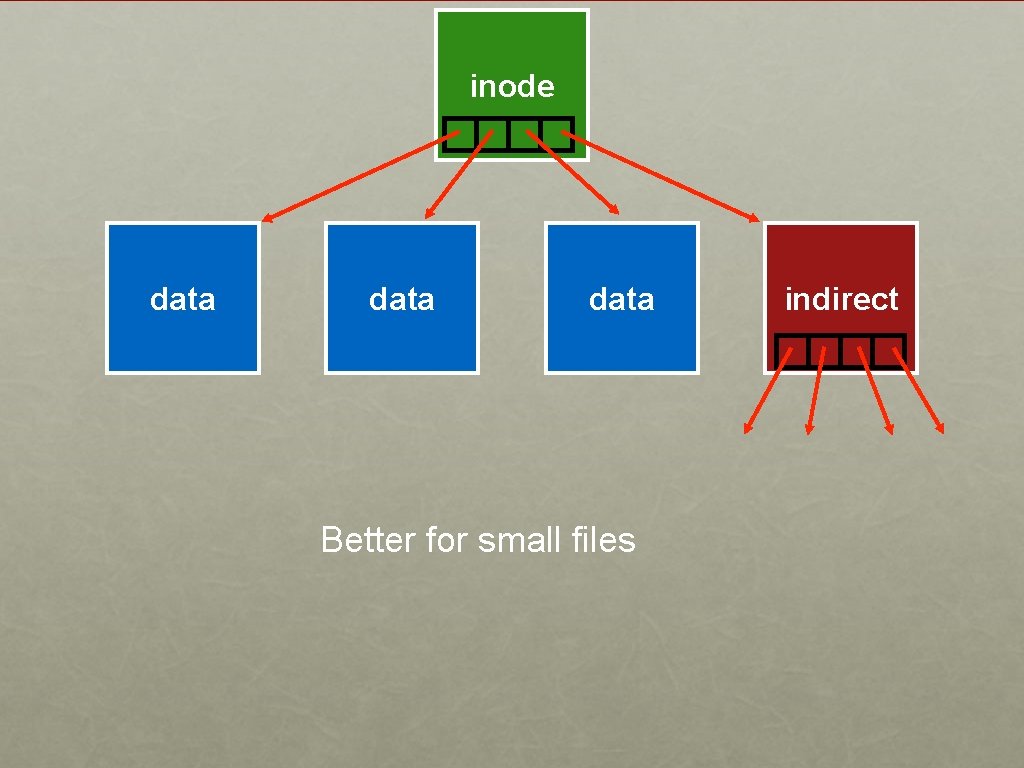
inode indirect Indirect blocks are stored in regular data blocks. indirect what if we want to optimize for small files?
inode data Better for small files indirect
Assume 256 byte inodes (16 inodes/block). What is offset for inode with number 0? D 0 D 16 D 32 D 48 D D I I I 7 D D D D 23 D D D D 39 D D D D 55 D 8 D 24 D 40 D 56 D D D D 15 D D D D 31 D D D D 47 D D D D 63
Assume 256 byte inodes (16 inodes/block). What is offset for inode with number 4? D 0 D 16 D 32 D 48 D D I I I 7 D D D D 23 D D D D 39 D D D D 55 D 8 D 24 D 40 D 56 D D D D 15 D D D D 31 D D D D 47 D D D D 63
Assume 256 byte inodes (16 inodes/block). What is offset for inode with number 40? D 0 D 16 D 32 D 48 D D I I I 7 D D D D 23 D D D D 39 D D D D 55 D 8 D 24 D 40 D 56 D D D D 15 D D D D 31 D D D D 47 D D D D 63
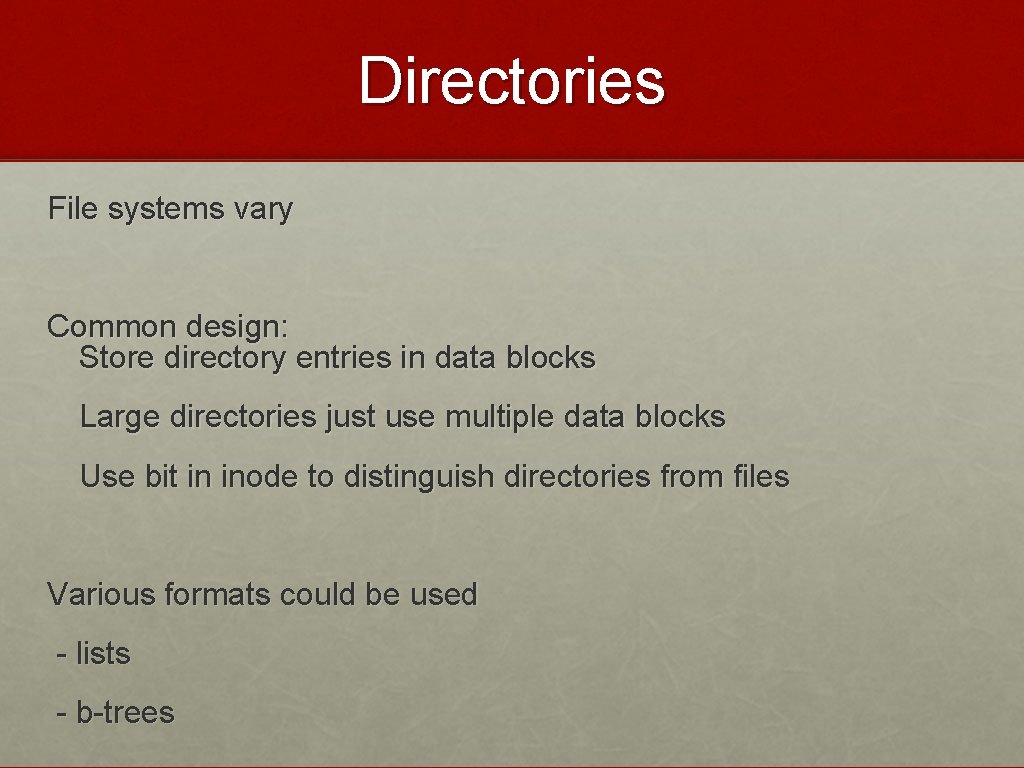
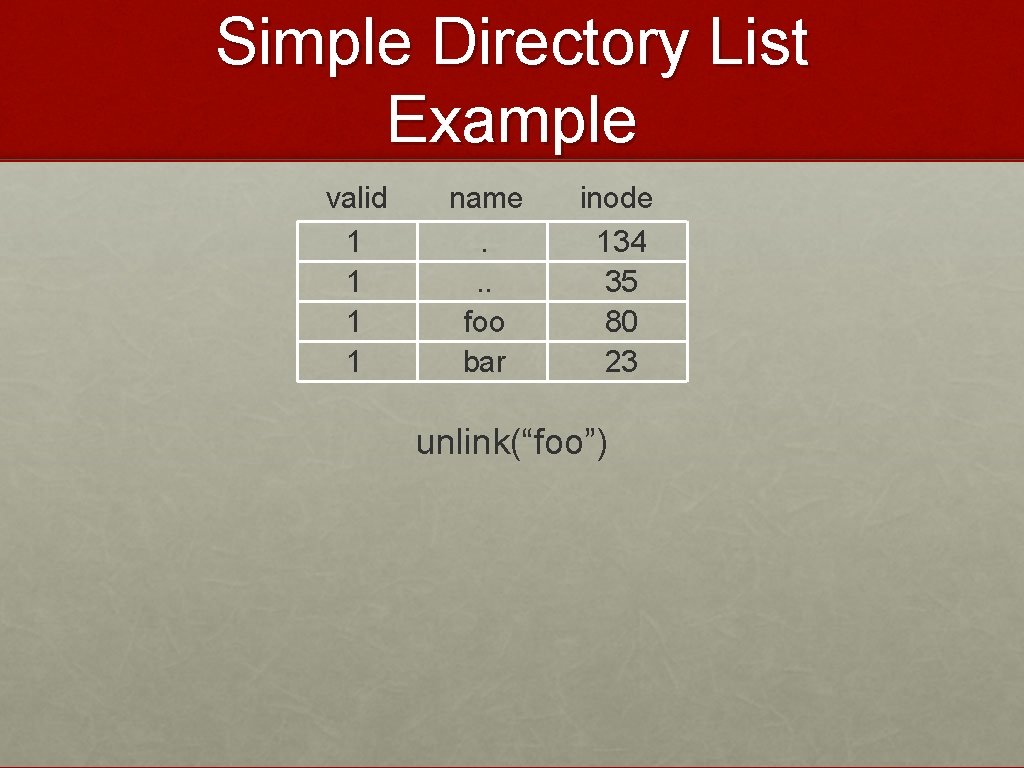
Directories File systems vary Common design: Store directory entries in data blocks Large directories just use multiple data blocks Use bit in inode to distinguish directories from files Various formats could be used - lists - b-trees
Simple Directory List Example valid 1 1 name. . . foo bar inode 134 35 80 23 unlink(“foo”)
Allocation How do we find free data blocks or free inodes?
Allocation How do we find free data blocks or free inodes? Free list Bitmaps
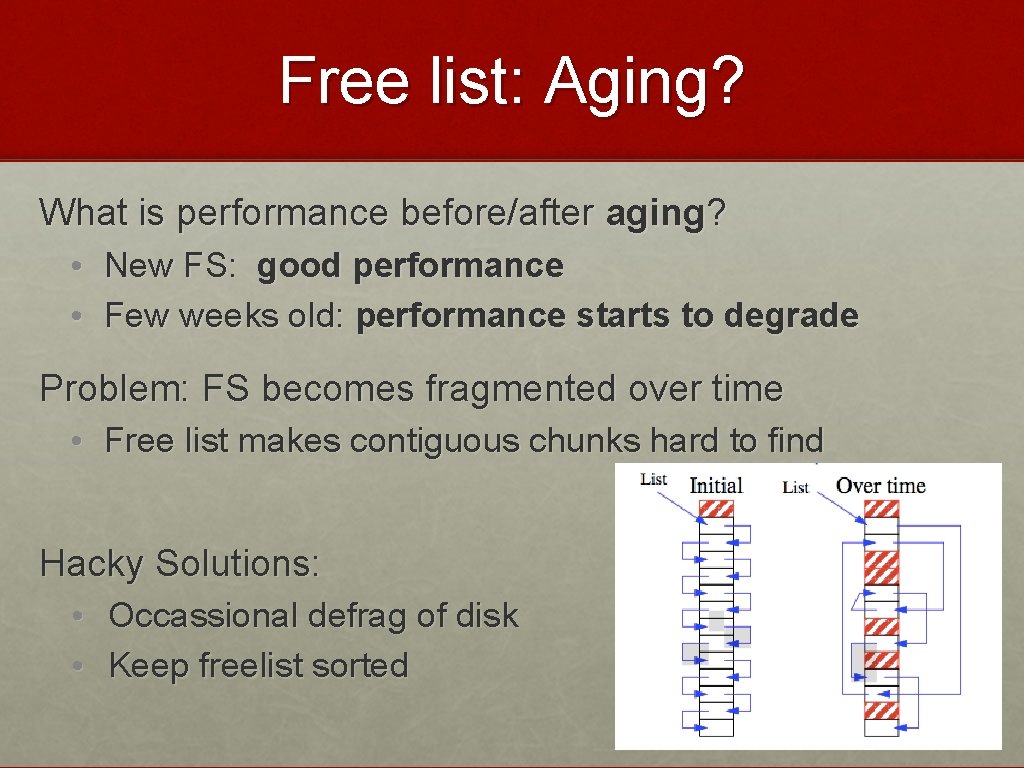
Free list: Aging? What is performance before/after aging? • New FS: good performance • Few weeks old: performance starts to degrade Problem: FS becomes fragmented over time • Free list makes contiguous chunks hard to find Hacky Solutions: • Occassional defrag of disk • Keep freelist sorted
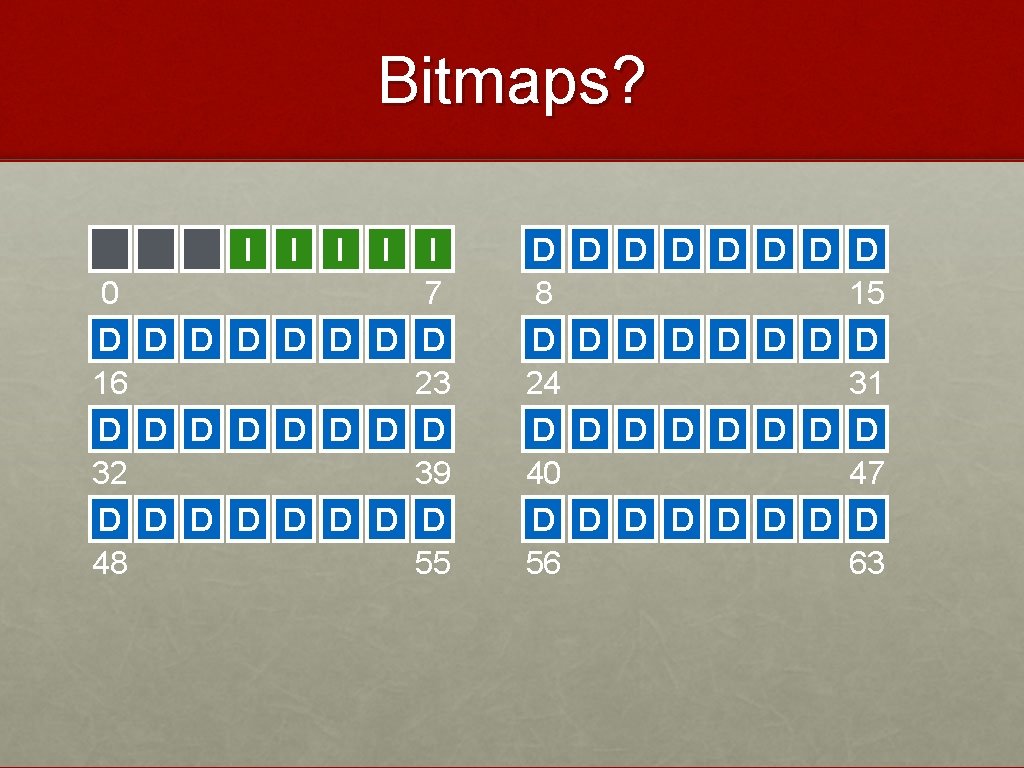
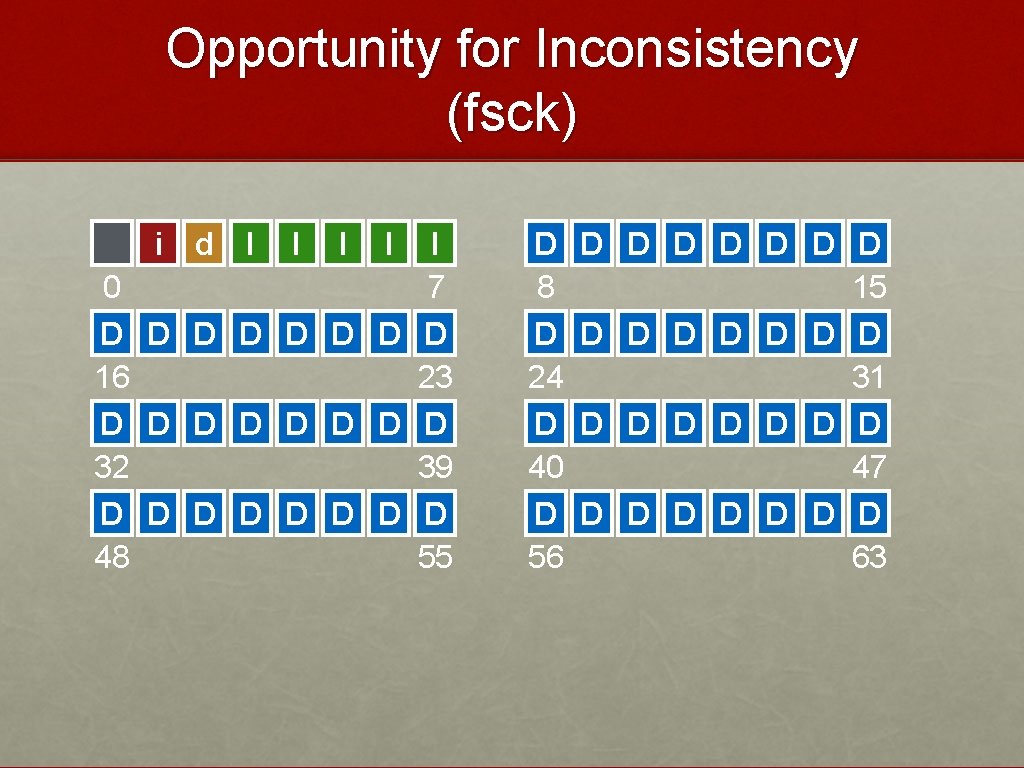
Bitmaps? D 0 D 16 D 32 D 48 D D I I I 7 D D D D 23 D D D D 39 D D D D 55 D 8 D 24 D 40 D 56 D D D D 15 D D D D 31 D D D D 47 D D D D 63
Opportunity for Inconsistency (fsck) D 0 D 16 D 32 D 48 i d I I I 7 D D D D 23 D D D D 39 D D D D 55 D 8 D 24 D 40 D 56 D D D D 15 D D D D 31 D D D D 47 D D D D 63
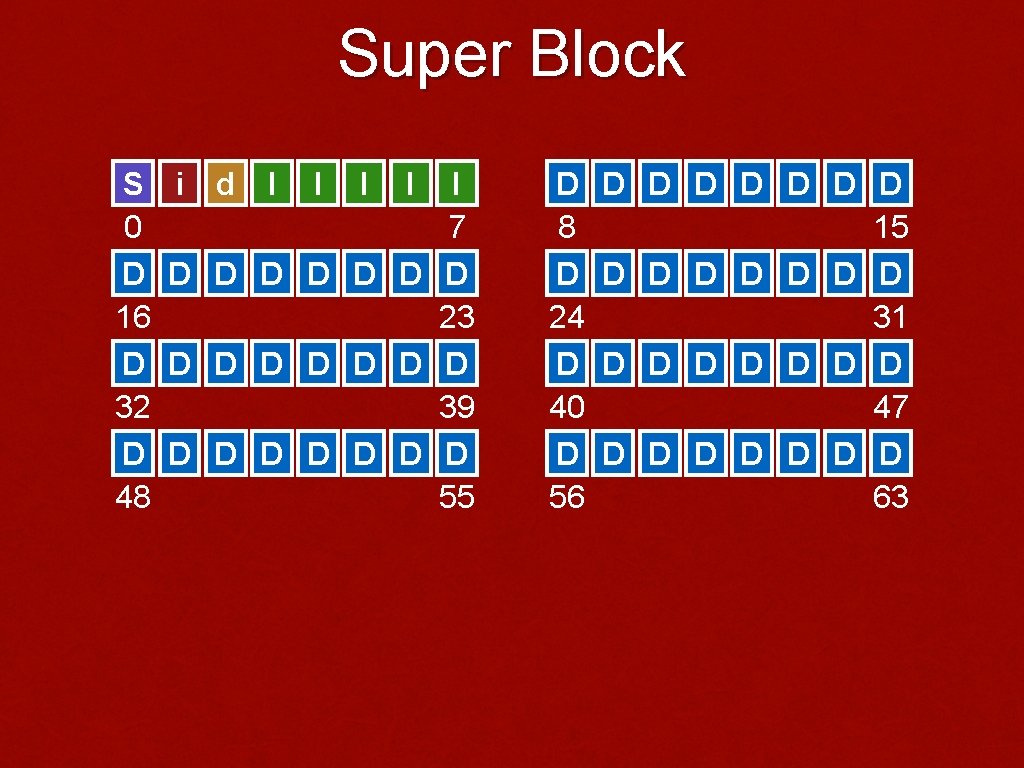
Superblock Need to know basic FS configuration metadata, like: - block size - # of inodes Store this in superblock
Super Block S 0 D 16 D 32 D 48 i d I I I 7 D D D D 23 D D D D 39 D D D D 55 D 8 D 24 D 40 D 56 D D D D 15 D D D D 31 D D D D 47 D D D D 63
On-Disk Structures Super Block Data Bitmap Data Block directories indirects Inode Bitmap Inode Table
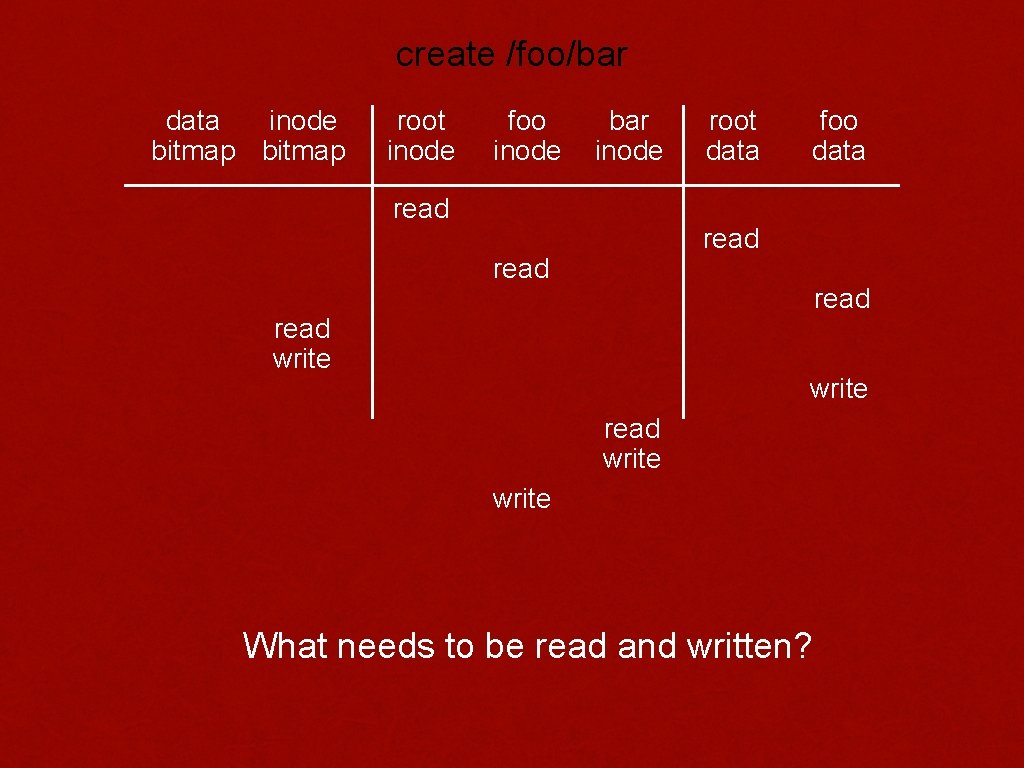
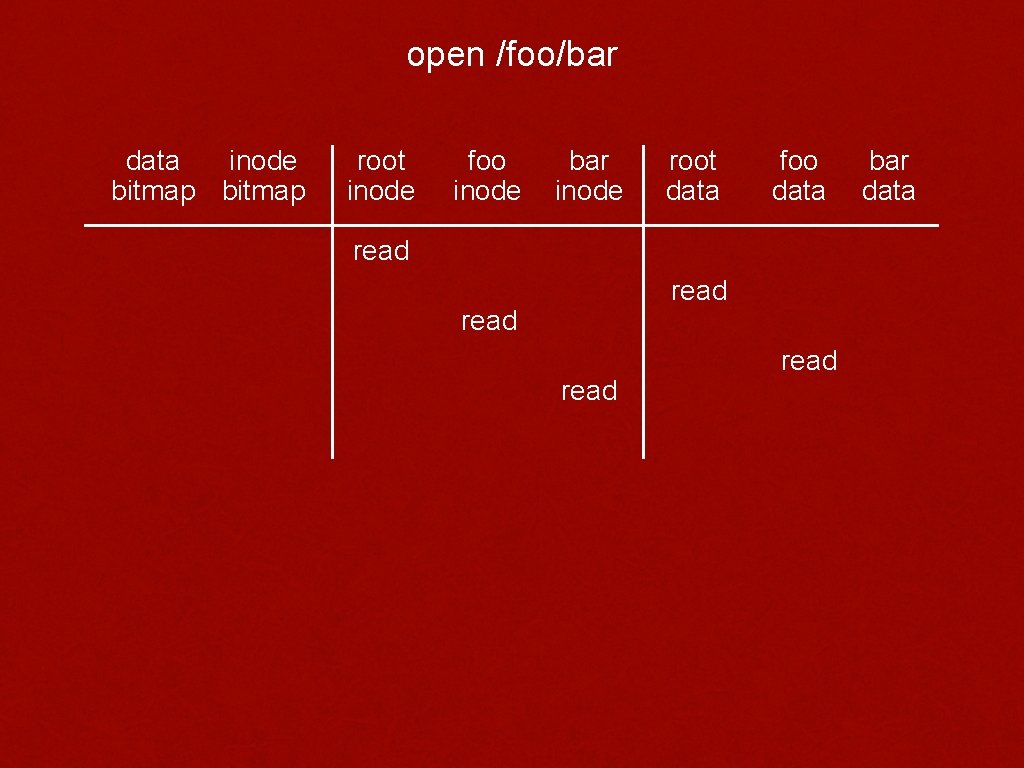
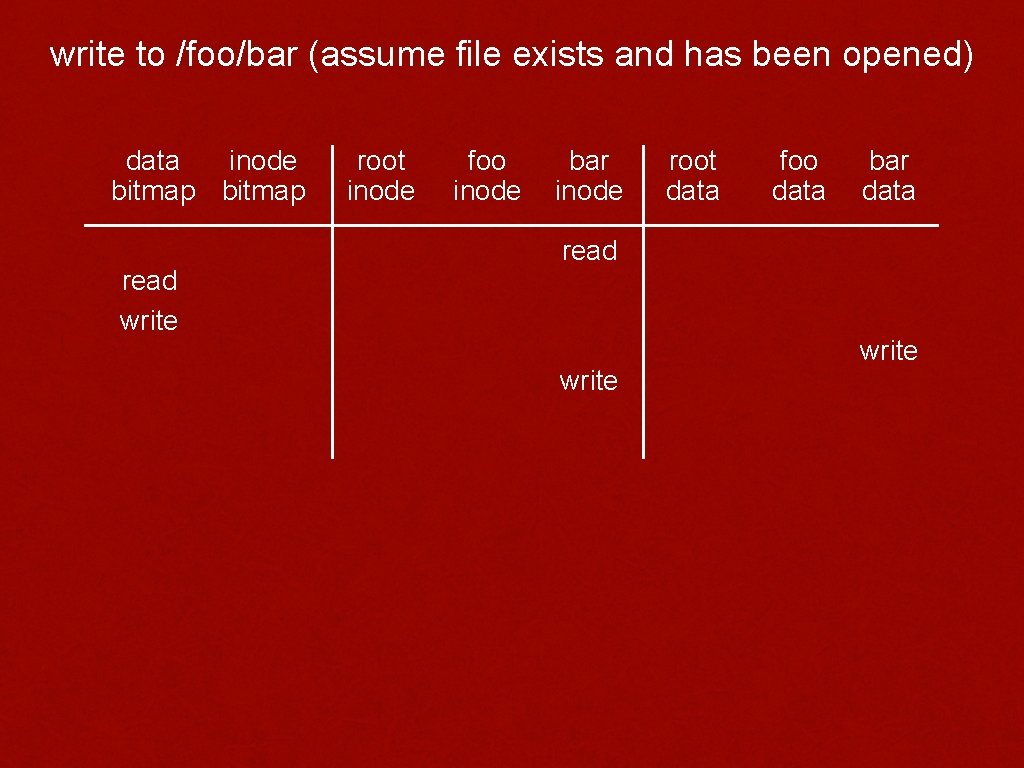
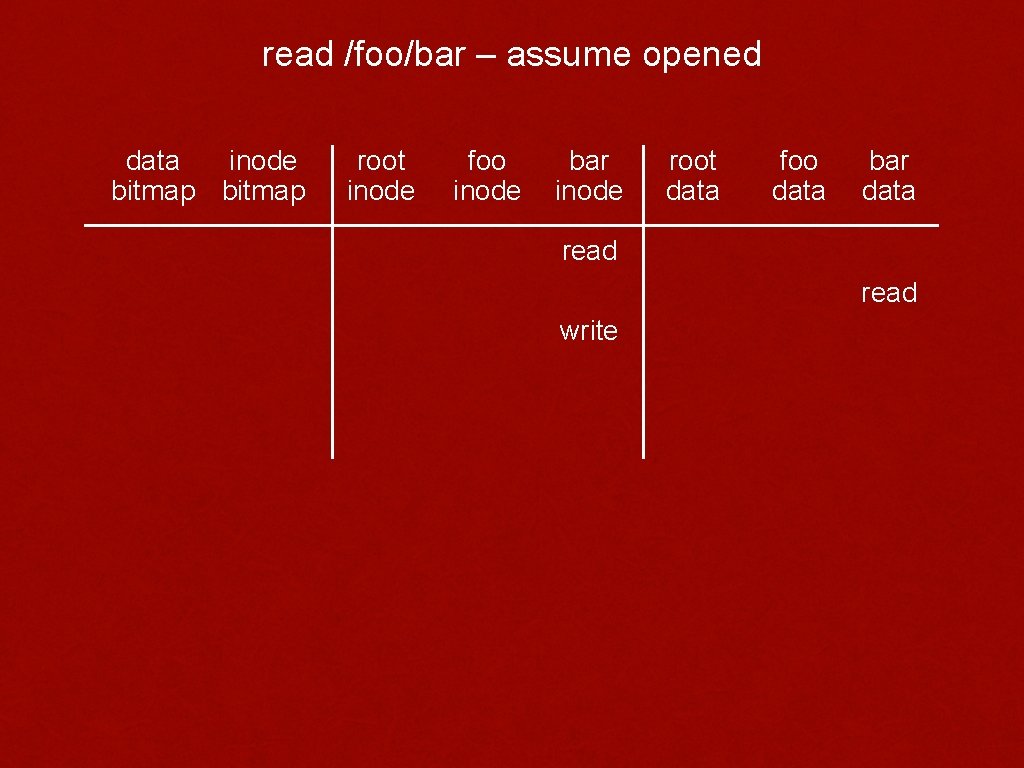
Part 2 : Operations - create file - write - open - read - close
create /foo/bar data inode bitmap root inode foo inode bar inode read root data foo data read write read write What needs to be read and written?
open /foo/bar data inode bitmap root inode foo inode bar inode root data foo data read read bar data
write to /foo/bar (assume file exists and has been opened) data inode bitmap read write root inode foo inode bar inode root data foo data bar data read write
read /foo/bar – assume opened data inode bitmap root inode foo inode bar inode root data foo data bar data read write
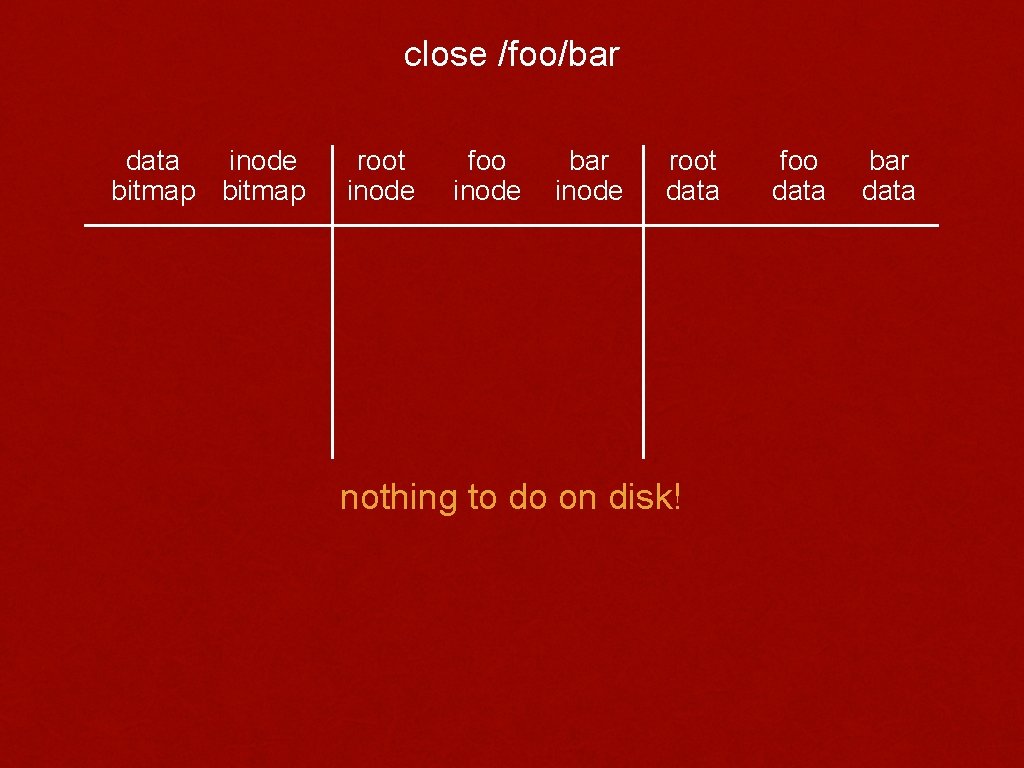
close /foo/bar data inode bitmap root inode foo inode bar inode root data nothing to do on disk! foo data bar data
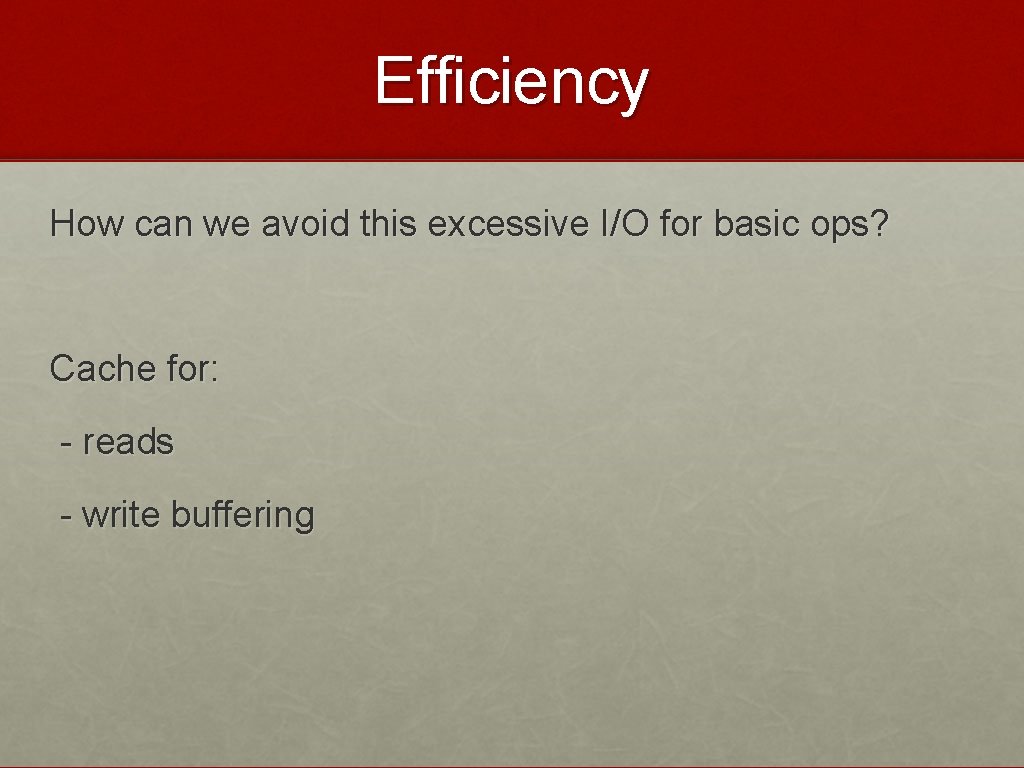
Efficiency How can we avoid this excessive I/O for basic ops? Cache for: - reads - write buffering
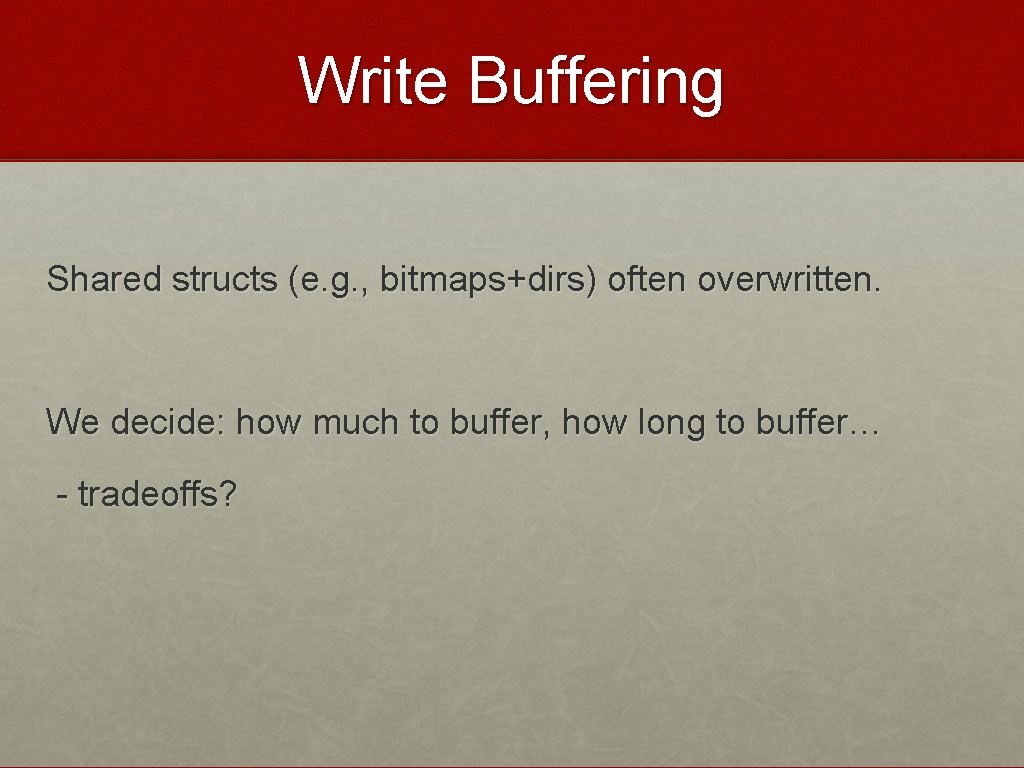
Write Buffering Shared structs (e. g. , bitmaps+dirs) often overwritten. We decide: how much to buffer, how long to buffer… - tradeoffs?
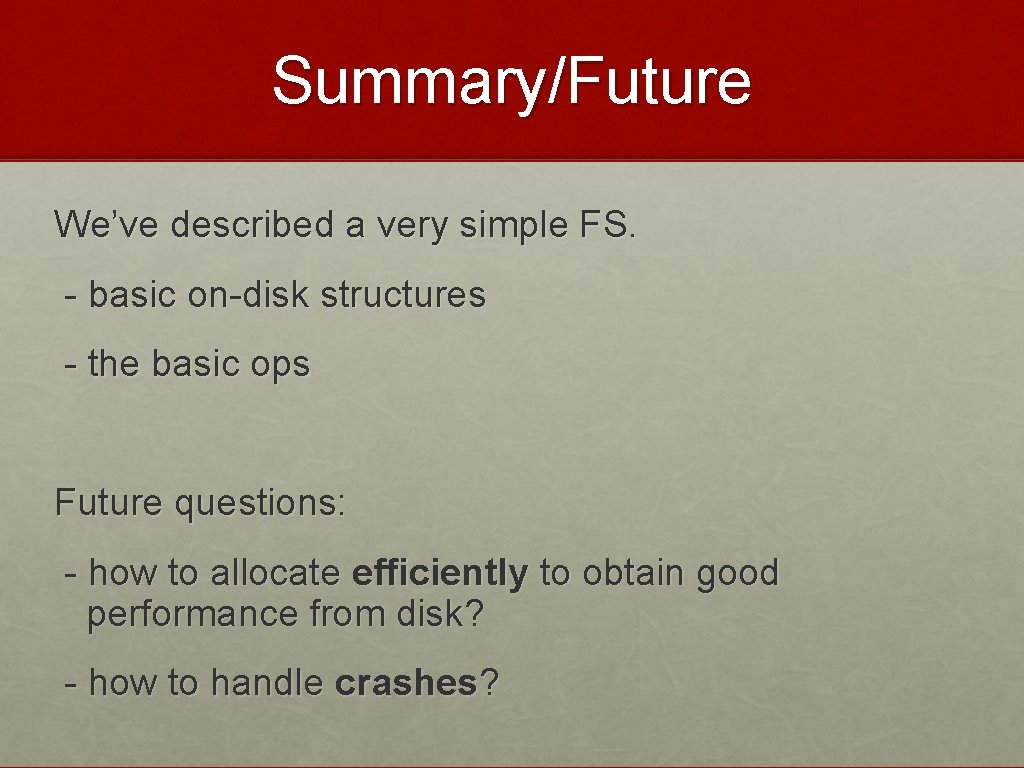
Summary/Future We’ve described a very simple FS. - basic on-disk structures - the basic ops Future questions: - how to allocate efficiently to obtain good performance from disk? - how to handle crashes?