
FILARIASIS Filariasis is tropical transmissible biohelminthiasis caused by
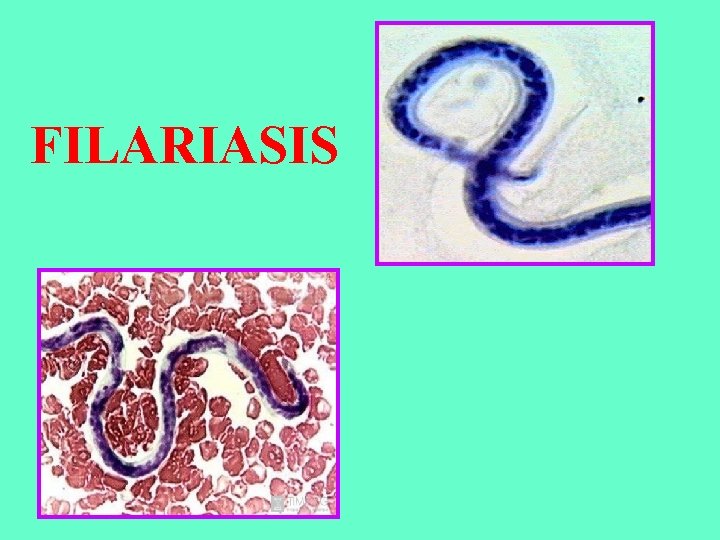
FILARIASIS
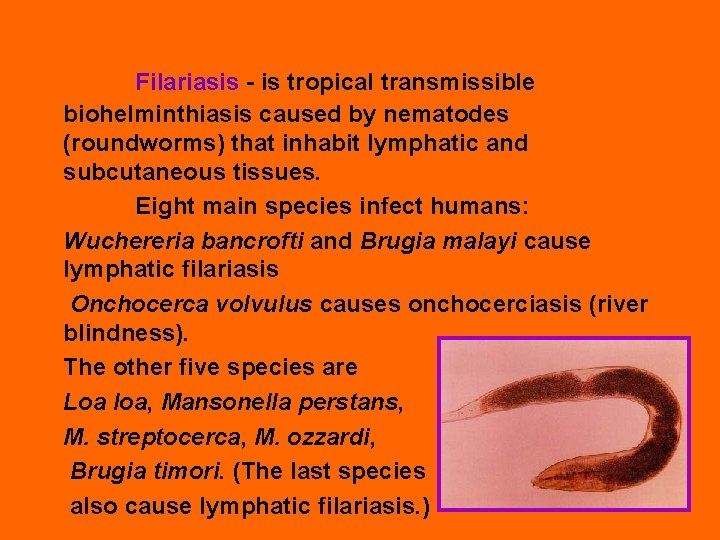
Filariasis - is tropical transmissible biohelminthiasis caused by nematodes (roundworms) that inhabit lymphatic and subcutaneous tissues. Eight main species infect humans: Wuchereria bancrofti and Brugia malayi cause lymphatic filariasis Onchocerca volvulus causes onchocerciasis (river blindness). The other five species are Loa loa, Mansonella perstans, M. streptocerca, M. ozzardi, Brugia timori. (The last species also cause lymphatic filariasis. )
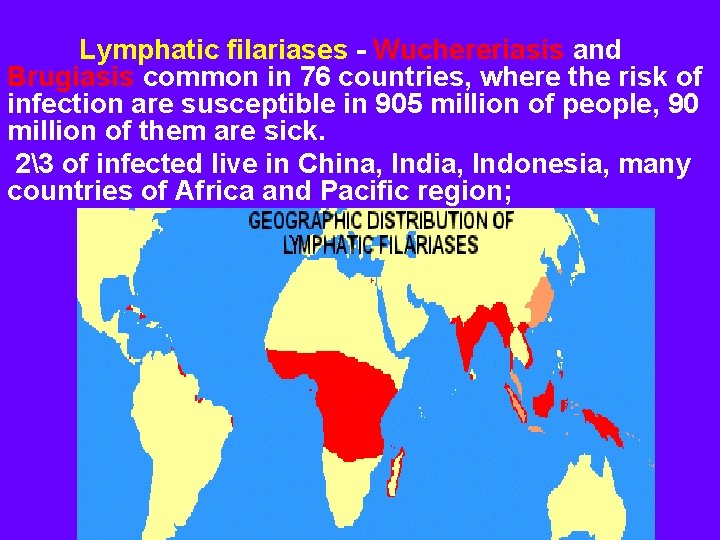
Lymphatic filariases - Wuchereriasis and Brugiasis common in 76 countries, where the risk of infection are susceptible in 905 million of people, 90 million of them are sick. 23 of infected live in China, India, Indonesia, many countries of Africa and Pacific region;
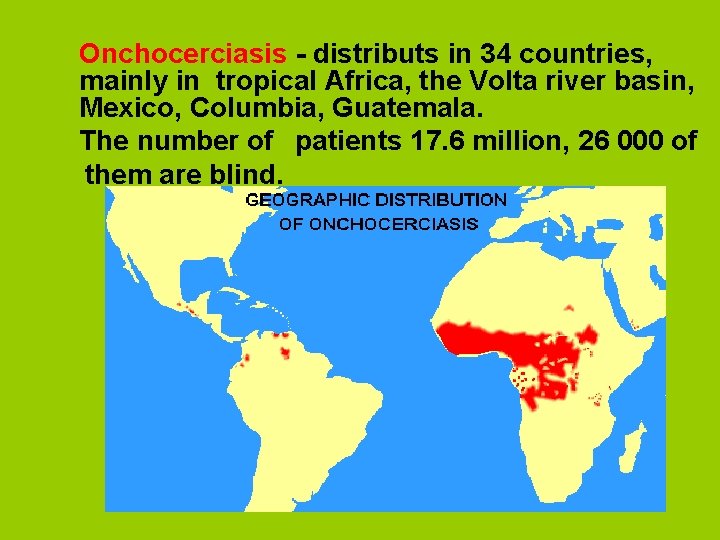
Onchocerciasis - distributs in 34 countries, mainly in tropical Africa, the Volta river basin, Mexico, Columbia, Guatemala. The number of patients 17. 6 million, 26 000 of them are blind.
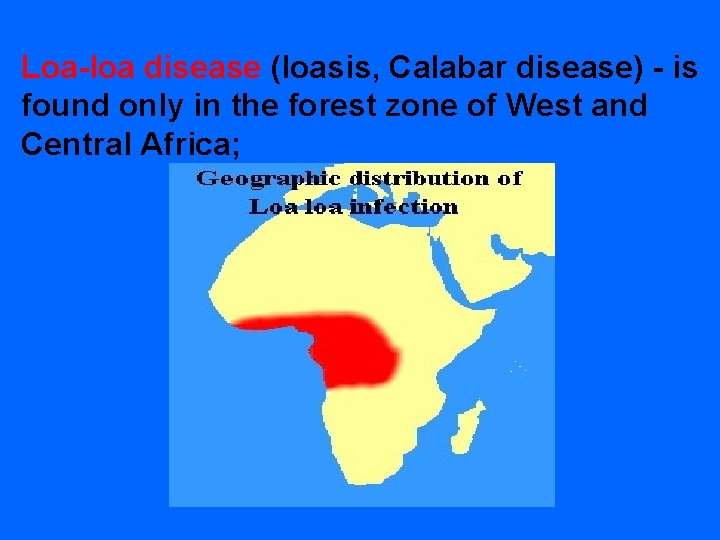
Loa-loa disease (loasis, Сalabar disease) - is found only in the forest zone of West and Central Africa;
Features of filariases 1. Causative agent – is small thin (thread-like) biogelminth 2. Cycle of development occurs with the participation of the definitive host (human)and intermediate – insect 3. Disease has a tendency to chronic course 4. All filariases have the same methods of diagnostics and treatment 5. Filariases are strictly endemic diseases registered only in the tropics and subtropics
General properties of all filariaе: 1. They are – larvaeparous bisexual biohelminths , developing with the change of host. 2. The final host – is human, intermediate host – arthropods (mosquitoes, midges, gadflies). 3. The adult warms (macrofilaria) dwell in various human tissues where they can live for several years (subcutaneous tissue – onchocerciasis, loasis, streptocerciasis, lymph vessels – wuchereriasis and brugiasis connective tissue etc). 5. Females produce larvae (microfilaria) which penetrate into blood stream or superficial skin layers (onchocercoiasis), they do not grow and change morphologically. 6. Length of adult males up to 50 mm, females - up to 100 mm, microfilaria - 0, 3 mm.
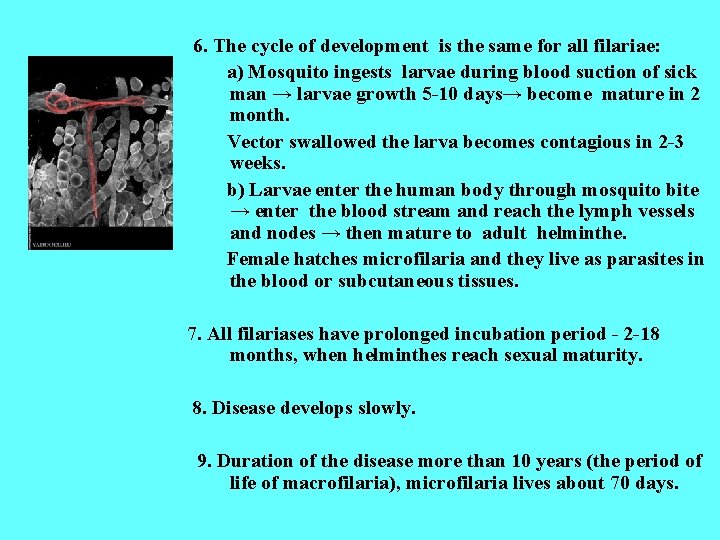
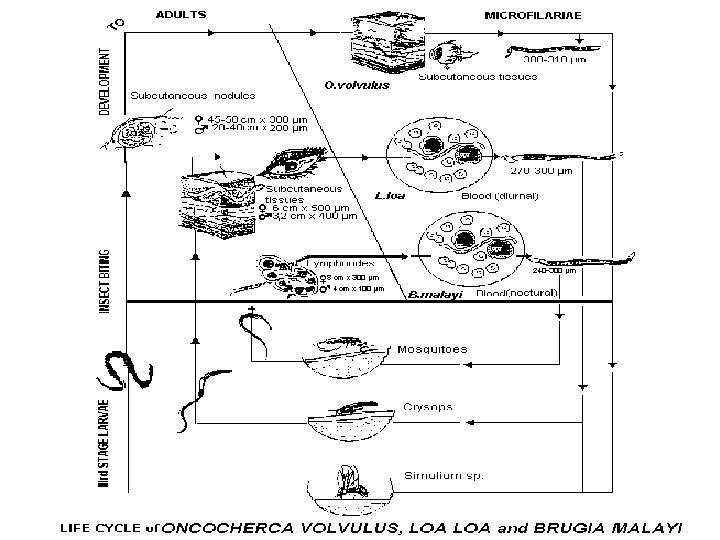
6. The cycle of development is the same for all filariae: a) Mosquito ingests larvae during blood suction of sick man → larvae growth 5 -10 days→ become mature in 2 month. Vector swallowed the larva becomes contagious in 2 -3 weeks. b) Larvae enter the human body through mosquito bite → enter the blood stream and reach the lymph vessels and nodes → then mature to adult helminthe. Female hatches microfilaria and they live as parasites in the blood or subcutaneous tissues. 7. All filariases have prolonged incubation period - 2 -18 months, when helminthes reach sexual maturity. 8. Disease develops slowly. 9. Duration of the disease more than 10 years (the period of life of macrofilaria), microfilaria lives about 70 days.
10. There are three groups of filariases depending on the concentration of larvae in the peripheral blood: - periodical –peak of the highest concentration of larvae in peripheral blood is observed in a day or at night, in other times filariae are absent , - subperiodical - larvae is constantly present in the peripheral blood, but the highest concentration may be seen only in the same time of the day. - non- periodical– microfilariae are always present in the blood in constant concentration. Frequency coincides with the period of maximal activity of the vector.

Wuchereriasis and Brugiasis (Filariasis Bancrofti, F. Malayi) - transmissible tissue tropical helminthiasis with primary affection of the lymphatic system. ETIOLOGY: causative agent of wuchereriasis – Wuchereria bancrofti (Wucherer and Bancroft - scientists, who have described the helminthe), brugiasis - Brugia malayi (Brug – scientist) Macrofilaria parasites in the lymph nodes and vessels, microfilaria - in the blood. EPIDEMIOLOGY: source of infection in W. (anthroponosis) – human, in B. (zoonosis) – cats, dogs, monkeys, human.
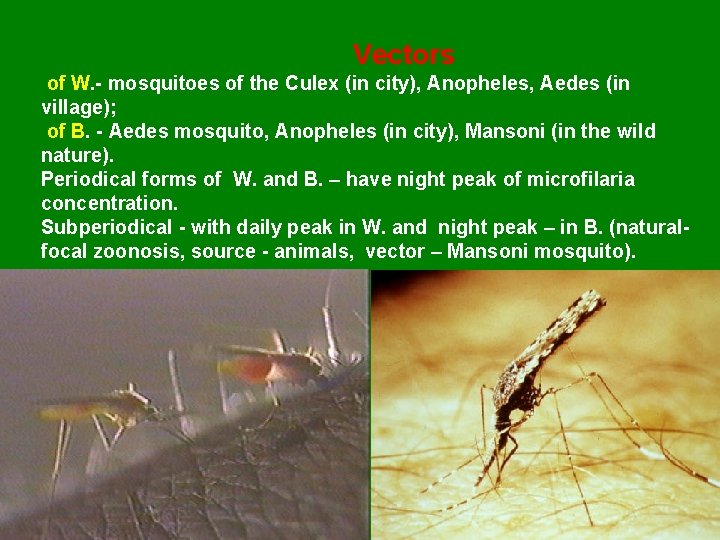
Vectors of W. - mosquitoes of the Culex (in city), Anopheles, Aedes (in village); of B. - Aedes mosquito, Anopheles (in city), Mansoni (in the wild nature). Periodical forms of W. and B. – have night peak of microfilaria concentration. Subperiodical - with daily peak in W. and night peak – in B. (naturalfocal zoonosis, source - animals, vector – Mansoni mosquito).
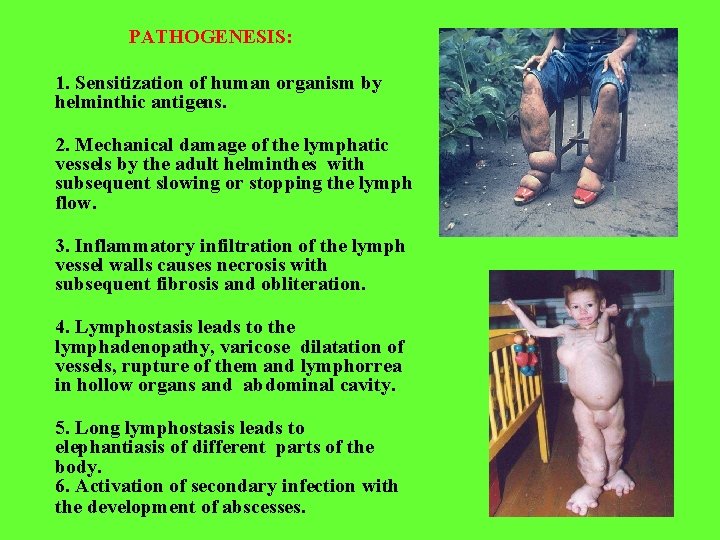
PATHOGENESIS: 1. Sensitization of human organism by helminthic antigens. 2. Mechanical damage of the lymphatic vessels by the adult helminthes with subsequent slowing or stopping the lymph flow. 3. Inflammatory infiltration of the lymph vessel walls causes necrosis with subsequent fibrosis and obliteration. 4. Lymphostasis leads to the lymphadenopathy, varicose dilatation of vessels, rupture of them and lymphorrea in hollow organs and abdominal cavity. 5. Long lymphostasis leads to elephantiasis of different parts of the body. 6. Activation of secondary infection with the development of abscesses.
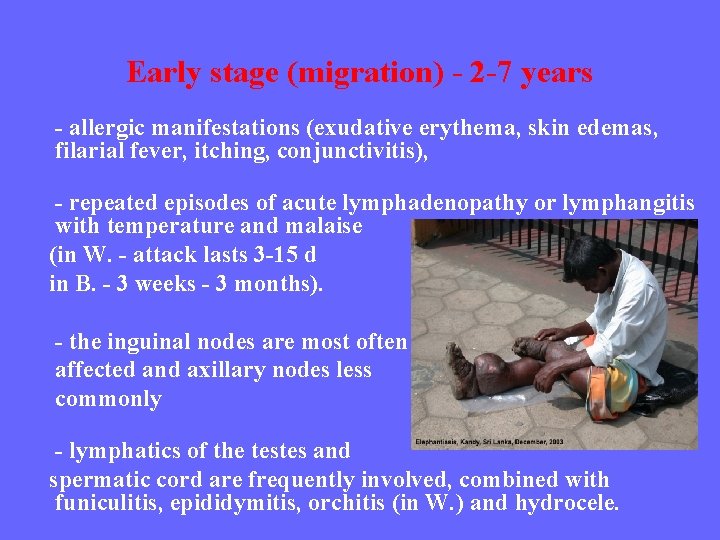
Early stage (migration) - 2 -7 years - allergic manifestations (exudative erythema, skin edemas, filarial fever, itching, conjunctivitis), - repeated episodes of acute lymphadenopathy or lymphangitis with temperature and malaise (in W. - attack lasts 3 -15 d in B. - 3 weeks - 3 months). - the inguinal nodes are most often affected and axillary nodes less commonly - lymphatics of the testes and spermatic cord are frequently involved, combined with funiculitis, epididymitis, orchitis (in W. ) and hydrocele.
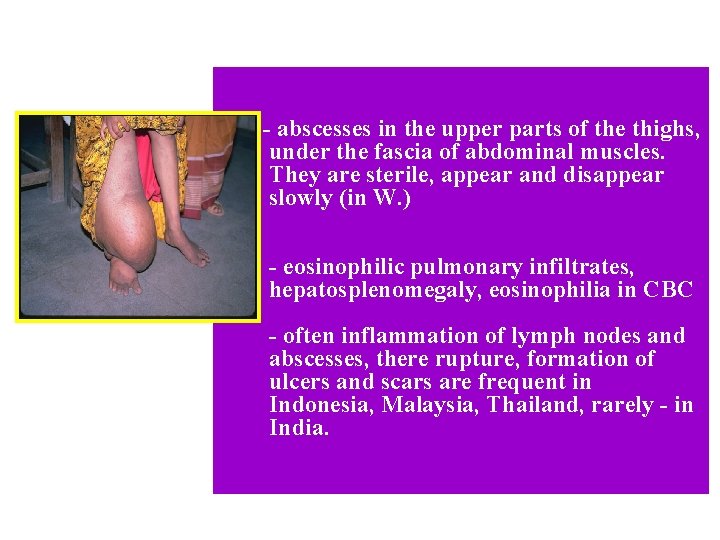
- - - abscesses in the upper parts of the thighs, under the fascia of abdominal muscles. They are sterile, appear and disappear slowly (in W. ) - eosinophilic pulmonary infiltrates, hepatosplenomegaly, eosinophilia in CBC - often inflammation of lymph nodes and abscesses, there rupture, formation of ulcers and scars are frequent in Indonesia, Malaysia, Thailand, rarely - in India.
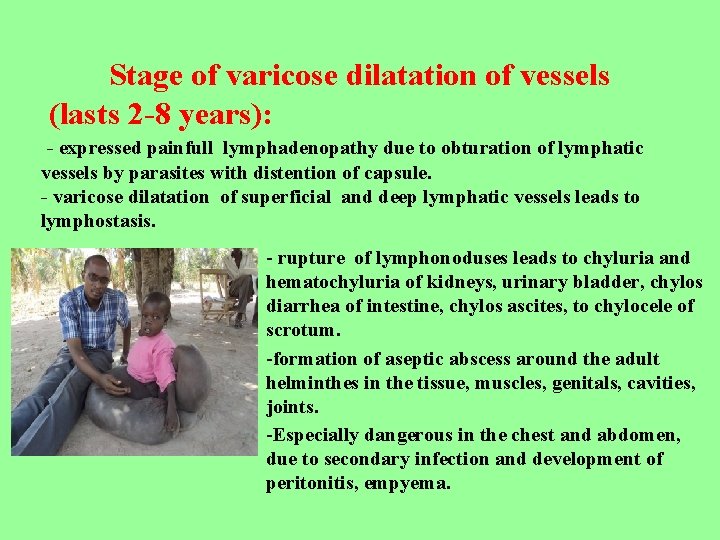
Stage of varicose dilatation of vessels (lasts 2 -8 years): - expressed painfull lymphadenopathy due to obturation of lymphatic vessels by parasites with distention of capsule. - varicose dilatation of superficial and deep lymphatic vessels leads to lymphostasis. - rupture of lymphonoduses leads to chyluria and hematochyluria of kidneys, urinary bladder, chylos diarrhea of intestine, chylos ascites, to chylocele of scrotum. -formation of aseptic abscess around the adult helminthes in the tissue, muscles, genitals, cavities, joints. -Especially dangerous in the chest and abdomen, due to secondary infection and development of peritonitis, empyema.
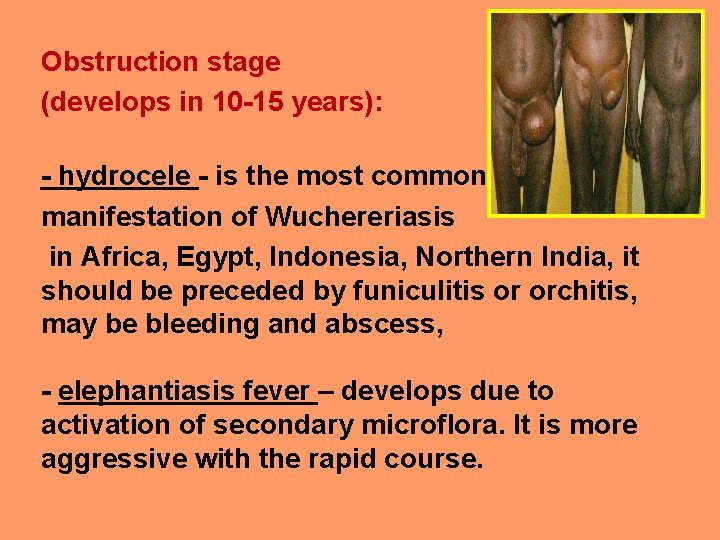
Obstruction stage (develops in 10 -15 years): - hydrocele - is the most common manifestation of Wuchereriasis in Africa, Egypt, Indonesia, Northern India, it should be preceded by funiculitis or orchitis, may be bleeding and abscess, - elephantiasis fever – develops due to activation of secondary microflora. It is more aggressive with the rapid course.
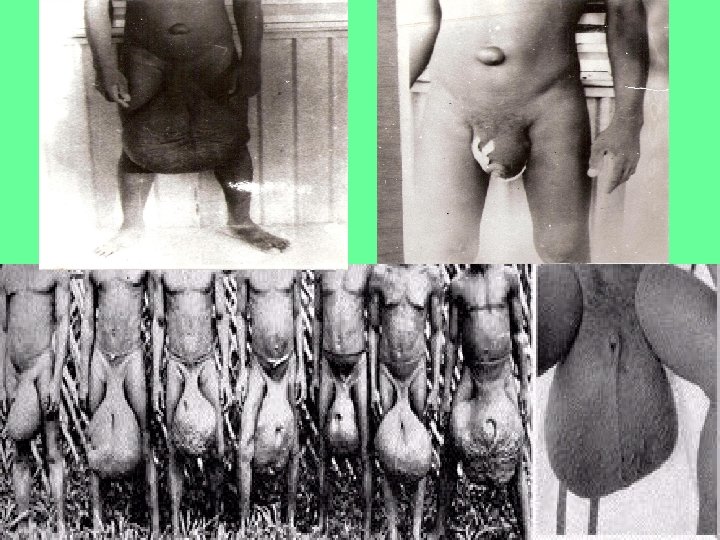
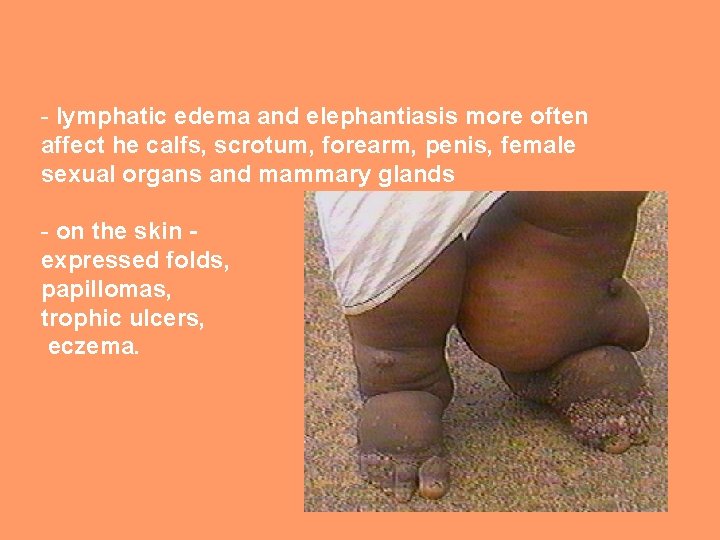
- lymphatic edema and elephantiasis more often affect he calfs, scrotum, forearm, penis, female sexual organs and mammary glands - on the skin expressed folds, papillomas, trophic ulcers, eczema.
IMMUNITY - low reactivity antigens of filaria - development of immunosuppression (serum-factors, T-lymphocytes, monocytes), Антиген - high ratio of suppressors to helper T-cells, -titles of Ig. E are high, but signs of allergic reactivity are not observed.
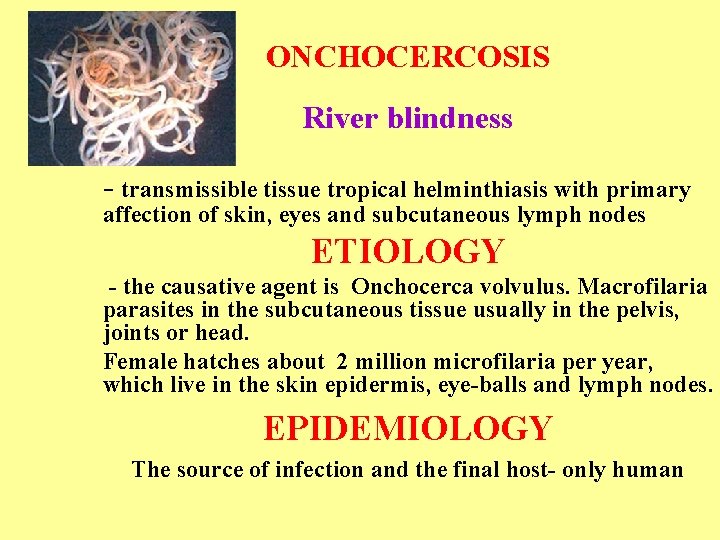
ONCHOCERCOSIS River blindness - transmissible tissue tropical helminthiasis with primary affection of skin, eyes and subcutaneous lymph nodes ETIOLOGY - the causative agent is Onchocerca volvulus. Macrofilaria parasites in the subcutaneous tissue usually in the pelvis, joints or head. Female hatches about 2 million microfilaria per year, which live in the skin epidermis, eye-balls and lymph nodes. EPIDEMIOLOGY The source of infection and the final host- only human
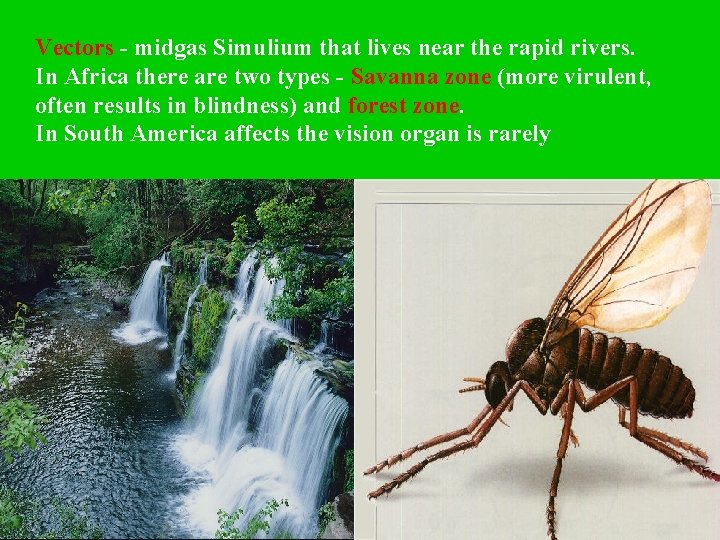
Vectors - midgas Simulium that lives near the rapid rivers. In Africa there are two types - Savanna zone (more virulent, often results in blindness) and forest zone. In South America affects the vision organ is rarely
PATHOGENESIS 1. Mechanical influence of adult parasites, around which onchocercoma is formed (connective tissue node) 2. Toxico-allergic effects of mature parasite and it’s larvae (especially dead worm) 3. Penetration of the larvae into eyeballs results in iritis or iridocyclitis ( «anterior uveitis» ) and/or chorioiditis or chorioretinitis ( «posterior uveitis» ), keratitis, conjunctivitis with subsequent development of gradual sclerosis, atrophy of the optic nerve and blindness 4. Parasitizing microfilaria causes dermatitis with lymph swelling of the skin of genitals, lower extremities and elephantiasis 5. In the final stages depigmentation, atrophy, ulceration is developed
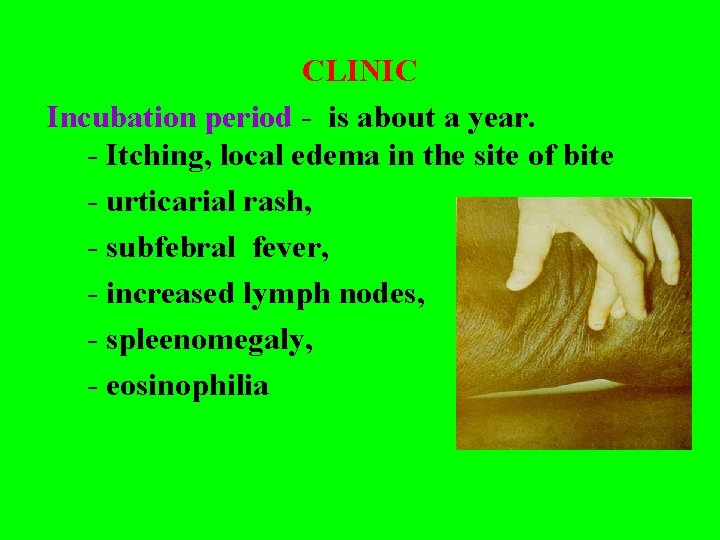
CLINIC Incubation period - is about a year. - Itching, local edema in the site of bite - urticarial rash, - subfebral fever, - increased lymph nodes, - spleenomegaly, - eosinophilia
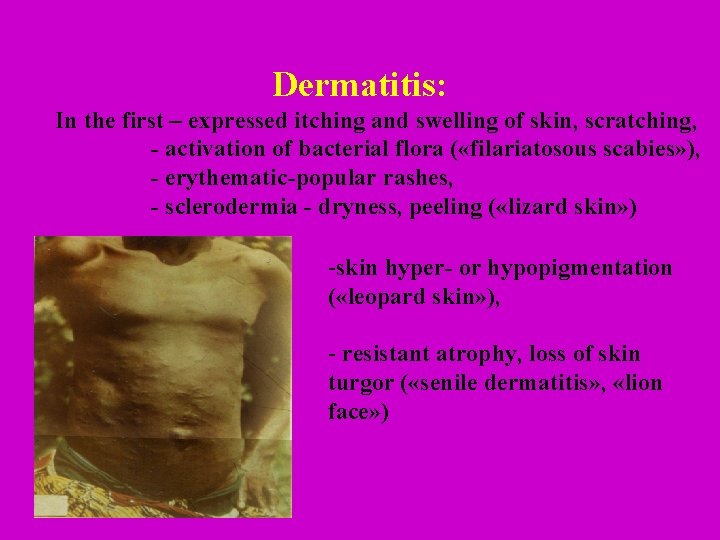
Dermatitis: In the first – expressed itching and swelling of skin, scratching, - activation of bacterial flora ( «filariatosous scabies» ), - erythematic-popular rashes, - sclerodermia - dryness, peeling ( «lizard skin» ) -skin hyper- or hypopigmentation ( «leopard skin» ), - resistant atrophy, loss of skin turgor ( «senile dermatitis» , «lion face» )
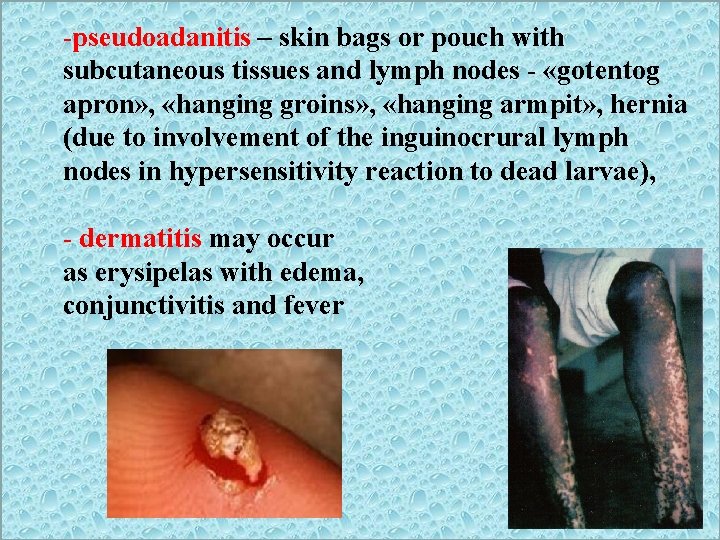
-pseudoadanitis – skin bags or pouch with subcutaneous tissues and lymph nodes - «gotentog apron» , «hanging groins» , «hanging armpit» , hernia (due to involvement of the inguinocrural lymph nodes in hypersensitivity reaction to dead larvae), - dermatitis may occur as erysipelas with edema, conjunctivitis and fever
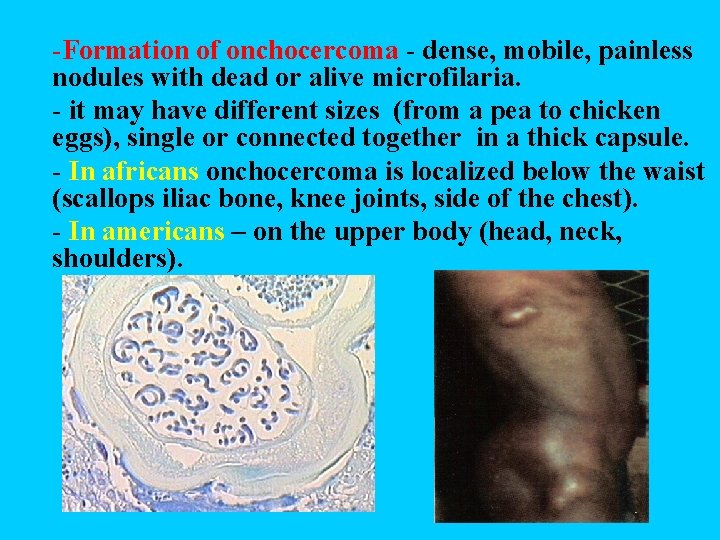
-Formation of onchocercoma - dense, mobile, painless nodules with dead or alive microfilaria. - it may have different sizes (from a pea to chicken eggs), single or connected together in a thick capsule. - In africans onchocercoma is localized below the waist (scallops iliac bone, knee joints, side of the chest). - In americans – on the upper body (head, neck, shoulders).
-affection of lymphatic system lymphadenitis (groin and armpit), lymph edema, orchitis, hydrocele, elephantiasis of the lower limbs and genitals - microfilaria is detected in urine, sputum, vaginal discharge, lymphatic and blood circulation system, saliva, cerebrospinal fluid, liver, kidneys, lungs, spleen Onchocercosis is a systemic disease
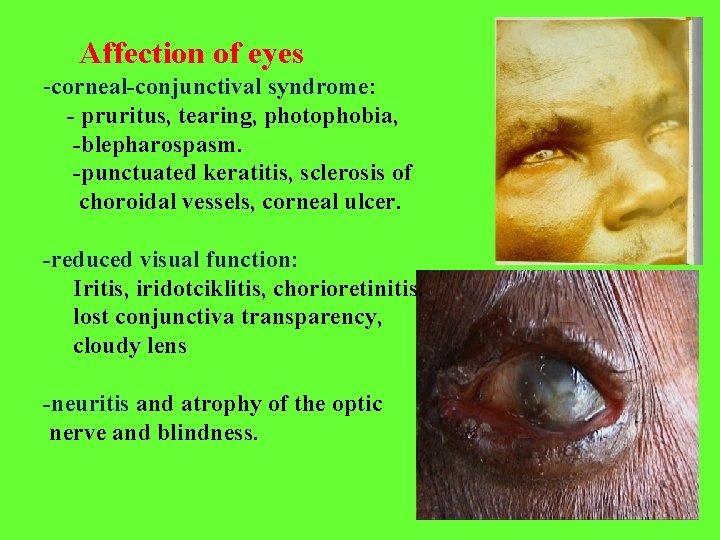
Affection of eyes -corneal-conjunctival syndrome: - pruritus, tearing, photophobia, -blepharospasm. -punctuated keratitis, sclerosis of choroidal vessels, corneal ulcer. -reduced visual function: Iritis, iridotciklitis, chorioretinitis. lost conjunctiva transparency, cloudy lens -neuritis and atrophy of the optic nerve and blindness.
LOASIS (Calabar swelling disease) - transmissible tissue tropical helminthiasis, characterized by different allergic reactions, edema of soft tissues, affection of eyes and genital organs. ETIOLOGY Pathogen - Loa loa, adult worm parasites under the conjunctiva of the eye and pericardium, microfilaria – in the blood in afternoon.
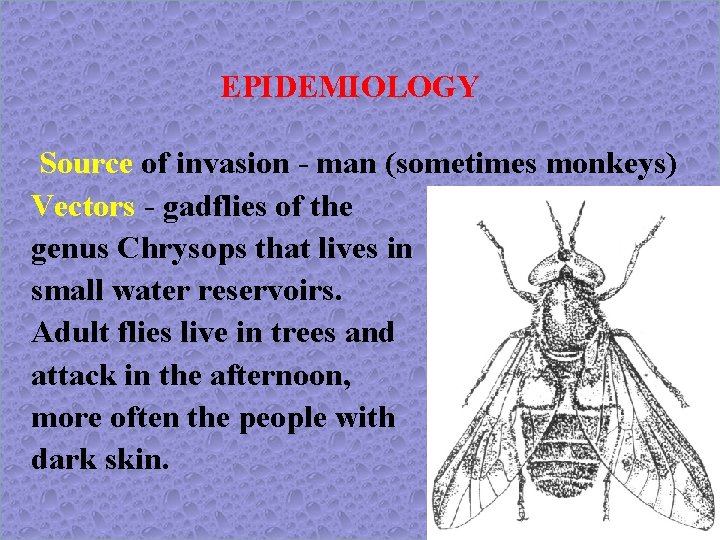
EPIDEMIOLOGY Source of invasion - man (sometimes monkeys) Vectors - gadflies of the genus Chrysops that lives in small water reservoirs. Adult flies live in trees and attack in the afternoon, more often the people with dark skin.
PATHOGENESIS – the same to other filariasis CLINIC Incubation period - 4 months, till one year. 1. Skin itching, rash, neuropathic pain, subfibrale fever, hypereosinophilia – allergic syndrom. 2. Colabar swelling (dense, painless, slowly disappearing) on local open parts of body (often on the extremities), skin above is pale, hot, fossa does not remain. 3. Edema of eyelids, hyperemia of conjunctiva, pain in eyes, lacrimation. Helminth is visible by eyes. 4. Symptoms correspond to the place of helminth migration (dysuria, meningoencephalitis, neuritis, nephritic syndrome, hydrocele). 5. Abscesses around the dead worms. 6. Sometimes parasites visible under the skin and come out through the skin.
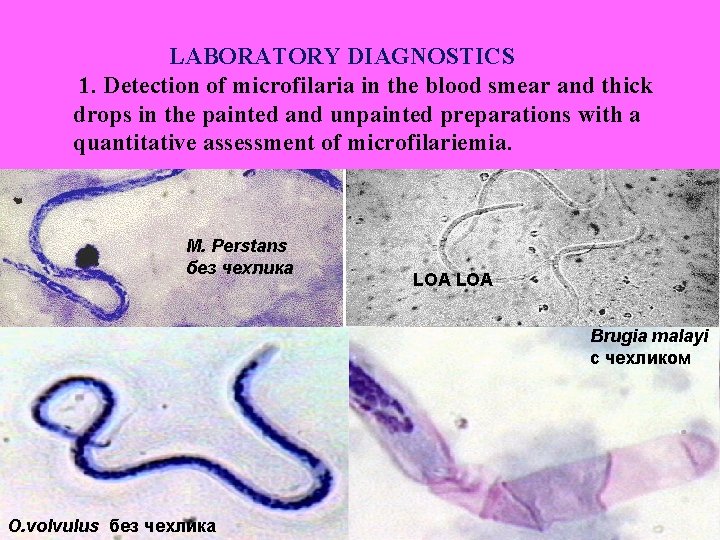
LABORATORY DIAGNOSTICS 1. Detection of microfilaria in the blood smear and thick drops in the painted and unpainted preparations with a quantitative assessment of microfilariemia. M. Perstans без чехлика LOA Brugia malayi с чехликом O. volvulus без чехлика
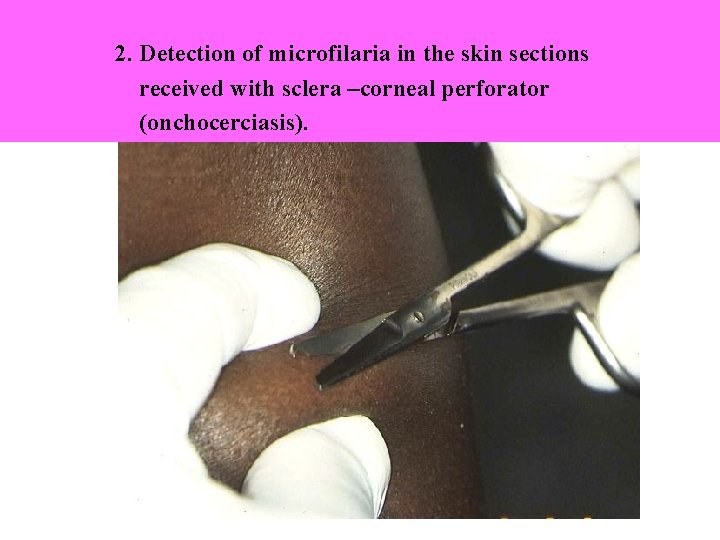
2. Detection of microfilaria in the skin sections received with sclera –corneal perforator (onchocerciasis).
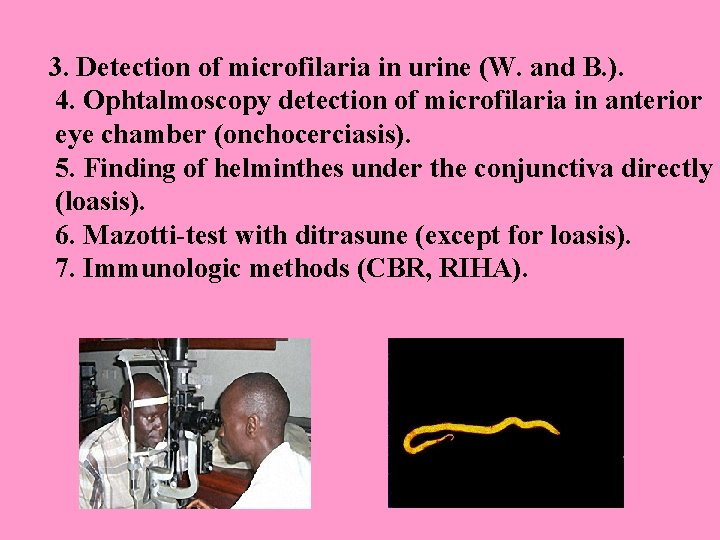
3. Detection of microfilaria in urine (W. and B. ). 4. Ophtalmoscopy detection of microfilaria in anterior eye chamber (onchocerciasis). 5. Finding of helminthes under the conjunctiva directly (loasis). 6. Маzоtti-test with ditrasune (except for loasis). 7. Immunologic methods (CBR, RIHA).

TREATMENT Dietylcarbamasine - is effective in acute and chronic stage, in latent filariasis 6 mg /kg /day (after meal) - 12 days (from 3 to 6 mg / kg / day). In loasis - on the first day - 12 of doses, gradually increasing to 0. 1 (3 -4 times) - 2 -3 weeks. Onchocerciasis: Dietylcarbamasine (initial dose reduced) -12 days Antripol (suramin)- 10% - 5 ml - 1 st day 10% - 10 ml - 2 nd day 10% - 10 ml -1 times in 7 days 5 -7 weeks Ivermectine (mektisane) 150 mgkg 1 time in 6 months.

PREVENTION 1. Straggle with the intermediate hosts 2. Improvement of the source of the invasion: therapy of sick people 3. Sanitary-hygienic measures for improvement of settlements (water, sewerage, shower and other). 4. Individual prevention - protective clothing at risk groups. 5. Health education of the population (not pollute the water with feces, not to swim and others). 6. Sanitary supervision over natural reservoirs
- Slides: 37