
FILA 450 Information Session Academic Year 2020 2021
- Slides: 33
FILA 450 Information Session Academic Year 2020 -2021
Buy or sell? • The FILA 450 Portfolio is just a formality. As long as you complete it on time, you’re good. Sell!!! Sell it now!!!!! • Other than allowing you to graduate from BC, the benefits of completing a FILA 450 Portfolio are very limited Definitely SELL!!!!!
What can you accomplish by completing the FILA 450 Portfolio? • Create a cohesive narrative about your 4 -year trajectory at BC and how your development will continue after graduation • INTEGRATION: Piecing all the areas of your liberal arts education and your distinct career plans into one story you can articulate for • Graduate schools • Employers • Yourself • The ability to clearly and effectively set yourself apart as an excellent candidate for career opportunities you want • After completing your portfolio, your unique skills, experience, and knowledge will be fresh on your mind and ready to be shared
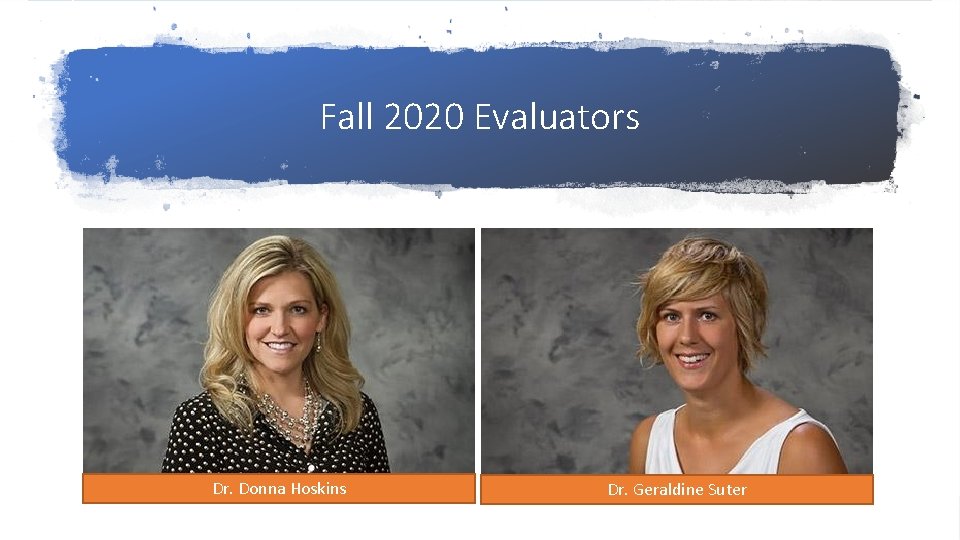
Fall 2020 Evaluators Dr. Donna Hoskins Dr. Geraldine Suter
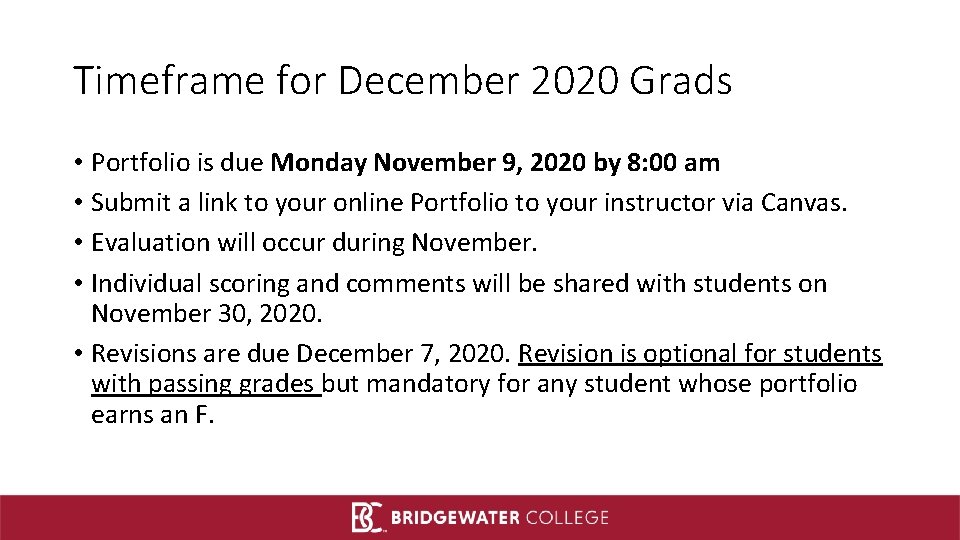
Timeframe for December 2020 Grads • Portfolio is due Monday November 9, 2020 by 8: 00 am • Submit a link to your online Portfolio to your instructor via Canvas. • Evaluation will occur during November. • Individual scoring and comments will be shared with students on November 30, 2020. • Revisions are due December 7, 2020. Revision is optional for students with passing grades but mandatory for any student whose portfolio earns an F.
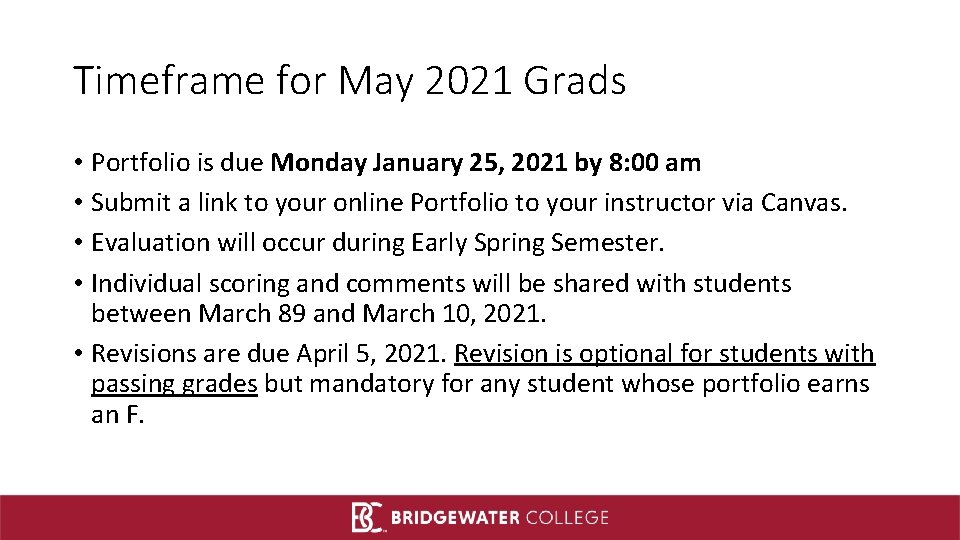
Timeframe for May 2021 Grads • Portfolio is due Monday January 25, 2021 by 8: 00 am • Submit a link to your online Portfolio to your instructor via Canvas. • Evaluation will occur during Early Spring Semester. • Individual scoring and comments will be shared with students between March 89 and March 10, 2021. • Revisions are due April 5, 2021. Revision is optional for students with passing grades but mandatory for any student whose portfolio earns an F.
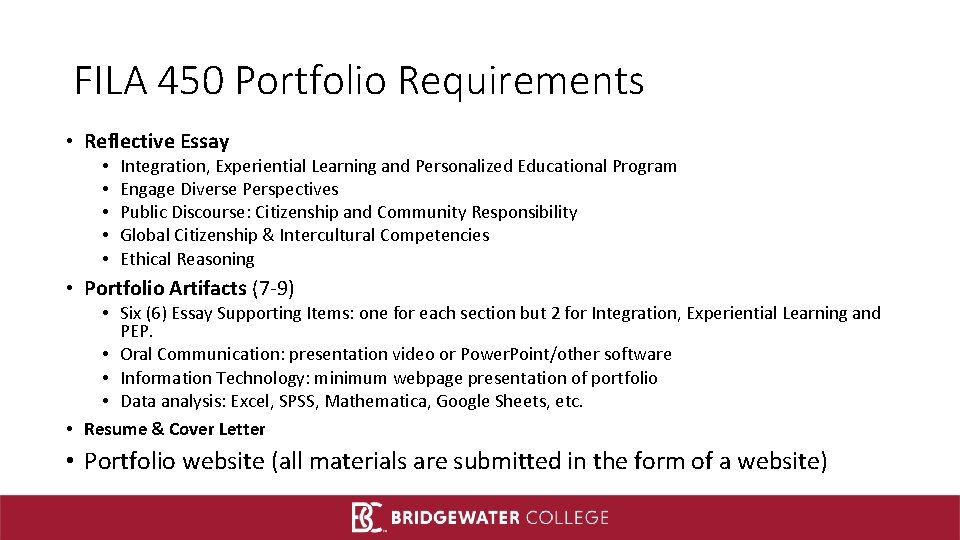
FILA 450 Portfolio Requirements • Reflective Essay • • • Integration, Experiential Learning and Personalized Educational Program Engage Diverse Perspectives Public Discourse: Citizenship and Community Responsibility Global Citizenship & Intercultural Competencies Ethical Reasoning • Portfolio Artifacts (7 -9) • Six (6) Essay Supporting Items: one for each section but 2 for Integration, Experiential Learning and PEP. • Oral Communication: presentation video or Power. Point/other software • Information Technology: minimum webpage presentation of portfolio • Data analysis: Excel, SPSS, Mathematica, Google Sheets, etc. • Resume & Cover Letter • Portfolio website (all materials are submitted in the form of a website)
Question break! Ask me three questions about the senior portfolio!
KEEP IN MIND: Punctuality matters. If the portfolio is late, you forfeit 100 points (out of 1000 -100 points total). Make sure to turn it in by November 9 th (December grads) or January 25 th (May grads)
Information online BC’s Word. Press page on FILA 450: https: //wp. bridgewater. edu/fila-450 -portfolio/ • Guidelines for FILA 450 Portfolio 2020 -2021 • Examples of Reflecting for FILA 450 • Grading Rubric for FILA 450 Portfolio • FILA 450 Fall Portfolio Score Sheet Template 2020 -2021 • FILA 450 Spring Portfolio Score Sheet Template 2020 -2021
What is Reflection? Academic Citizenship You may have encountered model of reflection in various classes at BC that we denominate Academic Citizenship includes active listening, perspective taking, public reasoning and self-authorship. Quality reflection should include all four steps or components.
Active Listening Explain the texts, experiences or course content that were important to your learning. This requires that you adopt a posture of actively trying to understand show respect for the ideas or people you encountered. That requires getting into very specific details!
Perspective-taking involves articulating multiple viewpoints, gathering evidence, and clarifying perspectives. Such exploration doesn’t require that you give up your own preconceptions, but it does require visiting the opinions of others and imagining what the world looks like from the perspective of their interests, values, and situation.
Public Reasoning Public reasoning involves using public dialogue to gather and interrogate evidence, identify unstated assumptions, look for illogical or fallacious reasoning, and draw logical inferences. We call this public reasoning, because it involves standards of logic and the scientific method that we can use to adjudicate disputes. While private reasoning is based on just pursuing our own private or subjective interests and beliefs, public reasoning deploys public or objective criteria.
Self-Authorship Self-authorship synthesizes the implications of your reflections. It involves a new examination (a re-examination) of the topic. Ideally, this re-examination from a new (informed analyzed) perspective casts new light on your former, current, and future knowledge, actions or goals. Since you make or “write” this synthesis on your own terms, which involves projecting the sort of self you are or want to be, we call it self-authorship.
Reflection: Don’t Dr. Hayes’ Sociology 101 class was very important to me. She was hard, but I sure learned a lot. I didn’t think I would like sociology at first, but in the end I liked it a lot! This is only simple and vague description, not reflection!
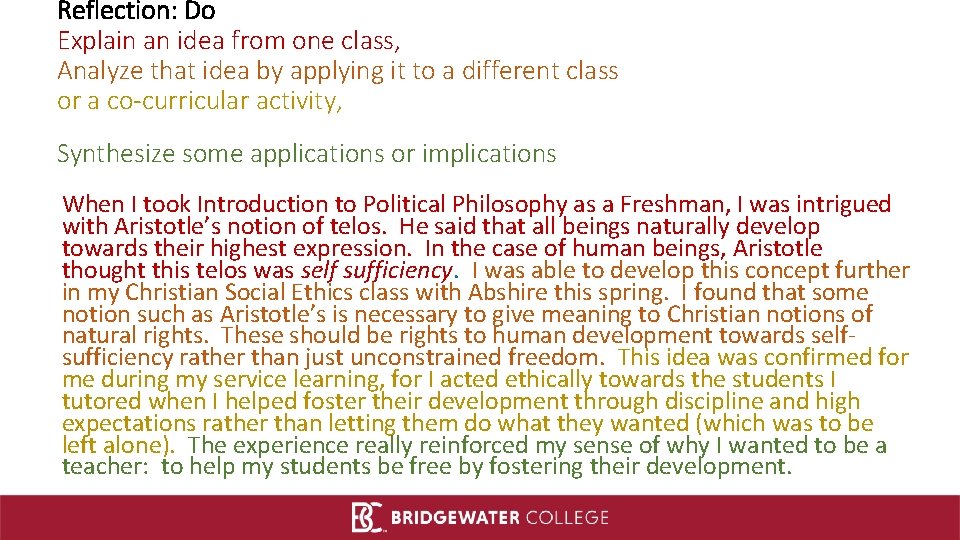
Reflection: Do Explain an idea from one class, Analyze that idea by applying it to a different class or a co-curricular activity, Synthesize some applications or implications When I took Introduction to Political Philosophy as a Freshman, I was intrigued with Aristotle’s notion of telos. He said that all beings naturally develop towards their highest expression. In the case of human beings, Aristotle thought this telos was self sufficiency. I was able to develop this concept further in my Christian Social Ethics class with Abshire this spring. I found that some notion such as Aristotle’s is necessary to give meaning to Christian notions of natural rights. These should be rights to human development towards selfsufficiency rather than just unconstrained freedom. This idea was confirmed for me during my service learning, for I acted ethically towards the students I tutored when I helped foster their development through discipline and high expectations rather than letting them do what they wanted (which was to be left alone). The experience really reinforced my sense of why I wanted to be a teacher: to help my students be free by fostering their development.
Question break! Ask more questions (all questions welcome)
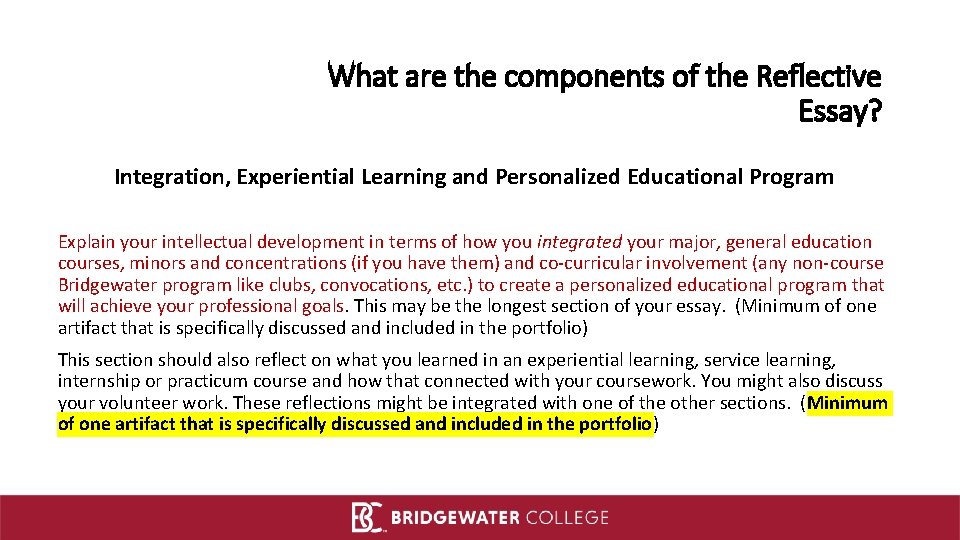
What are the components of the Reflective Essay? Integration, Experiential Learning and Personalized Educational Program Explain your intellectual development in terms of how you integrated your major, general education courses, minors and concentrations (if you have them) and co-curricular involvement (any non-course Bridgewater program like clubs, convocations, etc. ) to create a personalized educational program that will achieve your professional goals. This may be the longest section of your essay. (Minimum of one artifact that is specifically discussed and included in the portfolio) This section should also reflect on what you learned in an experiential learning, service learning, internship or practicum course and how that connected with your coursework. You might also discuss your volunteer work. These reflections might be integrated with one of the other sections. (Minimum of one artifact that is specifically discussed and included in the portfolio)
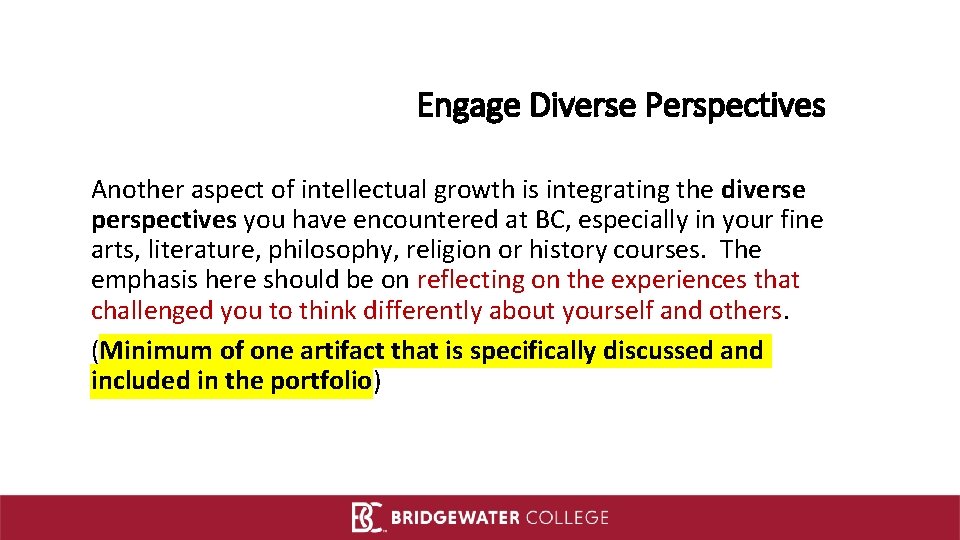
Engage Diverse Perspectives Another aspect of intellectual growth is integrating the diverse perspectives you have encountered at BC, especially in your fine arts, literature, philosophy, religion or history courses. The emphasis here should be on reflecting on the experiences that challenged you to think differently about yourself and others. (Minimum of one artifact that is specifically discussed and included in the portfolio)
Public Discourse: Citizenship & Community Responsibility Reflect on how you have taken part in public discourse as a citizen of an academic community and as a member of the larger communities that you live in. This might mean explaining what you learned about specific problems facing our communities, various perspectives on those issues, exploring the ethical basis for your own positions, using public reasoning to understand the impact of your choices on local or national communities, and drawing conclusions about what you can do as a citizen to exercise community responsibility. Your courses in history, social science, natural science, ethics or philosophy/religion might be especially important in this section. (Minimum of one artifact that is specifically discussed and included in the portfolio).
Global Citizenship & Intercultural Competencies This section should address what you learned about issues that affect people outside the United States. It might include what you learned about problems facing global communities, the political and economic institutions that affect our ability to address these issues, the cultural knowledge that helped you understand the diverse interests and perspectives involved and steps you can take address these issues as a global citizen. Your language, travel and global dynamics classes might be especially important here. (Minimum of one artifact that is specifically discussed and included in the portfolio)
Ethical Reasoning Your essay should reflect on what you learned about ethical reasoning: the systematic thinking about ethical issues, virtues, and principles. Engaged, responsible citizens of any community are able to provide publicly accessible reasons for their intentions and actions and to understand the logical and ethical consequences of those actions. Draw from your coursework as you reflect on your processes for ethical reasoning. These reflections might be integrated with one of the other sections. (Minimum of one artifact that is specifically discussed and included in the portfolio)
Question break! Ask more questions (all questions welcome)
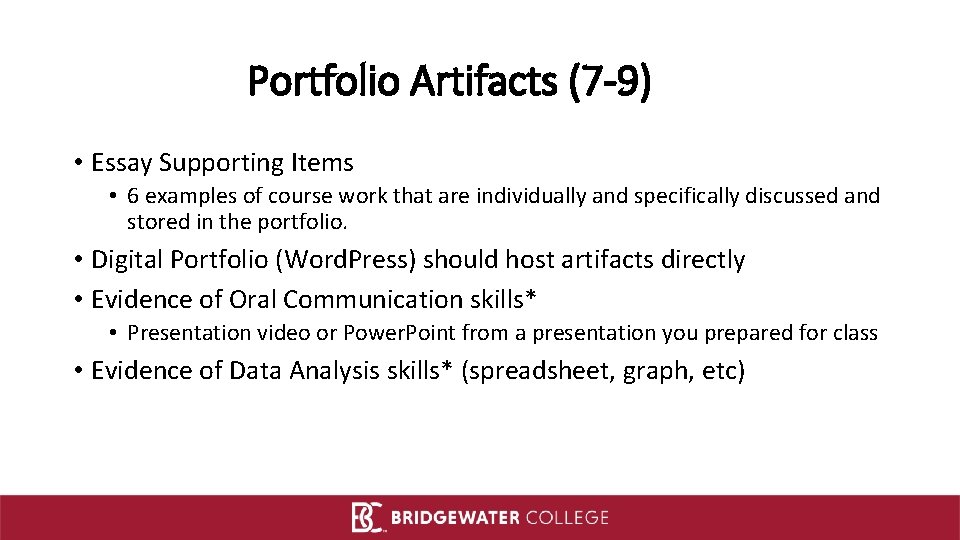
Portfolio Artifacts (7 -9) • Essay Supporting Items • 6 examples of course work that are individually and specifically discussed and stored in the portfolio. • Digital Portfolio (Word. Press) should host artifacts directly • Evidence of Oral Communication skills* • Presentation video or Power. Point from a presentation you prepared for class • Evidence of Data Analysis skills* (spreadsheet, graph, etc)
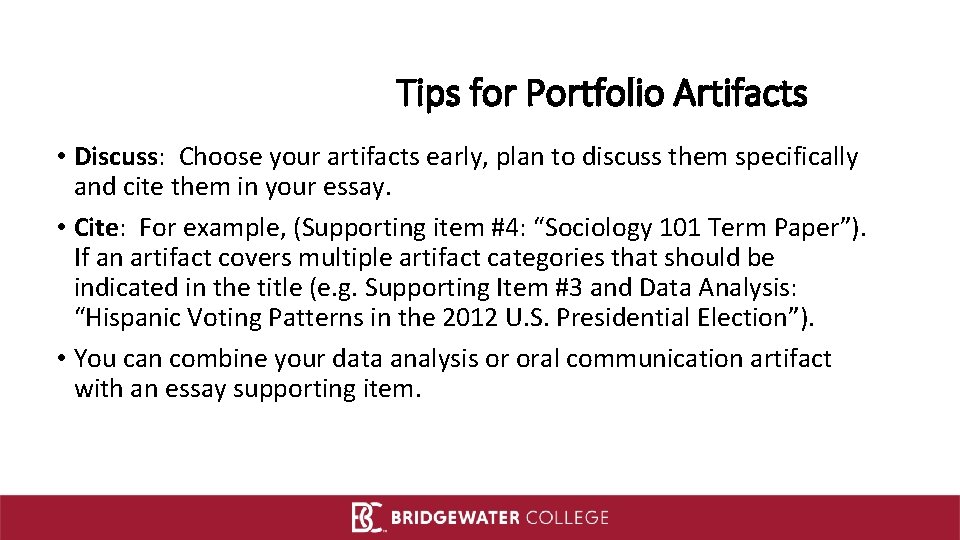
Tips for Portfolio Artifacts • Discuss: Choose your artifacts early, plan to discuss them specifically and cite them in your essay. • Cite: For example, (Supporting item #4: “Sociology 101 Term Paper”). If an artifact covers multiple artifact categories that should be indicated in the title (e. g. Supporting Item #3 and Data Analysis: “Hispanic Voting Patterns in the 2012 U. S. Presidential Election”). • You can combine your data analysis or oral communication artifact with an essay supporting item.
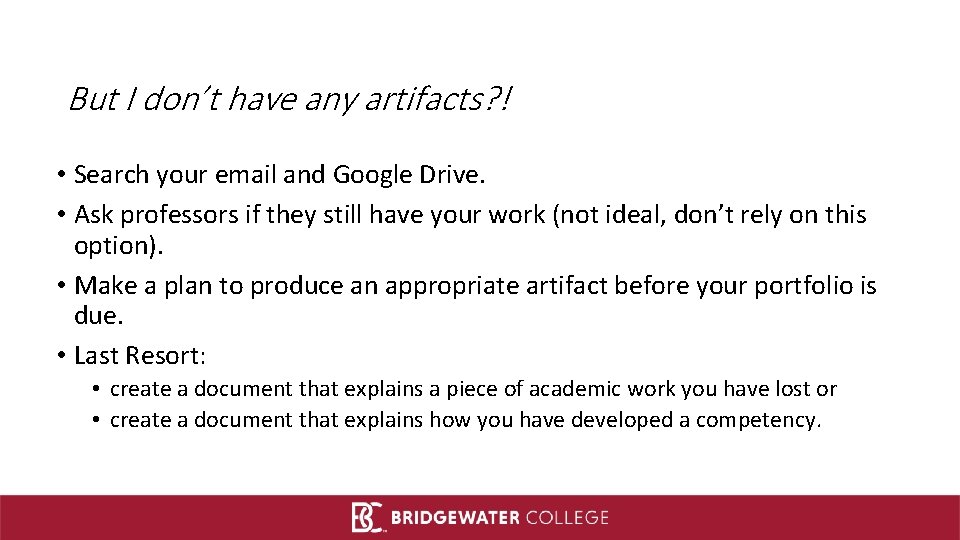
But I don’t have any artifacts? ! • Search your email and Google Drive. • Ask professors if they still have your work (not ideal, don’t rely on this option). • Make a plan to produce an appropriate artifact before your portfolio is due. • Last Resort: • create a document that explains a piece of academic work you have lost or • create a document that explains how you have developed a competency.
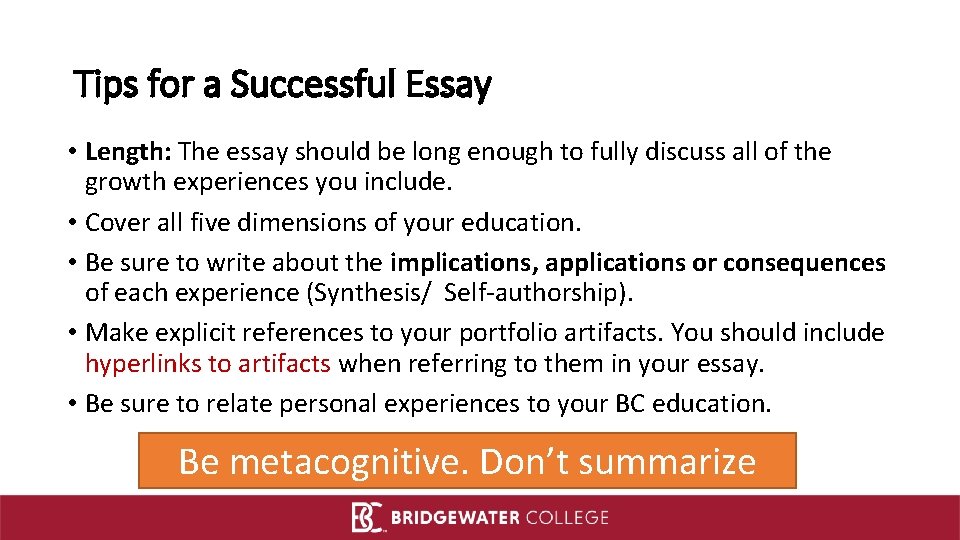
Tips for a Successful Essay • Length: The essay should be long enough to fully discuss all of the growth experiences you include. • Cover all five dimensions of your education. • Be sure to write about the implications, applications or consequences of each experience (Synthesis/ Self-authorship). • Make explicit references to your portfolio artifacts. You should include hyperlinks to artifacts when referring to them in your essay. • Be sure to relate personal experiences to your BC education. Be metacognitive. Don’t summarize
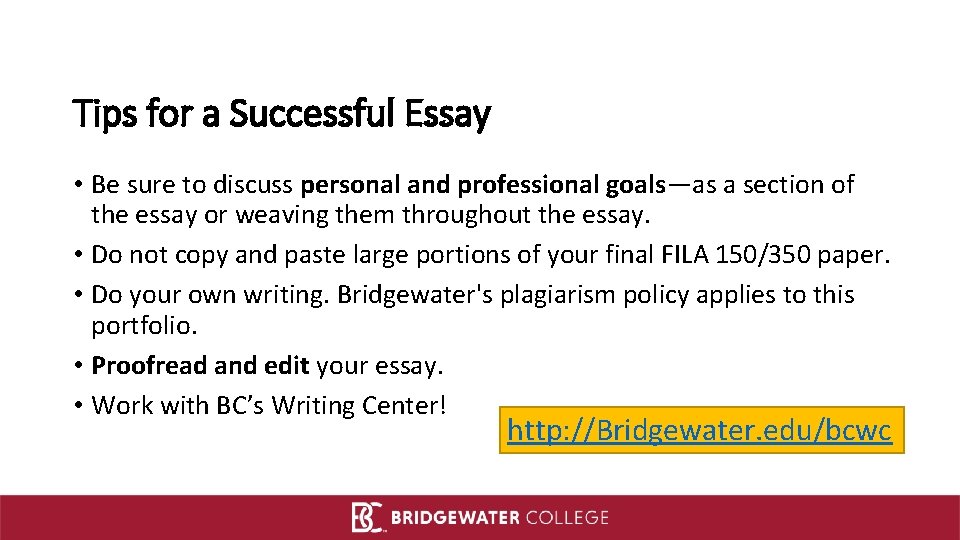
Tips for a Successful Essay • Be sure to discuss personal and professional goals—as a section of the essay or weaving them throughout the essay. • Do not copy and paste large portions of your final FILA 150/350 paper. • Do your own writing. Bridgewater's plagiarism policy applies to this portfolio. • Proofread and edit your essay. • Work with BC’s Writing Center! http: //Bridgewater. edu/bcwc
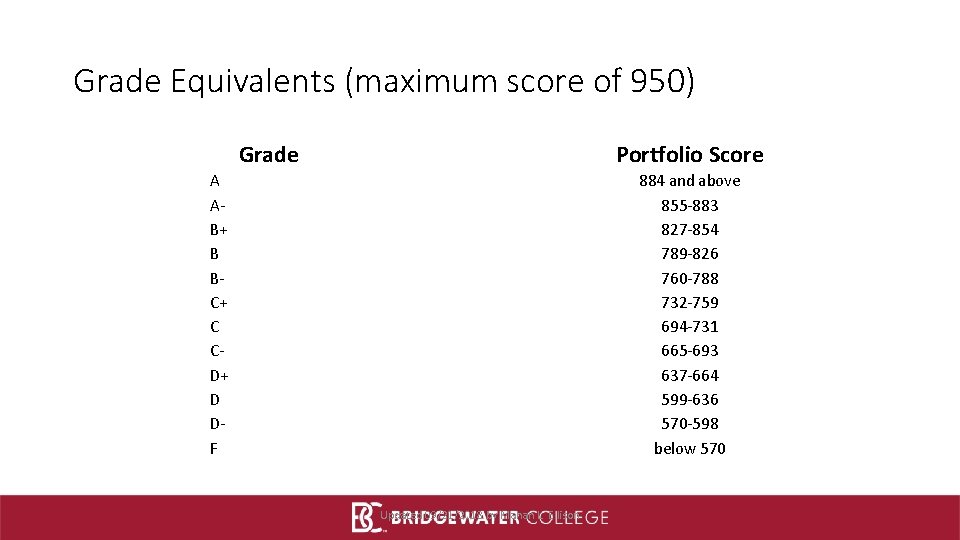
Grade Equivalents (maximum score of 950) Grade Portfolio Score A AB+ B BC+ C CD+ D DF 884 and above 855 -883 827 -854 789 -826 760 -788 732 -759 694 -731 665 -693 637 -664 599 -636 570 -598 below 570 Updated 09/21/2018 by Mahan L. Ellison
Examples Go to FILA 450 Word. Press to see excerpts from past FILA 450 essays that illustrate explaining, exploring, analyzing, and synthesizing.
If you revise. . . • Pay close attention to your evaluator's comments and make substantive (not minor) changes that address the comments. • If you have questions, request a meeting with your evaluator to discuss the comments. • When you meet, make notes to assist you in revising. Revising is optional if you receive a passing grade but is required if you receive an F.
Creating a Word. Press Portfolio • Portfolios should be submitted as a Word. Press site • FILA 450 Portfolios can easily be adapted into a personal professional website after graduation • Message from the BC Digital Scholarship Gurus: If you would like to use Word. Press to develop your portfolio, but don’t have an account set up please put in a request to gurus@bridgewater. edu. The email should be subjected Word. Press and tells us your Username and the reason for needing an account, such as FILA 450 Portfolio. After which you should receive an email saying your site has been created with instructions on logging in. Please allow 24 hours for requests to be processed. Requests made on Fridays, Saturdays, and/or Sundays, please allow 48 hours to be processed. • Please be sure to contact the Digital Scholarship Gurus far in advance of your portfolio due date and be mindful of the volume of requests they will be receiving from seniors completing FILA 450.