
Figures of Speech Metaphor An implicit comparison between
Figures of Speech • Metaphor: An implicit comparison between two unlike things. An implied comparison in which one thing is described referring to something else -The lions were fighting in the battlefield. - In the peak of his career
Simile • An explicit comparison between two unlike things, usually using «like» or «as» -The soldiers were fighting in the battlefield like lions. - John is as cunning as a fox.
Personification • The attribution of human feelings or characteristic to abstractions, nonhuman entities. - Smiling flowers - Time waits for no one (song by Rolling Stones)
Paradox • A paradox seems to be a self-contradictory, even absurd, statement at first; but after a closer inspection, it is found to contain some truth - «youth is wasted on the young» (George Bernard Shaw)
Oxymoron • An oxymoron is a very concise paradox; a paradox often compressed into two or three words. In other words, it consists of two or three contradictory words: -Original copy -Only choice -Live recording
Irony • The term always includes some element of saying the reverse of the literal meaning. • In verbal irony, one meaning is stated, and a different, usually antithetical meaning is intended. - Walking into an empty theatre and saying, “it’s too crowded”
• Situational Irony - A marriage counsellor has divorced his third wife - A burglar whose house is burglarized while he’s burglarizing someone else’s house

Symbol. Something that stands for something else - Scales symbolize justice - Dove stands for peace
Hyperbole (overstatement) • Exaggeration for emphasis. In hyperbole, what is meant is emphasized by saying more than what is literally meant. • Her brain is the size of a pea • I’ll die if he asks me to a dance.
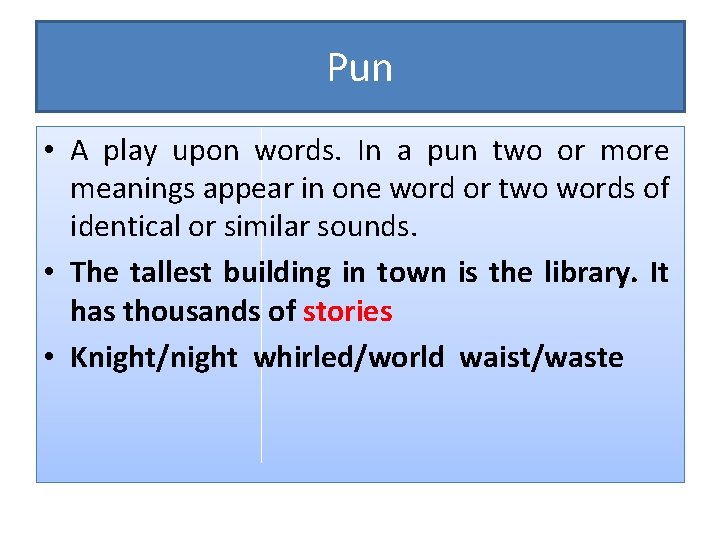
Pun • A play upon words. In a pun two or more meanings appear in one word or two words of identical or similar sounds. • The tallest building in town is the library. It has thousands of stories • Knight/night whirled/world waist/waste
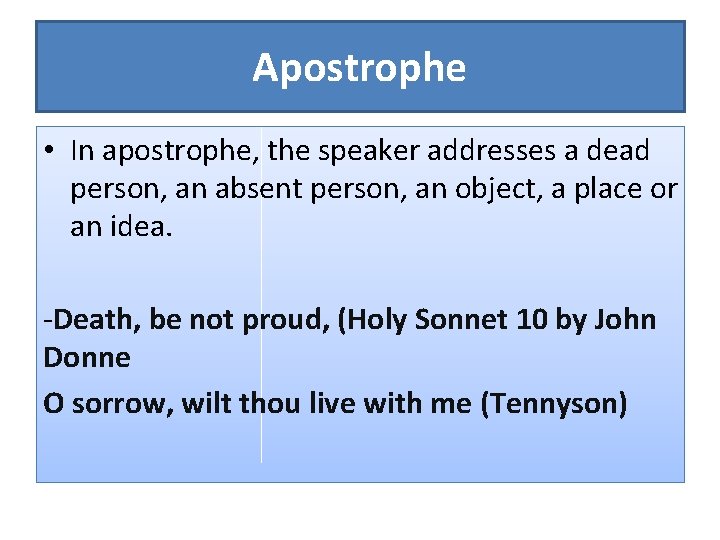
Apostrophe • In apostrophe, the speaker addresses a dead person, an absent person, an object, a place or an idea. -Death, be not proud, (Holy Sonnet 10 by John Donne O sorrow, wilt thou live with me (Tennyson)
- Slides: 11