
Figure nbsp Route of cowpox virus CPXV transmission
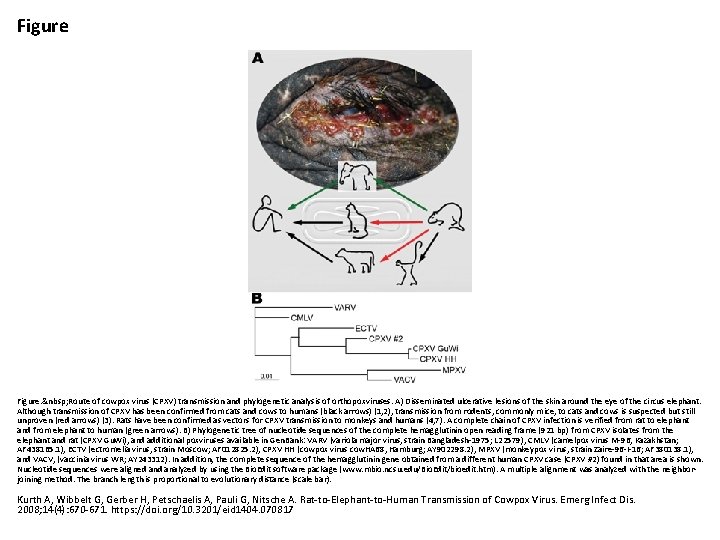
Figure. Route of cowpox virus (CPXV) transmission and phylogenetic analysis of orthopoxviruses. A) Disseminated ulcerative lesions of the skin around the eye of the circus elephant. Although transmission of CPXV has been confirmed from cats and cows to humans (black arrows) (1, 2), transmission from rodents, commonly mice, to cats and cows is suspected but still unproven (red arrows) (3). Rats have been confirmed as vectors for CPXV transmission to monkeys and humans (4, 7). A complete chain of CPXV infection is verified from rat to elephant and from elephant to human (green arrows). B) Phylogenetic tree of nucleotide sequences of the complete hemagglutinin open reading frame (921 bp) from CPXV isolates from the elephant and rat (CPXV Gu. Wi), and additional poxviruses available in Gen. Bank: VARV (variola major virus, strain Bangladesh-1975; L 22579), CMLV (camelpox virus M-96, Kazakhstan; AF 438165. 1), ECTV (ectromelia virus, strain Moscow; AF 012825. 2), CPXV HH (cowpox virus cow. HA 68, Hamburg; AY 902298. 2), MPXV (monkeypox virus, strain Zaire-96 -I-16; AF 380138. 1), and VACV, (vaccinia virus WR; AY 243312). In addition, the complete sequence of the hemagglutinin gene obtained from a different human CPXV case (CPXV #2) found in that area is shown. Nucleotide sequences were aligned analyzed by using the Bio. Edit software package (www. mbio. ncsu. edu/Bio. Edit/bioedit. htm). A multiple alignment was analyzed with the neighborjoining method. The branch length is proportional to evolutionary distance (scale bar). Kurth A, Wibbelt G, Gerber H, Petschaelis A, Pauli G, Nitsche A. Rat-to-Elephant-to-Human Transmission of Cowpox Virus. Emerg Infect Dis. 2008; 14(4): 670 -671. https: //doi. org/10. 3201/eid 1404. 070817
- Slides: 1