
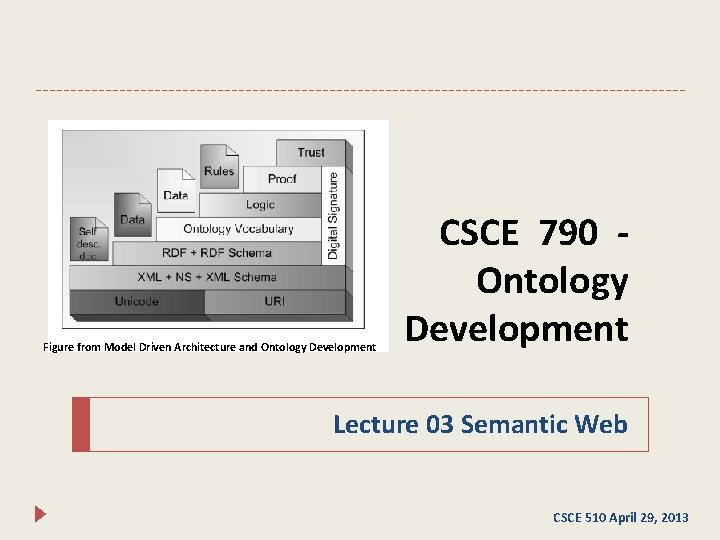
Figure from Model Driven Architecture and Ontology Development
![URI Syntax � <scheme name> : <hierarchical part> [ ? <query> ] [ #](https://slidetodoc.com/presentation_image_h2/2b5023c238a5943388e8564c1c0a878f/image-7.jpg "URI Syntax � <scheme name> : <hierarchical part> [ ? <query> ] [ #")
- Slides: 39
Figure from Model Driven Architecture and Ontology Development CSCE 790 Ontology Development Lecture 03 Semantic Web CSCE 510 April 29, 2013
Outline �Pragmatics � Assignments, Papers, and Projects instead of exams �Ontologies � medical ontologies, UML, Snowmed, …Gene ontology � Wordnet, Framenet, Verbnet, SUMO �Tools: protégé, reasoners – pellet, fact++, … �Ontology Languages: RDF, OWL-lite, OWL 2. 0 �Reasoning about ontologies: consistency �Reasoning with Ontologies �Semi-automatic construction Slide - 2 - Protege - CSCE 790 C 2013 -
Semantic Web http: //www. w 3 schools. com/w 3 c/default. asp � � � W 3 C RDF and OWL Activities The Semantic Web is a framework for sharing data between companies, applications, enterprises, communities, and people, independent of platform and software. RDF and OWL are key Semantic Web technologies. RDF - Resource Description Framework RDF is a language for describing Web resources, such as the title, author, modification date, content, and copyright information of a Web page. OWL - Web Ontology Language OWL is built on top of RDF, and is a language for processing information on the internet. If you want to learn more about OWL, please visit W 3 Schools' RDF Tutorial. SPARQL - Query Language for RDF SPARQL offer developers a way to write queries across the wide range of RDF information on the internet. W 3 C Specifications and Timeline Slide - 3 - Semantic Web - CSCE 790 C 2013 -
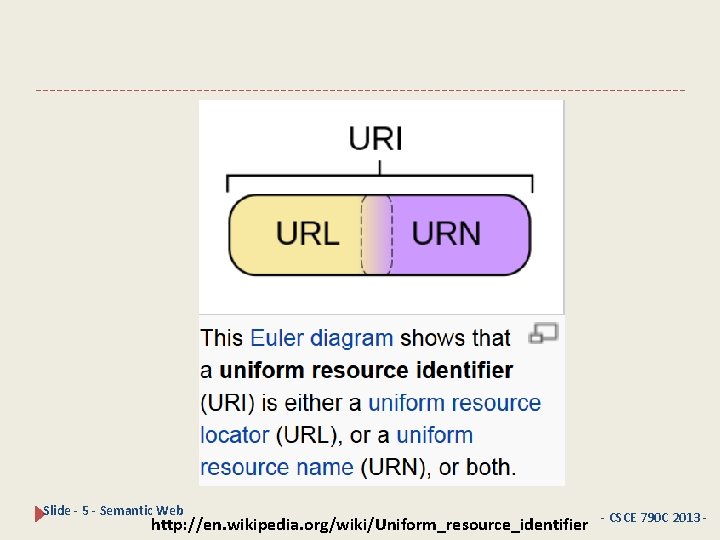
Uniform Resource Identifier (URI) �a uniform resource identifier (URI) is a string of characters used to identify a name or a web resource. �Not to be confused with its two subclasses: uniform resource locator (URL) and � uniform resource name (URN) � Slide - 4 - Semantic Web http: //en. wikipedia. org/wiki/Uniform_resource_identifier - CSCE 790 C 2013 -
Slide - 5 - Semantic Web http: //en. wikipedia. org/wiki/Uniform_resource_identifier - CSCE 790 C 2013 -
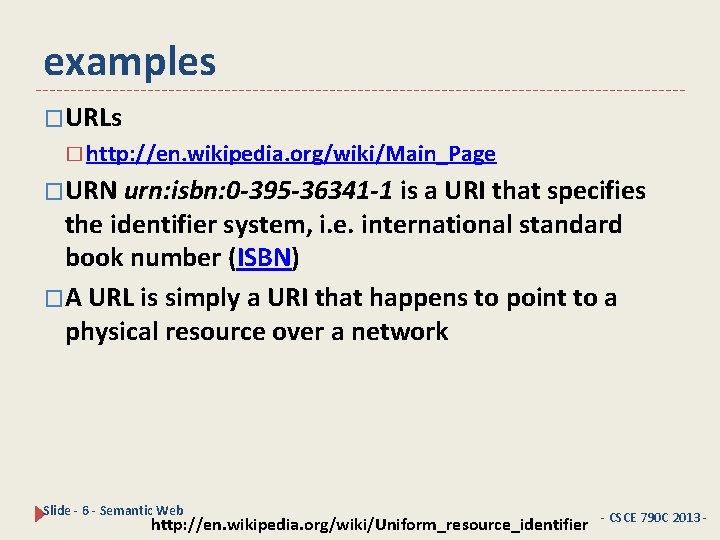
examples �URLs � http: //en. wikipedia. org/wiki/Main_Page �URN urn: isbn: 0 -395 -36341 -1 is a URI that specifies the identifier system, i. e. international standard book number (ISBN) �A URL is simply a URI that happens to point to a physical resource over a network Slide - 6 - Semantic Web http: //en. wikipedia. org/wiki/Uniform_resource_identifier - CSCE 790 C 2013 -
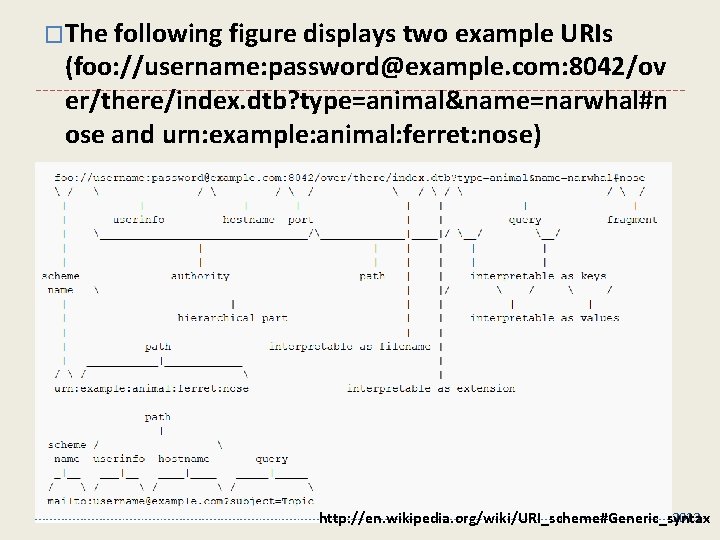
URI Syntax � <scheme name> : <hierarchical part> [ ? <query> ] [ # <fragment> � scheme name consists of a sequence of characters beginning with a letter � hierarchical part of the URI begins with “//” � authority part holds an optional user-information part, terminated with "@“ � path part, if present, must begin with a forward slash ("/") � query is an optional part, separated by a question mark ("? "), generally a sequence of <key>=<value> pairs Slide - 7 - Semantic Web http: //en. wikipedia. org/wiki/URI_scheme#Generic_syntax - CSCE 790 C 2013 -
�The following figure displays two example URIs (foo: //username: password@example. com: 8042/ov er/there/index. dtb? type=animal&name=narwhal#n ose and urn: example: animal: ferret: nose) Slide - 8 - Semantic Web - CSCE 790 C 2013 http: //en. wikipedia. org/wiki/URI_scheme#Generic_syntax
Resource Description Framework (RDF) � Resource Description Framework (RDF) is a family of Consortium (W 3 C) specifications � triples: subject-predicate-object; originally data model World Wide Web designed as a metadata � now a general method for conceptual description or modeling of information that is implemented in web resources � similar to classic conceptual modeling approaches such as relationship or class diagrams entity– � http: //www. w 3. org/TR/rdf-syntax-grammar/ Slide - 9 - Semantic Web - CSCE 790 C 2013 -
RDF - the Basis of the Semantic Web Fundamental Concepts of Chapter 3 � RDF (Resource Description Framework) � Triple subject-predicate-object � Graph – structural view of RDF data � Merging � URI (Uniform Resource Indicator) � namespace – namespaces allow different agents to use the same word in different ways � qname – abbreviated URI of the form - namespace : name � rdf: type – relationship between instance and its type � rdf: Property – thetype of any property in RDF � reification – making statement about another stmt using ref: subject, rdf: predicate, rdf: object � N-triples, N 3, RDF/XML � blank nodes (no URI) stand for anonymous entries � From p 57 Semantic Web for the Working Ontologist by Allemang &Hendler Slide - 10 - Semantic Web - CSCE 790 C 2013 -
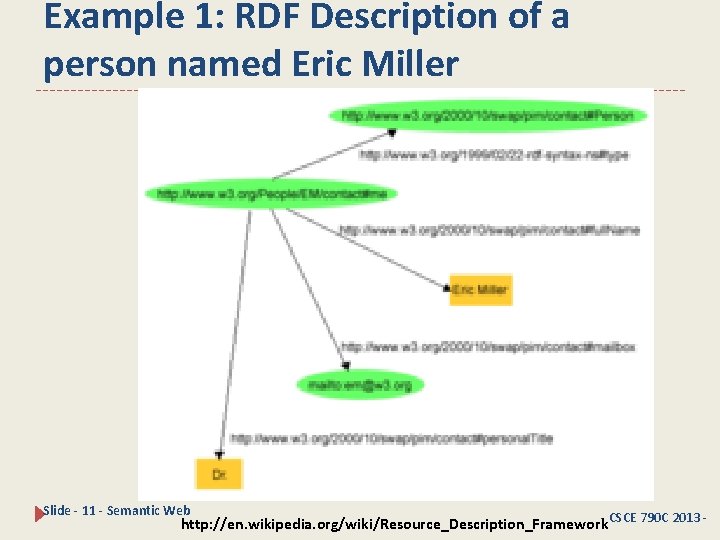
Example 1: RDF Description of a person named Eric Miller Slide - 11 - Semantic Web http: //en. wikipedia. org/wiki/Resource_Description_Framework- CSCE 790 C 2013 -
What is RDF? Resource Description Framework � What is RDF? RDF is a framework for describing resources on the web � RDF is designed to be read and understood by computers � RDF is not designed for being displayed to people � RDF is written in XML � RDF is a part of the W 3 C's Semantic Web Activity � RDF is a W 3 C Recommendation � � RDF - Examples of Use Describing properties for shopping items, such as price and availability � Describing time schedules for web events � Describing information about web pages (content, author, created and modified date) � Describing content and rating for web pictures � Describing content for search engines � Describing electronic libraries � Slide - 12 - Semantic Web From http: //www. w 3 schools. com/rdf_intro. asp- CSCE 790 C 2013 -
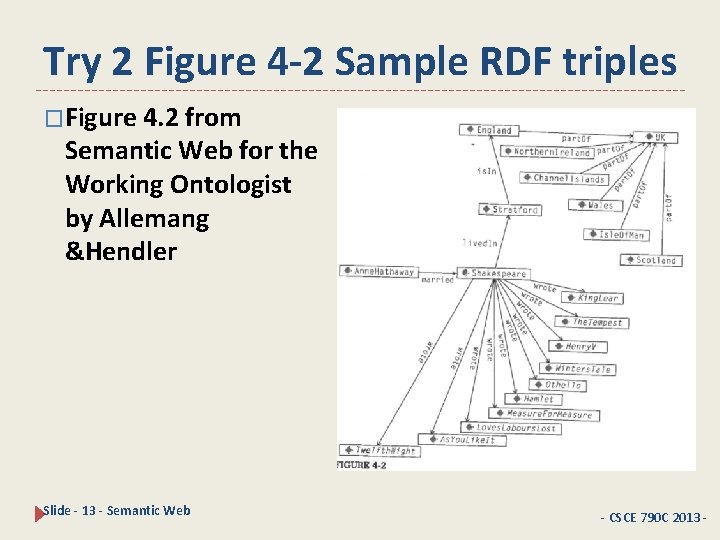
Try 2 Figure 4 -2 Sample RDF triples �Figure 4. 2 from Semantic Web for the Working Ontologist by Allemang &Hendler Slide - 13 - Semantic Web - CSCE 790 C 2013 -
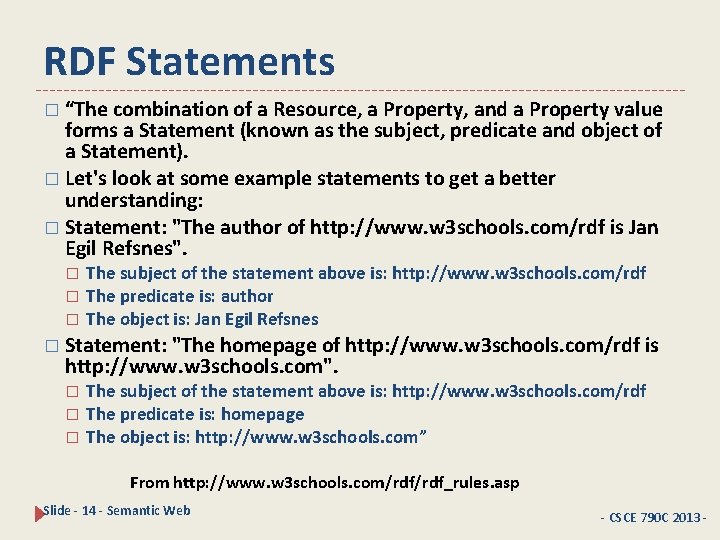
RDF Statements � “The combination of a Resource, a Property, and a Property value forms a Statement (known as the subject, predicate and object of a Statement). � Let's look at some example statements to get a better understanding: � Statement: "The author of http: //www. w 3 schools. com/rdf is Jan Egil Refsnes". � � � The subject of the statement above is: http: //www. w 3 schools. com/rdf The predicate is: author The object is: Jan Egil Refsnes � Statement: "The homepage of http: //www. w 3 schools. com/rdf is http: //www. w 3 schools. com". � � � The subject of the statement above is: http: //www. w 3 schools. com/rdf The predicate is: homepage The object is: http: //www. w 3 schools. com” From http: //www. w 3 schools. com/rdf_rules. asp Slide - 14 - Semantic Web - CSCE 790 C 2013 -
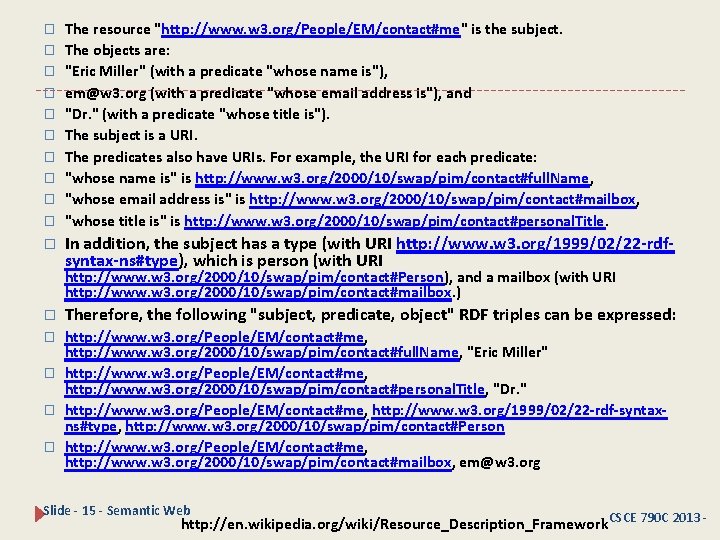
� � � The resource "http: //www. w 3. org/People/EM/contact#me" is the subject. The objects are: "Eric Miller" (with a predicate "whose name is"), em@w 3. org (with a predicate "whose email address is"), and "Dr. " (with a predicate "whose title is"). The subject is a URI. The predicates also have URIs. For example, the URI for each predicate: "whose name is" is http: //www. w 3. org/2000/10/swap/pim/contact#full. Name, "whose email address is" is http: //www. w 3. org/2000/10/swap/pim/contact#mailbox, "whose title is" is http: //www. w 3. org/2000/10/swap/pim/contact#personal. Title. In addition, the subject has a type (with URI http: //www. w 3. org/1999/02/22 -rdfsyntax-ns#type), which is person (with URI http: //www. w 3. org/2000/10/swap/pim/contact#Person), and a mailbox (with URI http: //www. w 3. org/2000/10/swap/pim/contact#mailbox. ) � Therefore, the following "subject, predicate, object" RDF triples can be expressed: � http: //www. w 3. org/People/EM/contact#me, http: //www. w 3. org/2000/10/swap/pim/contact#full. Name, "Eric Miller" http: //www. w 3. org/People/EM/contact#me, http: //www. w 3. org/2000/10/swap/pim/contact#personal. Title, "Dr. " http: //www. w 3. org/People/EM/contact#me, http: //www. w 3. org/1999/02/22 -rdf-syntaxns#type, http: //www. w 3. org/2000/10/swap/pim/contact#Person http: //www. w 3. org/People/EM/contact#me, http: //www. w 3. org/2000/10/swap/pim/contact#mailbox, em@w 3. org � � � Slide - 15 - Semantic Web http: //en. wikipedia. org/wiki/Resource_Description_Framework- CSCE 790 C 2013 -
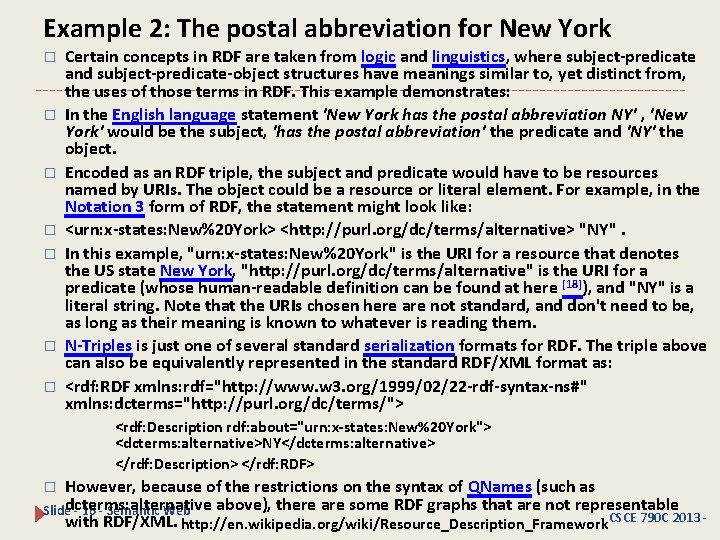
Example 2: The postal abbreviation for New York � � � � Certain concepts in RDF are taken from logic and linguistics, where subject-predicate and subject-predicate-object structures have meanings similar to, yet distinct from, the uses of those terms in RDF. This example demonstrates: In the English language statement 'New York has the postal abbreviation NY' , 'New York' would be the subject, 'has the postal abbreviation' the predicate and 'NY' the object. Encoded as an RDF triple, the subject and predicate would have to be resources named by URIs. The object could be a resource or literal element. For example, in the Notation 3 form of RDF, the statement might look like: <urn: x-states: New%20 York> <http: //purl. org/dc/terms/alternative> "NY". In this example, "urn: x-states: New%20 York" is the URI for a resource that denotes the US state New York, "http: //purl. org/dc/terms/alternative" is the URI for a predicate (whose human-readable definition can be found at here [18]), and "NY" is a literal string. Note that the URIs chosen here are not standard, and don't need to be, as long as their meaning is known to whatever is reading them. N-Triples is just one of several standard serialization formats for RDF. The triple above can also be equivalently represented in the standard RDF/XML format as: <rdf: RDF xmlns: rdf="http: //www. w 3. org/1999/02/22 -rdf-syntax-ns#" xmlns: dcterms="http: //purl. org/dc/terms/"> <rdf: Description rdf: about="urn: x-states: New%20 York"> <dcterms: alternative>NY</dcterms: alternative> </rdf: Description> </rdf: RDF> However, because of the restrictions on the syntax of QNames (such as above), there are some RDF graphs that are not representable Slidedcterms: alternative - 16 - Semantic Web with RDF/XML. http: //en. wikipedia. org/wiki/Resource_Description_Framework- CSCE 790 C 2013 �
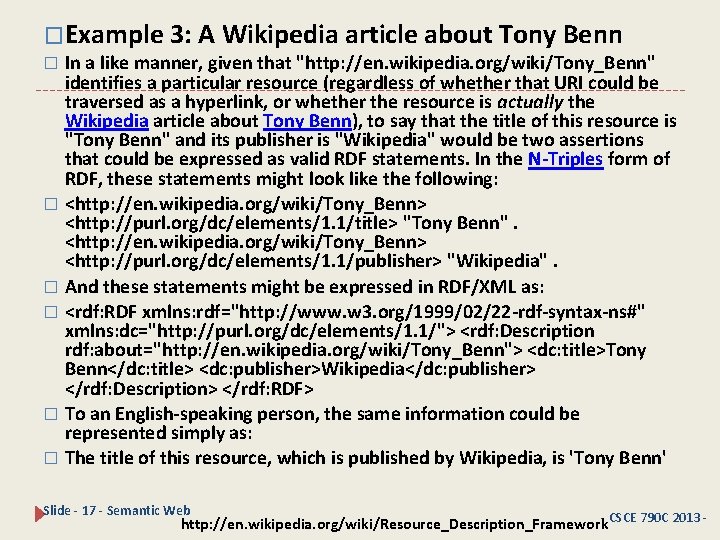
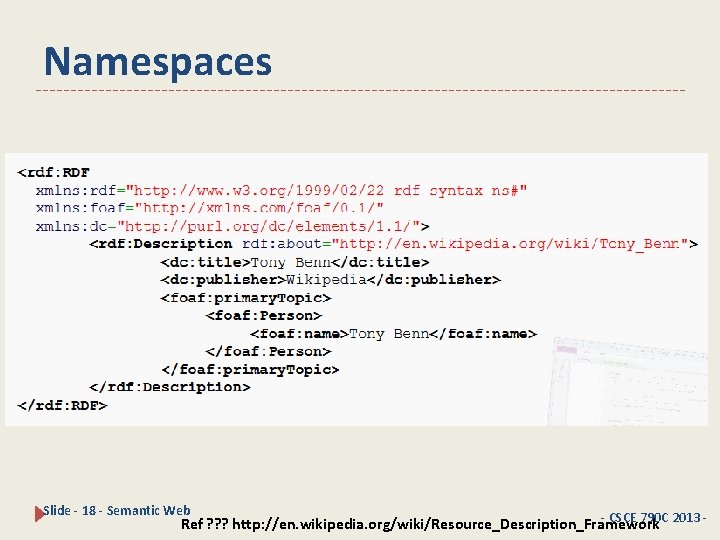
�Example 3: A Wikipedia article about Tony Benn In a like manner, given that "http: //en. wikipedia. org/wiki/Tony_Benn" identifies a particular resource (regardless of whether that URI could be traversed as a hyperlink, or whether the resource is actually the Wikipedia article about Tony Benn), to say that the title of this resource is "Tony Benn" and its publisher is "Wikipedia" would be two assertions that could be expressed as valid RDF statements. In the N-Triples form of RDF, these statements might look like the following: � <http: //en. wikipedia. org/wiki/Tony_Benn> <http: //purl. org/dc/elements/1. 1/title> "Tony Benn". <http: //en. wikipedia. org/wiki/Tony_Benn> <http: //purl. org/dc/elements/1. 1/publisher> "Wikipedia". � And these statements might be expressed in RDF/XML as: � <rdf: RDF xmlns: rdf="http: //www. w 3. org/1999/02/22 -rdf-syntax-ns#" xmlns: dc="http: //purl. org/dc/elements/1. 1/"> <rdf: Description rdf: about="http: //en. wikipedia. org/wiki/Tony_Benn"> <dc: title>Tony Benn</dc: title> <dc: publisher>Wikipedia</dc: publisher> </rdf: Description> </rdf: RDF> � To an English-speaking person, the same information could be represented simply as: � The title of this resource, which is published by Wikipedia, is 'Tony Benn' � Slide - 17 - Semantic Web http: //en. wikipedia. org/wiki/Resource_Description_Framework- CSCE 790 C 2013 -
Namespaces Slide - 18 - Semantic Web - CSCE 790 C 2013 Ref ? ? ? http: //en. wikipedia. org/wiki/Resource_Description_Framework
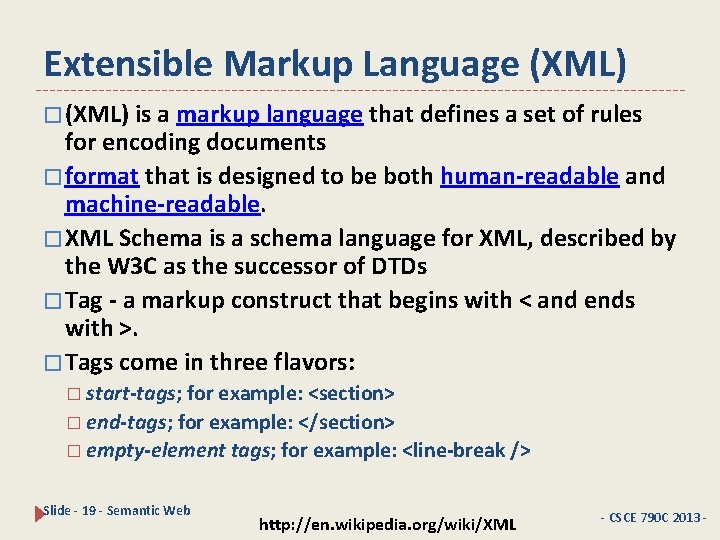
Extensible Markup Language (XML) � (XML) is a markup language that defines a set of rules for encoding documents � format that is designed to be both human-readable and machine-readable. � XML Schema is a schema language for XML, described by the W 3 C as the successor of DTDs � Tag - a markup construct that begins with < and ends with >. � Tags come in three flavors: � start-tags; for example: <section> � end-tags; for example: </section> � empty-element tags; for example: <line-break /> Slide - 19 - Semantic Web http: //en. wikipedia. org/wiki/XML - CSCE 790 C 2013 -
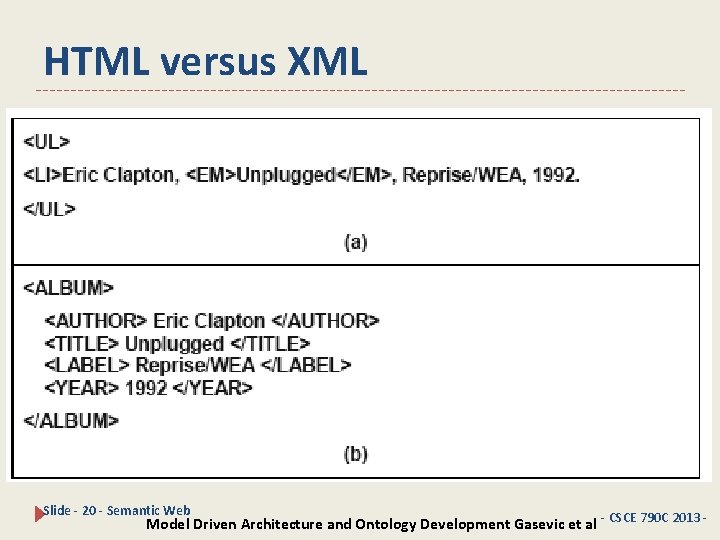
HTML versus XML Slide - 20 - Semantic Web Model Driven Architecture and Ontology Development Gasevic et al - CSCE 790 C 2013 -
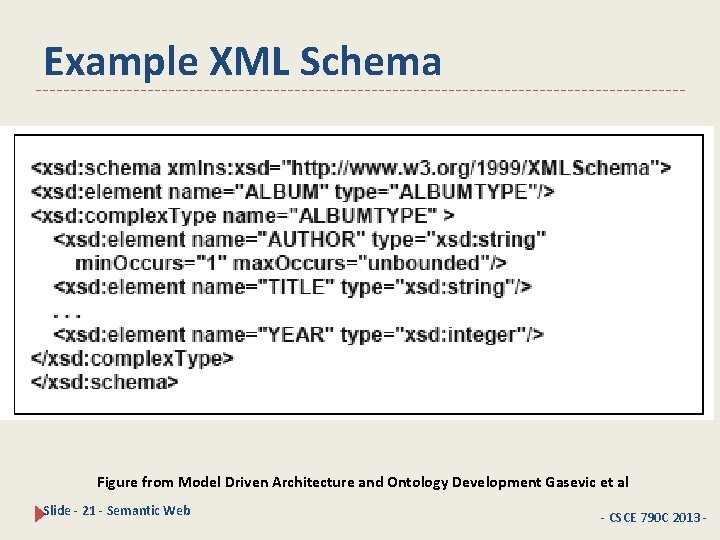
Example XML Schema Figure from Model Driven Architecture and Ontology Development Gasevic et al Slide - 21 - Semantic Web - CSCE 790 C 2013 -
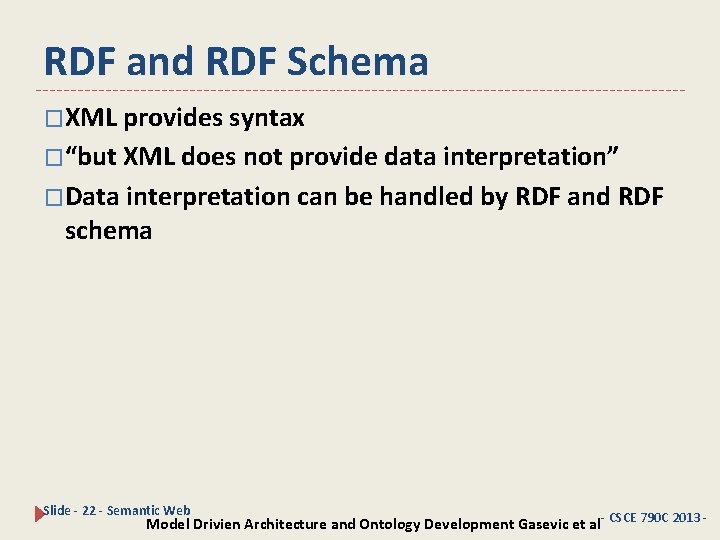
RDF and RDF Schema �XML provides syntax �“but XML does not provide data interpretation” �Data interpretation can be handled by RDF and RDF schema Slide - 22 - Semantic Web Model Drivien Architecture and Ontology Development Gasevic et al- CSCE 790 C 2013 -
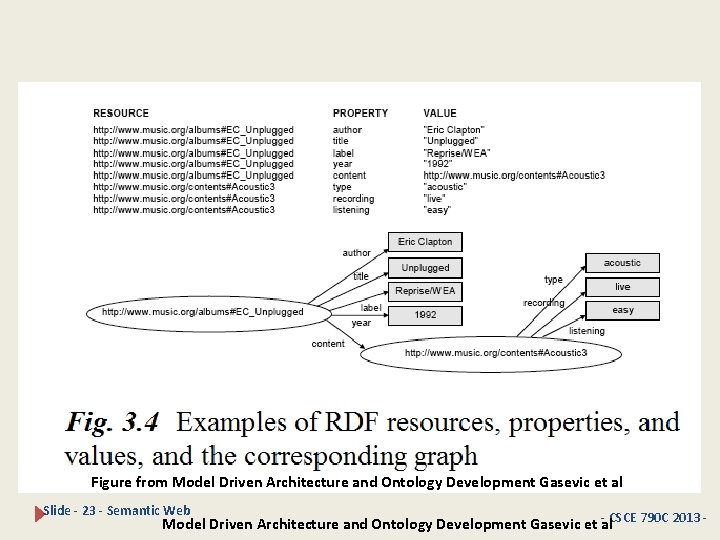
Figure from Model Driven Architecture and Ontology Development Gasevic et al Slide - 23 - Semantic Web Model Driven Architecture and Ontology Development Gasevic et -al. CSCE 790 C 2013 -
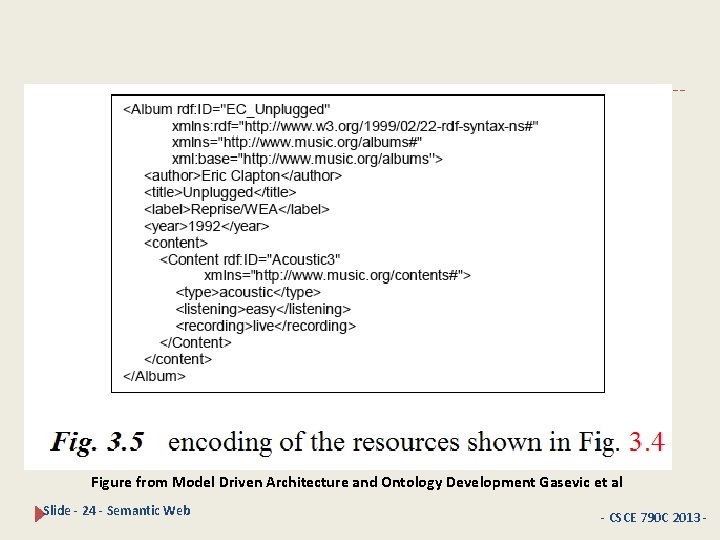
Figure from Model Driven Architecture and Ontology Development Gasevic et al Slide - 24 - Semantic Web - CSCE 790 C 2013 -
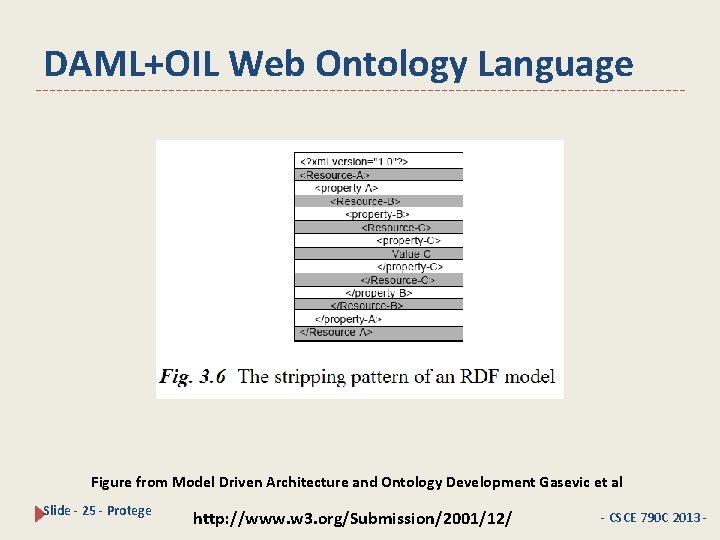
DAML+OIL Web Ontology Language Figure from Model Driven Architecture and Ontology Development Gasevic et al Slide - 25 - Protege http: //www. w 3. org/Submission/2001/12/ - CSCE 790 C 2013 -
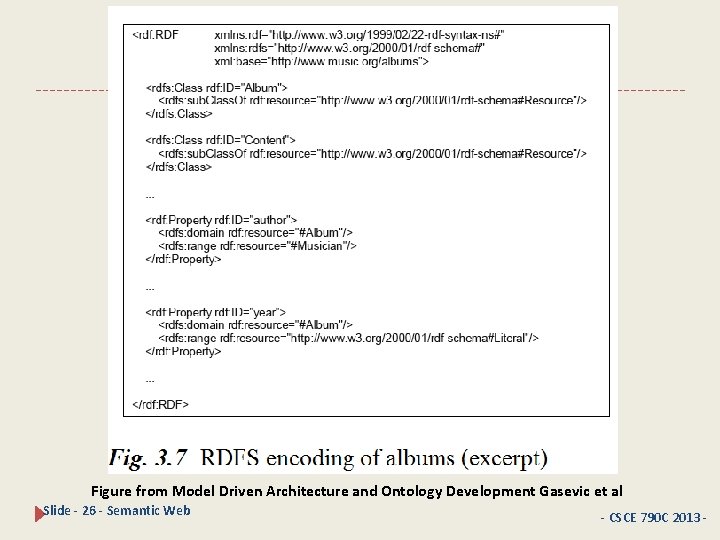
Figure from Model Driven Architecture and Ontology Development Gasevic et al Slide - 26 - Semantic Web - CSCE 790 C 2013 -
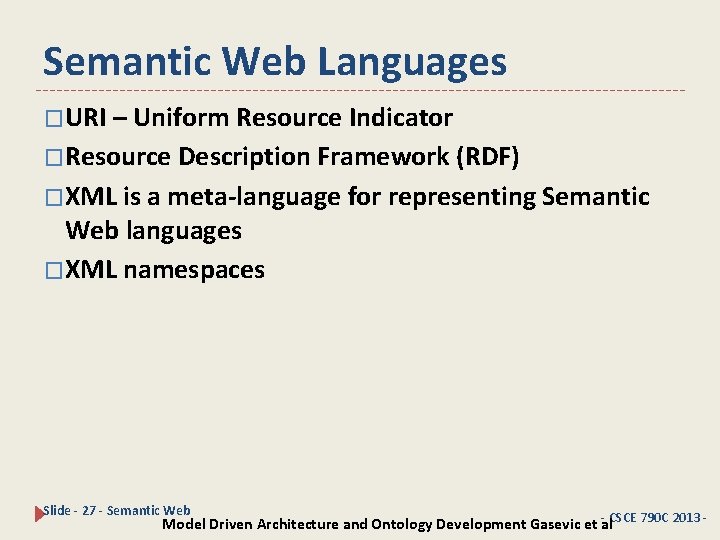
Semantic Web Languages �URI – Uniform Resource Indicator �Resource Description Framework (RDF) �XML is a meta-language for representing Semantic Web languages �XML namespaces Slide - 27 - Semantic Web Model Driven Architecture and Ontology Development Gasevic et -al. CSCE 790 C 2013 -
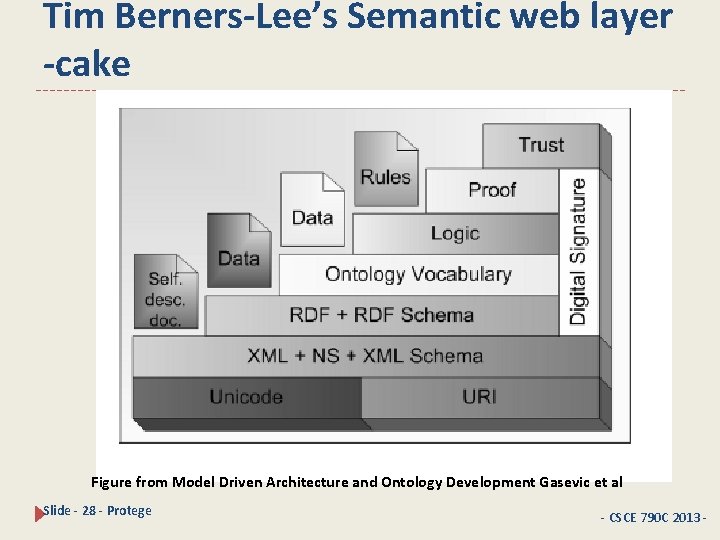
Tim Berners-Lee’s Semantic web layer -cake Figure from Model Driven Architecture and Ontology Development Gasevic et al Slide - 28 - Protege - CSCE 790 C 2013 -
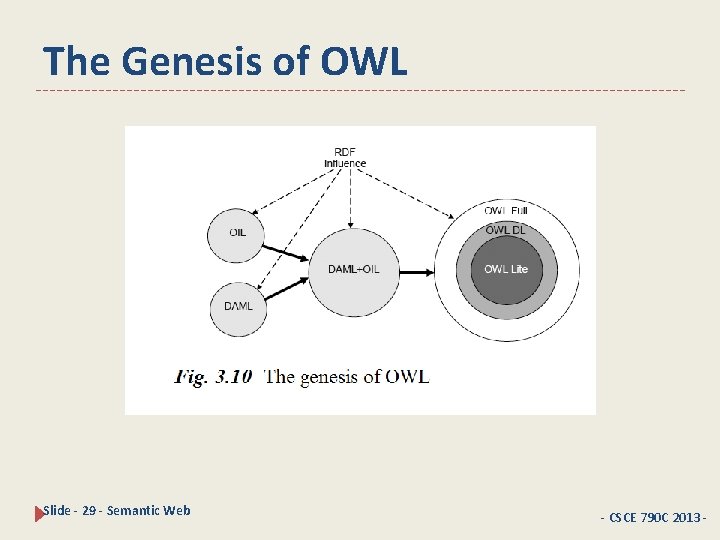
The Genesis of OWL Slide - 29 - Semantic Web - CSCE 790 C 2013 -
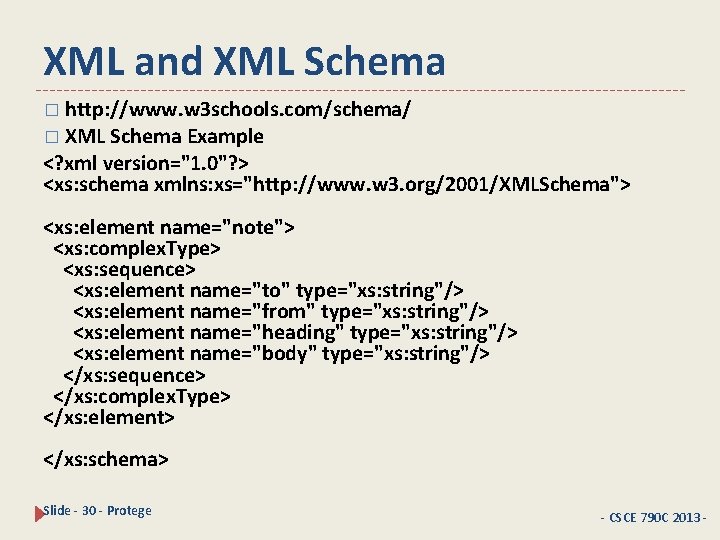
XML and XML Schema � http: //www. w 3 schools. com/schema/ � XML Schema Example <? xml version="1. 0"? > <xs: schema xmlns: xs="http: //www. w 3. org/2001/XMLSchema"> <xs: element name="note"> <xs: complex. Type> <xs: sequence> <xs: element name="to" type="xs: string"/> <xs: element name="from" type="xs: string"/> <xs: element name="heading" type="xs: string"/> <xs: element name="body" type="xs: string"/> </xs: sequence> </xs: complex. Type> </xs: element> </xs: schema> Slide - 30 - Protege - CSCE 790 C 2013 -
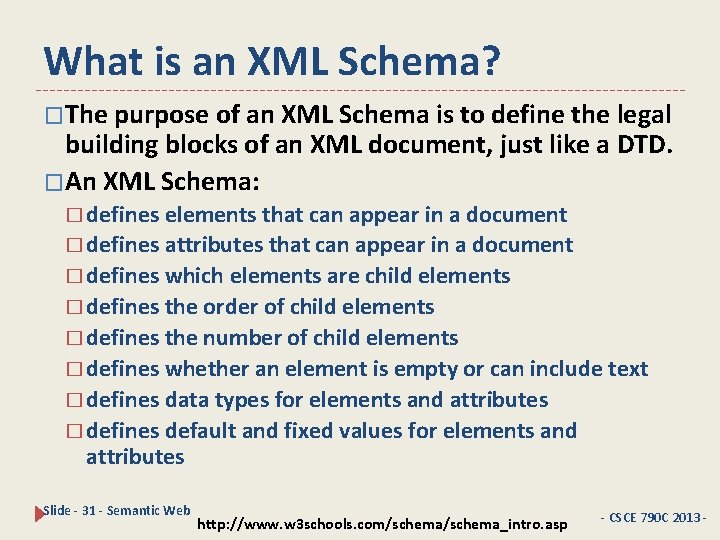
What is an XML Schema? �The purpose of an XML Schema is to define the legal building blocks of an XML document, just like a DTD. �An XML Schema: � defines elements that can appear in a document � defines attributes that can appear in a document � defines which elements are child elements � defines the order of child elements � defines the number of child elements � defines whether an element is empty or can include text � defines data types for elements and attributes � defines default and fixed values for elements and attributes Slide - 31 - Semantic Web http: //www. w 3 schools. com/schema_intro. asp - CSCE 790 C 2013 -
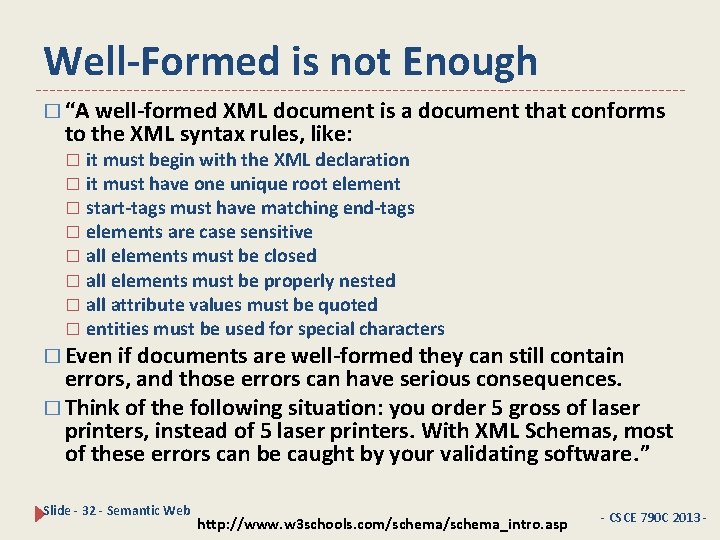
Well-Formed is not Enough � “A well-formed XML document is a document that conforms to the XML syntax rules, like: it must begin with the XML declaration � it must have one unique root element � start-tags must have matching end-tags � elements are case sensitive � all elements must be closed � all elements must be properly nested � all attribute values must be quoted � entities must be used for special characters � � Even if documents are well-formed they can still contain errors, and those errors can have serious consequences. � Think of the following situation: you order 5 gross of laser printers, instead of 5 laser printers. With XML Schemas, most of these errors can be caught by your validating software. ” Slide - 32 - Semantic Web http: //www. w 3 schools. com/schema_intro. asp - CSCE 790 C 2013 -
Slide - 33 - Semantic Web - CSCE 790 C 2013 -
What is OWL? �OWL stands for Web Ontology Language �OWL is built on top of RDF �OWL is for processing information on the web �OWL was designed to be interpreted by computers �OWL was not designed for being read by people �OWL is written in XML �OWL has three sublanguages �OWL is a W 3 C standard Slide - 34 - Semantic Web http: //www. w 3 schools. com/rdf_owl. asp - CSCE 790 C 2013 -
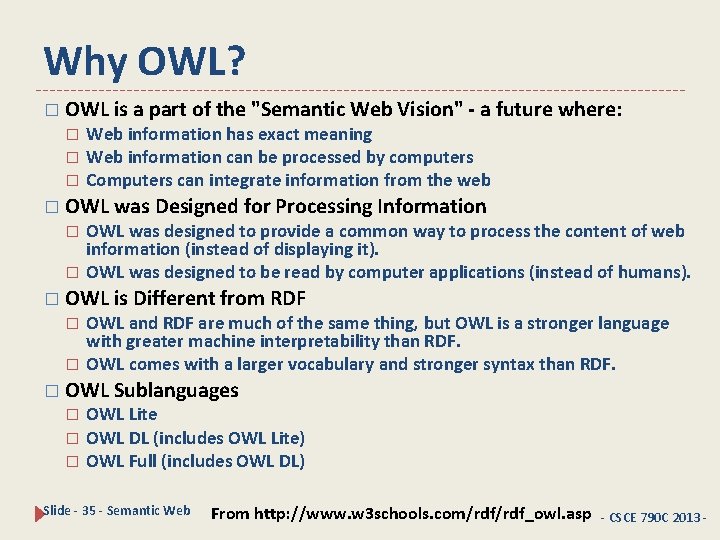
Why OWL? � OWL is a part of the "Semantic Web Vision" - a future where: � � � Web information has exact meaning Web information can be processed by computers Computers can integrate information from the web � OWL was Designed for Processing Information � � OWL was designed to provide a common way to process the content of web information (instead of displaying it). OWL was designed to be read by computer applications (instead of humans). � OWL is Different from RDF � � OWL and RDF are much of the same thing, but OWL is a stronger language with greater machine interpretability than RDF. OWL comes with a larger vocabulary and stronger syntax than RDF. � OWL Sublanguages � � � OWL Lite OWL DL (includes OWL Lite) OWL Full (includes OWL DL) Slide - 35 - Semantic Web From http: //www. w 3 schools. com/rdf_owl. asp - CSCE 790 C 2013 -
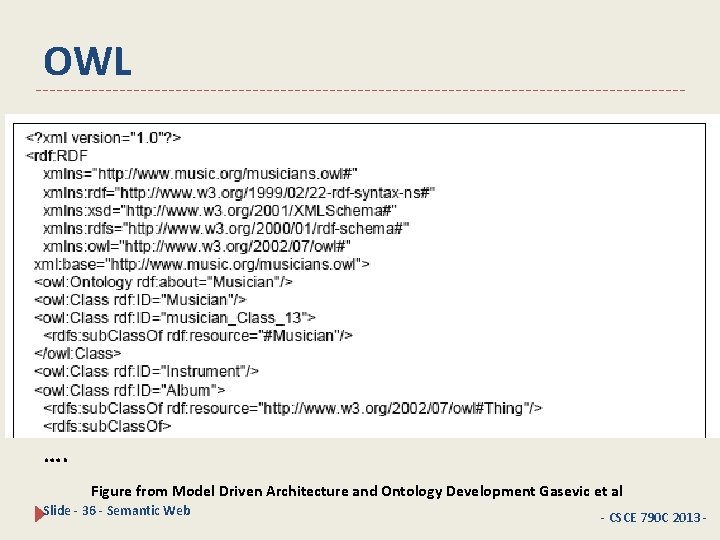
OWL … …. Figure from Model Driven Architecture and Ontology Development Gasevic et al Slide - 36 - Semantic Web - CSCE 790 C 2013 -
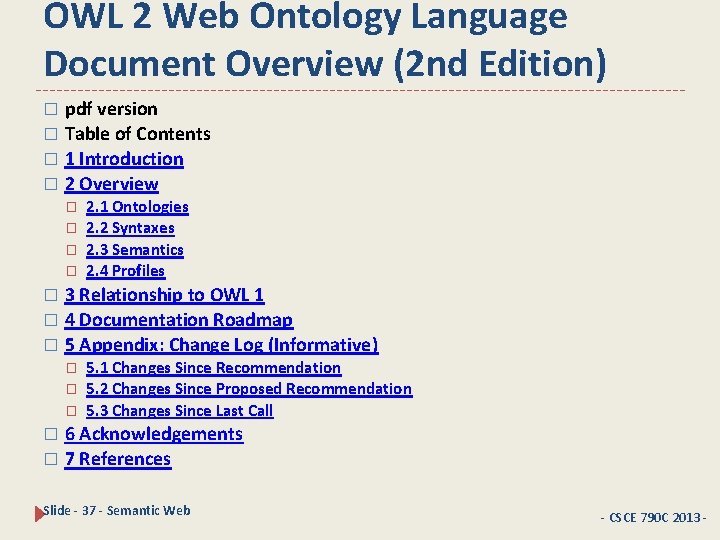
OWL 2 Web Ontology Language Document Overview (2 nd Edition) pdf version � Table of Contents � 1 Introduction � 2 Overview � � � 2. 1 Ontologies 2. 2 Syntaxes 2. 3 Semantics 2. 4 Profiles 3 Relationship to OWL 1 � 4 Documentation Roadmap � 5 Appendix: Change Log (Informative) � � 5. 1 Changes Since Recommendation 5. 2 Changes Since Proposed Recommendation 5. 3 Changes Since Last Call 6 Acknowledgements � 7 References � Slide - 37 - Semantic Web - CSCE 790 C 2013 -
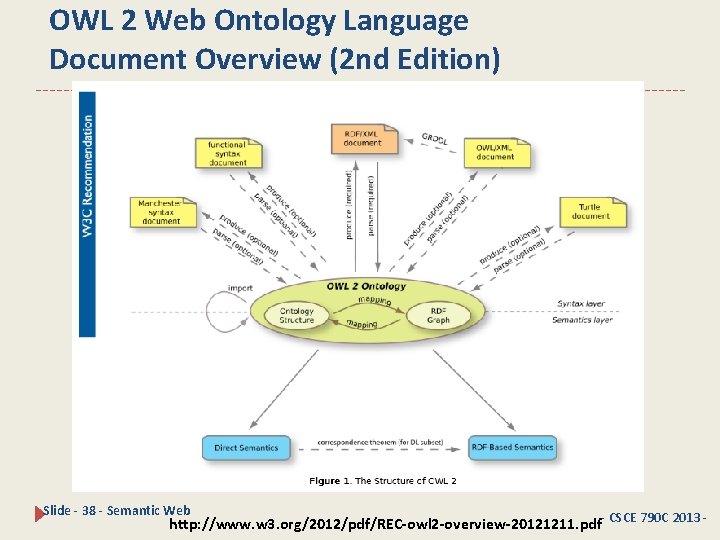
OWL 2 Web Ontology Language Document Overview (2 nd Edition) Slide - 38 - Semantic Web http: //www. w 3. org/2012/pdf/REC-owl 2 -overview-20121211. pdf- CSCE 790 C 2013 -
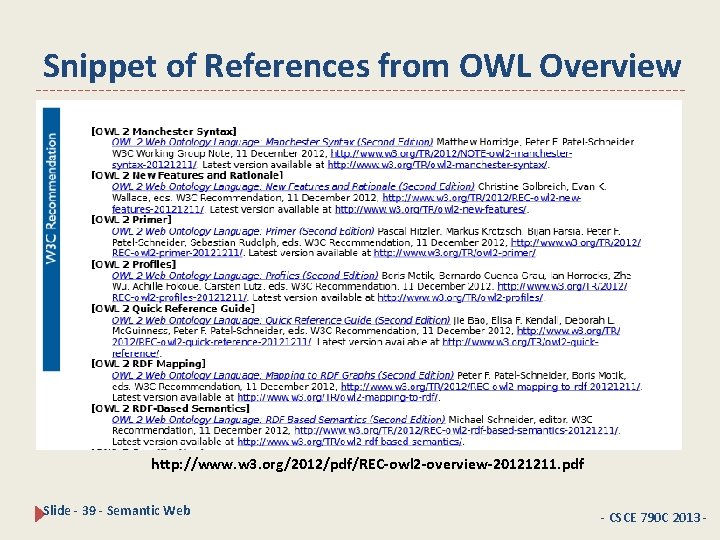
Snippet of References from OWL Overview http: //www. w 3. org/2012/pdf/REC-owl 2 -overview-20121211. pdf Slide - 39 - Semantic Web - CSCE 790 C 2013 -