
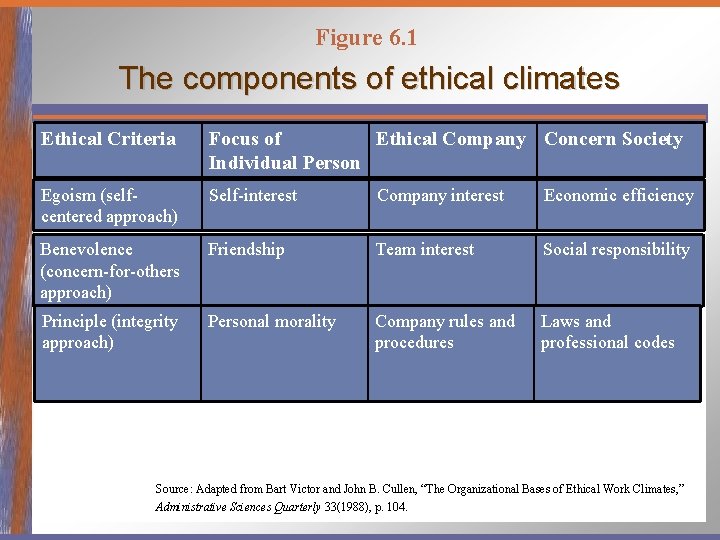
Figure 6 1 The components of ethical climates
- Slides: 9
Figure 6. 1 The components of ethical climates Ethical Criteria Focus of Ethical Company Concern Society Individual Person Egoism (selfcentered approach) Self-interest Company interest Economic efficiency Benevolence (concern-for-others approach) Friendship Team interest Social responsibility Principle (integrity approach) Personal morality Company rules and procedures Laws and professional codes Source: Adapted from Bart Victor and John B. Cullen, “The Organizational Bases of Ethical Work Climates, ” Administrative Sciences Quarterly 33(1988), p. 104.
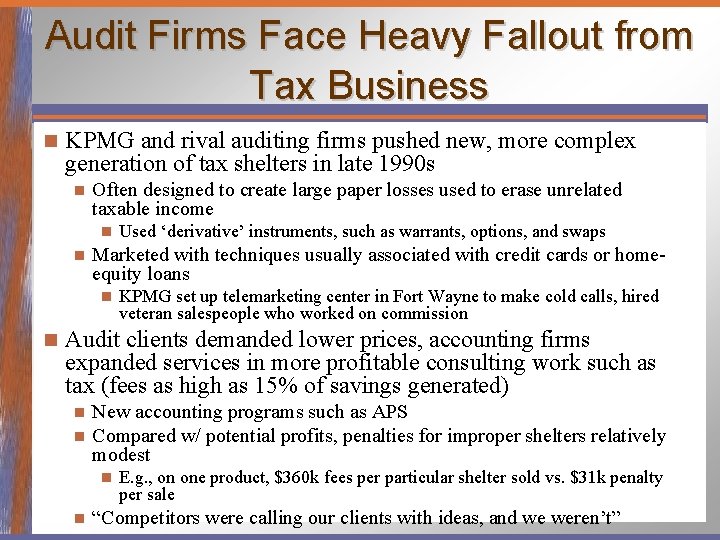
Audit Firms Face Heavy Fallout from Tax Business n KPMG and rival auditing firms pushed new, more complex generation of tax shelters in late 1990 s n Often designed to create large paper losses used to erase unrelated taxable income n n Marketed with techniques usually associated with credit cards or homeequity loans n n Used ‘derivative’ instruments, such as warrants, options, and swaps KPMG set up telemarketing center in Fort Wayne to make cold calls, hired veteran salespeople who worked on commission Audit clients demanded lower prices, accounting firms expanded services in more profitable consulting work such as tax (fees as high as 15% of savings generated) n n New accounting programs such as APS Compared w/ potential profits, penalties for improper shelters relatively modest n n E. g. , on one product, $360 k fees per particular shelter sold vs. $31 k penalty per sale “Competitors were calling our clients with ideas, and we weren’t”
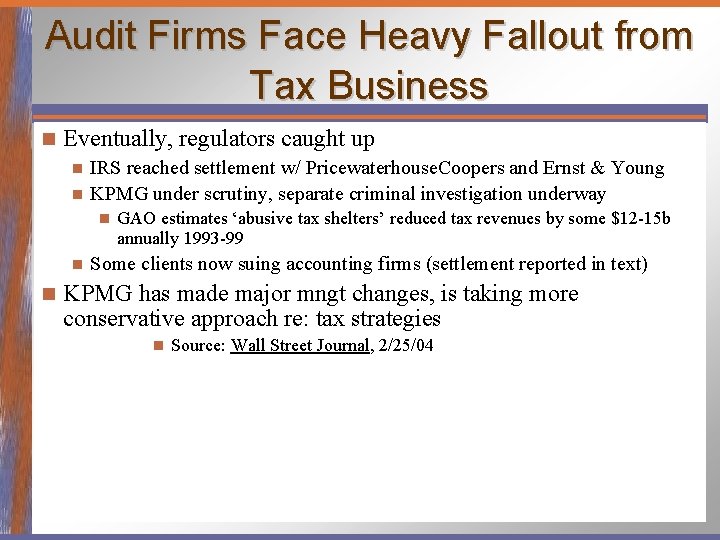
Audit Firms Face Heavy Fallout from Tax Business n Eventually, regulators caught up IRS reached settlement w/ Pricewaterhouse. Coopers and Ernst & Young n KPMG under scrutiny, separate criminal investigation underway n n GAO estimates ‘abusive tax shelters’ reduced tax revenues by some $12 -15 b annually 1993 -99 Some clients now suing accounting firms (settlement reported in text) KPMG has made major mngt changes, is taking more conservative approach re: tax strategies n Source: Wall Street Journal, 2/25/04
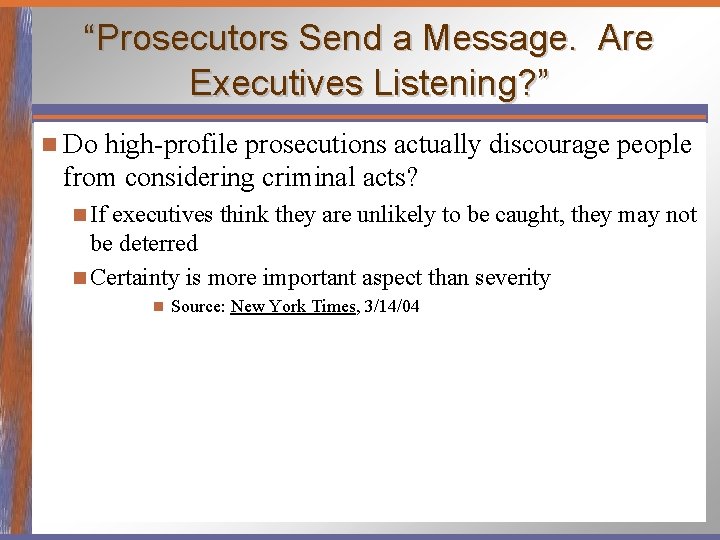
“Prosecutors Send a Message. Are Executives Listening? ” n Do high-profile prosecutions actually discourage people from considering criminal acts? n If executives think they are unlikely to be caught, they may not be deterred n Certainty is more important aspect than severity n Source: New York Times, 3/14/04
USI Code: Definitions of Academic Dishonesty n “…requires each student to do his or her academic work without recourse to unauthorized means of any kind” n “Both students and faculty are expected to report violations of academic dishonesty” n “Faculty should explain the special hazards regarding academic honesty in their discipline” n “Faculty should also plan and supervise academic work carefully so honest effort will be encouraged”
“Opportunity for Corporate Fraud Has Shrunk – but It’s Still There” n Despite new laws and regulations, cos still face enormous pressure to meet short-term financial goals, creating powerful motive for accounting fraud n Businesses pay price for missing revenue targets by even a penny or two n No slowdown in race for higher CEO pay n “As long as CEO pay is so fundamentally out of whack, we cannot say that boards are doing their job or that corporate governance reform has been accomplished” Greatest improvement since Sarbannes-Oxley was passed in 2002 has been in regulation of behavior of accountants n Corporate boards are meeting more often and paying more attention to work of auditors n Last year, longtime directors at American International Group overthrew Hank Greenberg as chairman after nearly 40 years at helm after regulators stepped up accounting probe at Co n However, opposition to some of changes made since Enron is growing n n Source: Washington Post, 1/26/06
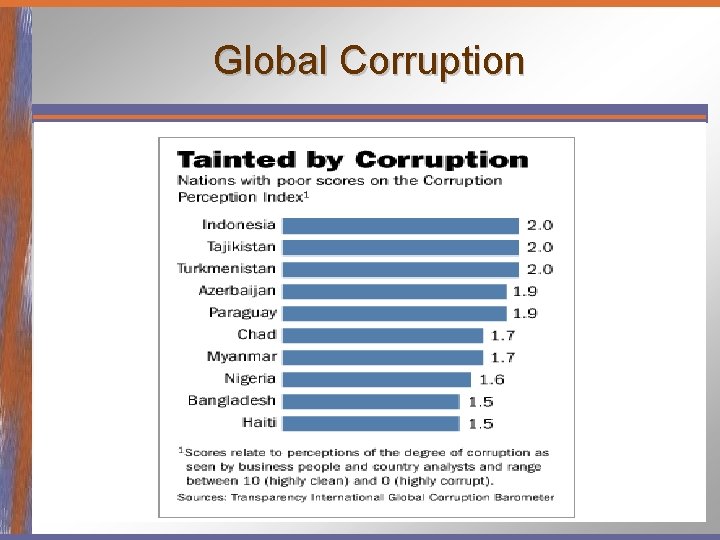
Global Corruption
“Multinational Companies Unite to Fight Bribery” Some of world’s biggest construction, energy, and metals and mining companies, their industries beset by corruption investigations around globe, are starting to coalesce around plan to clean house themselves n Organizers concentrating on these industries because they frequently operate in developing countries and have some of biggest corruption problems n Signing onto “zero tolerance” pact against paying bribes being sponsored by coalition of groups working with World Economic Forum n Many big MNCs already claim to observe strict prohibitions against bribery and influence peddling, many have signed other pacts opposing corruption, so latest effort is bound to raise questions about its effectiveness n First such part organized by the businesses themselves n n Main aim is to get all big players in key industries to sign deal so that they can work in unison, w/ feeling they are on level playing field, and monitor each other n Next step is to come up with enforcement structure, such as certification process by independent monitor n Source: Wall Street Journal, 1/27/05