
Figure 6 1 Relationship of Qualitative Research to




- Slides: 36
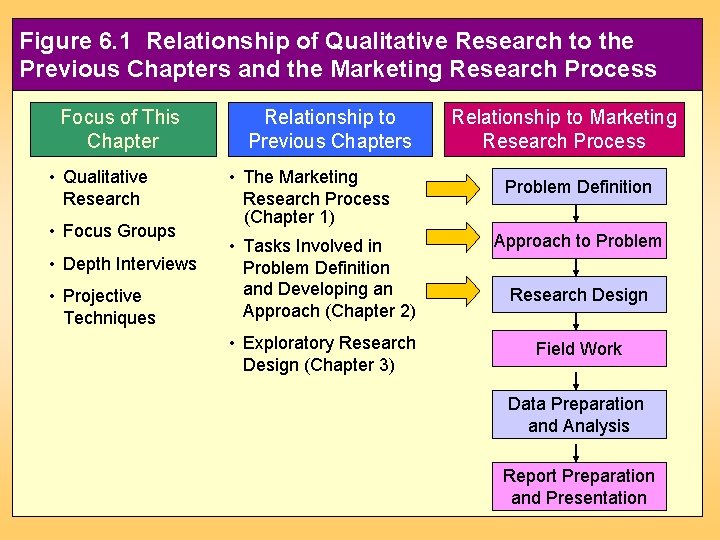
Figure 6. 1 Relationship of Qualitative Research to the Previous Chapters and the Marketing Research Process Focus of This Chapter • Qualitative Research • Focus Groups • Depth Interviews • Projective Techniques Relationship to Previous Chapters • The Marketing Research Process (Chapter 1) Relationship to Marketing Research Process Problem Definition • Tasks Involved in Problem Definition and Developing an Approach (Chapter 2) Approach to Problem • Exploratory Research Design (Chapter 3) Field Work Research Design Data Preparation and Analysis Report Preparation and Presentation
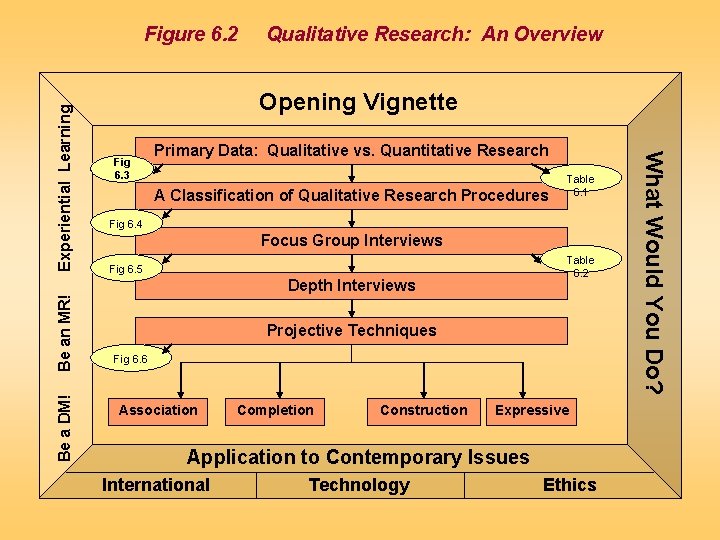
Be an MR! Be a DM! Qualitative Research: An Overview Opening Vignette Fig 6. 3 Primary Data: Qualitative vs. Quantitative Research A Classification of Qualitative Research Procedures Table 6. 1 Fig 6. 4 Focus Group Interviews Table 6. 2 Fig 6. 5 Depth Interviews Projective Techniques Fig 6. 6 Association Completion Construction Expressive Application to Contemporary Issues International Technology Ethics What Would You Do? Experiential Learning Figure 6. 2
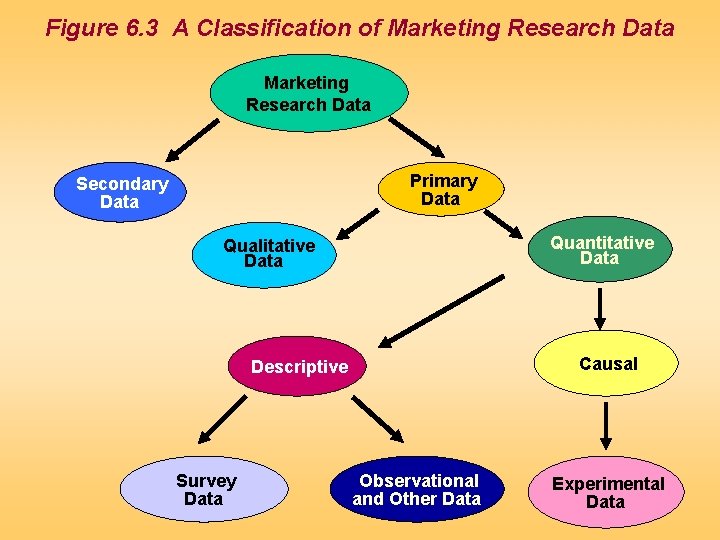
Figure 6. 3 A Classification of Marketing Research Data Primary Data Secondary Data Quantitative Data Qualitative Data Causal Descriptive Survey Data Observational and Other Data Experimental Data
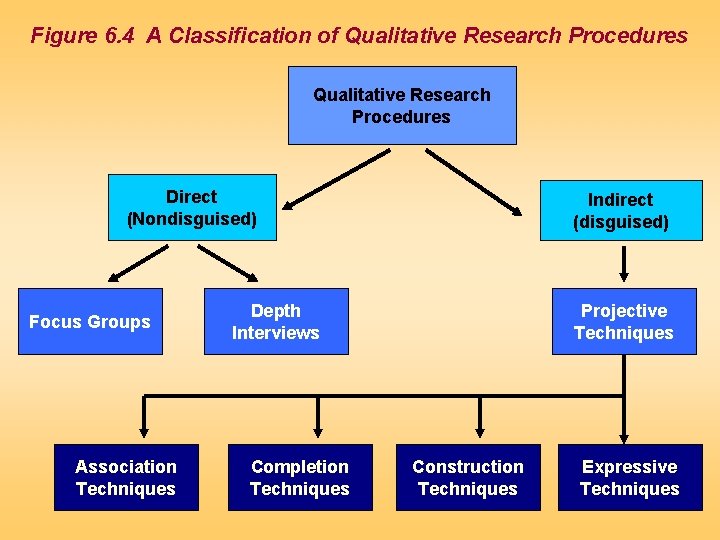
Figure 6. 4 A Classification of Qualitative Research Procedures Direct (Nondisguised) Focus Groups Association Techniques Indirect (disguised) Depth Interviews Completion Techniques Projective Techniques Construction Techniques Expressive Techniques
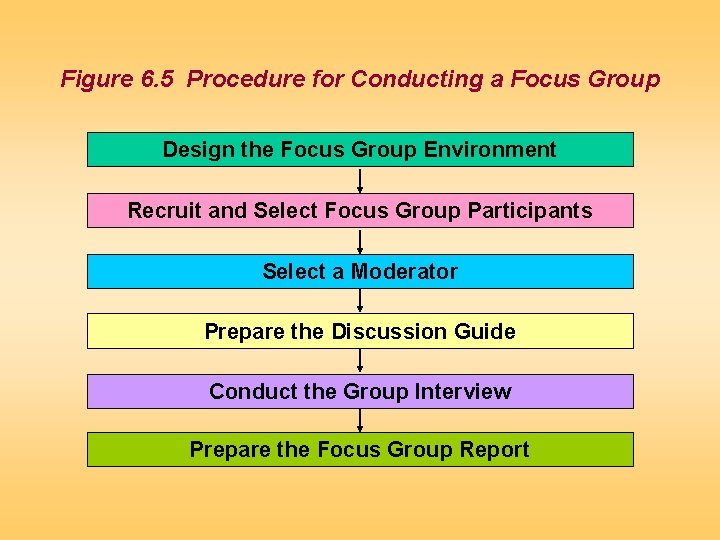
Figure 6. 5 Procedure for Conducting a Focus Group Design the Focus Group Environment Recruit and Select Focus Group Participants Select a Moderator Prepare the Discussion Guide Conduct the Group Interview Prepare the Focus Group Report
How to Conduct a Focus Group The process of conducting a focus group interview requires careful planning. There are mainly three issues the researcher must take into the consideration when she/he designs the focus group interview: designing the environment the focus group is conducted, the selection of participants, and the moderator.
Designing the Environment Focus group sessions are typically held in facilities specially equipped to comfortably accommodate and record a group discussion. The setting is typically an informal conference room equipped with a one-way mirror and microphones throughout the room. Behind the mirror is a viewing room for management. Most focus groups are scheduled to last one to three hours. This amount of time needed to establish rapport with the participants and to explore, in dept, their beliefs, feelings, ideas, attitudes, and insights regarding the topics of interest. Focus groups will be either audiorecorded or videotaped to preserve the comments for analysis later. Videotaping has the advantage of recording facial expressions and body movements.
Recruiting and Selecting Participants A focus group is generally made up of 8 to 12 members. The advantages that come from the group dynamics are often lost to group larger than this number. A focus group should be homogeneous in terms of demographic and socioeconomic characteristics. This commonality among group members avoids interactions and conflict on side issues. Not only should the group be homogeneous in terms of demographic and socioeconomic characteristics, there should also be a common base of experience or involvement with the object or issue being discussed. Thus, heavy users and non users should not be included in the same group. To ensure that the focus group respondents should be screened out through their background information.
Selecting a Moderator The moderator plays a key role and must be well trained. General group management skills as well as background in psychology and marketing typically suffice in most focus group situations. The moderator must be able to establish rapport with the participants, keep the discussion moving forward, and probe the respondents to elicit insights. In addition, this individual may also play an important role in the analysis and interpretation of the data. Therefore, the moderator should posses knowledge of the discussion topic and an understanding of the nature of group dynamics in order to appropriately interpret focus group responses.
Preparing the Discussion Guide Regardless of the skills or qualifications of the moderator, any focus group will flounder without an outline of the topics to be covered. Most group discussions can be broken into three phases, the first being an introduction to establish a rapport, relax the group, and describe the process. Second is the bulk of the discussions. In the closing phase, the moderator summarizes the comments and attempts to get final read on the strength of the group’s commitment to the statements made. This is done by having the respondents express their degree of agreement or disagreement to the statements.
Conducting the Group Interview During the interview, the moderator must (1) establish rapport with the group, (2)state the rules of group interaction, (3)set objectives, (4)probe the respondents and provoke intense discussions in the relevant areas, and (5)attempt to summarize the group’s response to determine the extent of agreement.
Preparing The Focus Group Report Following the focus group session, the moderator and the others who viewed the session often engage in an instant interpretation. Report should cover expressions such as “ most participants thought” or “participants were divided in this issue”. The report should not only present the findings based on the verbal comments but should also analyze consistent responses, new ideas, and concerns suggested by facial expressions and body language. Report should also addressed the issues that should be covered with the other detailed research.
Advantages of Focus Groups Synergism: a group of people together can produce more information than individual Snowballing: a one person’s comment triggers a chain reaction from the other participants Stimulation: the respondents want to express their ideas and expose their feeling as the general level of excitement over the topic increases in the group Security: because the participant’s feelings are similar to those of other group members, they feel comfortable Spontaneity: participants answers can be spontaneous and unconventional
Advantages of Focus Groups Serendipity: ideas are more likely to arise out of blue in a group than individual interview Specialization: using expensive, but expensive interviewer is justified Scientific scrutiny: The group interview allows close scrutiny of the data collection process , in that observes can witness the session and it can be recorded for later analysis Structure: The group interview allows for flexibility in the topics covered and the depth with which they are treated. Speed: Since a number of individuals are being interviewed at the same time, data collection and analysis proceed relatively quickly
Disadvantages of Focus Groups Misuse: focus groups can be misused and abused by considering the results as conclusive rather than exploratory Misjudge: focus group are particularly susceptible to client and researcher biases Moderation: They are difficult to moderate Messy: The unstructured nature of the responses makes coding, analysis, and interpretation difficult Misrepresentation: focus group results are not representative of the general population and are not projectable.
Applications of focus groups • Understanding consumers’ perceptions, preferences, and behavior concerning a product category • Obtaining impressions of new product concepts • Generating new ideas about older products • Developing creative concepts and copy material for advertisements • Securing price impressions • Obtaining preliminary consumer reaction to specific marketing program
Advantages of Online Focus Groups • Geographical constraints are removed and time constraints are lessened. • Unique opportunity to re-contact group participants at a later date. • Can recruit people not interested in traditional focus groups: doctors, lawyers, etc. • Moderators can carry on side conversations with individual respondents. • There is no travel, video taping, or facilities to arrange; so the cost is much lower.
Disadvantages of Online Focus Groups • Only people that have access to the Internet can participate. • Verifying that a respondent is a member of a target group is difficult. • There is lack of general control over the respondent's environment. • Only audio and visual stimuli can be tested. Products can not be touched (e. g. , clothing) or smelled (e. g. , perfumes).
Depth Interviews • Like focus groups, depth interviews are an unstructured and direct way of obtaining information. • Unlike focus groups, however, depth interviews are conducted on a one-on-one basis. • These interviews typically last from 30 minutes to more than an hour. • They attempt to uncover underlying motives, prejudices, or attitudes toward sensitive issues.
Depth Interviews • Substantial probing is done to surface underlying motives, beliefs, and attitudes. • Probing is done by asking such questions as: – “Why do you say that? '' – “That's interesting, can you tell me more? '' – “Would you like to add anything else? ”
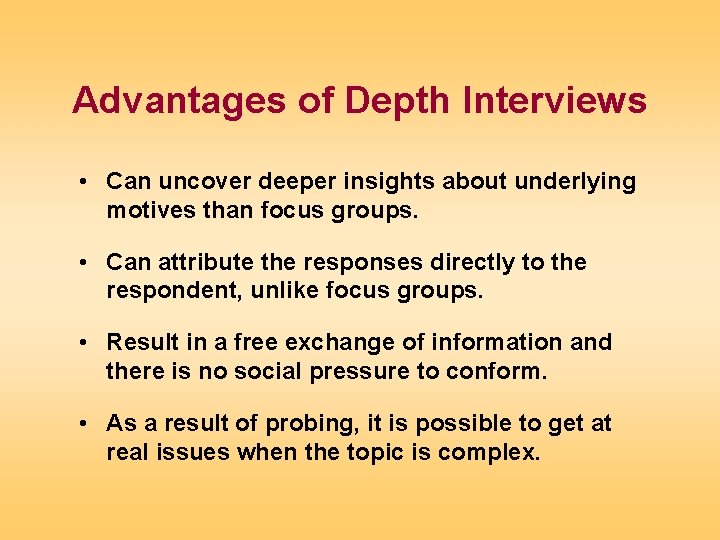
Advantages of Depth Interviews • Can uncover deeper insights about underlying motives than focus groups. • Can attribute the responses directly to the respondent, unlike focus groups. • Result in a free exchange of information and there is no social pressure to conform. • As a result of probing, it is possible to get at real issues when the topic is complex.
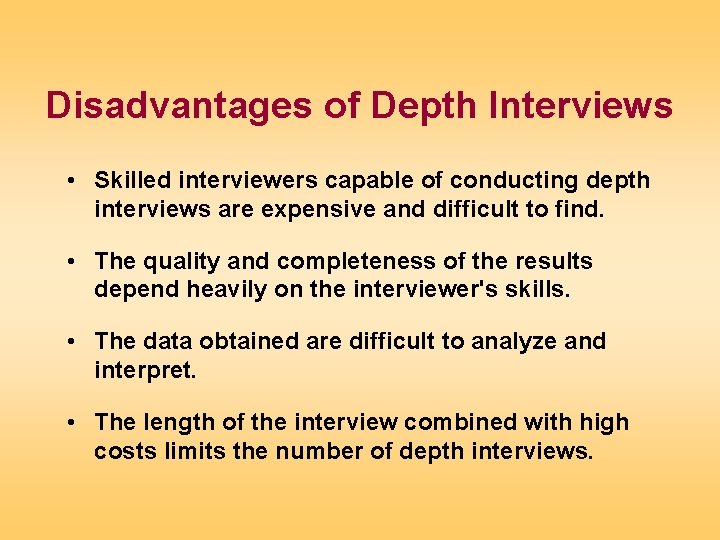
Disadvantages of Depth Interviews • Skilled interviewers capable of conducting depth interviews are expensive and difficult to find. • The quality and completeness of the results depend heavily on the interviewer's skills. • The data obtained are difficult to analyze and interpret. • The length of the interview combined with high costs limits the number of depth interviews.
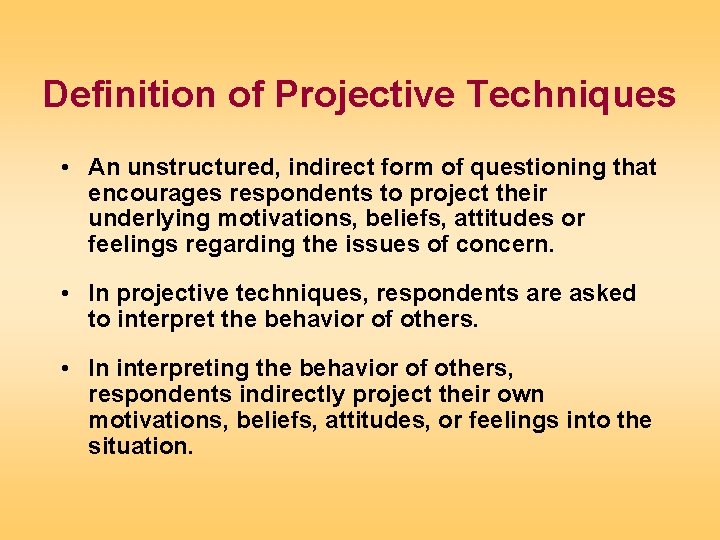
Definition of Projective Techniques • An unstructured, indirect form of questioning that encourages respondents to project their underlying motivations, beliefs, attitudes or feelings regarding the issues of concern. • In projective techniques, respondents are asked to interpret the behavior of others. • In interpreting the behavior of others, respondents indirectly project their own motivations, beliefs, attitudes, or feelings into the situation.
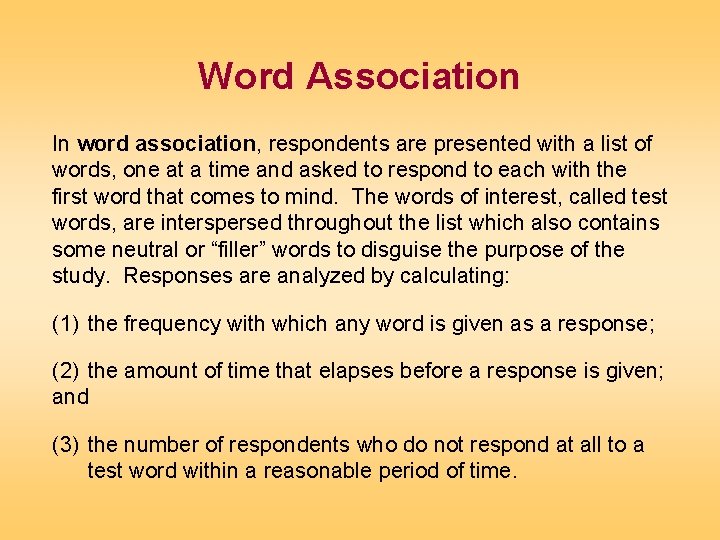
Word Association In word association, respondents are presented with a list of words, one at a time and asked to respond to each with the first word that comes to mind. The words of interest, called test words, are interspersed throughout the list which also contains some neutral or “filler” words to disguise the purpose of the study. Responses are analyzed by calculating: (1) the frequency with which any word is given as a response; (2) the amount of time that elapses before a response is given; and (3) the number of respondents who do not respond at all to a test word within a reasonable period of time.
Completion Techniques In Sentence completion, respondents are given incomplete sentences and asked to complete them. Generally, they are asked to use the first word or phrase that comes to mind. A person who wears Tommy Hilfiger shirts is __________________ As compared to Polo, Gant and Eddie Bauer, Tommy Hilfiger shirts are _________________ Tommy Hilfiger shirts are most liked by __________________ A variation of sentence completion is paragraph completion, in which the respondent completes a paragraph beginning with the stimulus phrase.
Completion Techniques In story completion, respondents are given part of a story – enough to direct attention to a particular topic but not to hint at the ending. They are required to give the conclusion in their own words.
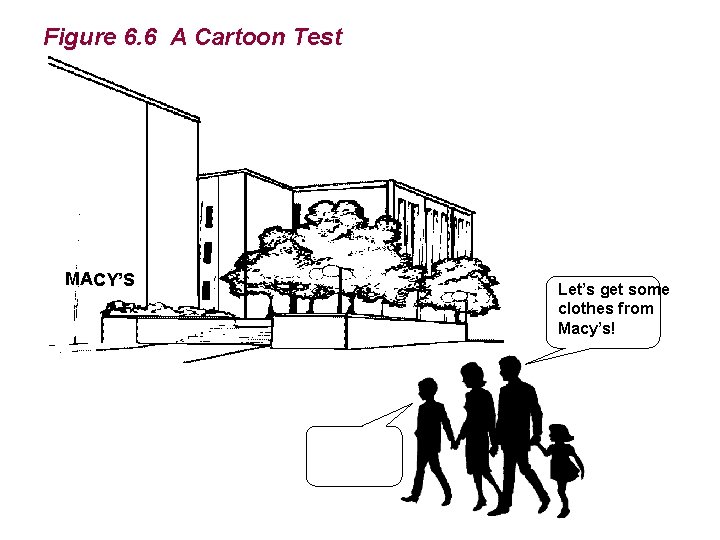
Construction Techniques With a picture response, the respondents are asked to describe a series of pictures of ordinary as well as unusual events. The respondent's interpretation of the pictures gives indications of that individual's personality. In cartoon tests, cartoon characters are shown in a specific situation related to the problem. The respondents are asked to indicate what one cartoon character might say in response to the comments of another character. Cartoon tests are simpler to administer and analyze than picture response techniques.
Figure 6. 6 A Cartoon Test MACY’S Let’s get some clothes from Macy’s!
Expressive Techniques In expressive techniques, respondents are presented with a verbal or visual situation and asked to relate the feelings and attitudes of other people to the situation. Role playing Respondents are asked to play the role or assume the behavior of someone else. Third-person technique The respondent is presented with a verbal or visual situation and the respondent is asked to relate the beliefs and attitudes of a third person rather than directly expressing personal beliefs and attitudes. This third person may be a friend, neighbor, colleague, or a “typical” person.
Advantages of Projective Techniques • They may elicit responses that subjects would be unwilling or unable to give if they knew the purpose of the study. • Helpful when the issues to be addressed are personal, sensitive, or subject to strong social norms. • Helpful when underlying motivations, beliefs, and attitudes are operating at a subconscious level.
Disadvantages of Projective Techniques • Suffer from many of the disadvantages of unstructured direct techniques, but to a greater extent. • Require highly trained interviewers. • Skilled interpreters are also required to analyze the responses. • There is a serious risk of interpretation bias. • They tend to be expensive. • May require respondents to engage in unusual behavior.
Guidelines for Using Projective Techniques • Projective techniques should be used because the required information cannot be accurately obtained by direct methods. • Projective techniques should be used for exploratory research to gain initial insights and understanding. • Given their complexity, projective techniques should not be used naively.