
Figure 6 0 1 CELLULAR RESPIRATION AEROBIC HARVESTING
Figure 6. 0 -1 CELLULAR RESPIRATION: AEROBIC HARVESTING OF ENERGY © 2015 Pearson Education, Inc.
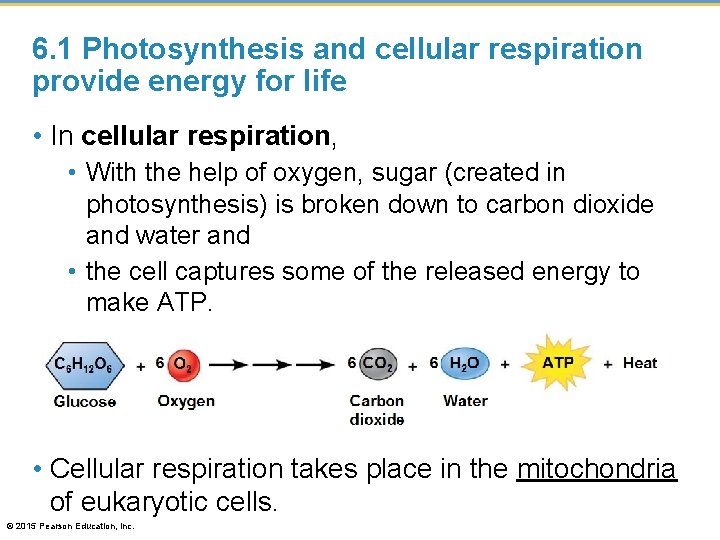
6. 1 Photosynthesis and cellular respiration provide energy for life • In cellular respiration, • With the help of oxygen, sugar (created in photosynthesis) is broken down to carbon dioxide and water and • the cell captures some of the released energy to make ATP. • Cellular respiration takes place in the mitochondria of eukaryotic cells. © 2015 Pearson Education, Inc.
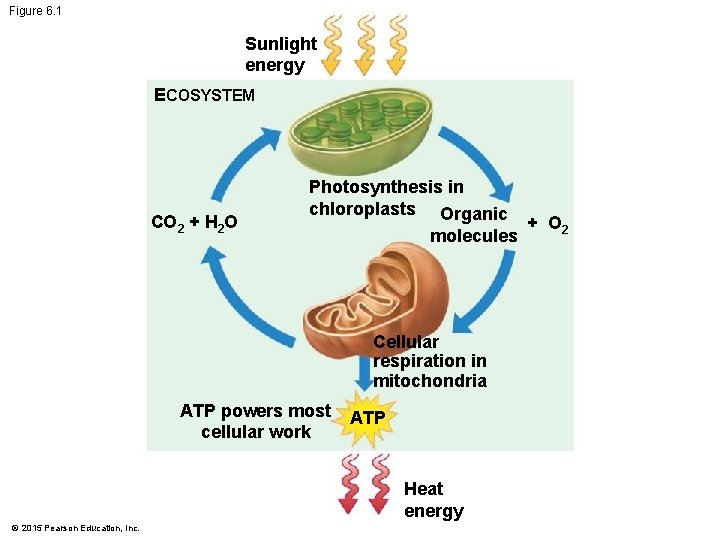
Figure 6. 1 Sunlight energy ECOSYSTEM CO 2 + H 2 O Photosynthesis in chloroplasts Organic molecules Cellular respiration in mitochondria ATP powers most cellular work ATP Heat energy © 2015 Pearson Education, Inc. + O 2
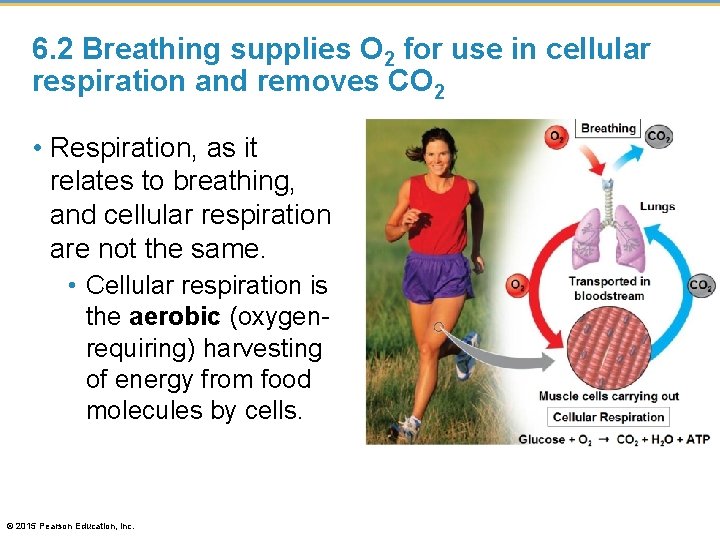
6. 2 Breathing supplies O 2 for use in cellular respiration and removes CO 2 • Respiration, as it relates to breathing, and cellular respiration are not the same. • Cellular respiration is the aerobic (oxygenrequiring) harvesting of energy from food molecules by cells. © 2015 Pearson Education, Inc.
6. 3 Cellular respiration banks energy in ATP molecules • Cellular respiration is an exergonic (energyreleasing) process that transfers energy from the bonds in glucose to form ATP. • Cellular respiration • can produce up to 32 ATP molecules for each glucose molecule © 2015 Pearson Education, Inc.
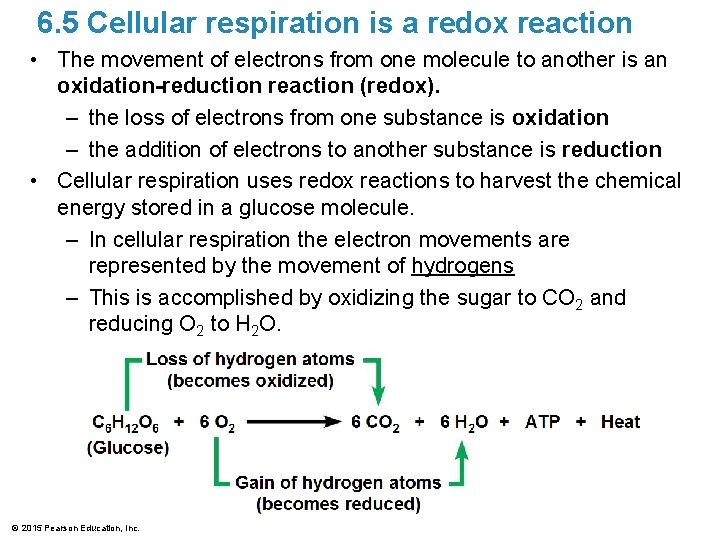
6. 5 Cellular respiration is a redox reaction • The movement of electrons from one molecule to another is an oxidation-reduction reaction (redox). – the loss of electrons from one substance is oxidation – the addition of electrons to another substance is reduction • Cellular respiration uses redox reactions to harvest the chemical energy stored in a glucose molecule. – In cellular respiration the electron movements are represented by the movement of hydrogens – This is accomplished by oxidizing the sugar to CO 2 and reducing O 2 to H 2 O. © 2015 Pearson Education, Inc.
STAGES OF CELLULAR RESPIRATION
6. 6 Overview: Cellular respiration occurs in three main stages • Cellular respiration consists of a sequence of steps that can be divided into three stages. • Stage 1: Glycolysis • Stage 2: Pyruvate oxidation and the citric acid cycle • Stage 3: Oxidative phosphorylation © 2015 Pearson Education, Inc.
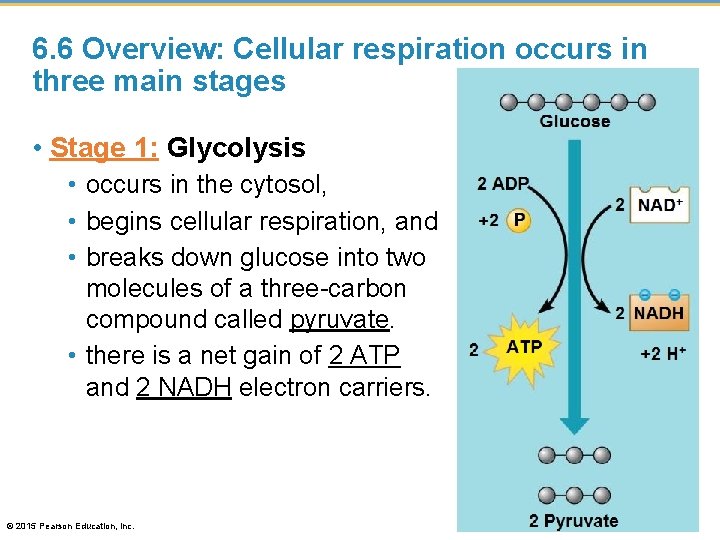
6. 6 Overview: Cellular respiration occurs in three main stages • Stage 1: Glycolysis • occurs in the cytosol, • begins cellular respiration, and • breaks down glucose into two molecules of a three-carbon compound called pyruvate. • there is a net gain of 2 ATP and 2 NADH electron carriers. © 2015 Pearson Education, Inc.
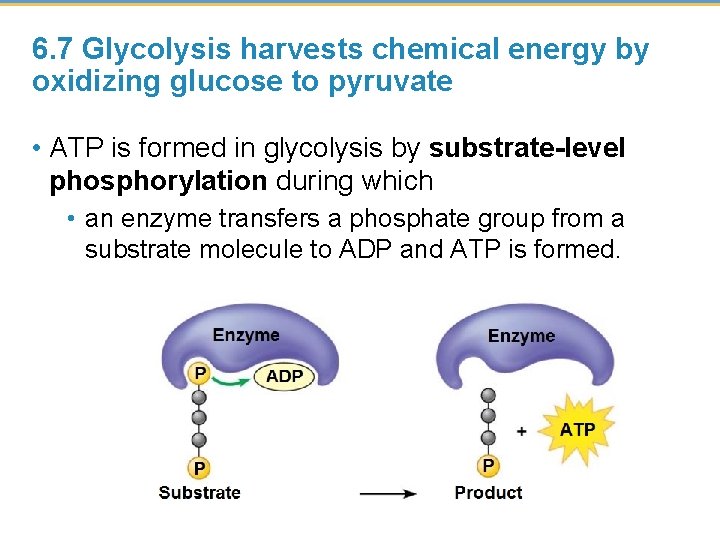
6. 7 Glycolysis harvests chemical energy by oxidizing glucose to pyruvate • ATP is formed in glycolysis by substrate-level phosphorylation during which • an enzyme transfers a phosphate group from a substrate molecule to ADP and ATP is formed.
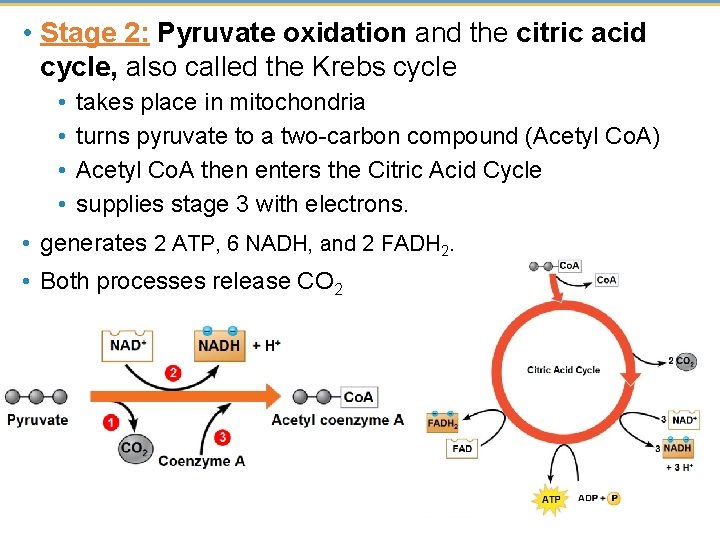
• Stage 2: Pyruvate oxidation and the citric acid cycle, also called the Krebs cycle • • takes place in mitochondria turns pyruvate to a two-carbon compound (Acetyl Co. A) Acetyl Co. A then enters the Citric Acid Cycle supplies stage 3 with electrons. • generates 2 ATP, 6 NADH, and 2 FADH 2. • Both processes release CO 2
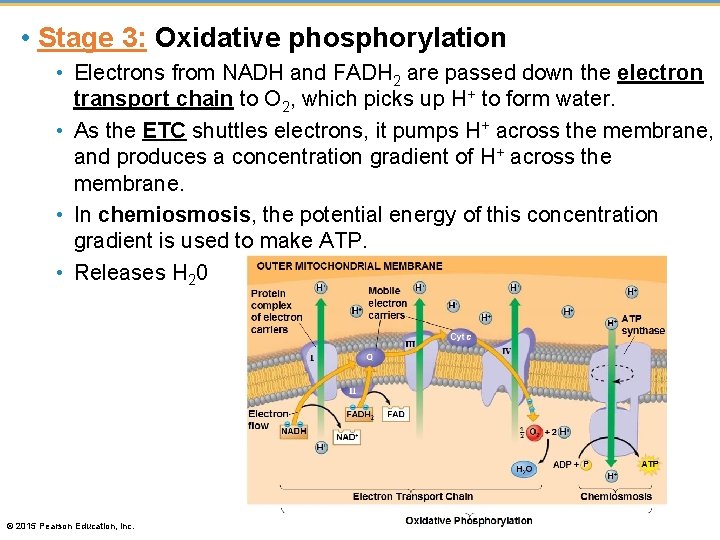
• Stage 3: Oxidative phosphorylation • Electrons from NADH and FADH 2 are passed down the electron transport chain to O 2, which picks up H+ to form water. • As the ETC shuttles electrons, it pumps H+ across the membrane, and produces a concentration gradient of H+ across the membrane. • In chemiosmosis, the potential energy of this concentration gradient is used to make ATP. • Releases H 20 © 2015 Pearson Education, Inc.
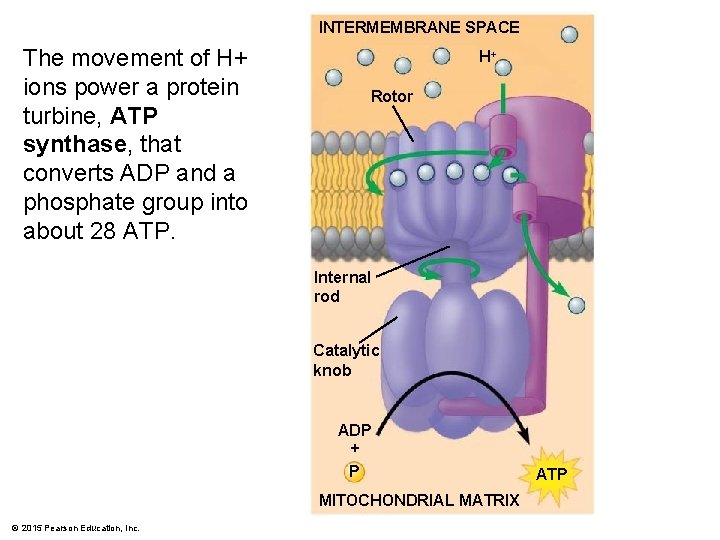
INTERMEMBRANE SPACE The movement of H+ ions power a protein turbine, ATP synthase, that converts ADP and a phosphate group into about 28 ATP. H+ Rotor Internal rod Catalytic knob ADP + P MITOCHONDRIAL MATRIX © 2015 Pearson Education, Inc. ATP
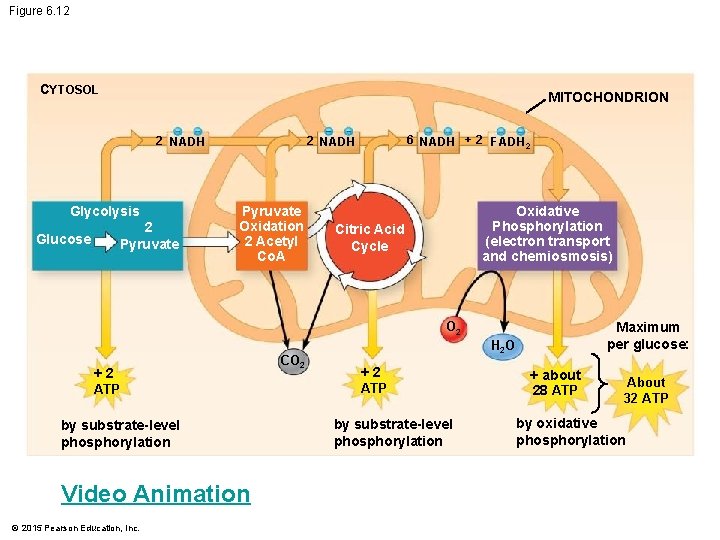
Figure 6. 12 CYTOSOL MITOCHONDRION 2 NADH Glycolysis 2 Pyruvate Glucose 6 NADH + 2 FADH 2 2 NADH Pyruvate Oxidation 2 Acetyl Co. A Oxidative Phosphorylation (electron transport and chemiosmosis) Citric Acid Cycle O 2 +2 ATP by substrate-level phosphorylation Video Animation © 2015 Pearson Education, Inc. CO 2 Maximum per glucose: H 2 O +2 ATP by substrate-level phosphorylation + about 28 ATP About 32 ATP by oxidative phosphorylation
FERMENTATION: ANAEROBIC HARVESTING OF ENERGY © 2015 Pearson Education, Inc.
6. 13 Fermentation enables cells to produce ATP without oxygen • Fermentation is a way of harvesting chemical energy that does not require oxygen (Anaerobic). • Fermentation • takes place in the cytosol, • uses glycolysis, • produces two ATP molecules per glucose © 2015 Pearson Education, Inc.
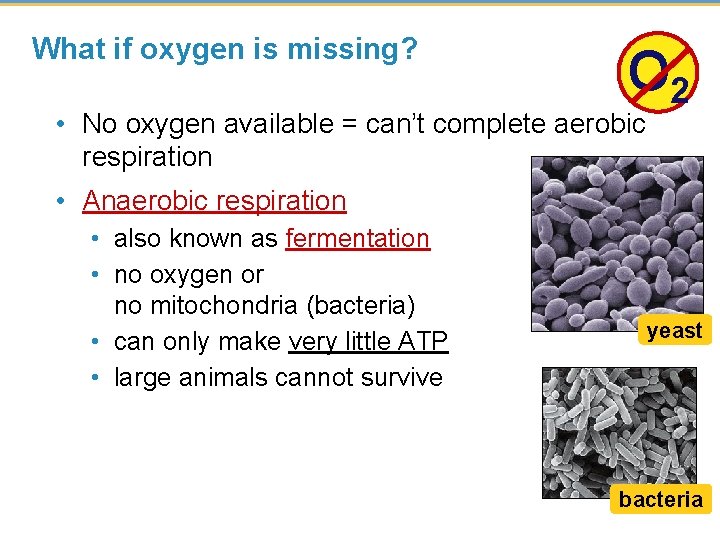
What if oxygen is missing? O 2 • No oxygen available = can’t complete aerobic respiration • Anaerobic respiration • also known as fermentation • no oxygen or no mitochondria (bacteria) • can only make very little ATP • large animals cannot survive yeast bacteria
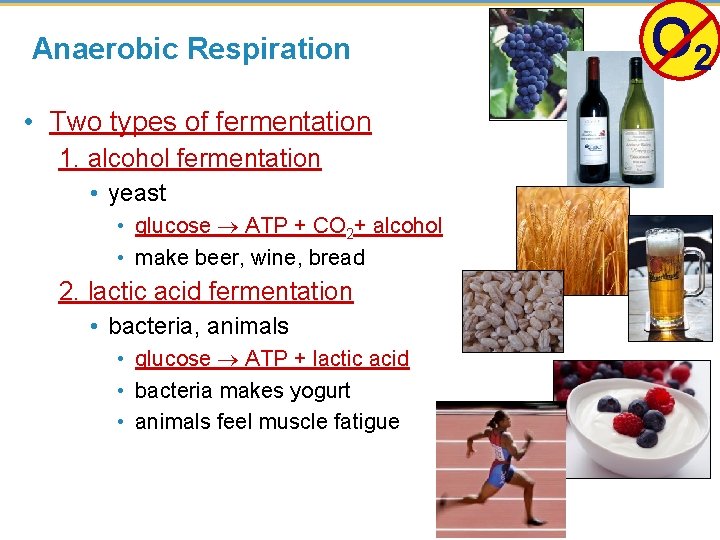
Anaerobic Respiration • Two types of fermentation 1. alcohol fermentation • yeast • glucose ATP + CO 2+ alcohol • make beer, wine, bread 2. lactic acid fermentation • bacteria, animals • glucose ATP + lactic acid • bacteria makes yogurt • animals feel muscle fatigue O 2
6. 13 Fermentation enables cells to produce ATP without oxygen • The dairy industry uses lactic acid fermentation by bacteria to make cheese and yogurt. • Other types of microbial fermentation turn soybeans into soy sauce and cabbage into sauerkraut. • Cellular Respiration and Fermentation Crash. Course © 2015 Pearson Education, Inc.
- Slides: 19