
Figure 5 Mites collected from dogs and cats
- Slides: 1
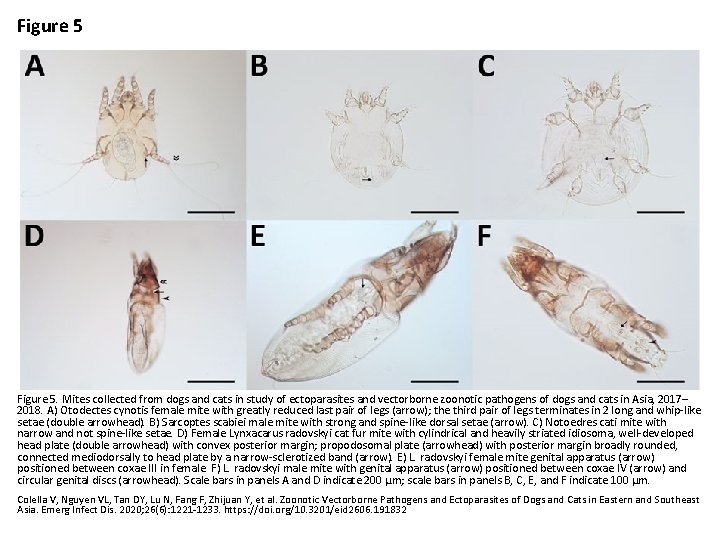
Figure 5. Mites collected from dogs and cats in study of ectoparasites and vectorborne zoonotic pathogens of dogs and cats in Asia, 2017– 2018. A) Otodectes cynotis female mite with greatly reduced last pair of legs (arrow); the third pair of legs terminates in 2 long and whip-like setae (double arrowhead). B) Sarcoptes scabiei male mite with strong and spine-like dorsal setae (arrow). C) Notoedres cati mite with narrow and not spine-like setae. D) Female Lynxacarus radovskyi cat fur mite with cylindrical and heavily striated idiosoma, well-developed head plate (double arrowhead) with convex posterior margin; propodosomal plate (arrowhead) with posterior margin broadly rounded, connected mediodorsally to head plate by a narrow-sclerotized band (arrow). E) L. radovskyi female mite genital apparatus (arrow) positioned between coxae III in female. F) L. radovskyi male mite with genital apparatus (arrow) positioned between coxae IV (arrow) and circular genital discs (arrowhead). Scale bars in panels A and D indicate 200 μm; scale bars in panels B, C, E, and F indicate 100 μm. Colella V, Nguyen VL, Tan DY, Lu N, Fang F, Zhijuan Y, et al. Zoonotic Vectorborne Pathogens and Ectoparasites of Dogs and Cats in Eastern and Southeast Asia. Emerg Infect Dis. 2020; 26(6): 1221 -1233. https: //doi. org/10. 3201/eid 2606. 191832