
FIGURE 5 1 MAP OF CORPORATE STAKEHOLDER ACCOUNTABILITY
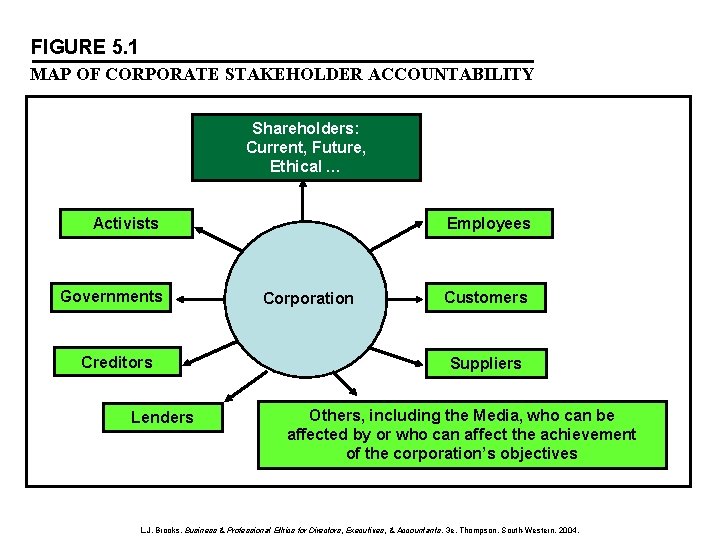
FIGURE 5. 1 MAP OF CORPORATE STAKEHOLDER ACCOUNTABILITY Shareholders: Current, Future, Ethical … Activists Governments Creditors Lenders Employees Corporation Customers Suppliers Others, including the Media, who can be affected by or who can affect the achievement of the corporation’s objectives L. J. Brooks, Business & Professional Ethics for Directors, Executives, & Accountants, 3 e, Thompson, South-Western, 2004.
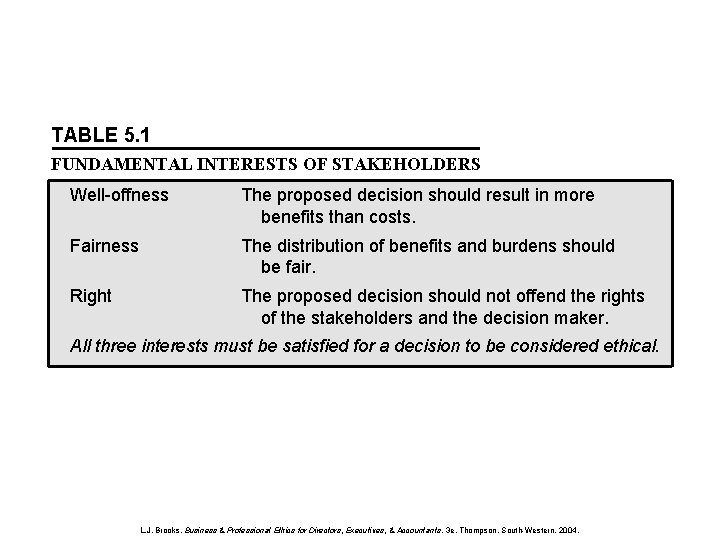
TABLE 5. 1 FUNDAMENTAL INTERESTS OF STAKEHOLDERS Well-offness The proposed decision should result in more benefits than costs. Fairness The distribution of benefits and burdens should be fair. Right The proposed decision should not offend the rights of the stakeholders and the decision maker. All three interests must be satisfied for a decision to be considered ethical. L. J. Brooks, Business & Professional Ethics for Directors, Executives, & Accountants, 3 e, Thompson, South-Western, 2004.
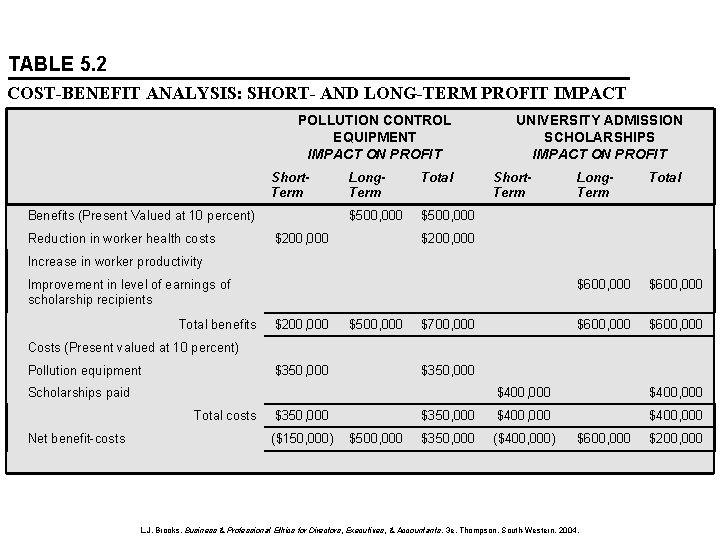
TABLE 5. 2 COST-BENEFIT ANALYSIS: SHORT- AND LONG-TERM PROFIT IMPACT POLLUTION CONTROL EQUIPMENT IMPACT ON PROFIT Short. Term Benefits (Present Valued at 10 percent) Reduction in worker health costs Long. Term Total $500, 000 $200, 000 UNIVERSITY ADMISSION SCHOLARSHIPS IMPACT ON PROFIT Short. Term Long. Term Total $600, 000 $200, 000 Increase in worker productivity Improvement in level of earnings of scholarship recipients Total benefits $200, 000 $500, 000 $700, 000 Costs (Present valued at 10 percent) Pollution equipment $350, 000 Scholarships paid Total costs Net benefit-costs $350, 000 ($150, 000) $500, 000 $400, 000 $350, 000 ($400, 000) $600, 000 L. J. Brooks, Business & Professional Ethics for Directors, Executives, & Accountants, 3 e, Thompson, South-Western, 2004. $200, 000

FIGURE 5. 2 STAKEHOLDER IDENTIFICATION AND INTERESTS POWER LEGITIMACY Dynamic Influence URGENCY SOURCES: Mitchell, Agle and Wood, 1997; Rowley, 1997. L. J. Brooks, Business & Professional Ethics for Directors, Executives, & Accountants, 3 e, Thompson, South-Western, 2004.
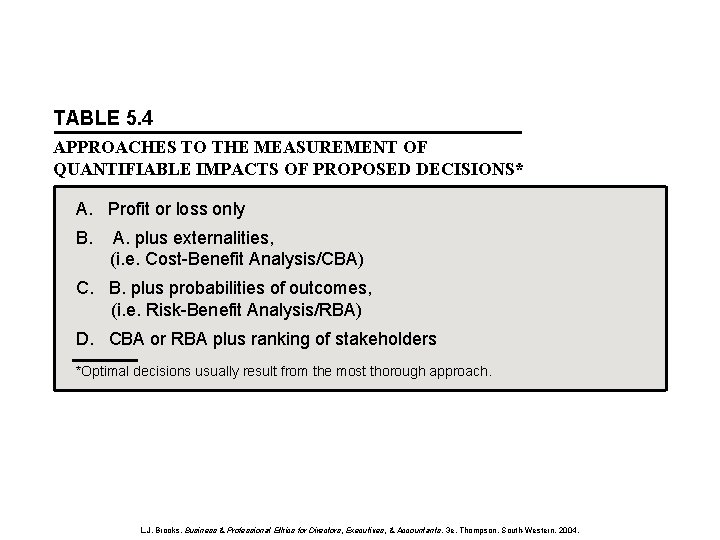
TABLE 5. 4 APPROACHES TO THE MEASUREMENT OF QUANTIFIABLE IMPACTS OF PROPOSED DECISIONS* A. Profit or loss only B. A. plus externalities, (i. e. Cost-Benefit Analysis/CBA) C. B. plus probabilities of outcomes, (i. e. Risk-Benefit Analysis/RBA) D. CBA or RBA plus ranking of stakeholders *Optimal decisions usually result from the most thorough approach. L. J. Brooks, Business & Professional Ethics for Directors, Executives, & Accountants, 3 e, Thompson, South-Western, 2004.
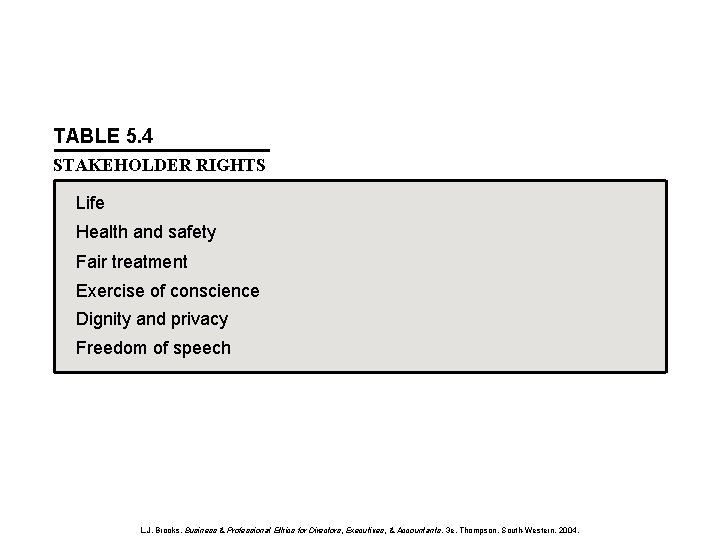
TABLE 5. 4 STAKEHOLDER RIGHTS Life Health and safety Fair treatment Exercise of conscience Dignity and privacy Freedom of speech L. J. Brooks, Business & Professional Ethics for Directors, Executives, & Accountants, 3 e, Thompson, South-Western, 2004.
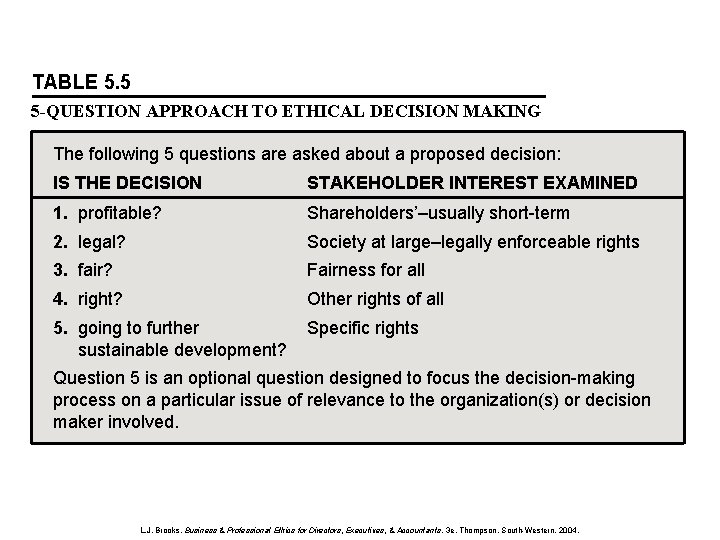
TABLE 5. 5 5 -QUESTION APPROACH TO ETHICAL DECISION MAKING The following 5 questions are asked about a proposed decision: IS THE DECISION STAKEHOLDER INTEREST EXAMINED 1. profitable? Shareholders’–usually short-term 2. legal? Society at large–legally enforceable rights 3. fair? Fairness for all 4. right? Other rights of all 5. going to further sustainable development? Specific rights Question 5 is an optional question designed to focus the decision-making process on a particular issue of relevance to the organization(s) or decision maker involved. L. J. Brooks, Business & Professional Ethics for Directors, Executives, & Accountants, 3 e, Thompson, South-Western, 2004.
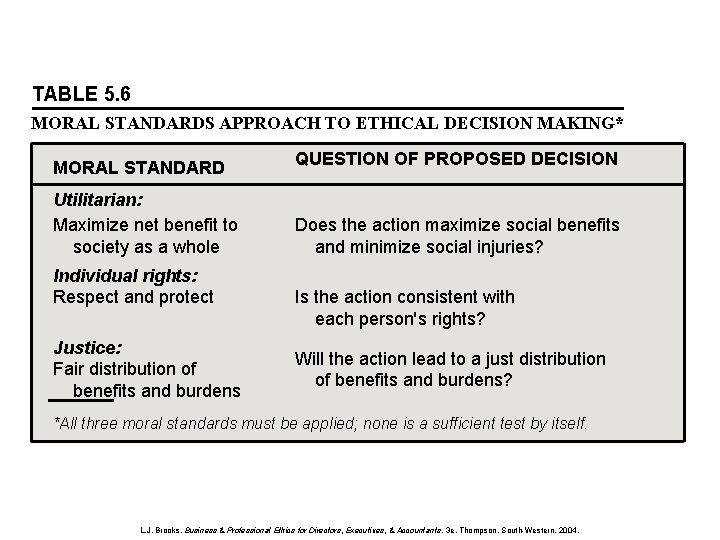
TABLE 5. 6 MORAL STANDARDS APPROACH TO ETHICAL DECISION MAKING* MORAL STANDARD Utilitarian: Maximize net benefit to society as a whole Individual rights: Respect and protect Justice: Fair distribution of benefits and burdens QUESTION OF PROPOSED DECISION Does the action maximize social benefits and minimize social injuries? Is the action consistent with each person's rights? Will the action lead to a just distribution of benefits and burdens? *All three moral standards must be applied; none is a sufficient test by itself. L. J. Brooks, Business & Professional Ethics for Directors, Executives, & Accountants, 3 e, Thompson, South-Western, 2004.
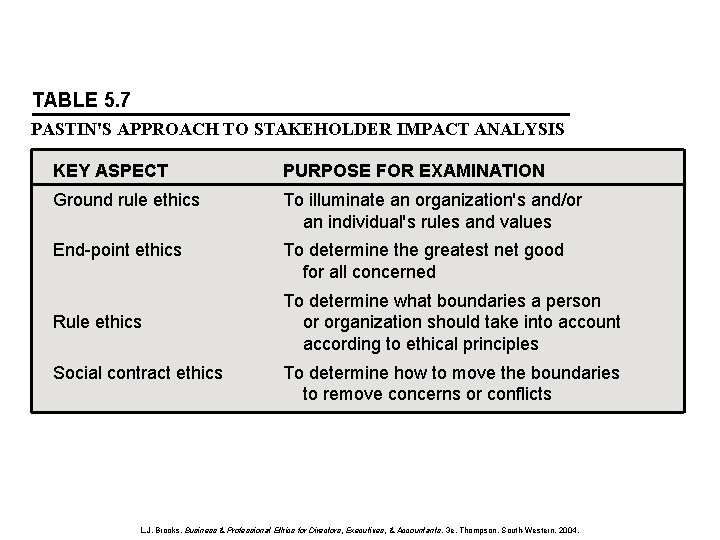
TABLE 5. 7 PASTIN'S APPROACH TO STAKEHOLDER IMPACT ANALYSIS KEY ASPECT PURPOSE FOR EXAMINATION Ground rule ethics To illuminate an organization's and/or an individual's rules and values End-point ethics To determine the greatest net good for all concerned Rule ethics Social contract ethics To determine what boundaries a person or organization should take into account according to ethical principles To determine how to move the boundaries to remove concerns or conflicts L. J. Brooks, Business & Professional Ethics for Directors, Executives, & Accountants, 3 e, Thompson, South-Western, 2004.
- Slides: 9