
Figure 4 Geographic patterns of Plasmodium falciparum infection
- Slides: 1
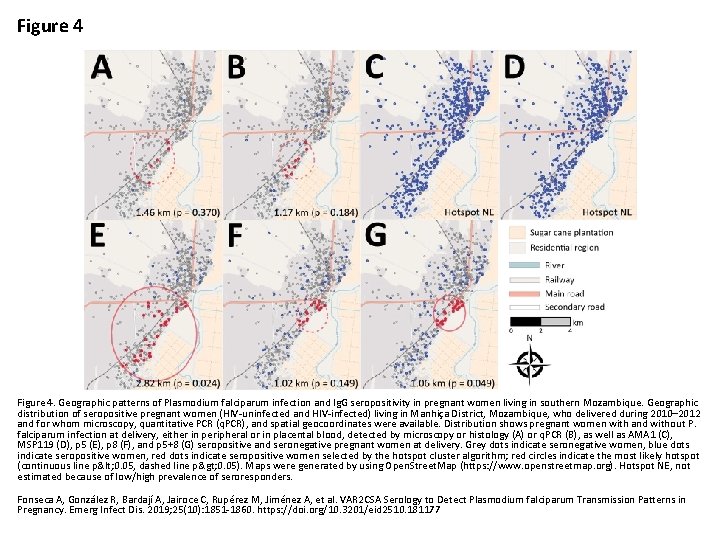
Figure 4. Geographic patterns of Plasmodium falciparum infection and Ig. G seropositivity in pregnant women living in southern Mozambique. Geographic distribution of seropositive pregnant women (HIV-uninfected and HIV-infected) living in Manhiça District, Mozambique, who delivered during 2010– 2012 and for whom microscopy, quantitative PCR (q. PCR), and spatial geocoordinates were available. Distribution shows pregnant women with and without P. falciparum infection at delivery, either in peripheral or in placental blood, detected by microscopy or histology (A) or q. PCR (B), as well as AMA 1 (C), MSP 119 (D), p 5 (E), p 8 (F), and p 5+8 (G) seropositive and seronegative pregnant women at delivery. Grey dots indicate seronegative women, blue dots indicate seropositive women, red dots indicate seropositive women selected by the hotspot cluster algorithm; red circles indicate the most likely hotspot (continuous line p< 0. 05, dashed line p> 0. 05). Maps were generated by using Open. Street. Map (https: //www. openstreetmap. org). Hotspot NE, not estimated because of low/high prevalence of seroresponders. Fonseca A, González R, Bardají A, Jairoce C, Rupérez M, Jiménez A, et al. VAR 2 CSA Serology to Detect Plasmodium falciparum Transmission Patterns in Pregnancy. Emerg Infect Dis. 2019; 25(10): 1851 -1860. https: //doi. org/10. 3201/eid 2510. 181177