
FIGURE 3 1 MAP OF CORPORATE STAKEHOLDER ACCOUNTABILITY
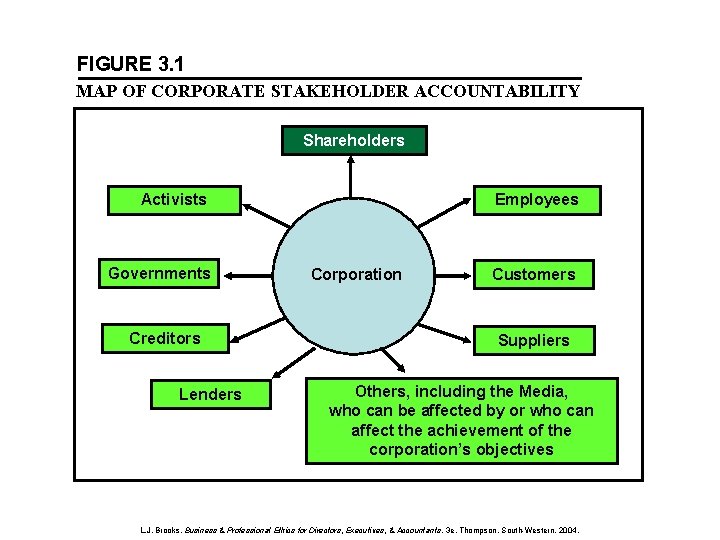
FIGURE 3. 1 MAP OF CORPORATE STAKEHOLDER ACCOUNTABILITY Shareholders Activists Governments Creditors Lenders Employees Corporation Customers Suppliers Others, including the Media, who can be affected by or who can affect the achievement of the corporation’s objectives L. J. Brooks, Business & Professional Ethics for Directors, Executives, & Accountants, 3 e, Thompson, South-Western, 2004.
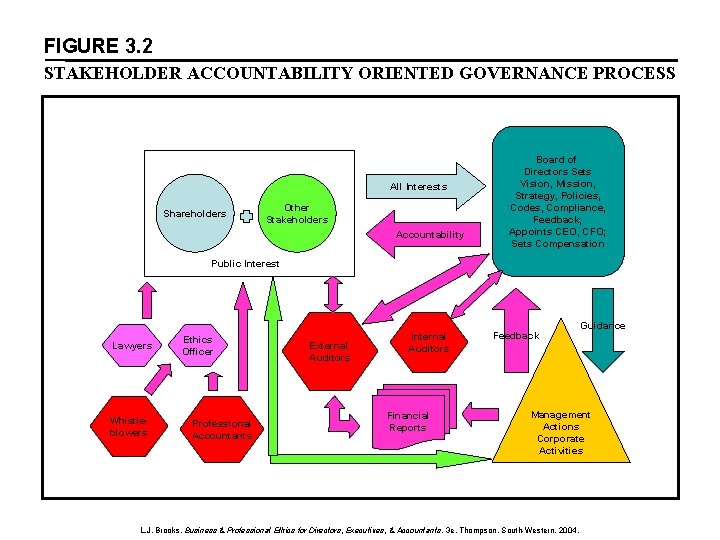
FIGURE 3. 2 STAKEHOLDER ACCOUNTABILITY ORIENTED GOVERNANCE PROCESS All Interests Shareholders Other Stakeholders Accountability Board of Directors Sets Vision, Mission, Strategy, Policies, Codes, Compliance, Feedback; Appoints CEO, CFO; Sets Compensation Public Interest Lawyers Whistleblowers Ethics Officer Professional Accountants External Auditors Internal Auditors Financial Reports Feedback Guidance Management Actions Corporate Activities L. J. Brooks, Business & Professional Ethics for Directors, Executives, & Accountants, 3 e, Thompson, South-Western, 2004.

FIGURE 3. 3 STAKEHOLDER INTERESTS RANKING, RISK, ASSESSMENT, AND USAGE Accountability Shareholders Other Stakeholders Board of Directors Sets Vision, Mission, Strategy, Policies, Codes, Compliance, Feedback; Appoints CEO, CFO; Sets Compensation Public Interest Corp. Value System All Interests Guidance Identify All Stakeholders Assess and Rank All Interests Feedback Integrate Into Corporate Value System and Actions Corporate Risk Assessment Management Actions Corporate Activities L. J. Brooks, Business & Professional Ethics for Directors, Executives, & Accountants, 3 e, Thompson, South-Western, 2004.
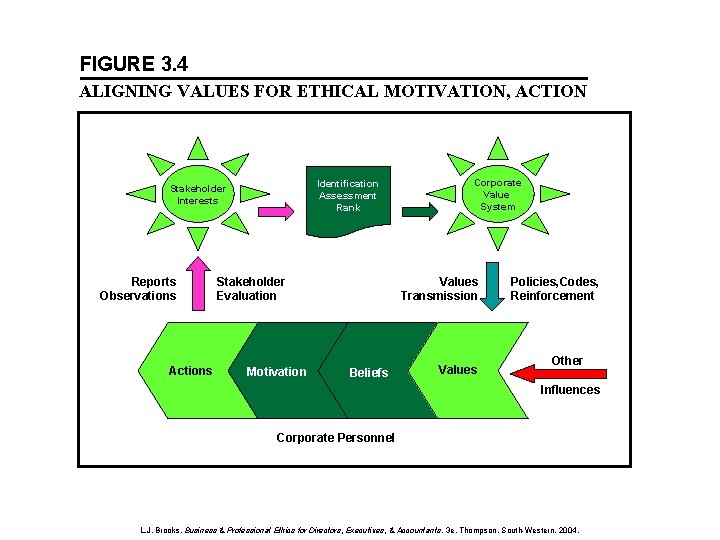
FIGURE 3. 4 ALIGNING VALUES FOR ETHICAL MOTIVATION, ACTION Identification Assessment Rank Stakeholder Interests Reports Observations Actions Stakeholder Evaluation Motivation Corporate Value System Values Transmission Beliefs Values Policies, Codes, Reinforcement Other Influences Corporate Personnel L. J. Brooks, Business & Professional Ethics for Directors, Executives, & Accountants, 3 e, Thompson, South-Western, 2004.
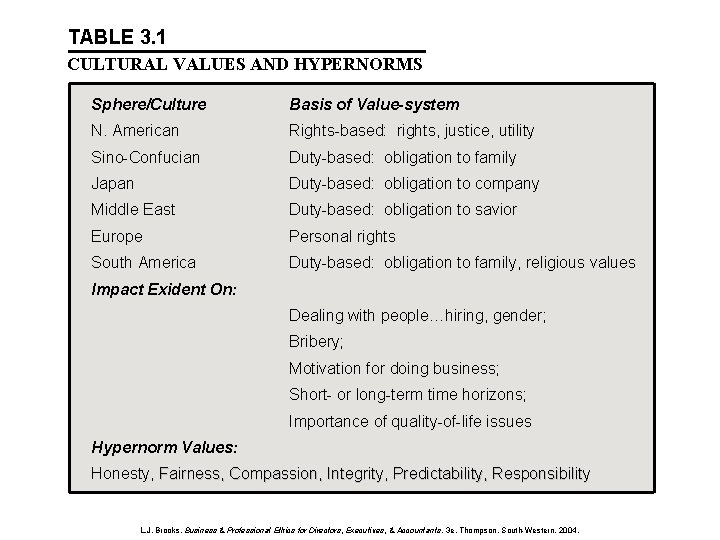
TABLE 3. 1 CULTURAL VALUES AND HYPERNORMS Sphere/Culture Basis of Value-system N. American Rights-based: rights, justice, utility Sino-Confucian Duty-based: obligation to family Japan Duty-based: obligation to company Middle East Duty-based: obligation to savior Europe Personal rights South America Duty-based: obligation to family, religious values Impact Exident On: Dealing with people…hiring, gender; Bribery; Motivation for doing business; Short- or long-term time horizons; Importance of quality-of-life issues Hypernorm Values: Honesty, Fairness, Compassion, Integrity, Predictability, Responsibility L. J. Brooks, Business & Professional Ethics for Directors, Executives, & Accountants, 3 e, Thompson, South-Western, 2004.
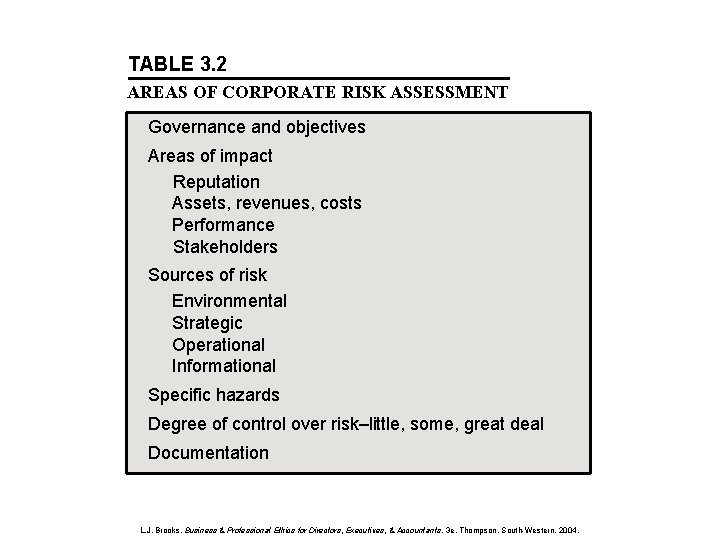
TABLE 3. 2 AREAS OF CORPORATE RISK ASSESSMENT Governance and objectives Areas of impact Reputation Assets, revenues, costs Performance Stakeholders Sources of risk Environmental Strategic Operational Informational Specific hazards Degree of control over risk–little, some, great deal Documentation L. J. Brooks, Business & Professional Ethics for Directors, Executives, & Accountants, 3 e, Thompson, South-Western, 2004.
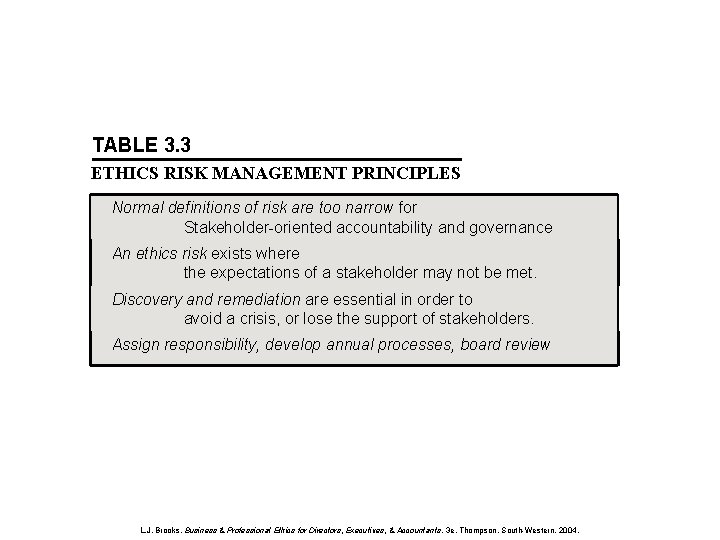
TABLE 3. 3 ETHICS RISK MANAGEMENT PRINCIPLES Normal definitions of risk are too narrow for Stakeholder-oriented accountability and governance An ethics risk exists where the expectations of a stakeholder may not be met. Discovery and remediation are essential in order to avoid a crisis, or lose the support of stakeholders. Assign responsibility, develop annual processes, board review L. J. Brooks, Business & Professional Ethics for Directors, Executives, & Accountants, 3 e, Thompson, South-Western, 2004.
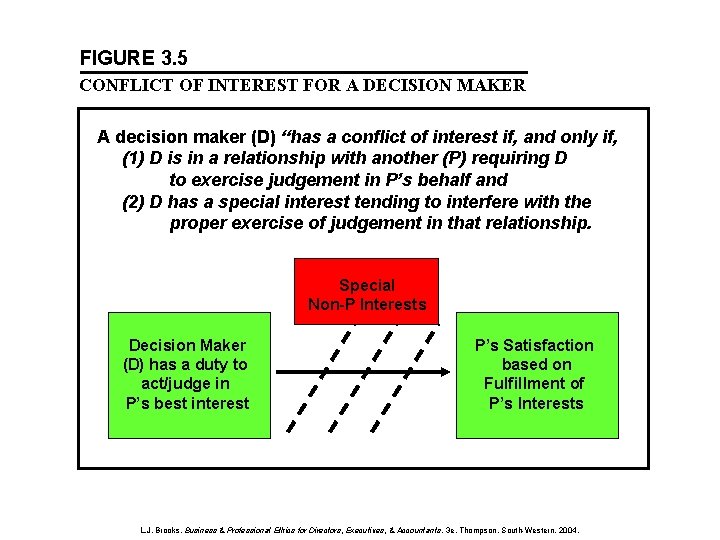
FIGURE 3. 5 CONFLICT OF INTEREST FOR A DECISION MAKER A decision maker (D) “has a conflict of interest if, and only if, (1) D is in a relationship with another (P) requiring D to exercise judgement in P’s behalf and (2) D has a special interest tending to interfere with the proper exercise of judgement in that relationship. Special Non-P Interests Decision Maker (D) has a duty to act/judge in P’s best interest P’s Satisfaction based on Fulfillment of P’s Interests L. J. Brooks, Business & Professional Ethics for Directors, Executives, & Accountants, 3 e, Thompson, South-Western, 2004.
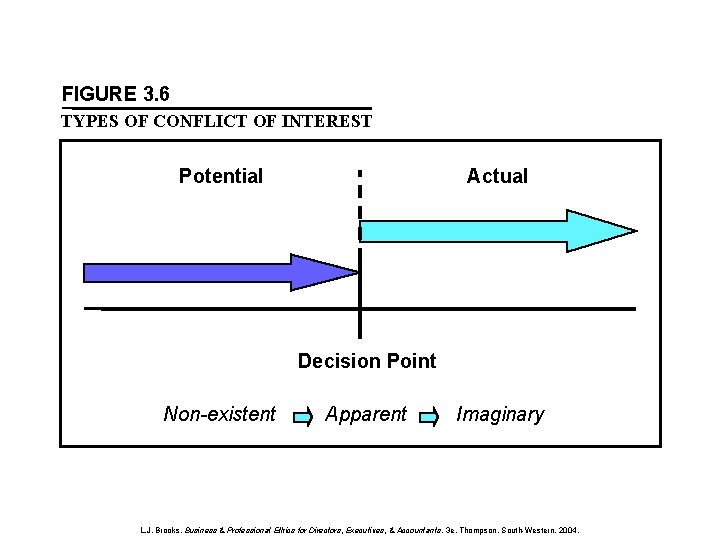
FIGURE 3. 6 TYPES OF CONFLICT OF INTEREST Potential Actual Decision Point Non-existent Apparent Imaginary L. J. Brooks, Business & Professional Ethics for Directors, Executives, & Accountants, 3 e, Thompson, South-Western, 2004.
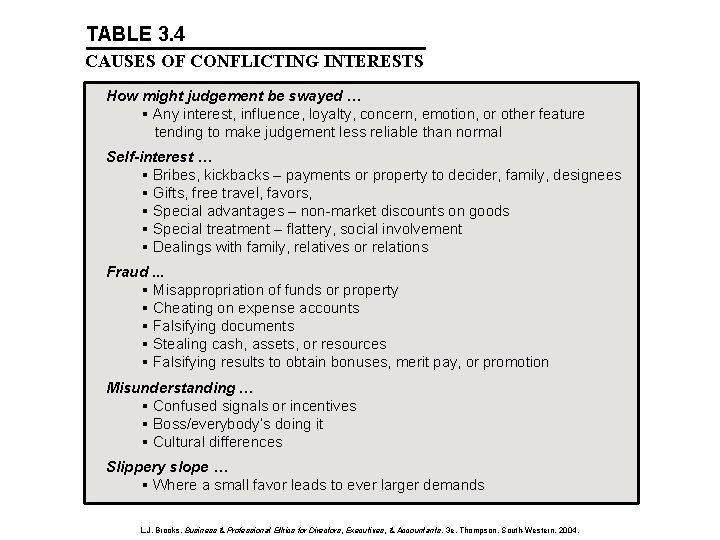
TABLE 3. 4 CAUSES OF CONFLICTING INTERESTS How might judgement be swayed … § Any interest, influence, loyalty, concern, emotion, or other feature tending to make judgement less reliable than normal Self-interest … § Bribes, kickbacks – payments or property to decider, family, designees § Gifts, free travel, favors, § Special advantages – non-market discounts on goods § Special treatment – flattery, social involvement § Dealings with family, relatives or relations Fraud. . . § Misappropriation of funds or property § Cheating on expense accounts § Falsifying documents § Stealing cash, assets, or resources § Falsifying results to obtain bonuses, merit pay, or promotion Misunderstanding … § Confused signals or incentives § Boss/everybody’s doing it § Cultural differences Slippery slope … § Where a small favor leads to ever larger demands L. J. Brooks, Business & Professional Ethics for Directors, Executives, & Accountants, 3 e, Thompson, South-Western, 2004.
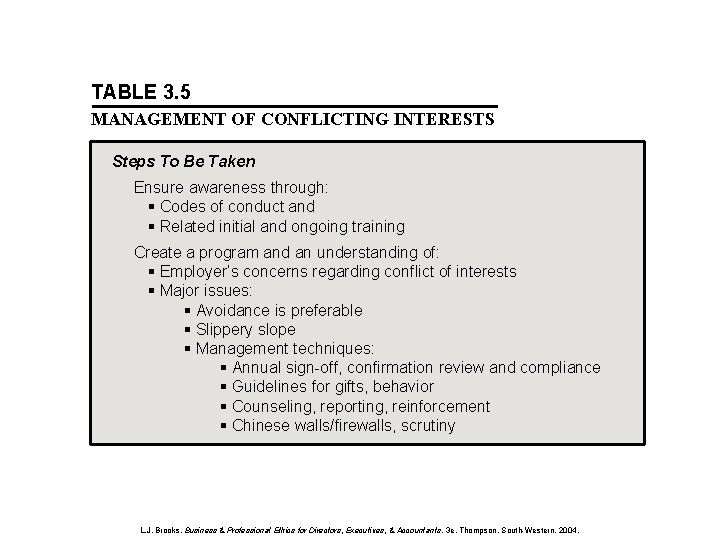
TABLE 3. 5 MANAGEMENT OF CONFLICTING INTERESTS Steps To Be Taken Ensure awareness through: § Codes of conduct and § Related initial and ongoing training Create a program and an understanding of: § Employer’s concerns regarding conflict of interests § Major issues: § Avoidance is preferable § Slippery slope § Management techniques: § Annual sign-off, confirmation review and compliance § Guidelines for gifts, behavior § Counseling, reporting, reinforcement § Chinese walls/firewalls, scrutiny L. J. Brooks, Business & Professional Ethics for Directors, Executives, & Accountants, 3 e, Thompson, South-Western, 2004.
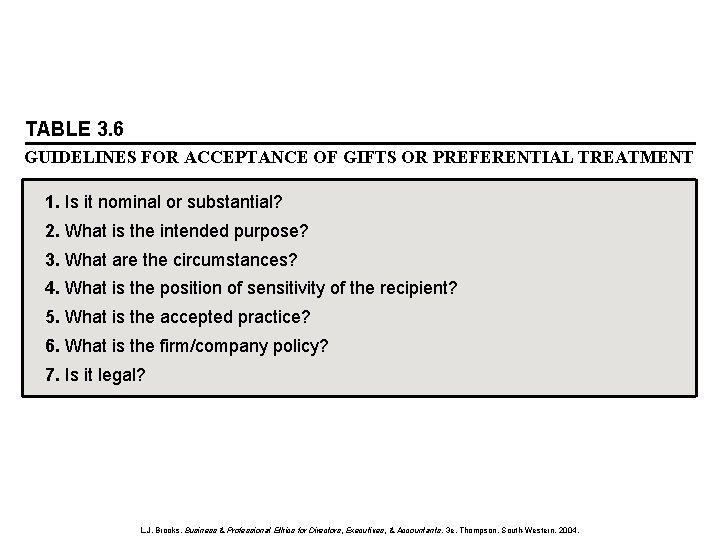
TABLE 3. 6 GUIDELINES FOR ACCEPTANCE OF GIFTS OR PREFERENTIAL TREATMENT 1. Is it nominal or substantial? 2. What is the intended purpose? 3. What are the circumstances? 4. What is the position of sensitivity of the recipient? 5. What is the accepted practice? 6. What is the firm/company policy? 7. Is it legal? L. J. Brooks, Business & Professional Ethics for Directors, Executives, & Accountants, 3 e, Thompson, South-Western, 2004.
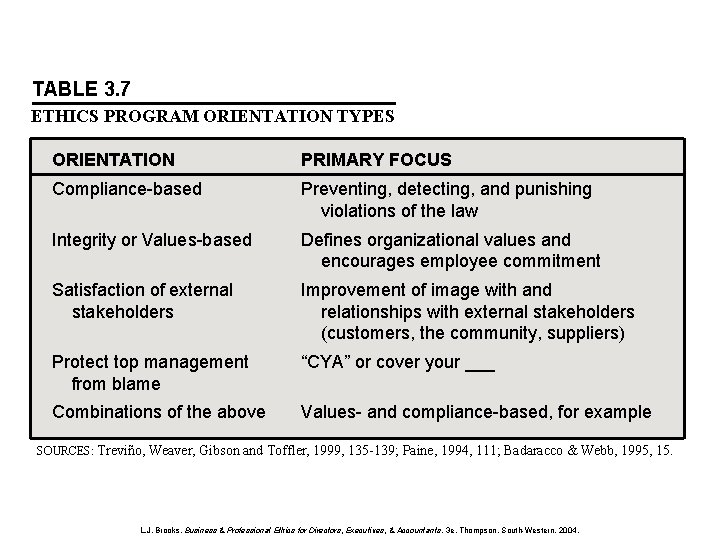
TABLE 3. 7 ETHICS PROGRAM ORIENTATION TYPES ORIENTATION PRIMARY FOCUS Compliance-based Preventing, detecting, and punishing violations of the law Integrity or Values-based Defines organizational values and encourages employee commitment Satisfaction of external stakeholders Improvement of image with and relationships with external stakeholders (customers, the community, suppliers) Protect top management from blame “CYA” or cover your ___ Combinations of the above Values- and compliance-based, for example SOURCES: Treviño, Weaver, Gibson and Toffler, 1999, 135 -139; Paine, 1994, 111; Badaracco & Webb, 1995, 15. L. J. Brooks, Business & Professional Ethics for Directors, Executives, & Accountants, 3 e, Thompson, South-Western, 2004.
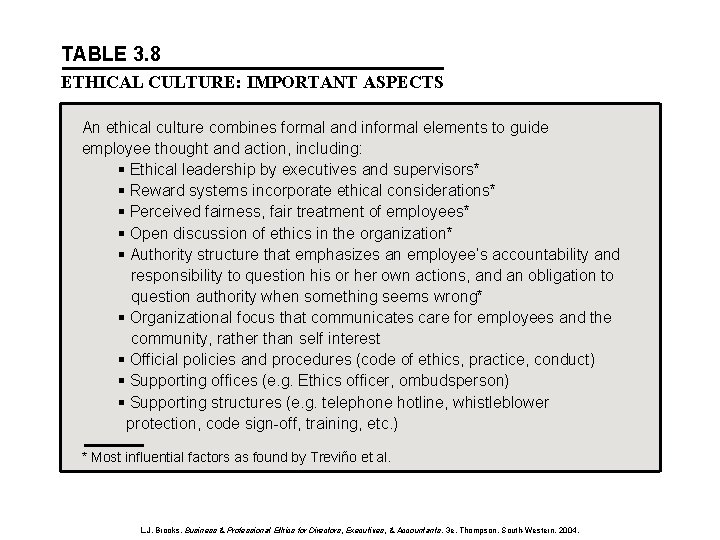
TABLE 3. 8 ETHICAL CULTURE: IMPORTANT ASPECTS An ethical culture combines formal and informal elements to guide employee thought and action, including: § Ethical leadership by executives and supervisors* § Reward systems incorporate ethical considerations* § Perceived fairness, fair treatment of employees* § Open discussion of ethics in the organization* § Authority structure that emphasizes an employee’s accountability and responsibility to question his or her own actions, and an obligation to question authority when something seems wrong* § Organizational focus that communicates care for employees and the community, rather than self interest § Official policies and procedures (code of ethics, practice, conduct) § Supporting offices (e. g. Ethics officer, ombudsperson) § Supporting structures (e. g. telephone hotline, whistleblower protection, code sign-off, training, etc. ) * Most influential factors as found by Treviño et al. L. J. Brooks, Business & Professional Ethics for Directors, Executives, & Accountants, 3 e, Thompson, South-Western, 2004.
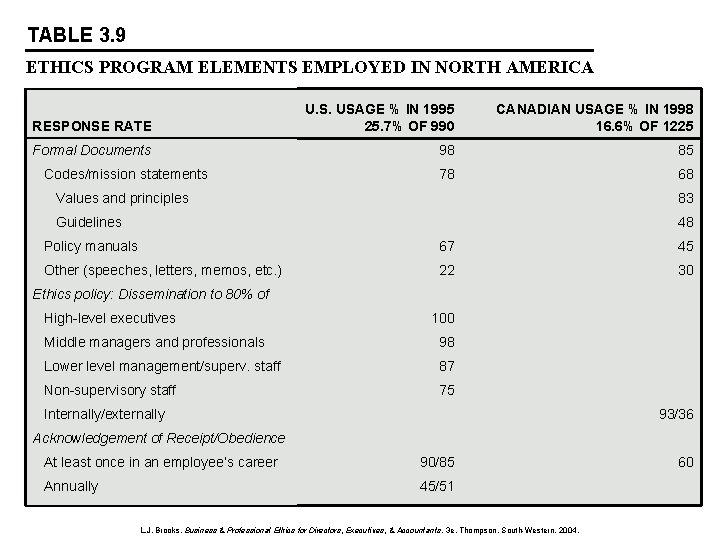
TABLE 3. 9 ETHICS PROGRAM ELEMENTS EMPLOYED IN NORTH AMERICA RESPONSE RATE U. S. USAGE % IN 1995 25. 7% OF 990 CANADIAN USAGE % IN 1998 16. 6% OF 1225 Formal Documents 98 85 78 68 Codes/mission statements Values and principles 83 Guidelines 48 Policy manuals 67 45 Other (speeches, letters, memos, etc. ) 22 30 Ethics policy: Dissemination to 80% of High-level executives 100 Middle managers and professionals 98 Lower level management/superv. staff 87 Non-supervisory staff 75 Internally/externally 93/36 Acknowledgement of Receipt/Obedience At least once in an employee’s career 90/85 Annually 45/51 L. J. Brooks, Business & Professional Ethics for Directors, Executives, & Accountants, 3 e, Thompson, South-Western, 2004. 60
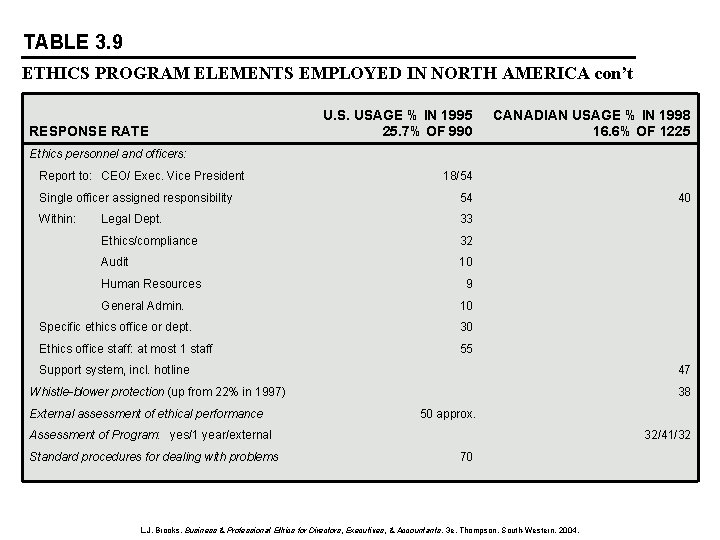
TABLE 3. 9 ETHICS PROGRAM ELEMENTS EMPLOYED IN NORTH AMERICA con’t RESPONSE RATE U. S. USAGE % IN 1995 25. 7% OF 990 CANADIAN USAGE % IN 1998 16. 6% OF 1225 Ethics personnel and officers: Report to: CEO/ Exec. Vice President 18/54 Single officer assigned responsibility 54 Within: Legal Dept. 33 Ethics/compliance 32 Audit 10 Human Resources General Admin. 9 10 Specific ethics office or dept. 30 Ethics office staff: at most 1 staff 55 Support system, incl. hotline 47 Whistle-blower protection (up from 22% in 1997) External assessment of ethical performance 38 50 approx. Assessment of Program: yes/1 year/external Standard procedures for dealing with problems 40 32/41/32 70 L. J. Brooks, Business & Professional Ethics for Directors, Executives, & Accountants, 3 e, Thompson, South-Western, 2004.
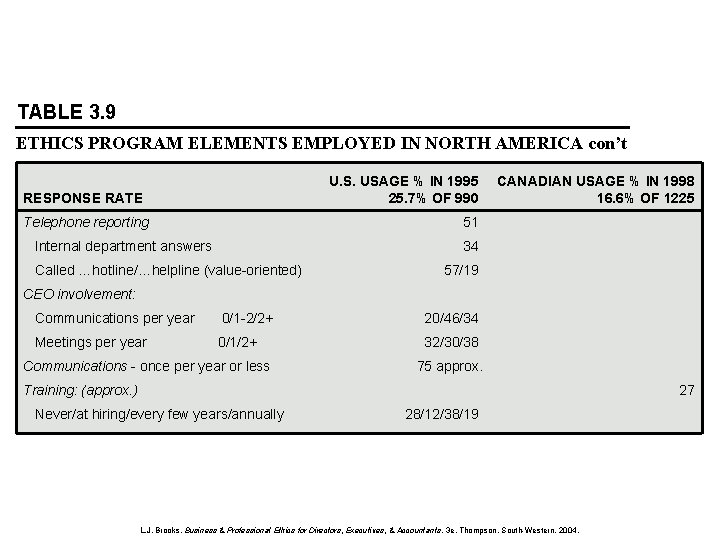
TABLE 3. 9 ETHICS PROGRAM ELEMENTS EMPLOYED IN NORTH AMERICA con’t U. S. USAGE % IN 1995 25. 7% OF 990 RESPONSE RATE Telephone reporting CANADIAN USAGE % IN 1998 16. 6% OF 1225 51 Internal department answers 34 Called …hotline/…helpline (value-oriented) 57/19 CEO involvement: Communications per year 0/1 -2/2+ 20/46/34 Meetings per year 0/1/2+ 32/30/38 Communications - once per year or less 75 approx. Training: (approx. ) 27 Never/at hiring/every few years/annually 28/12/38/19 L. J. Brooks, Business & Professional Ethics for Directors, Executives, & Accountants, 3 e, Thompson, South-Western, 2004.
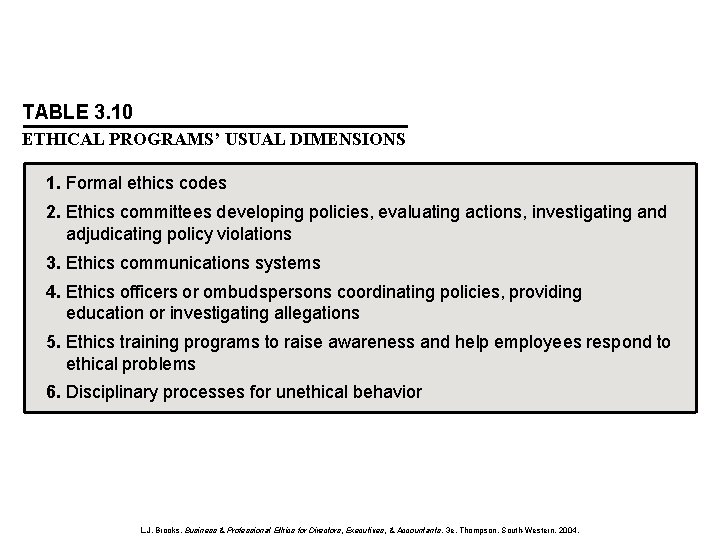
TABLE 3. 10 ETHICAL PROGRAMS’ USUAL DIMENSIONS 1. Formal ethics codes 2. Ethics committees developing policies, evaluating actions, investigating and adjudicating policy violations 3. Ethics communications systems 4. Ethics officers or ombudspersons coordinating policies, providing education or investigating allegations 5. Ethics training programs to raise awareness and help employees respond to ethical problems 6. Disciplinary processes for unethical behavior L. J. Brooks, Business & Professional Ethics for Directors, Executives, & Accountants, 3 e, Thompson, South-Western, 2004.
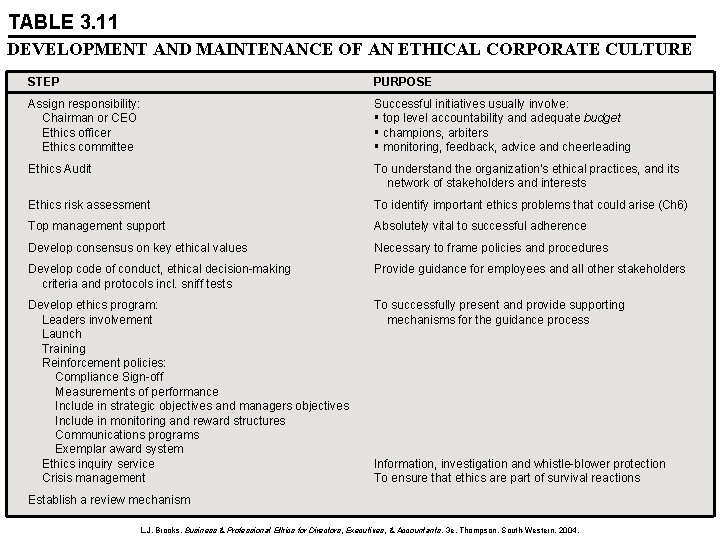
TABLE 3. 11 DEVELOPMENT AND MAINTENANCE OF AN ETHICAL CORPORATE CULTURE STEP PURPOSE Assign responsibility: Chairman or CEO Ethics officer Ethics committee Successful initiatives usually involve: § top level accountability and adequate budget § champions, arbiters § monitoring, feedback, advice and cheerleading Ethics Audit To understand the organization’s ethical practices, and its network of stakeholders and interests Ethics risk assessment To identify important ethics problems that could arise (Ch 6) Top management support Absolutely vital to successful adherence Develop consensus on key ethical values Necessary to frame policies and procedures Develop code of conduct, ethical decision-making criteria and protocols incl. sniff tests Provide guidance for employees and all other stakeholders Develop ethics program: Leaders involvement Launch Training Reinforcement policies: Compliance Sign-off Measurements of performance Include in strategic objectives and managers objectives Include in monitoring and reward structures Communications programs Exemplar award system Ethics inquiry service Crisis management To successfully present and provide supporting mechanisms for the guidance process Information, investigation and whistle-blower protection To ensure that ethics are part of survival reactions Establish a review mechanism L. J. Brooks, Business & Professional Ethics for Directors, Executives, & Accountants, 3 e, Thompson, South-Western, 2004.
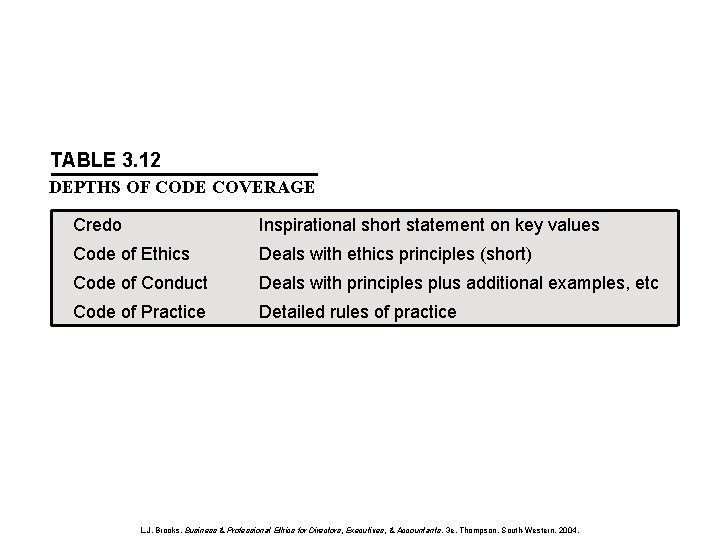
TABLE 3. 12 DEPTHS OF CODE COVERAGE Credo Inspirational short statement on key values Code of Ethics Deals with ethics principles (short) Code of Conduct Deals with principles plus additional examples, etc Code of Practice Detailed rules of practice L. J. Brooks, Business & Professional Ethics for Directors, Executives, & Accountants, 3 e, Thompson, South-Western, 2004.
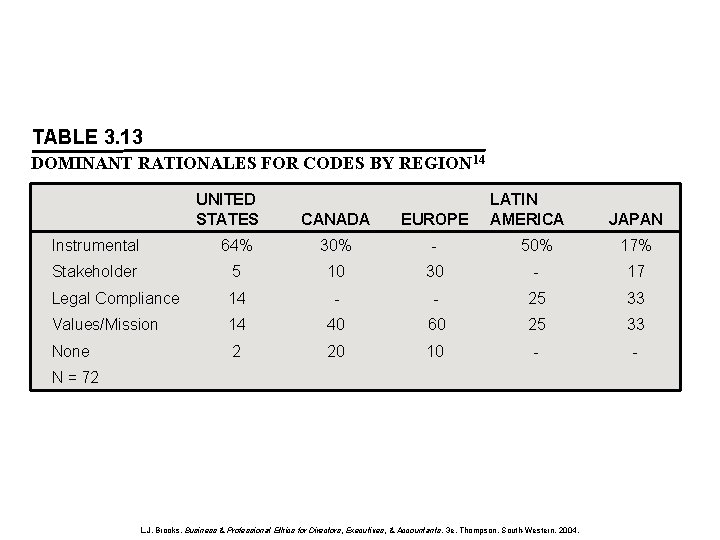
TABLE 3. 13 DOMINANT RATIONALES FOR CODES BY REGION 14 UNITED STATES CANADA EUROPE LATIN AMERICA JAPAN Instrumental 64% 30% - 50% 17% Stakeholder 5 10 30 - 17 Legal Compliance 14 - - 25 33 Values/Mission 14 40 60 25 33 None 2 20 10 - - N = 72 L. J. Brooks, Business & Professional Ethics for Directors, Executives, & Accountants, 3 e, Thompson, South-Western, 2004.
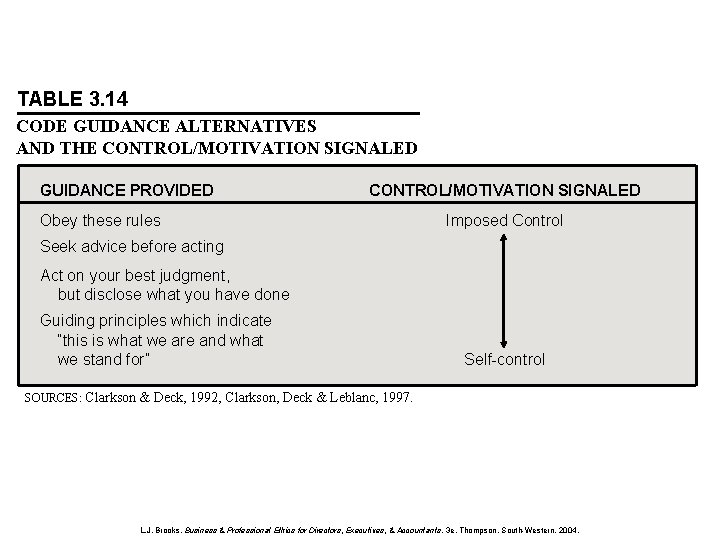
TABLE 3. 14 CODE GUIDANCE ALTERNATIVES AND THE CONTROL/MOTIVATION SIGNALED GUIDANCE PROVIDED CONTROL/MOTIVATION SIGNALED Obey these rules Imposed Control Seek advice before acting Act on your best judgment, but disclose what you have done Guiding principles which indicate “this is what we are and what we stand for” Self-control SOURCES: Clarkson & Deck, 1992, Clarkson, Deck & Leblanc, 1997. L. J. Brooks, Business & Professional Ethics for Directors, Executives, & Accountants, 3 e, Thompson, South-Western, 2004.
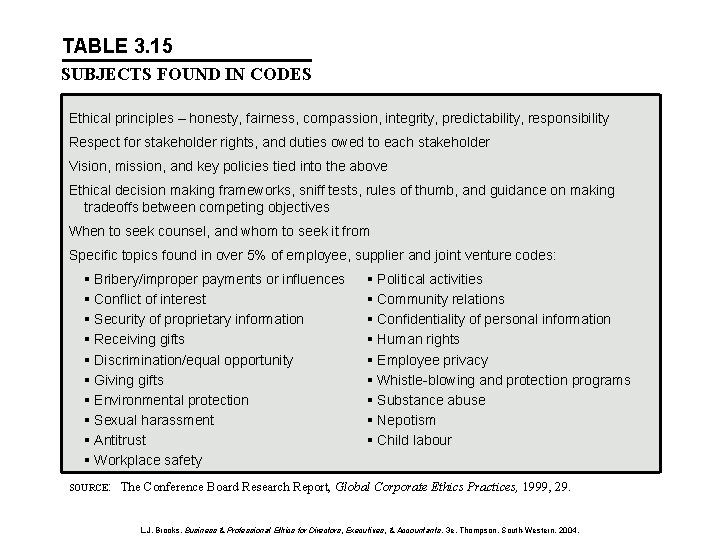
TABLE 3. 15 SUBJECTS FOUND IN CODES Ethical principles – honesty, fairness, compassion, integrity, predictability, responsibility Respect for stakeholder rights, and duties owed to each stakeholder Vision, mission, and key policies tied into the above Ethical decision making frameworks, sniff tests, rules of thumb, and guidance on making tradeoffs between competing objectives When to seek counsel, and whom to seek it from Specific topics found in over 5% of employee, supplier and joint venture codes: § Bribery/improper payments or influences § Conflict of interest § Security of proprietary information § Receiving gifts § Discrimination/equal opportunity § Giving gifts § Environmental protection § Sexual harassment § Antitrust § Workplace safety § Political activities § Community relations § Confidentiality of personal information § Human rights § Employee privacy § Whistle-blowing and protection programs § Substance abuse § Nepotism § Child labour : The Conference Board Research Report, Global Corporate Ethics Practices, 1999, 29. SOURCE L. J. Brooks, Business & Professional Ethics for Directors, Executives, & Accountants, 3 e, Thompson, South-Western, 2004.
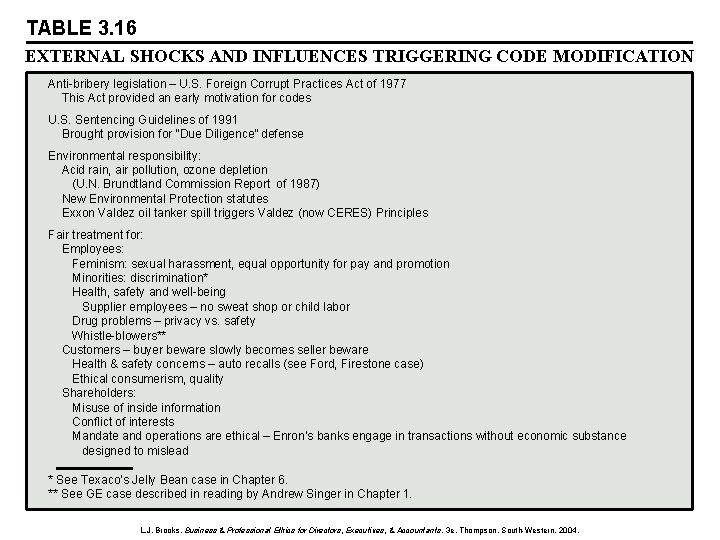
TABLE 3. 16 EXTERNAL SHOCKS AND INFLUENCES TRIGGERING CODE MODIFICATION Anti-bribery legislation – U. S. Foreign Corrupt Practices Act of 1977 This Act provided an early motivation for codes U. S. Sentencing Guidelines of 1991 Brought provision for “Due Diligence” defense Environmental responsibility: Acid rain, air pollution, ozone depletion (U. N. Brundtland Commission Report of 1987) New Environmental Protection statutes Exxon Valdez oil tanker spill triggers Valdez (now CERES) Principles Fair treatment for: Employees: Feminism: sexual harassment, equal opportunity for pay and promotion Minorities: discrimination* Health, safety and well-being Supplier employees – no sweat shop or child labor Drug problems – privacy vs. safety Whistle-blowers** Customers – buyer beware slowly becomes seller beware Health & safety concerns – auto recalls (see Ford, Firestone case) Ethical consumerism, quality Shareholders: Misuse of inside information Conflict of interests Mandate and operations are ethical – Enron’s banks engage in transactions without economic substance designed to mislead * See Texaco’s Jelly Bean case in Chapter 6. ** See GE case described in reading by Andrew Singer in Chapter 1. L. J. Brooks, Business & Professional Ethics for Directors, Executives, & Accountants, 3 e, Thompson, South-Western, 2004.
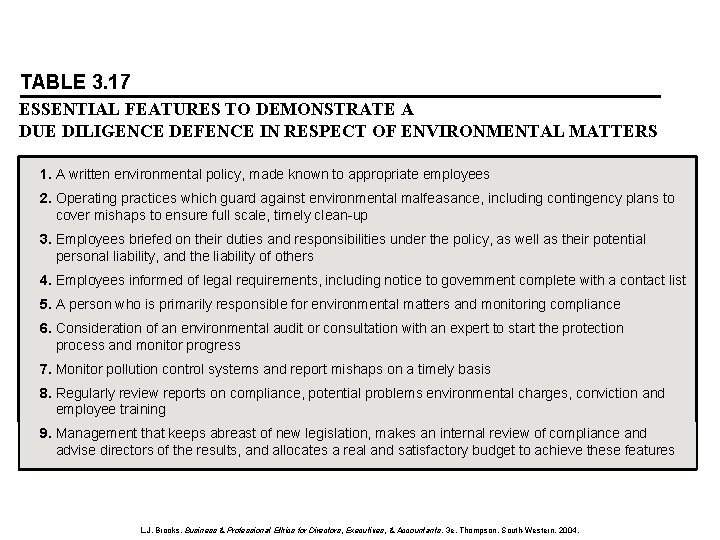
TABLE 3. 17 ESSENTIAL FEATURES TO DEMONSTRATE A DUE DILIGENCE DEFENCE IN RESPECT OF ENVIRONMENTAL MATTERS 1. A written environmental policy, made known to appropriate employees 2. Operating practices which guard against environmental malfeasance, including contingency plans to cover mishaps to ensure full scale, timely clean-up 3. Employees briefed on their duties and responsibilities under the policy, as well as their potential personal liability, and the liability of others 4. Employees informed of legal requirements, including notice to government complete with a contact list 5. A person who is primarily responsible for environmental matters and monitoring compliance 6. Consideration of an environmental audit or consultation with an expert to start the protection process and monitor progress 7. Monitor pollution control systems and report mishaps on a timely basis 8. Regularly review reports on compliance, potential problems environmental charges, conviction and employee training 9. Management that keeps abreast of new legislation, makes an internal review of compliance and advise directors of the results, and allocates a real and satisfactory budget to achieve these features L. J. Brooks, Business & Professional Ethics for Directors, Executives, & Accountants, 3 e, Thompson, South-Western, 2004.
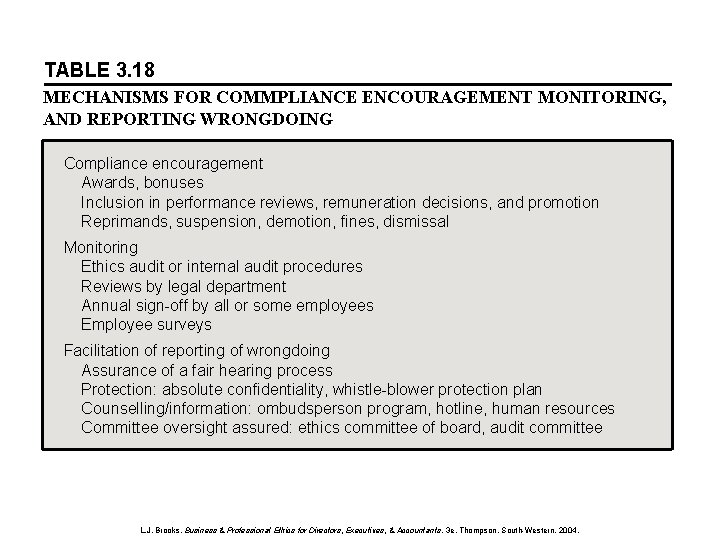
TABLE 3. 18 MECHANISMS FOR COMMPLIANCE ENCOURAGEMENT MONITORING, AND REPORTING WRONGDOING Compliance encouragement Awards, bonuses Inclusion in performance reviews, remuneration decisions, and promotion Reprimands, suspension, demotion, fines, dismissal Monitoring Ethics audit or internal audit procedures Reviews by legal department Annual sign-off by all or some employees Employee surveys Facilitation of reporting of wrongdoing Assurance of a fair hearing process Protection: absolute confidentiality, whistle-blower protection plan Counselling/information: ombudsperson program, hotline, human resources Committee oversight assured: ethics committee of board, audit committee L. J. Brooks, Business & Professional Ethics for Directors, Executives, & Accountants, 3 e, Thompson, South-Western, 2004.
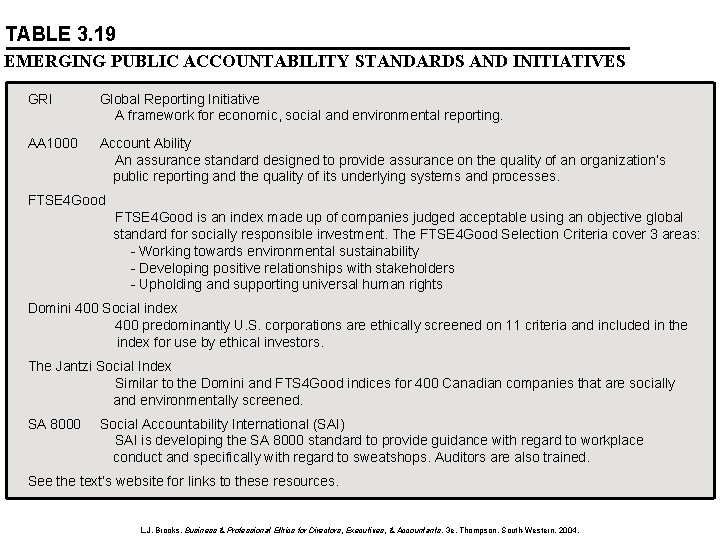
TABLE 3. 19 EMERGING PUBLIC ACCOUNTABILITY STANDARDS AND INITIATIVES GRI Global Reporting Initiative A framework for economic, social and environmental reporting. AA 1000 Account Ability An assurance standard designed to provide assurance on the quality of an organization’s public reporting and the quality of its underlying systems and processes. FTSE 4 Good is an index made up of companies judged acceptable using an objective global standard for socially responsible investment. The FTSE 4 Good Selection Criteria cover 3 areas: - Working towards environmental sustainability - Developing positive relationships with stakeholders - Upholding and supporting universal human rights Domini 400 Social index 400 predominantly U. S. corporations are ethically screened on 11 criteria and included in the index for use by ethical investors. The Jantzi Social Index Similar to the Domini and FTS 4 Good indices for 400 Canadian companies that are socially and environmentally screened. SA 8000 Social Accountability International (SAI) SAI is developing the SA 8000 standard to provide guidance with regard to workplace conduct and specifically with regard to sweatshops. Auditors are also trained. See the text’s website for links to these resources. L. J. Brooks, Business & Professional Ethics for Directors, Executives, & Accountants, 3 e, Thompson, South-Western, 2004.
- Slides: 27