
Figure 3 1 Diffusion of dye into a
- Slides: 13
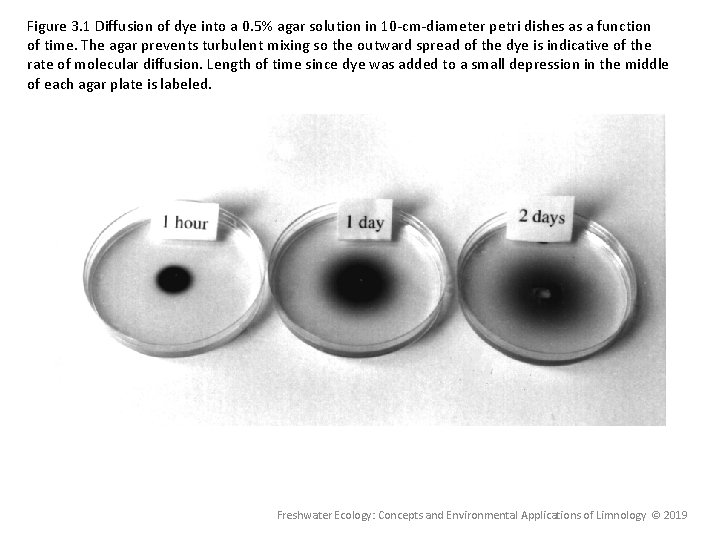
Figure 3. 1 Diffusion of dye into a 0. 5% agar solution in 10 -cm-diameter petri dishes as a function of time. The agar prevents turbulent mixing so the outward spread of the dye is indicative of the rate of molecular diffusion. Length of time since dye was added to a small depression in the middle of each agar plate is labeled. Freshwater Ecology: Concepts and Environmental Applications of Limnology © 2019
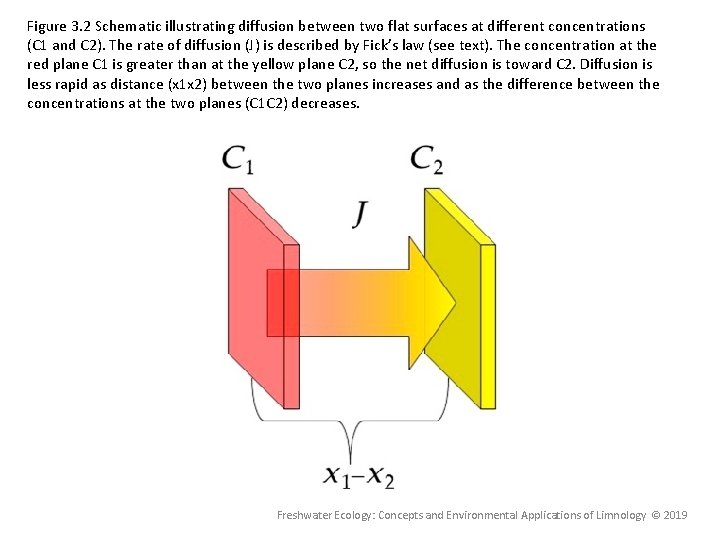
Figure 3. 2 Schematic illustrating diffusion between two flat surfaces at different concentrations (C 1 and C 2). The rate of diffusion (J) is described by Fick’s law (see text). The concentration at the red plane C 1 is greater than at the yellow plane C 2, so the net diffusion is toward C 2. Diffusion is less rapid as distance (x 1 x 2) between the two planes increases and as the difference between the concentrations at the two planes (C 1 C 2) decreases. Freshwater Ecology: Concepts and Environmental Applications of Limnology © 2019
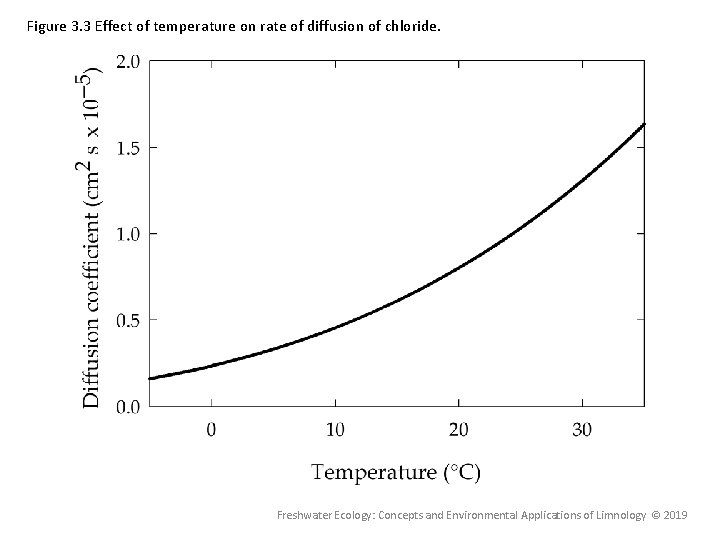
Figure 3. 3 Effect of temperature on rate of diffusion of chloride. Freshwater Ecology: Concepts and Environmental Applications of Limnology © 2019
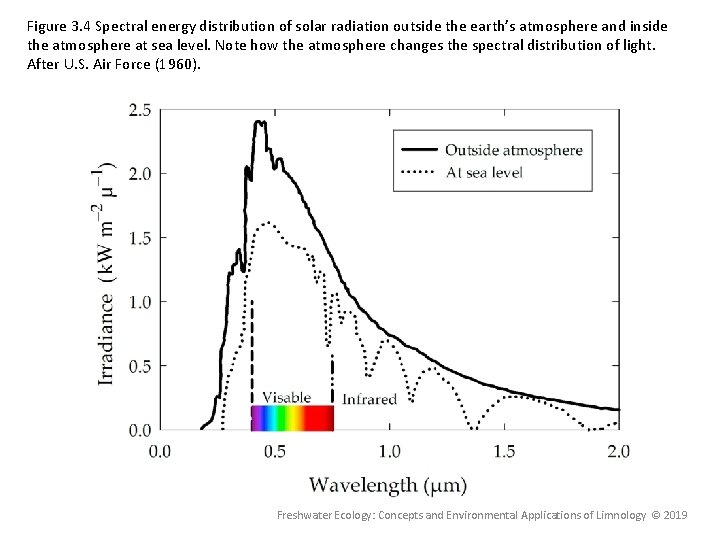
Figure 3. 4 Spectral energy distribution of solar radiation outside the earth’s atmosphere and inside the atmosphere at sea level. Note how the atmosphere changes the spectral distribution of light. After U. S. Air Force (1960). Freshwater Ecology: Concepts and Environmental Applications of Limnology © 2019
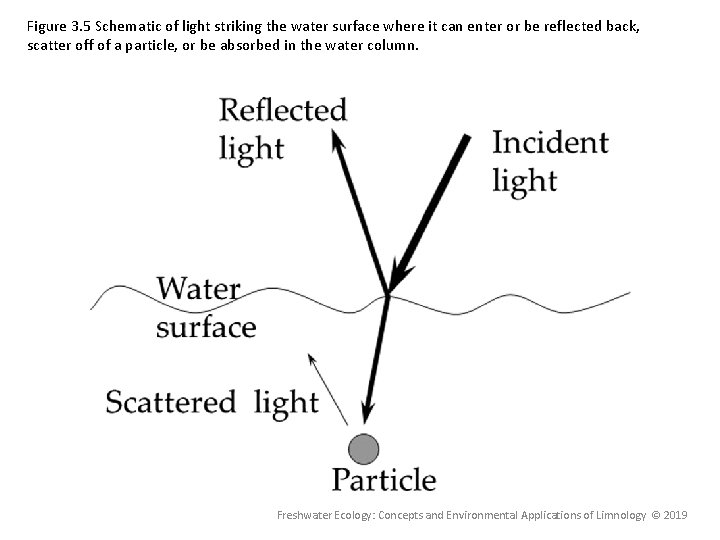
Figure 3. 5 Schematic of light striking the water surface where it can enter or be reflected back, scatter off of a particle, or be absorbed in the water column. Freshwater Ecology: Concepts and Environmental Applications of Limnology © 2019
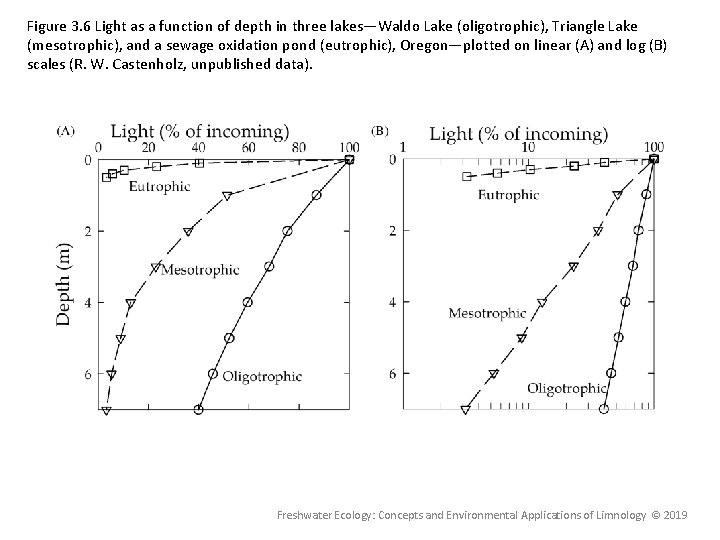
Figure 3. 6 Light as a function of depth in three lakes—Waldo Lake (oligotrophic), Triangle Lake (mesotrophic), and a sewage oxidation pond (eutrophic), Oregon—plotted on linear (A) and log (B) scales (R. W. Castenholz, unpublished data). Freshwater Ecology: Concepts and Environmental Applications of Limnology © 2019
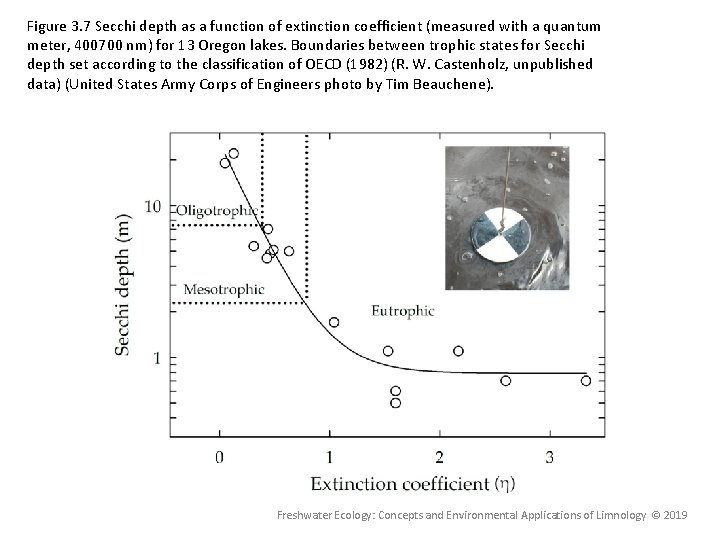
Figure 3. 7 Secchi depth as a function of extinction coefficient (measured with a quantum meter, 400700 nm) for 13 Oregon lakes. Boundaries between trophic states for Secchi depth set according to the classification of OECD (1982) (R. W. Castenholz, unpublished data) (United States Army Corps of Engineers photo by Tim Beauchene). Freshwater Ecology: Concepts and Environmental Applications of Limnology © 2019
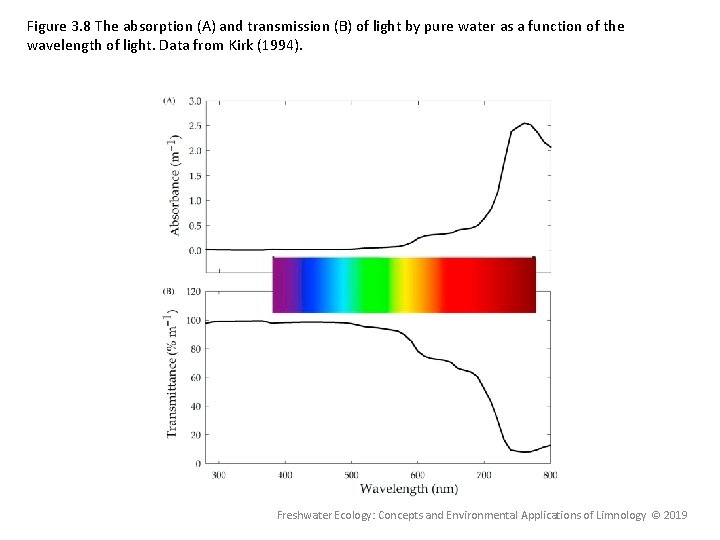
Figure 3. 8 The absorption (A) and transmission (B) of light by pure water as a function of the wavelength of light. Data from Kirk (1994). Freshwater Ecology: Concepts and Environmental Applications of Limnology © 2019
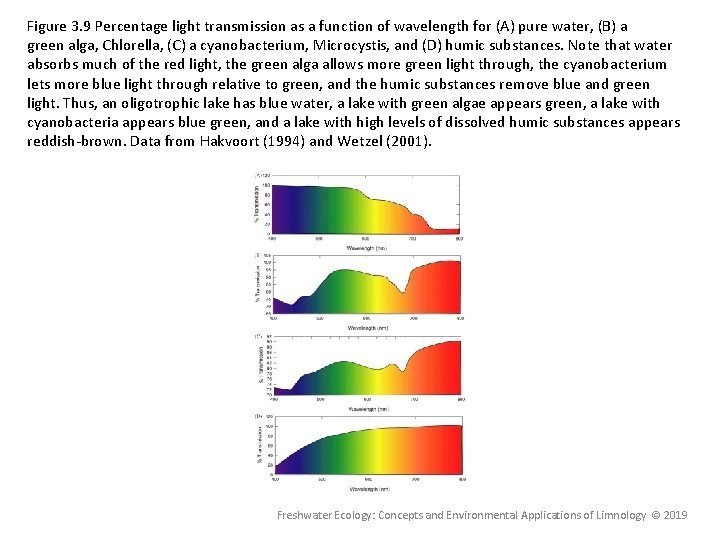
Figure 3. 9 Percentage light transmission as a function of wavelength for (A) pure water, (B) a green alga, Chlorella, (C) a cyanobacterium, Microcystis, and (D) humic substances. Note that water absorbs much of the red light, the green alga allows more green light through, the cyanobacterium lets more blue light through relative to green, and the humic substances remove blue and green light. Thus, an oligotrophic lake has blue water, a lake with green algae appears green, a lake with cyanobacteria appears blue green, and a lake with high levels of dissolved humic substances appears reddish-brown. Data from Hakvoort (1994) and Wetzel (2001). Freshwater Ecology: Concepts and Environmental Applications of Limnology © 2019
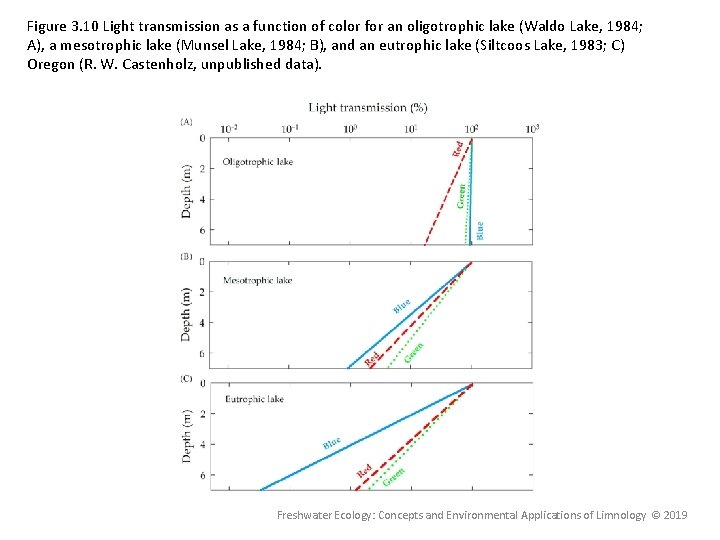
Figure 3. 10 Light transmission as a function of color for an oligotrophic lake (Waldo Lake, 1984; A), a mesotrophic lake (Munsel Lake, 1984; B), and an eutrophic lake (Siltcoos Lake, 1983; C) Oregon (R. W. Castenholz, unpublished data). Freshwater Ecology: Concepts and Environmental Applications of Limnology © 2019
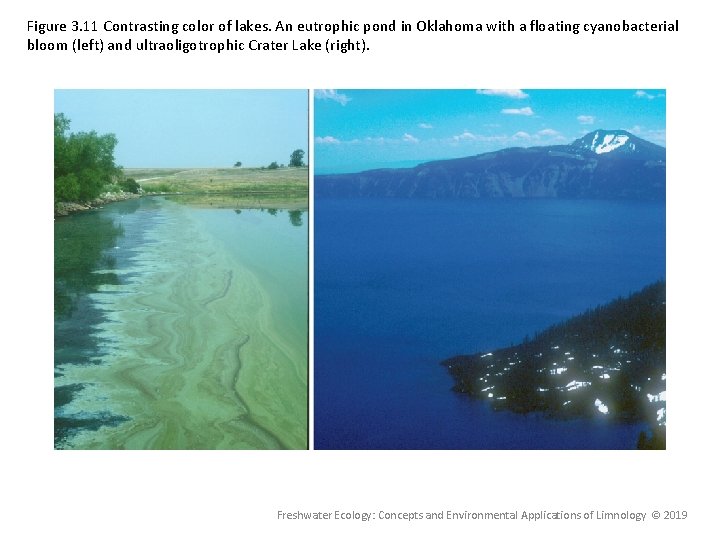
Figure 3. 11 Contrasting color of lakes. An eutrophic pond in Oklahoma with a floating cyanobacterial bloom (left) and ultraoligotrophic Crater Lake (right). Freshwater Ecology: Concepts and Environmental Applications of Limnology © 2019
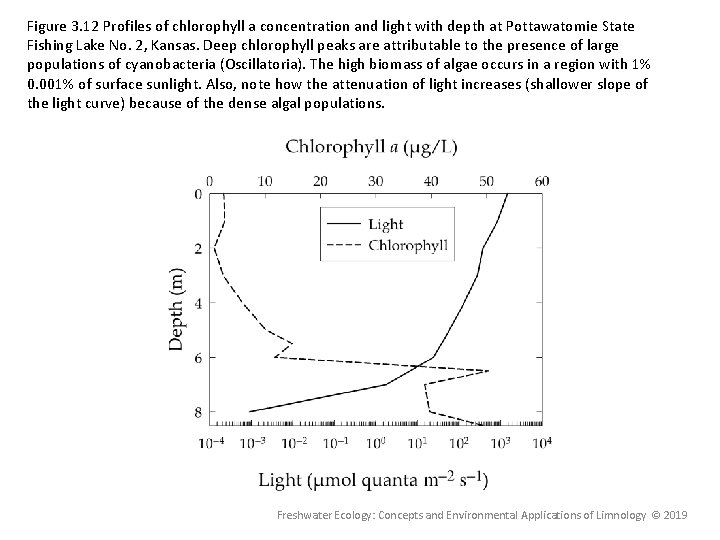
Figure 3. 12 Profiles of chlorophyll a concentration and light with depth at Pottawatomie State Fishing Lake No. 2, Kansas. Deep chlorophyll peaks are attributable to the presence of large populations of cyanobacteria (Oscillatoria). The high biomass of algae occurs in a region with 1% 0. 001% of surface sunlight. Also, note how the attenuation of light increases (shallower slope of the light curve) because of the dense algal populations. Freshwater Ecology: Concepts and Environmental Applications of Limnology © 2019
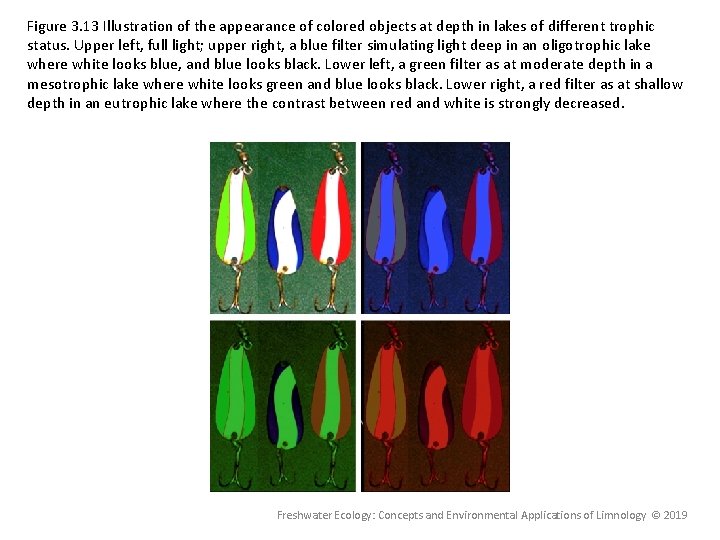
Figure 3. 13 Illustration of the appearance of colored objects at depth in lakes of different trophic status. Upper left, full light; upper right, a blue filter simulating light deep in an oligotrophic lake where white looks blue, and blue looks black. Lower left, a green filter as at moderate depth in a mesotrophic lake where white looks green and blue looks black. Lower right, a red filter as at shallow depth in an eutrophic lake where the contrast between red and white is strongly decreased. Freshwater Ecology: Concepts and Environmental Applications of Limnology © 2019