
Figure 25 3 b Renal Vascular Pathway Figure
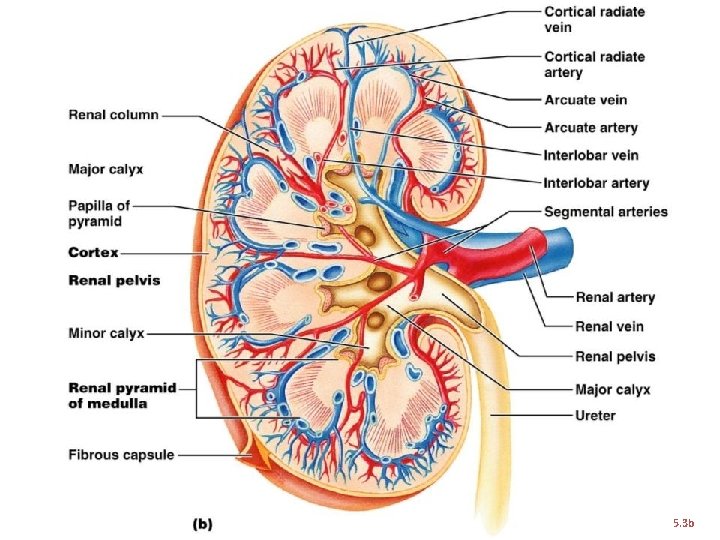
Figure 25. 3 b
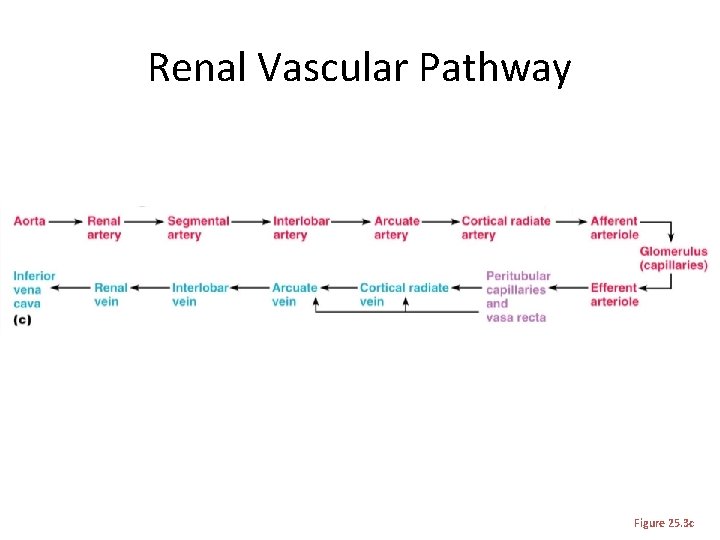
Renal Vascular Pathway Figure 25. 3 c
The Nephron • ____________ are the structural and functional units that form urine, consisting of: – Glomerulus • a tuft of ________________ associated with a _ – Glomerular (Bowman’s) capsule • blind, __________________ that completely surrounds the glomerulus
The Nephron – Renal _ • the glomerulus and its Bowman’s capsule – • ___________ epithelium that allows solute-rich, _________________ to pass from the blood into the glomerular capsule
Renal Tubule • Proximal convoluted tubule (PCT) – – composed of cuboidal cells with numerous _ – ______________ and solutes from filtrate and secretes substances into it
Renal Tubule • – a hairpin-shaped loop of the renal tubule • Distal convoluted tubule (DCT) – cuboidal cells without microvilli that _
Nephrons • – 85% of nephrons; located in the cortex • Juxtamedullary nephrons: – Are located at the cortex-medulla junction – Have loops of Henle that _ – Are involved in the production of _
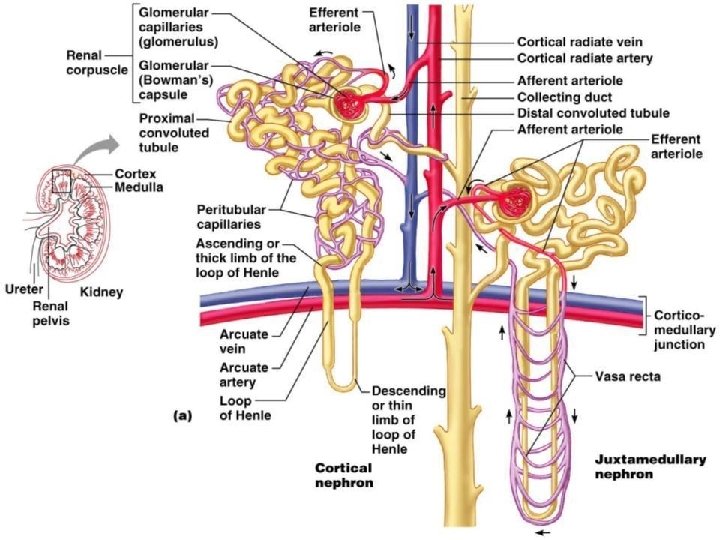
Figure 25. 5 a
Capillary Beds of the Nephron • Every nephron has _____ capillary beds – – • Each glomerulus is: – Fed by an _ – Drained by an _
Capillary Beds of the Nephron • Blood pressure in the glomerulus is high because: – Arterioles are high-resistance vessels – Afferent arterioles ___________ than efferent arterioles • Fluids and solutes are forced out of the blood throughout the entire length of the glomerulus
Capillary Beds • Peritubular beds are ___________, porous capillaries __________ that: – Arise from efferent arterioles – Cling to adjacent renal tubules – Empty into the renal venous system • Vasa recta – long, straight _
Juxtaglomerular Apparatus (JGA) • Where the distal tubule lies against the afferent (sometimes efferent) arteriole • Arteriole walls have juxtaglomerular (JG) cells – Enlarged, _ – Have _ – Act as _
Juxtaglomerular Apparatus (JGA) • – Tall, closely packed distal tubule cells – Lie adjacent to _ – Function as chemoreceptors or osmoreceptors • Mesanglial cells: – Have _______________ properties – Influence capillary _
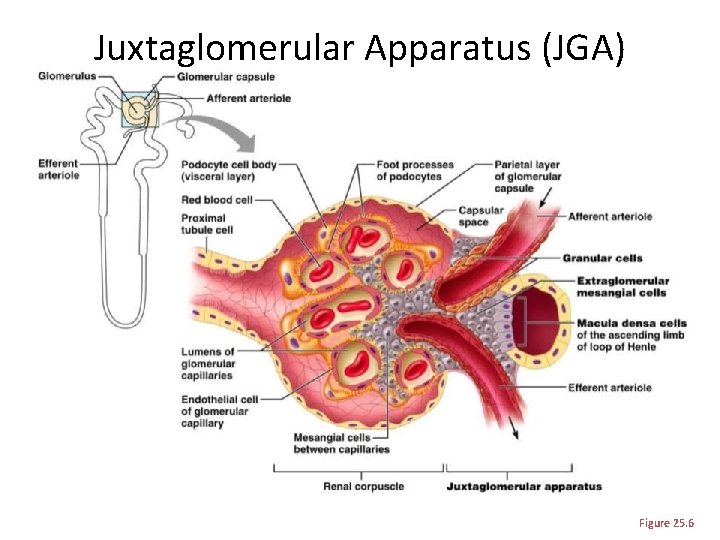
Juxtaglomerular Apparatus (JGA) Figure 25. 6
Mechanisms of Urine Formation • The kidneys filter the body’s _ • The filtrate: – Contains all plasma components _ – Loses water, nutrients, and essential ions to become urine • The urine contains _
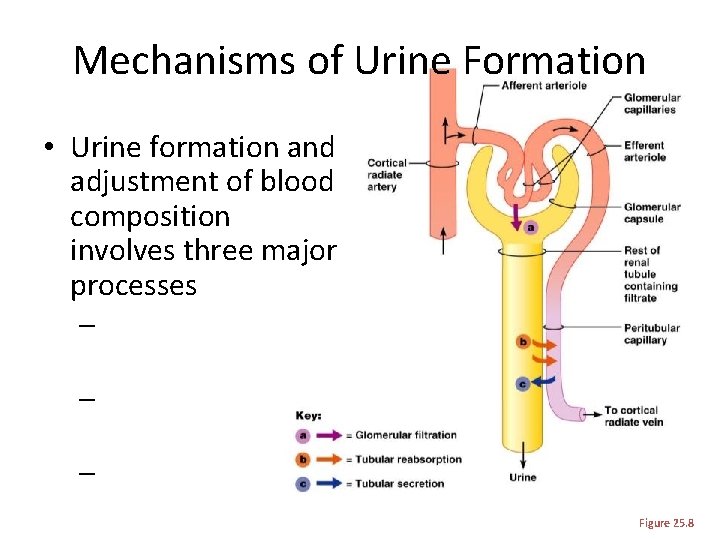
Mechanisms of Urine Formation • Urine formation and adjustment of blood composition involves three major processes – – – Figure 25. 8
Glomerular Filtration • The _____________ is more efficient than other capillary beds because: – Its filtration membrane is _ – Glomerular _ – It has a higher _
Glomerular Filtration Rate (GFR) • The total amount of filtrate formed per minute by the kidneys • Factors governing filtration rate at the capillary bed are: – Total _____________ available for filtration – Filtration membrane _ –
Glomerular Filtration Rate (GFR) • GFR is ______________ to the NFP • Changes in GFR normally result from changes in _
Regulation of Glomerular Filtration • If the GFR is too high: – Needed substances _ • If the GFR is too low: – __________________, including wastes that are normally disposed of
Regulation of Glomerular Filtration • Three mechanisms control the GFR – Renal autoregulation _ – Neural controls – Hormonal mechanism (the _________________ system)
Intrinsic Controls • Under normal conditions, renal autoregulation maintains a _______________ glomerular filtration rate
Extrinsic Controls • When the _____________ nervous system is at ________: – Renal blood vessels are _ – Autoregulation mechanisms prevail
Extrinsic Controls • Under stress: – ____________ is released by the sympathetic nervous system – ____________ is released by the _ – __________________ and filtration is inhibited • The sympathetic nervous system also stimulates the renin-angiotensin mechanism
Renin-Angiotensin Mechanism • Is triggered when the JG cells release renin • Renin acts on ______________ to release _ • Angiotensin I is converted to angiotensin_ • Angiotensin II: – Causes mean _ – Stimulates the adrenal cortex to release _ • As a result, both systemic and glomerular hydrostatic pressure rise
Renin Release • Renin release is triggered by: – ______________ of the granular JG cells – Stimulation of the JG cells by _ – Direct stimulation of the JG cells by _ – Angiotensin _
- Slides: 26