
Figure 15 UN 07 Bacteria Prokaryotes Archaea Protists
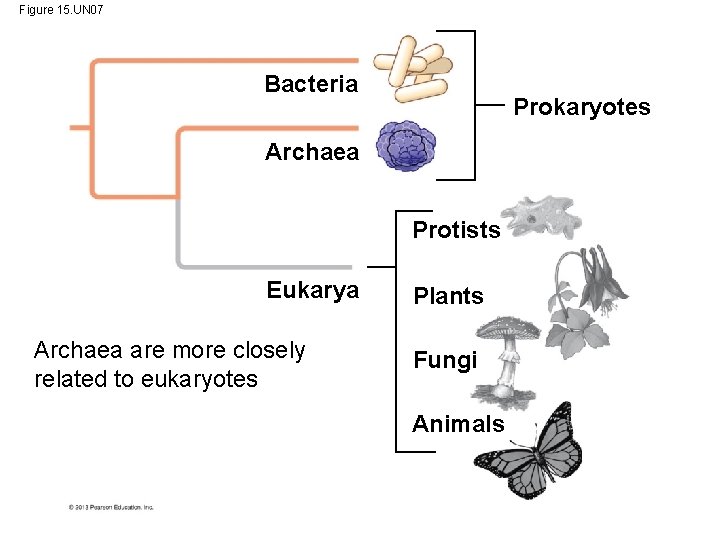
Figure 15. UN 07 Bacteria Prokaryotes Archaea Protists Eukarya Archaea are more closely related to eukaryotes Plants Fungi Animals
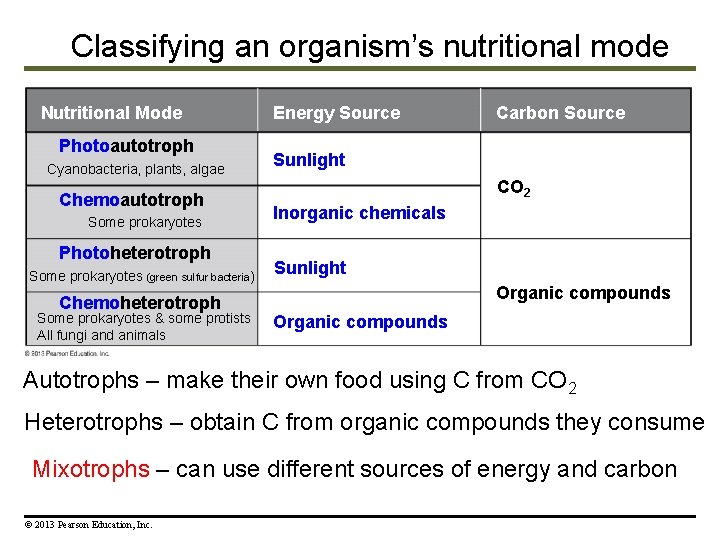
Classifying an organism’s nutritional mode Nutritional Mode Energy Source Carbon Source Photoautotroph thrive in habitats too cold, too hot, too • Prokaryotes Sunlight salty, too acidic, or too alkaline for any. CO eukaryote, Cyanobacteria, plants, algae Chemoautotroph 2 Inorganic chemicals – cause about half of all human diseases, and Some prokaryotes Photoheterotroph Sunlight – are more commonly benign or beneficial. Organic compounds Some prokaryotes (green sulfur bacteria) Chemoheterotroph Some prokaryotes & some protists All fungi and animals Organic compounds Autotrophs – make their own food using C from CO 2 Heterotrophs – obtain C from organic compounds they consume Mixotrophs – can use different sources of energy and carbon © 2013 Pearson Education, Inc.

PROTISTS: ancestral to all other eukaryotes • A diverse collection of eukaryotes – Most are aquatic (oceans, lakes & ponds), few are terrestrial (damp soil or leaf litter) & some are found in the bodies of other organisms – Most are unicellular, some are multi-cellular & some form colonies – Some are autotrophs, some are heterotrophs, and few are mixotrophs – Most undergo asexual reproduction via binary fission & some undergo sexual reproduction – Some are non-mobile and some are mobile (use pseudopodia, flagella, or cilia)

Protists obtain nutrition in a variety of ways: • Autotrophs: algae (single-celled, filamentous colonial & multi-cellular seaweeds) i. e. Green Algae: chlorophyll is the main pigment Chlamydomonas (flagella) Spirogyra Caulerpa Volvox (colony of (filamentous, (seaweed) flagellated non-mobile, but carried by cells) water currents)

Protists obtain nutrition in a variety of ways: • Heterotrophs: - Animal-like (protozoans): ingest bacteria/protists Amoeba proteus (pseudopodia)

Protists obtain nutrition in a variety of ways: • Heterotrophs: - Animal-like (protozoans): ingest bacteria/protists m u i in d i D m u i ec am r a P Vorticella Stentor Stylonychia Ciliates
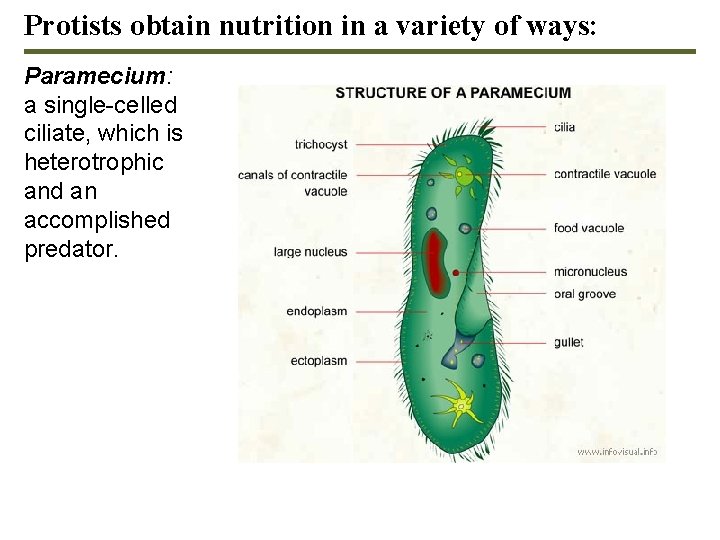
Protists obtain nutrition in a variety of ways: Paramecium: a single-celled ciliate, which is heterotrophic and an accomplished predator.
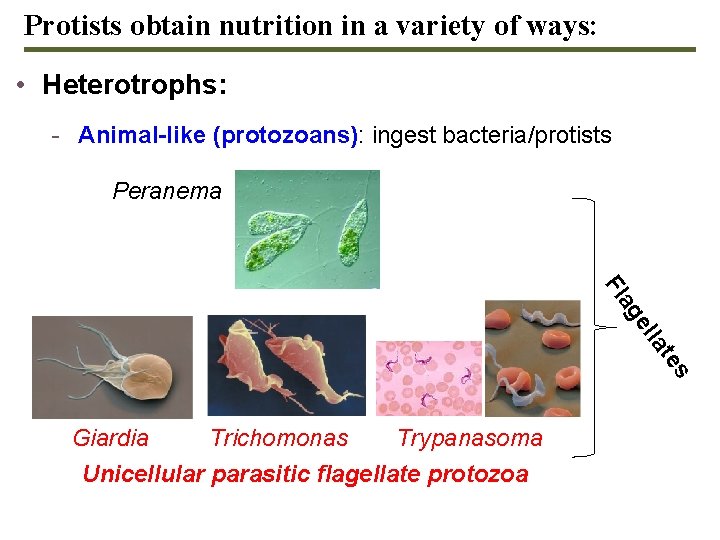
Protists obtain nutrition in a variety of ways: • Heterotrophs: - Animal-like (protozoans): ingest bacteria/protists Peranema Fl s te la el ag Giardia Trichomonas Trypanasoma Unicellular parasitic flagellate protozoa

Protists obtain nutrition in a variety of ways: • Mixotrophs are capable of photosynthesis and heterotrophy Euglena: a singlecelled flagellate with a photoreceptor & a shield of red pigment that allow it to orient itself and to move toward light. This is important for photosynthesis.
- Slides: 9