
Figure 14 1 Physiological effects of electricity Threshold
- Slides: 21
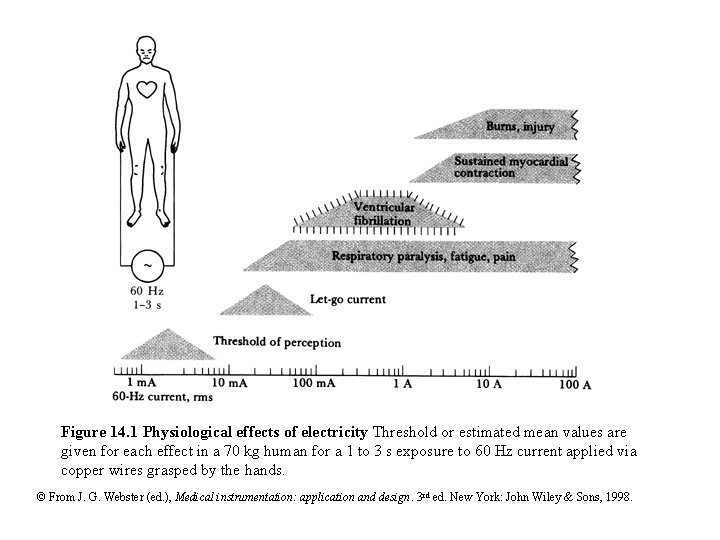
Figure 14. 1 Physiological effects of electricity Threshold or estimated mean values are given for each effect in a 70 kg human for a 1 to 3 s exposure to 60 Hz current applied via copper wires grasped by the hands. © From J. G. Webster (ed. ), Medical instrumentation: application and design. 3 rd ed. New York: John Wiley & Sons, 1998.
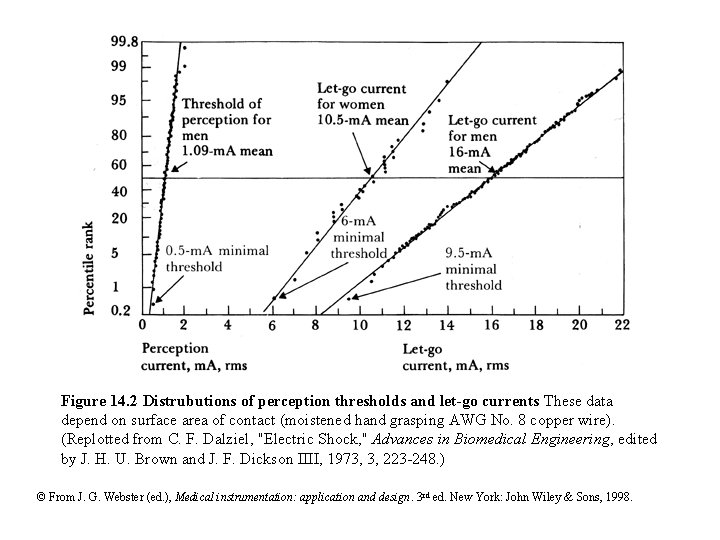
Figure 14. 2 Distrubutions of perception thresholds and let-go currents These data depend on surface area of contact (moistened hand grasping AWG No. 8 copper wire). (Replotted from C. F. Dalziel, "Electric Shock, " Advances in Biomedical Engineering, edited by J. H. U. Brown and J. F. Dickson IIII, 1973, 3, 223 -248. ) © From J. G. Webster (ed. ), Medical instrumentation: application and design. 3 rd ed. New York: John Wiley & Sons, 1998.
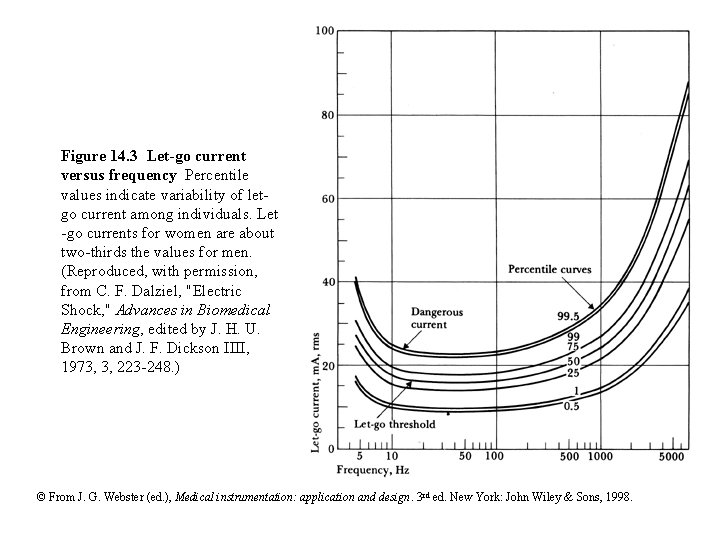
Figure 14. 3 Let-go current versus frequency Percentile values indicate variability of letgo current among individuals. Let -go currents for women are about two-thirds the values for men. (Reproduced, with permission, from C. F. Dalziel, "Electric Shock, " Advances in Biomedical Engineering, edited by J. H. U. Brown and J. F. Dickson IIII, 1973, 3, 223 -248. ) © From J. G. Webster (ed. ), Medical instrumentation: application and design. 3 rd ed. New York: John Wiley & Sons, 1998.
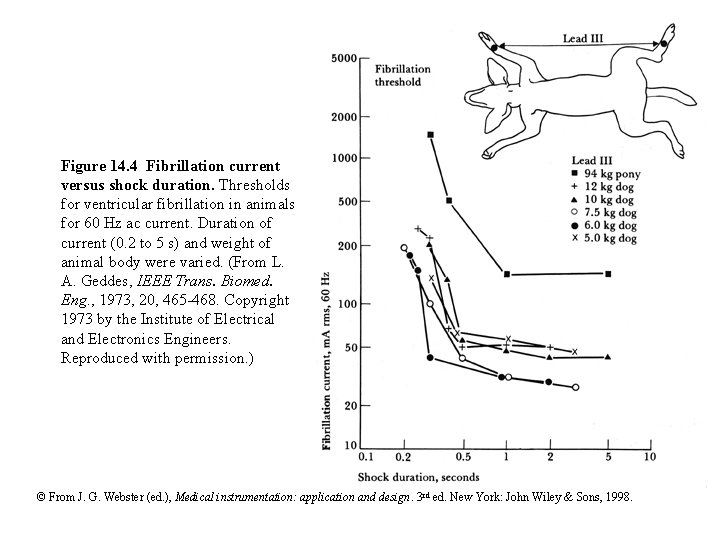
Figure 14. 4 Fibrillation current versus shock duration. Thresholds for ventricular fibrillation in animals for 60 Hz ac current. Duration of current (0. 2 to 5 s) and weight of animal body were varied. (From L. A. Geddes, IEEE Trans. Biomed. Eng. , 1973, 20, 465 -468. Copyright 1973 by the Institute of Electrical and Electronics Engineers. Reproduced with permission. ) © From J. G. Webster (ed. ), Medical instrumentation: application and design. 3 rd ed. New York: John Wiley & Sons, 1998.
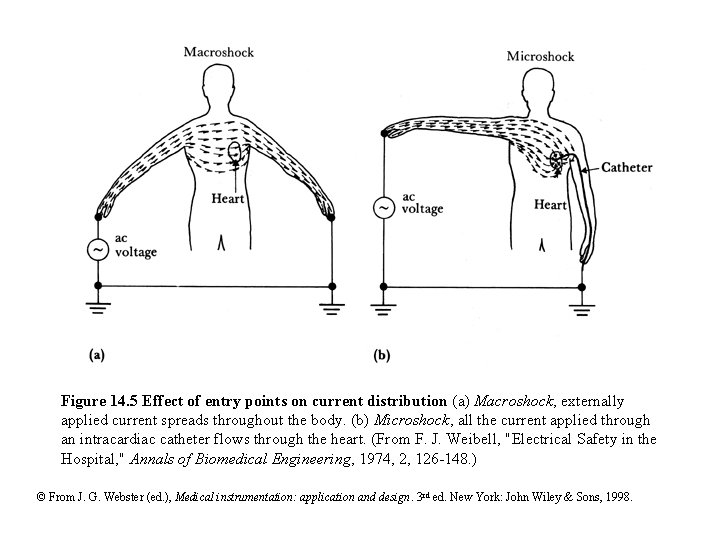
Figure 14. 5 Effect of entry points on current distribution (a) Macroshock, externally applied current spreads throughout the body. (b) Microshock, all the current applied through an intracardiac catheter flows through the heart. (From F. J. Weibell, "Electrical Safety in the Hospital, " Annals of Biomedical Engineering, 1974, 2, 126 -148. ) © From J. G. Webster (ed. ), Medical instrumentation: application and design. 3 rd ed. New York: John Wiley & Sons, 1998.
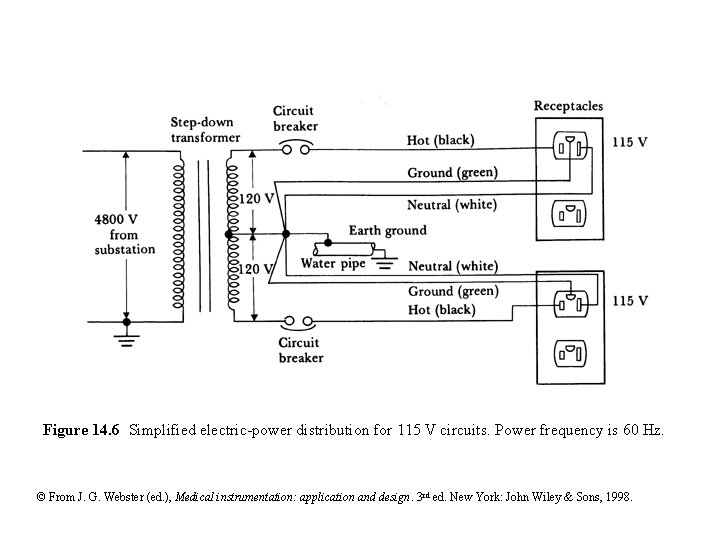
Figure 14. 6 Simplified electric-power distribution for 115 V circuits. Power frequency is 60 Hz. © From J. G. Webster (ed. ), Medical instrumentation: application and design. 3 rd ed. New York: John Wiley & Sons, 1998.
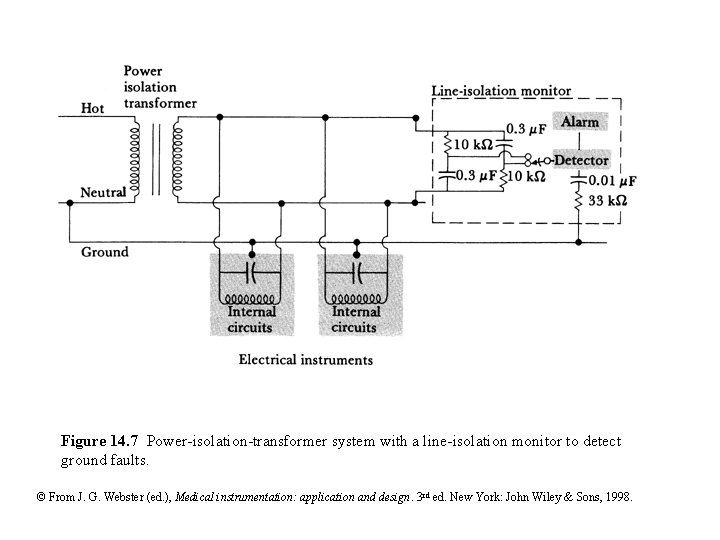
Figure 14. 7 Power-isolation-transformer system with a line-isolation monitor to detect ground faults. © From J. G. Webster (ed. ), Medical instrumentation: application and design. 3 rd ed. New York: John Wiley & Sons, 1998.
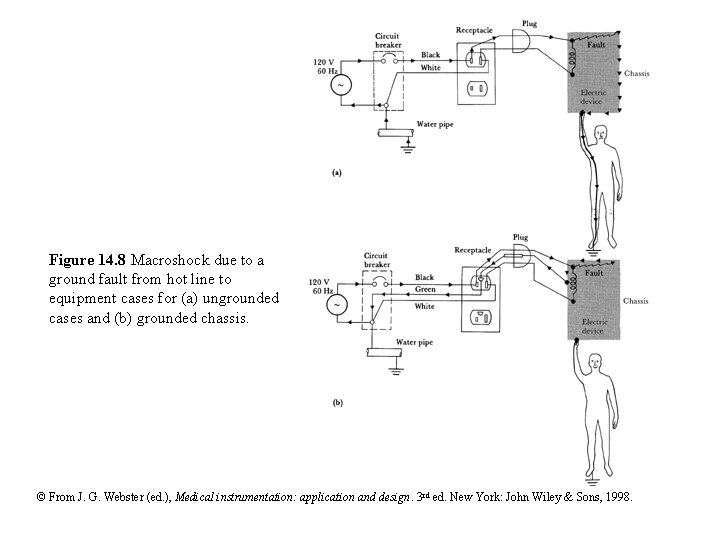
Figure 14. 8 Macroshock due to a ground fault from hot line to equipment cases for (a) ungrounded cases and (b) grounded chassis. © From J. G. Webster (ed. ), Medical instrumentation: application and design. 3 rd ed. New York: John Wiley & Sons, 1998.
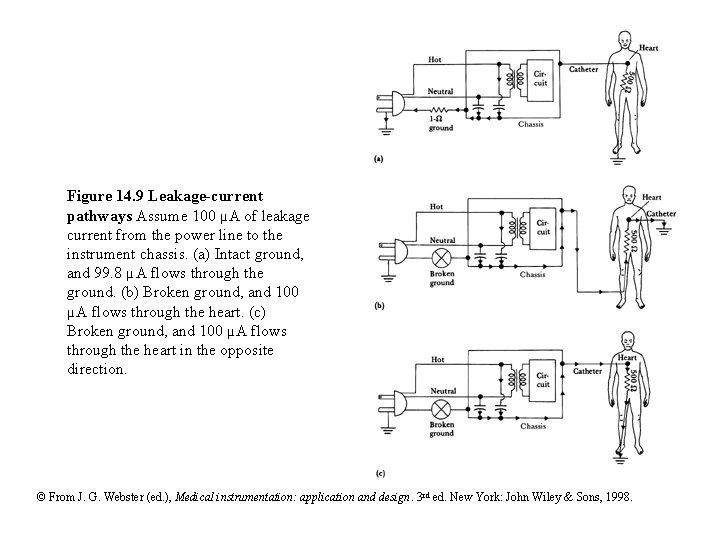
Figure 14. 9 Leakage-current pathways Assume 100 µA of leakage current from the power line to the instrument chassis. (a) Intact ground, and 99. 8 µA flows through the ground. (b) Broken ground, and 100 µA flows through the heart. (c) Broken ground, and 100 µA flows through the heart in the opposite direction. © From J. G. Webster (ed. ), Medical instrumentation: application and design. 3 rd ed. New York: John Wiley & Sons, 1998.
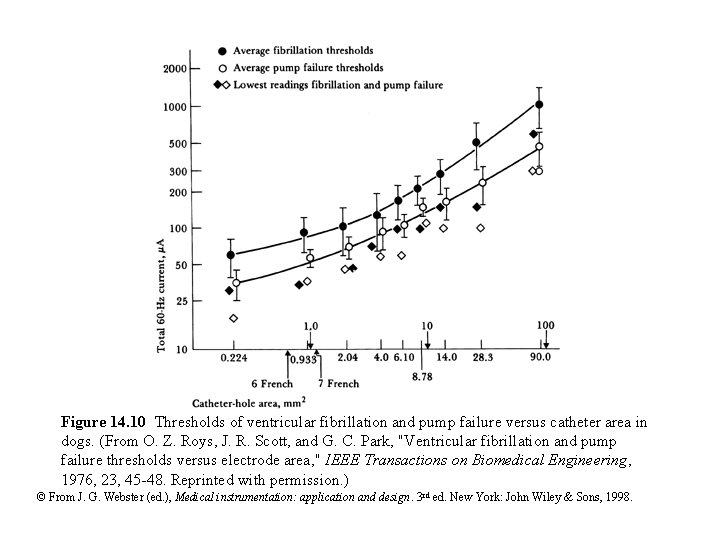
Figure 14. 10 Thresholds of ventricular fibrillation and pump failure versus catheter area in dogs. (From O. Z. Roys, J. R. Scott, and G. C. Park, "Ventricular fibrillation and pump failure thresholds versus electrode area, " IEEE Transactions on Biomedical Engineering, 1976, 23, 45 -48. Reprinted with permission. ) © From J. G. Webster (ed. ), Medical instrumentation: application and design. 3 rd ed. New York: John Wiley & Sons, 1998.
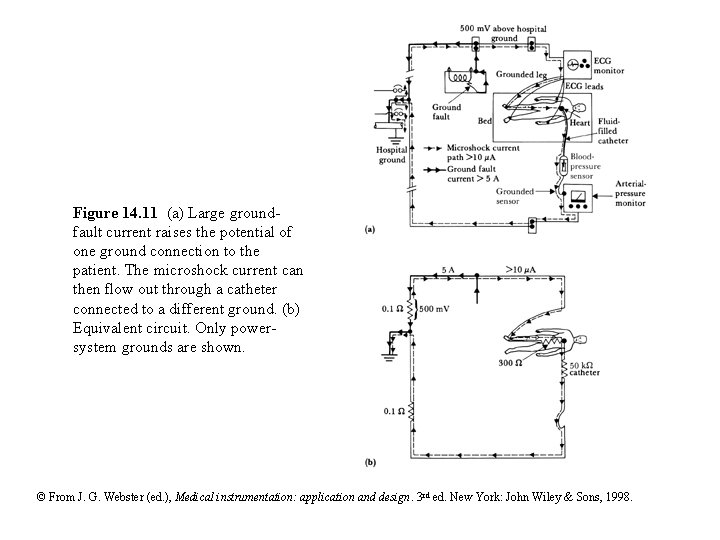
Figure 14. 11 (a) Large groundfault current raises the potential of one ground connection to the patient. The microshock current can then flow out through a catheter connected to a different ground. (b) Equivalent circuit. Only powersystem grounds are shown. © From J. G. Webster (ed. ), Medical instrumentation: application and design. 3 rd ed. New York: John Wiley & Sons, 1998.
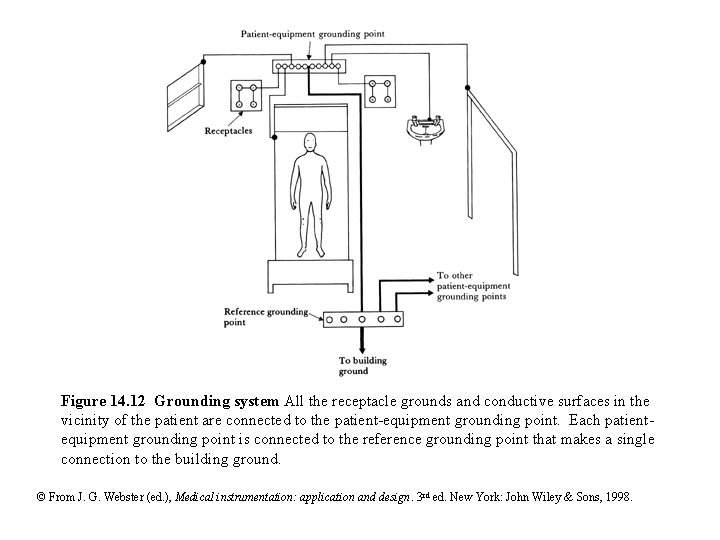
Figure 14. 12 Grounding system All the receptacle grounds and conductive surfaces in the vicinity of the patient are connected to the patient-equipment grounding point. Each patientequipment grounding point is connected to the reference grounding point that makes a single connection to the building ground. © From J. G. Webster (ed. ), Medical instrumentation: application and design. 3 rd ed. New York: John Wiley & Sons, 1998.
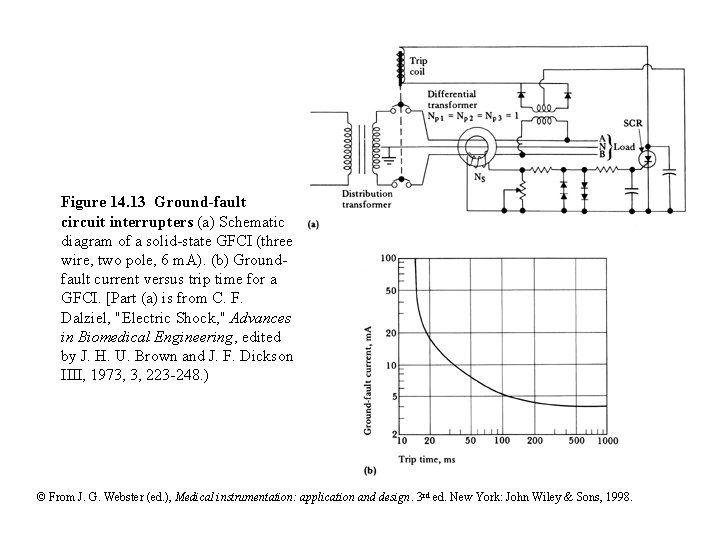
Figure 14. 13 Ground-fault circuit interrupters (a) Schematic diagram of a solid-state GFCI (three wire, two pole, 6 m. A). (b) Groundfault current versus trip time for a GFCI. [Part (a) is from C. F. Dalziel, "Electric Shock, " Advances in Biomedical Engineering, edited by J. H. U. Brown and J. F. Dickson IIII, 1973, 3, 223 -248. ) © From J. G. Webster (ed. ), Medical instrumentation: application and design. 3 rd ed. New York: John Wiley & Sons, 1998.
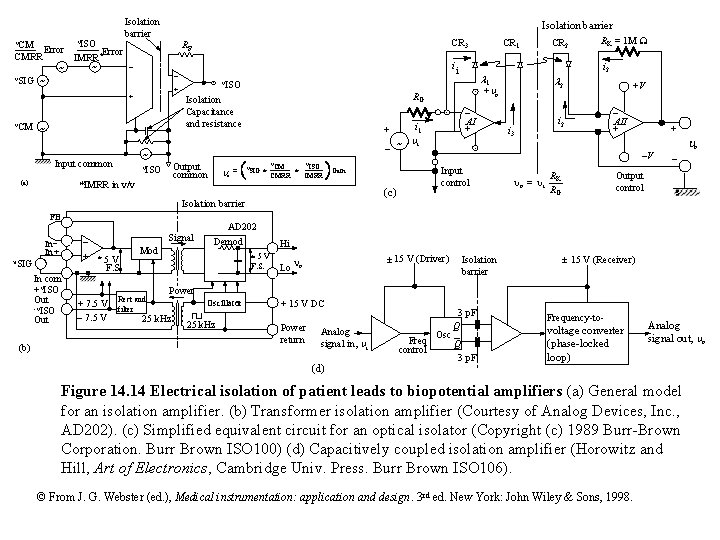
CM CMRR SIG Error ~ ~ Isolation barrier ISO Error IMRR* ~ Isolation barrier - Isolation Capacitance and resistance + - Output common ISO *IMRR in v/v o = SIG ± CM CMRR ± ISO IMRR FB + In In + SIG In com + ISO Out - ISO Out (b) Signal ± 5 V F. S. + 7. 5 V - 7. 5 V Mod Rect and filter AI + ~ i CR 2 RK = 1 M i 2 2 + o i 1 i 3 i 2 +V AII + + -V Input control Gain (c) Isolation barrier CR 1 1 RG ~ Input common i ISO + ~ (a) i - + CM CR 3 RF o = i RK RG o - Output control AD 202 Demod Hi ± 5 V F. S. Lo ± 15 V (Driver) o Isolation barrier ± 15 V (Receiver) Power 25 k. Hz Oscillator 25 k. Hz + 15 V DC Power return Analog signal in, i (d) Freq control Osc 3 p. F Q Q 3 p. F Frequency-to- voltage converter (phase-locked loop) Analog signal out, o Figure 14. 14 Electrical isolation of patient leads to biopotential amplifiers (a) General model for an isolation amplifier. (b) Transformer isolation amplifier (Courtesy of Analog Devices, Inc. , AD 202). (c) Simplified equivalent circuit for an optical isolator (Copyright (c) 1989 Burr-Brown Corporation. Burr Brown ISO 100) (d) Capacitively coupled isolation amplifier (Horowitz and Hill, Art of Electronics, Cambridge Univ. Press. Burr Brown ISO 106). © From J. G. Webster (ed. ), Medical instrumentation: application and design. 3 rd ed. New York: John Wiley & Sons, 1998.
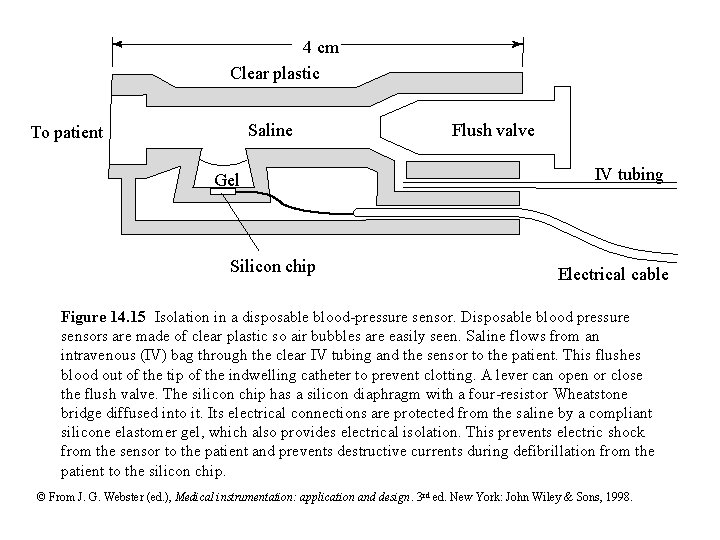
4 cm Clear plastic Saline To patient Gel Silicon chip Flush valve IV tubing Electrical cable Figure 14. 15 Isolation in a disposable blood-pressure sensor. Disposable blood pressure sensors are made of clear plastic so air bubbles are easily seen. Saline flows from an intravenous (IV) bag through the clear IV tubing and the sensor to the patient. This flushes blood out of the tip of the indwelling catheter to prevent clotting. A lever can open or close the flush valve. The silicon chip has a silicon diaphragm with a four-resistor Wheatstone bridge diffused into it. Its electrical connections are protected from the saline by a compliant silicone elastomer gel, which also provides electrical isolation. This prevents electric shock from the sensor to the patient and prevents destructive currents during defibrillation from the patient to the silicon chip. © From J. G. Webster (ed. ), Medical instrumentation: application and design. 3 rd ed. New York: John Wiley & Sons, 1998.
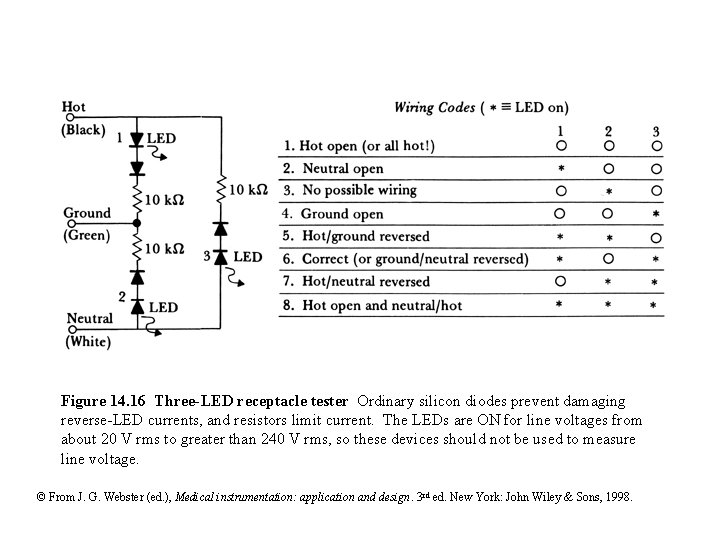
Figure 14. 16 Three-LED receptacle tester Ordinary silicon diodes prevent damaging reverse-LED currents, and resistors limit current. The LEDs are ON for line voltages from about 20 V rms to greater than 240 V rms, so these devices should not be used to measure line voltage. © From J. G. Webster (ed. ), Medical instrumentation: application and design. 3 rd ed. New York: John Wiley & Sons, 1998.
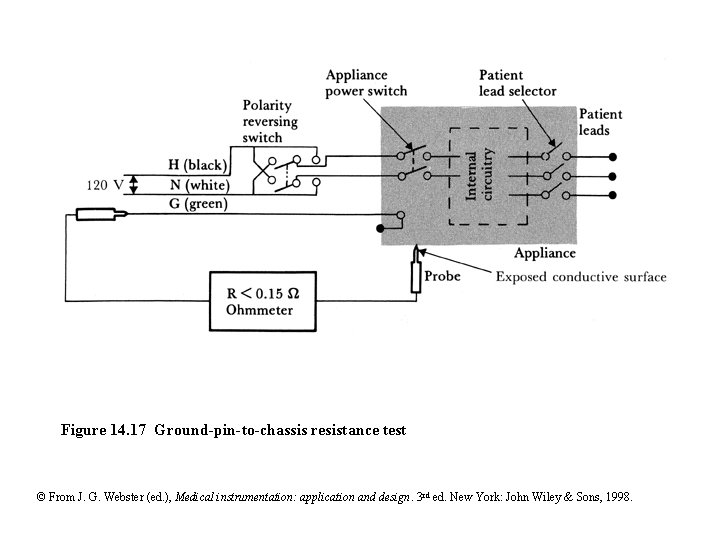
Figure 14. 17 Ground-pin-to-chassis resistance test © From J. G. Webster (ed. ), Medical instrumentation: application and design. 3 rd ed. New York: John Wiley & Sons, 1998.
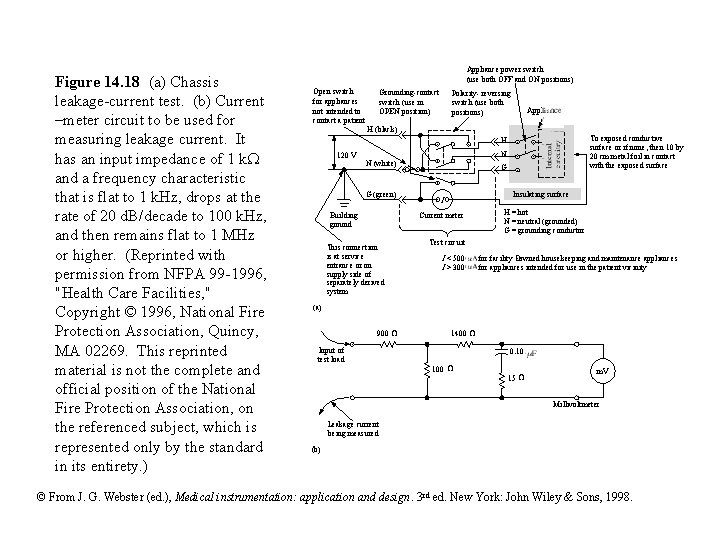
Figure 14. 18 (a) Chassis leakage-current test. (b) Current –meter circuit to be used for measuring leakage current. It has an input impedance of 1 k and a frequency characteristic that is flat to 1 k. Hz, drops at the rate of 20 d. B/decade to 100 k. Hz, and then remains flat to 1 MHz or higher. (Reprinted with permission from NFPA 99 -1996, "Health Care Facilities, " Copyright © 1996, National Fire Protection Association, Quincy, MA 02269. This reprinted material is not the complete and official position of the National Fire Protection Association, on the referenced subject, which is represented only by the standard in its entirety. ) Appliance power switch (use both OFF and ON positions) Open switch for appliances not intended to contact a patient Grounding-contact switch (use in OPEN position) Polarity- reversing switch (use both positions) Appliance H (black) To exposed conductive surface or if none, then 10 by 20 cm metal foil in contact with the exposed surface H 120 V N N (white) G (green) Building ground G Insulating surface I Current meter This connection is at service entrance or on supply side of separately derived system H = hot N = neutral (grounded) G = grounding conductor Test circuit I < 500 A for facility Ðowned housekeeping and maintenance appliances I > 300 A for appliances intended for use in the patient vicinity (a) 900 Input of test load 1400 0. 10 F 100 15 m. V Millivoltmeter Leakage current being measured (b) © From J. G. Webster (ed. ), Medical instrumentation: application and design. 3 rd ed. New York: John Wiley & Sons, 1998.
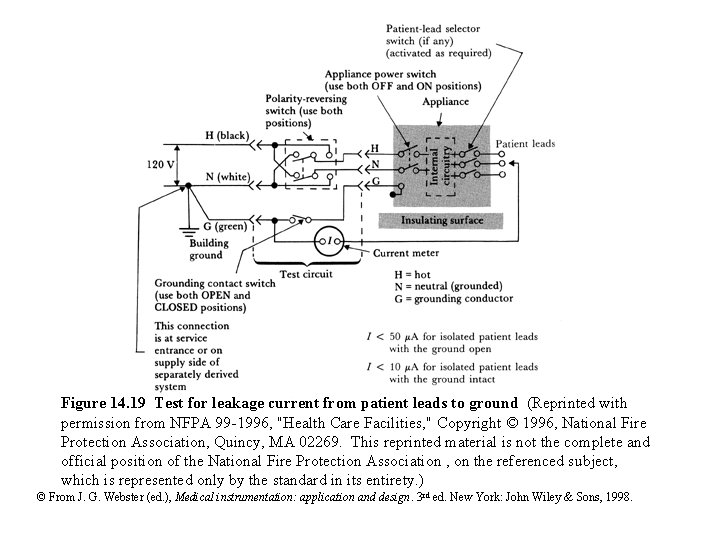
Figure 14. 19 Test for leakage current from patient leads to ground (Reprinted with permission from NFPA 99 -1996, "Health Care Facilities, " Copyright © 1996, National Fire Protection Association, Quincy, MA 02269. This reprinted material is not the complete and official position of the National Fire Protection Association , on the referenced subject, which is represented only by the standard in its entirety. ) © From J. G. Webster (ed. ), Medical instrumentation: application and design. 3 rd ed. New York: John Wiley & Sons, 1998.
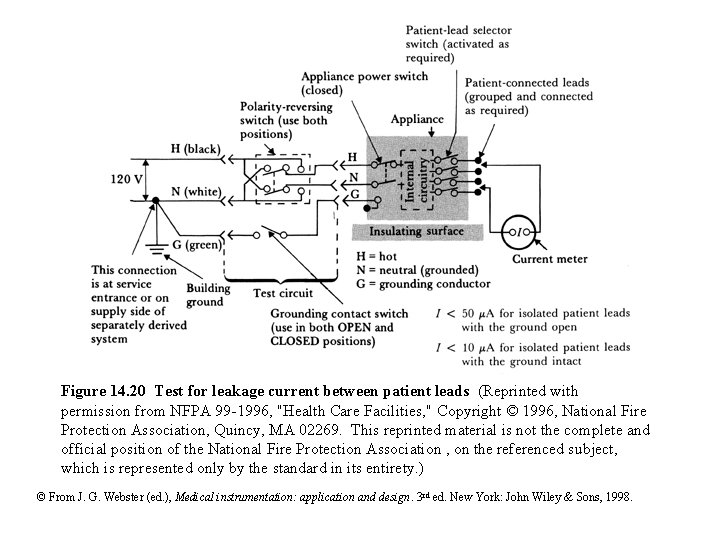
Figure 14. 20 Test for leakage current between patient leads (Reprinted with permission from NFPA 99 -1996, "Health Care Facilities, " Copyright © 1996, National Fire Protection Association, Quincy, MA 02269. This reprinted material is not the complete and official position of the National Fire Protection Association , on the referenced subject, which is represented only by the standard in its entirety. ) © From J. G. Webster (ed. ), Medical instrumentation: application and design. 3 rd ed. New York: John Wiley & Sons, 1998.
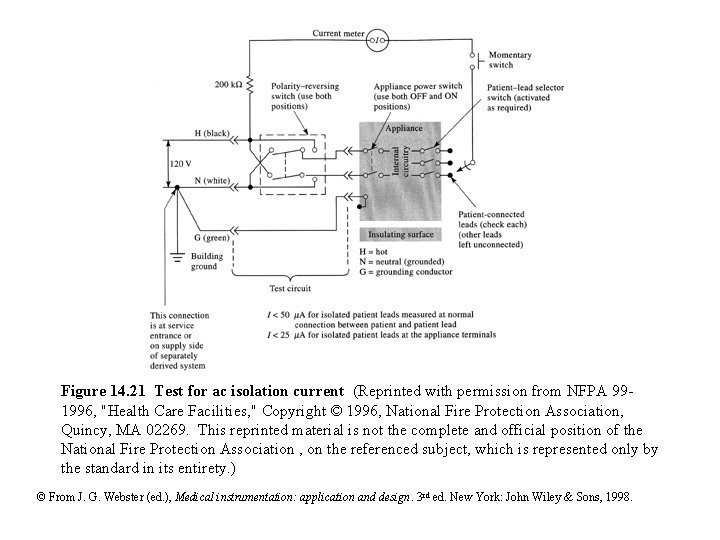
Figure 14. 21 Test for ac isolation current (Reprinted with permission from NFPA 991996, "Health Care Facilities, " Copyright © 1996, National Fire Protection Association, Quincy, MA 02269. This reprinted material is not the complete and official position of the National Fire Protection Association , on the referenced subject, which is represented only by the standard in its entirety. ) © From J. G. Webster (ed. ), Medical instrumentation: application and design. 3 rd ed. New York: John Wiley & Sons, 1998.