
Figure 12 1 Microscopic anatomy of skeletal muscle
- Slides: 35
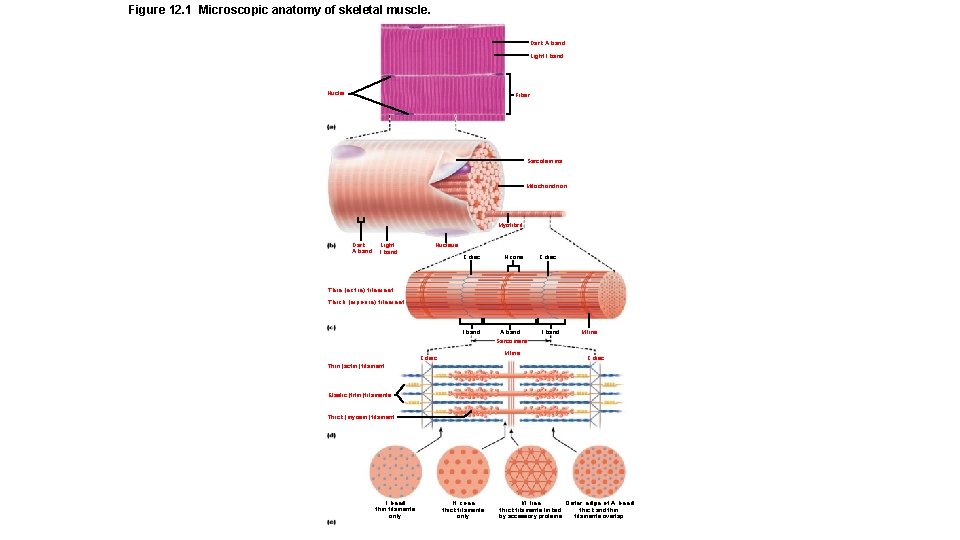
Figure 12. 1 Microscopic anatomy of skeletal muscle. Dark A band Light I band Nuclei Fiber Sarcolemma Mitochondrion Myofibril Dark A band Light I band Nucleus Z disc H zone Z disc Thin (actin) filament Thick (myosin) filament I band A band Sarcomere M line Z disc I band M line Z disc Thin (actin) filament Elastic (titin) filaments Thick (myosin) filament I band thin filaments only H zone thick filaments only Outer edge of A band M line thick and thin thick filaments linked filaments overlap by accessory proteins
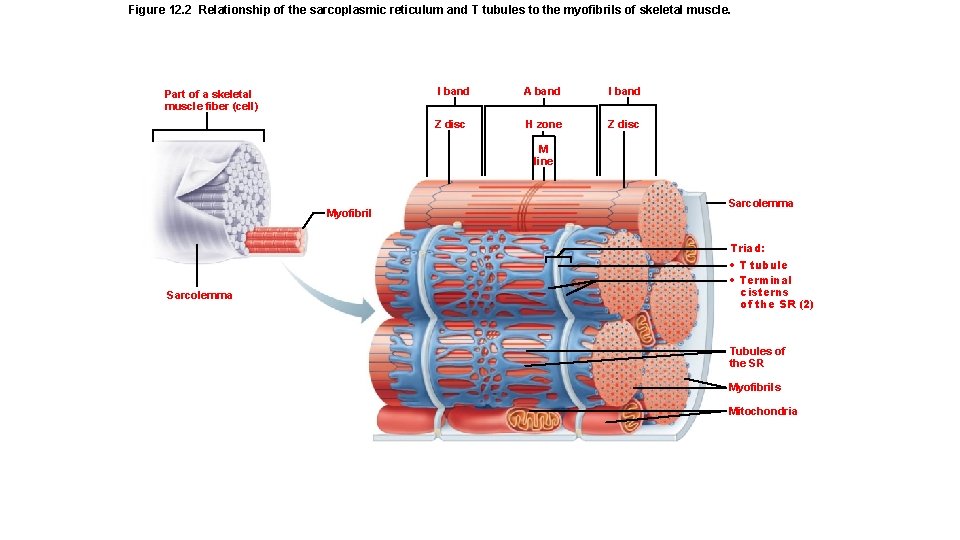
Figure 12. 2 Relationship of the sarcoplasmic reticulum and T tubules to the myofibrils of skeletal muscle. Part of a skeletal muscle fiber (cell) I band A band I band Z disc H zone Z disc M line Myofibril Sarcolemma Triad: Sarcolemma • T tubule • Terminal cisterns of the SR (2) Tubules of the SR Myofibrils Mitochondria
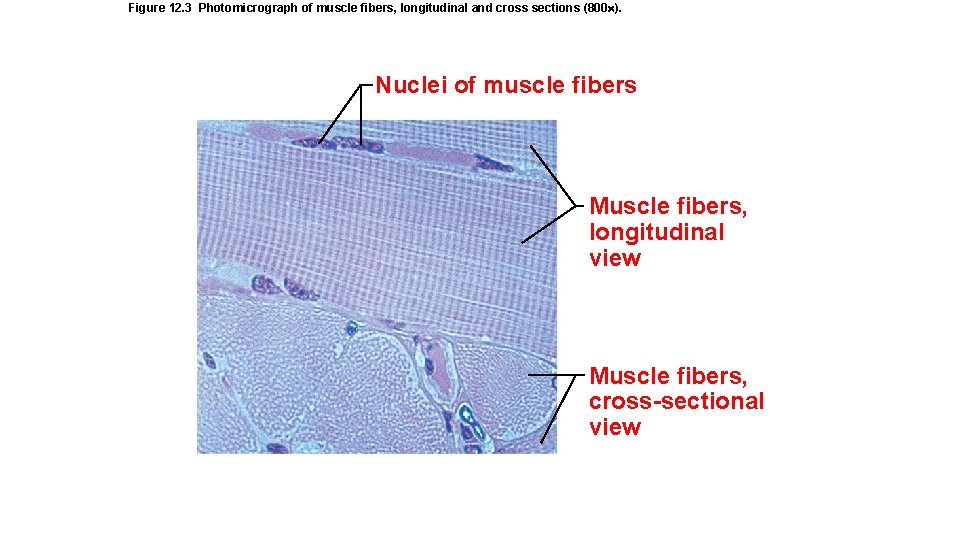
Figure 12. 3 Photomicrograph of muscle fibers, longitudinal and cross sections (800 ). Nuclei of muscle fibers Muscle fibers, longitudinal view Muscle fibers, cross-sectional view
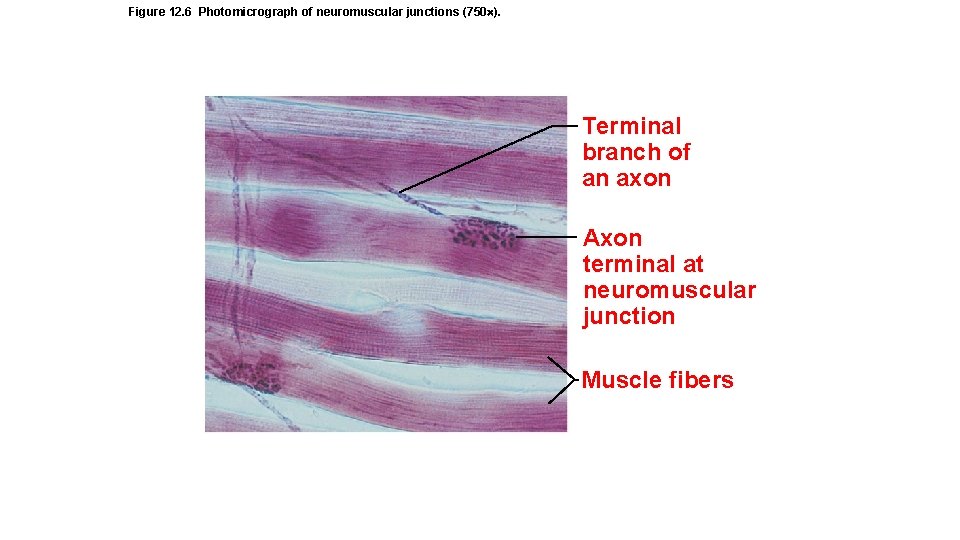
Figure 12. 6 Photomicrograph of neuromuscular junctions (750 ). Terminal branch of an axon Axon terminal at neuromuscular junction Muscle fibers
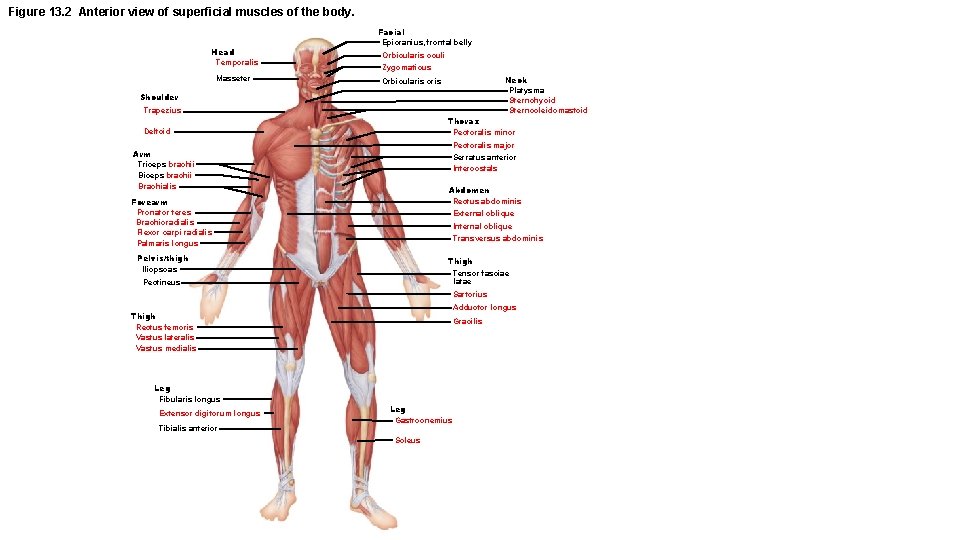
Figure 13. 2 Anterior view of superficial muscles of the body. Head Temporalis Masseter Facial Epicranius, frontal belly Orbicularis oculi Zygomaticus Neck Platysma Sternohyoid Sternocleidomastoid Orbicularis oris Shoulder Trapezius Thorax Pectoralis minor Deltoid Pectoralis major Serratus anterior Intercostals Arm Triceps brachii Brachialis Abdomen Rectus abdominis Forearm Pronator teres Brachioradialis Flexor carpi radialis Palmaris longus External oblique Internal oblique Transversus abdominis Pelvis/thigh Iliopsoas Thigh Tensor fasciae latae Pectineus Sartorius Adductor longus Thigh Rectus femoris Vastus lateralis Vastus medialis Leg Fibularis longus Extensor digitorum longus Tibialis anterior Gracilis Leg Gastrocnemius Soleus
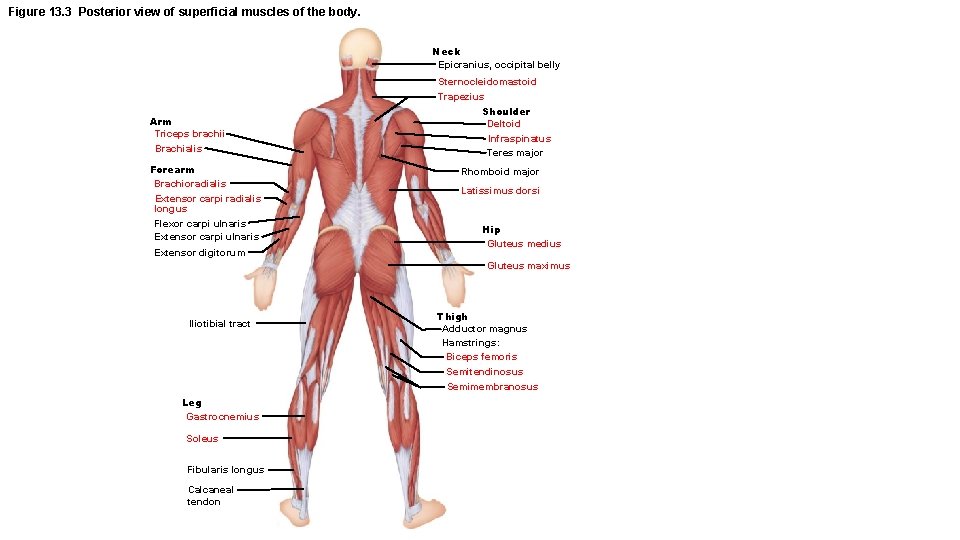
Figure 13. 3 Posterior view of superficial muscles of the body. Neck Epicranius, occipital belly Sternocleidomastoid Arm Triceps brachii Brachialis Forearm Brachioradialis Extensor carpi radialis longus Flexor carpi ulnaris Extensor digitorum Trapezius Shoulder Deltoid Infraspinatus Teres major Rhomboid major Latissimus dorsi Hip Gluteus medius Gluteus maximus Iliotibial tract Thigh Adductor magnus Hamstrings: Biceps femoris Semitendinosus Semimembranosus Leg Gastrocnemius Soleus Fibularis longus Calcaneal tendon
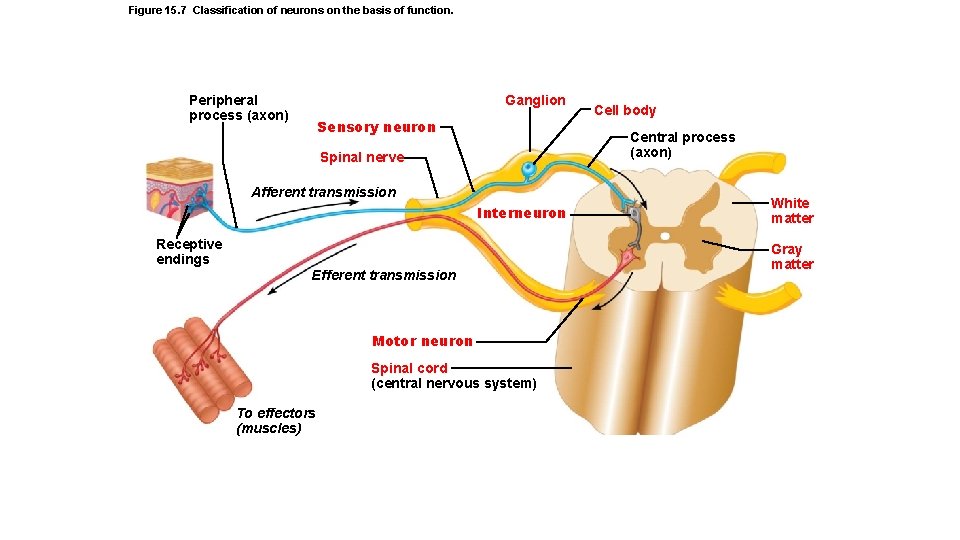
Figure 15. 7 Classification of neurons on the basis of function. Ganglion Peripheral process (axon) Sensory neuron Central process (axon) Spinal nerve Afferent transmission Interneuron Receptive endings Efferent transmission Motor neuron Spinal cord (central nervous system) To effectors (muscles) Cell body White matter Gray matter
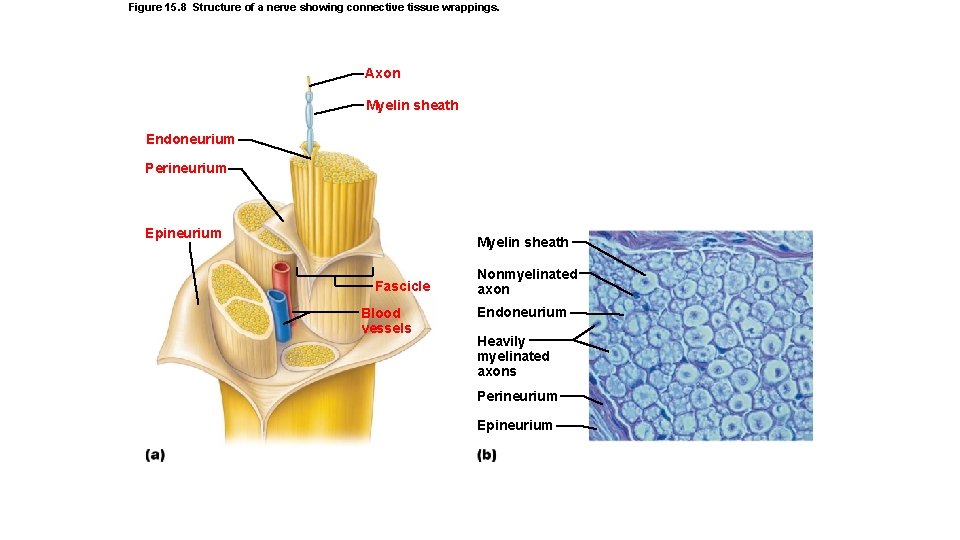
Figure 15. 8 Structure of a nerve showing connective tissue wrappings. Axon Myelin sheath Endoneurium Perineurium Epineurium Myelin sheath Fascicle Blood vessels Nonmyelinated axon Endoneurium Heavily myelinated axons Perineurium Epineurium
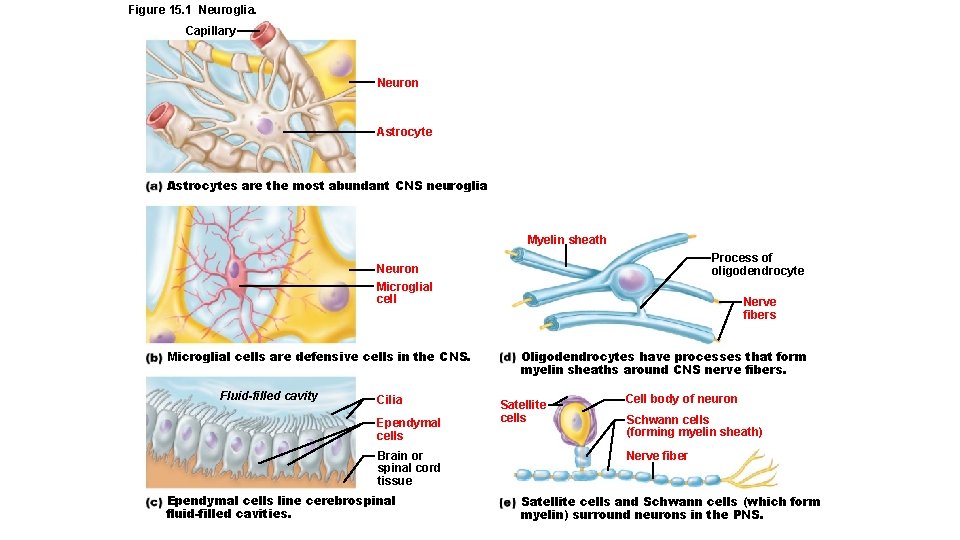
Figure 15. 1 Neuroglia. Capillary Neuron Astrocytes are the most abundant CNS neuroglia Myelin sheath Process of oligodendrocyte Neuron Microglial cells are defensive cells in the CNS. Fluid-filled cavity Cilia Ependymal cells Brain or spinal cord tissue Ependymal cells line cerebrospinal fluid-filled cavities. Nerve fibers Oligodendrocytes have processes that form myelin sheaths around CNS nerve fibers. Satellite cells Cell body of neuron Schwann cells (forming myelin sheath) Nerve fiber Satellite cells and Schwann cells (which form myelin) surround neurons in the PNS.
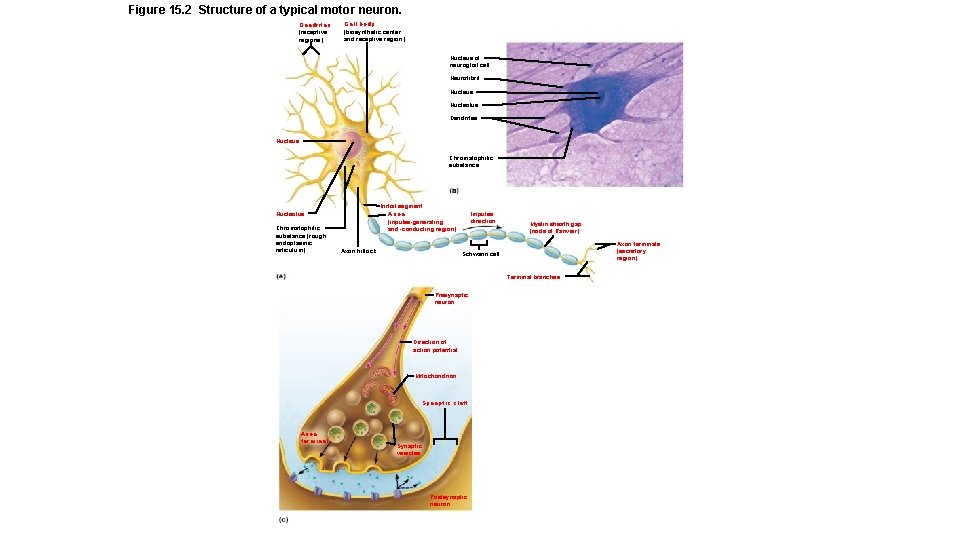
Figure 15. 2 Structure of a typical motor neuron. Dendrites (receptive regions) Cell body (biosynthetic center and receptive region) Nucleus of neuroglial cell Neurofibril Nucleus Nucleolus Dendrites Nucleus Chromatophilic substance Initial segment Axon (inpulse-generating and -conducting region) Nucleolus Chromatophilic substance (rough endoplasmic reticulum) Axon hillock Impulse direction Myelin sheath gap (node of Ranvier) Axon terminals (secretory region) Schwann cell Terminal branches Presynaptic neuron Direction of action potential Mitochondrion Synaptic cleft Axon terminal Synaptic vesicles Postsynaptic neuron
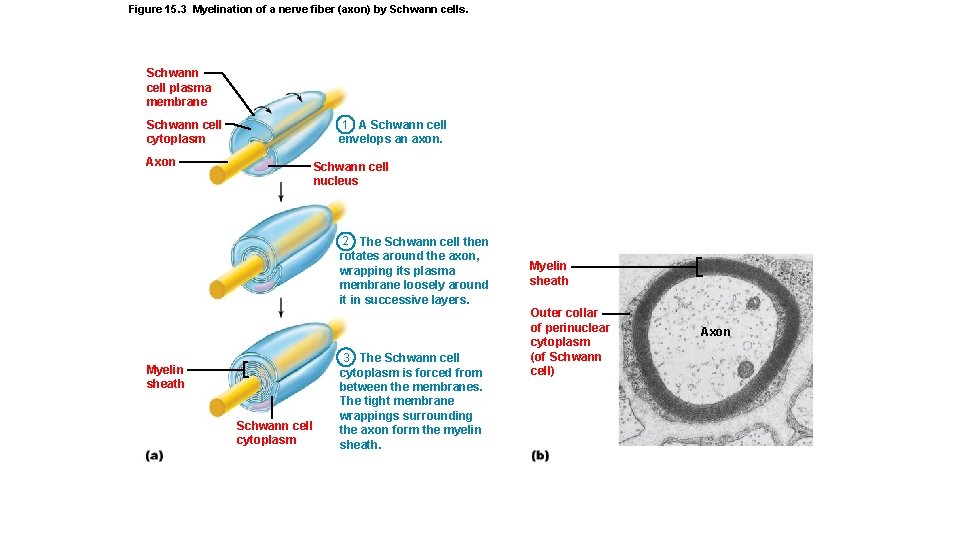
Figure 15. 3 Myelination of a nerve fiber (axon) by Schwann cells. Schwann cell plasma membrane Schwann cell cytoplasm 1 A Schwann cell envelops an axon. Axon Schwann cell nucleus 2 The Schwann cell then rotates around the axon, wrapping its plasma membrane loosely around it in successive layers. Myelin sheath Schwann cell cytoplasm 3 The Schwann cell cytoplasm is forced from between the membranes. The tight membrane wrappings surrounding the axon form the myelin sheath. Myelin sheath Outer collar of perinuclear cytoplasm (of Schwann cell) Axon
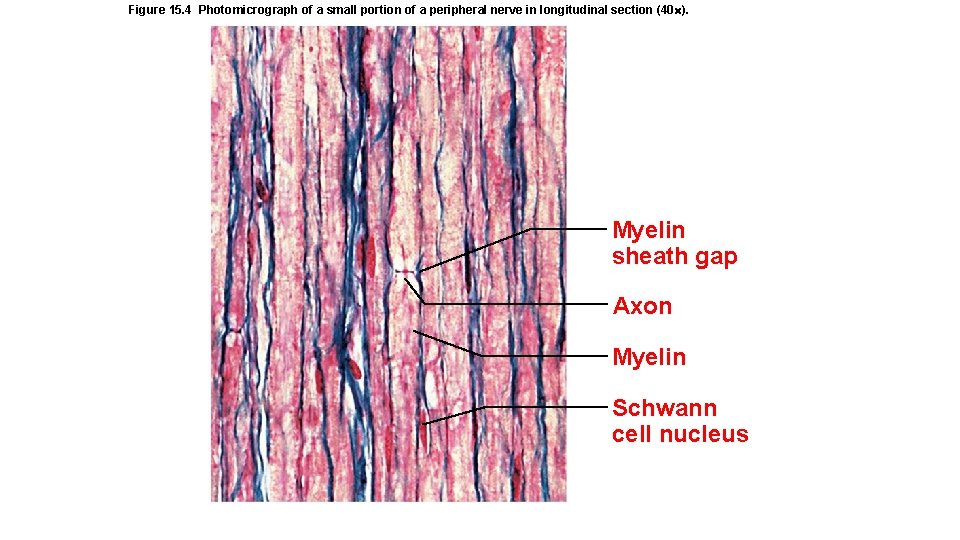
Figure 15. 4 Photomicrograph of a small portion of a peripheral nerve in longitudinal section (40 ). Myelin sheath gap Axon Myelin Schwann cell nucleus
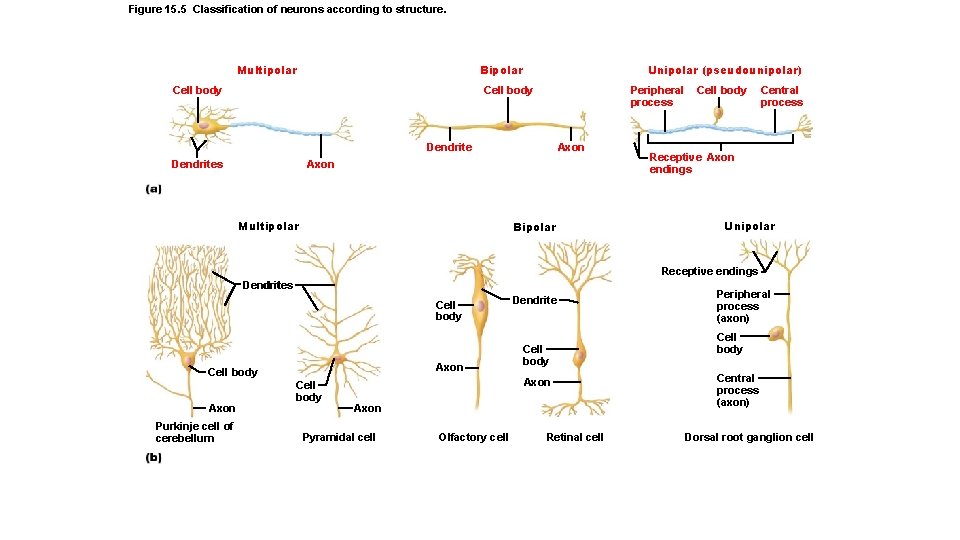
Figure 15. 5 Classification of neurons according to structure. Multipolar Bipolar Cell body Unipolar (pseudounipolar) Peripheral process Cell body Axon Dendrites Axon Multipolar Bipolar Cell body Central process Receptive Axon endings Unipolar Receptive endings Dendrites Cell body Axon Purkinje cell of cerebellum Cell body Dendrite Cell body Axon Pyramidal cell Olfactory cell Retinal cell Peripheral process (axon) Cell body Central process (axon) Dorsal root ganglion cell
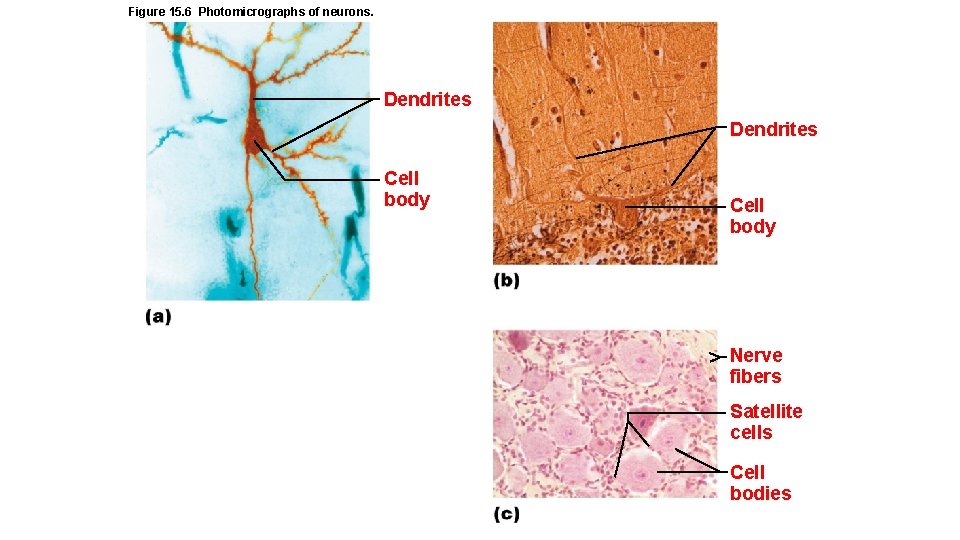
Figure 15. 6 Photomicrographs of neurons. Dendrites Cell body Nerve fibers Satellite cells Cell bodies
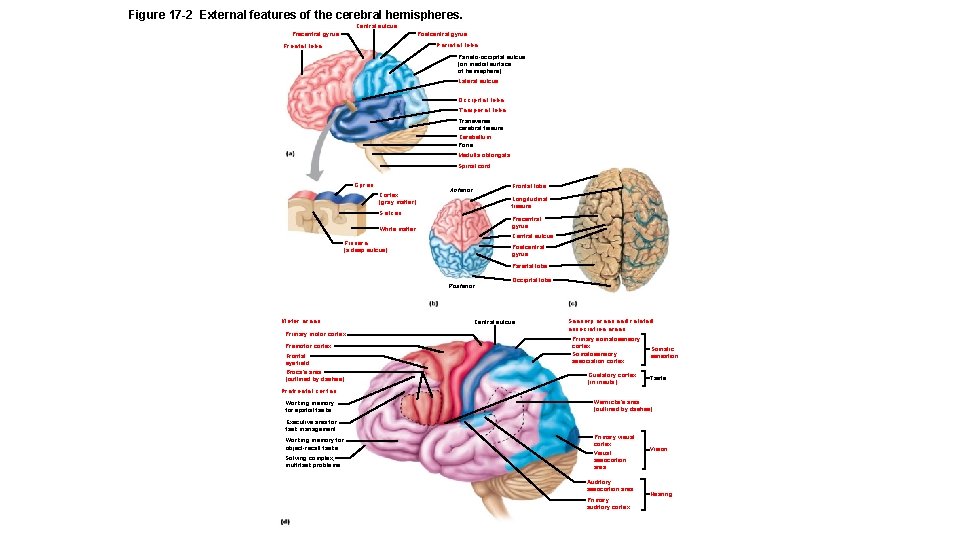
Figure 17 -2 External features of the cerebral hemispheres. Central sulcus Precentral gyrus Postcentral gyrus Parietal lobe Frontal lobe Parieto-occipital sulcus (on medial surface of hemisphere) Lateral sulcus Occipital lobe Temporal lobe Transverse cerebral fissure Cerebellum Pons Medulla oblongata Spinal cord Gyrus Cortex (gray matter) Frontal lobe Anterior Longitudinal fissure Sulcus Precentral gyrus White matter Central sulcus Fissure (a deep sulcus) Postcentral gyrus Parietal lobe Occipital lobe Posterior Motor areas Primary motor cortex Premotor cortex Frontal eye field Broca’s area (outlined by dashes) Central sulcus Sensory areas and related association areas Primary somatosensory cortex Somatosensory association cortex Gustatory cortex (in insula) Somatic sensation Taste Prefrontal cortex Working memory for spatial tasks Wernicke’s area (outlined by dashes) Executive area for task management Working memory for object-recall tasks Solving complex, multitask problems Primary visual cortex Visual association area Auditory association area Primary auditory cortex Vision Hearing
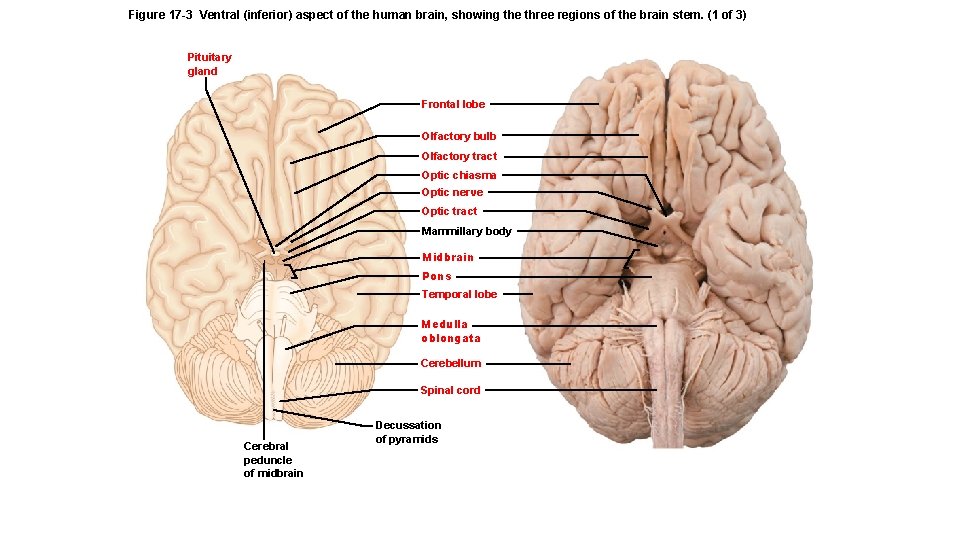
Figure 17 -3 Ventral (inferior) aspect of the human brain, showing the three regions of the brain stem. (1 of 3) Pituitary gland Frontal lobe Olfactory bulb Olfactory tract Optic chiasma Optic nerve Optic tract Mammillary body Midbrain Pons Temporal lobe Medulla oblongata Cerebellum Spinal cord Cerebral peduncle of midbrain Decussation of pyramids
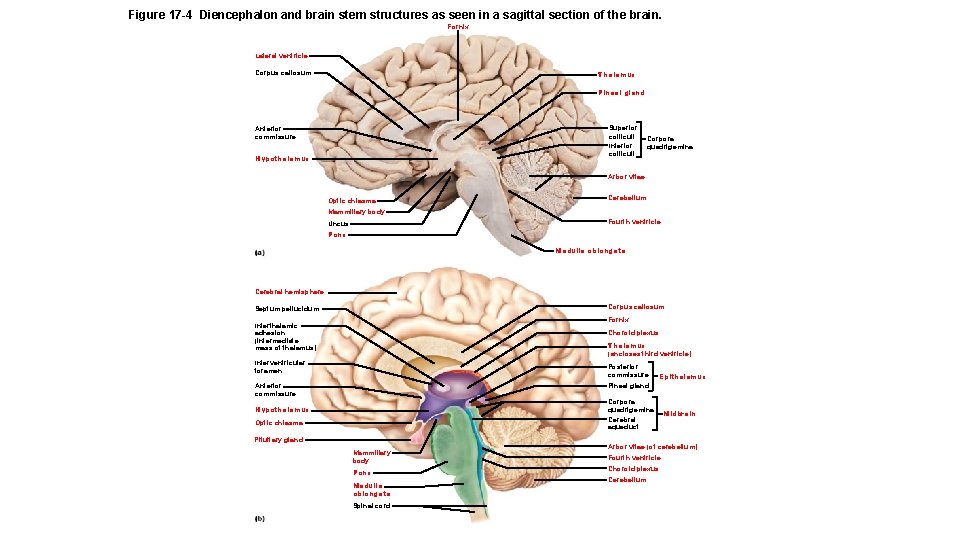
Figure 17 -4 Diencephalon and brain stem structures as seen in a sagittal section of the brain. Fornix Lateral ventricle Corpus callosum Thalamus Pineal gland Superior colliculi Inferior colliculi Anterior commissure Hypothalamus Corpora quadrigemina Arbor vitae Optic chiasma Cerebellum Mammillary body Fourth ventricle Uncus Pons Medulla oblongata Cerebral hemisphere Corpus callosum Septum pellucidum Fornix Interthalamic adhesion (intermediate mass of thalamus) Choroid plexus Thalamus (encloses third ventricle) Interventricular foramen Posterior commissure Epithalamus Pineal gland Anterior commissure Corpora quadrigemina Cerebral aqueduct Hypothalamus Optic chiasma Pituitary gland Mammillary body Pons Medulla oblongata Spinal cord Midbrain Arbor vitae (of cerebellum) Fourth ventricle Choroid plexus Cerebellum
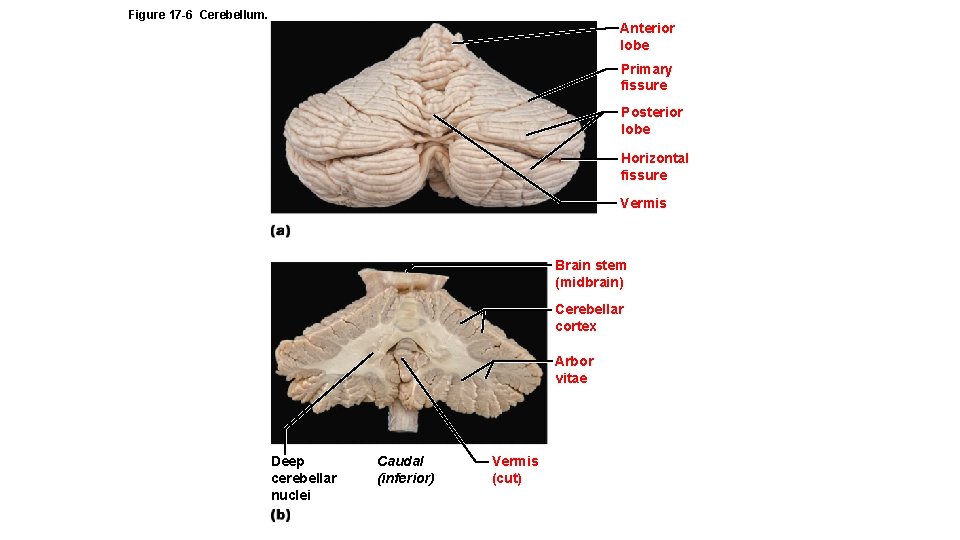
Figure 17 -6 Cerebellum. Anterior lobe Primary fissure Posterior lobe Horizontal fissure Vermis Brain stem (midbrain) Cerebellar cortex Arbor vitae Deep cerebellar nuclei Caudal (inferior) Vermis (cut)
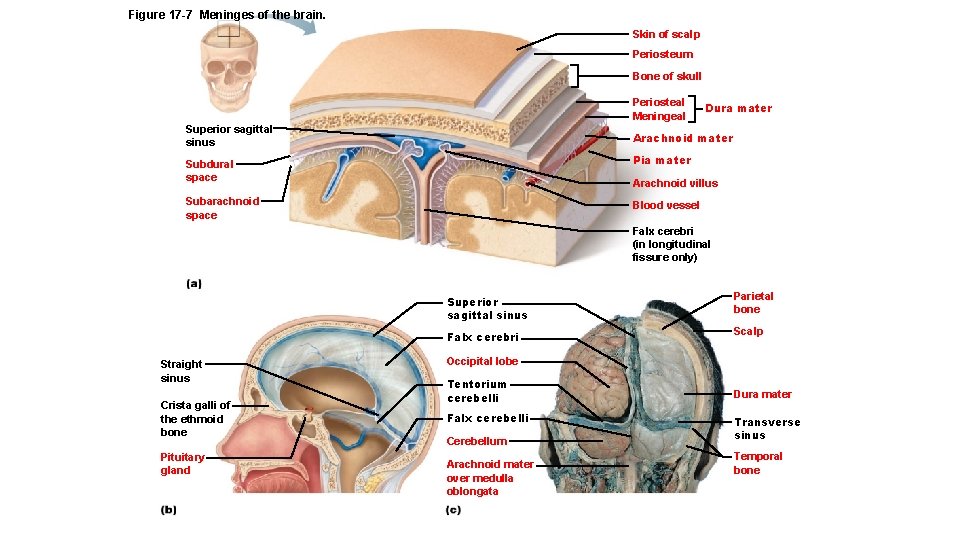
Figure 17 -7 Meninges of the brain. Skin of scalp Periosteum Bone of skull Periosteal Meningeal Superior sagittal sinus Dura mater Arachnoid mater Pia mater Subdural space Arachnoid villus Subarachnoid space Blood vessel Falx cerebri (in longitudinal fissure only) Straight sinus Crista galli of the ethmoid bone Pituitary gland Superior sagittal sinus Parietal bone Falx cerebri Scalp Occipital lobe Tentorium cerebelli Falx cerebelli Cerebellum Arachnoid mater over medulla oblongata Dura mater Transverse sinus Temporal bone
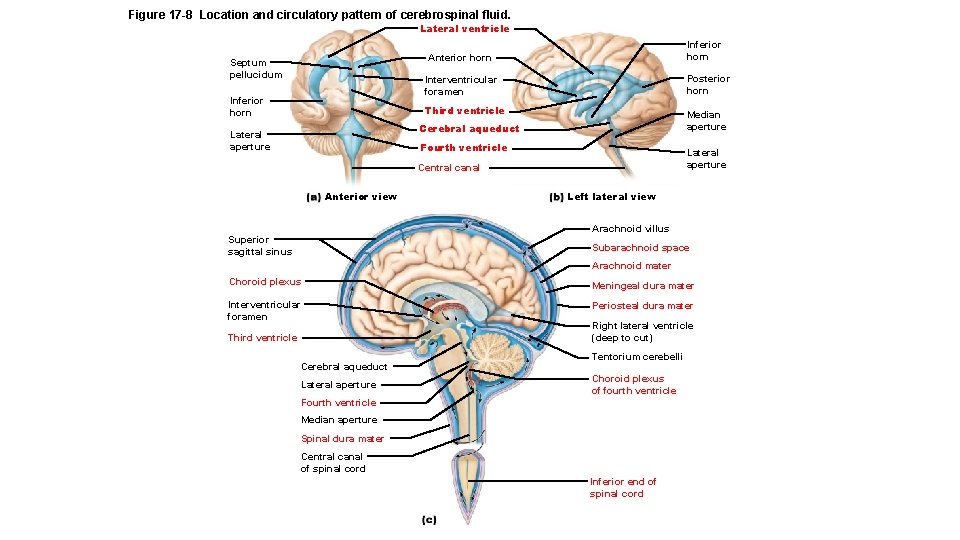
Figure 17 -8 Location and circulatory pattern of cerebrospinal fluid. Lateral ventricle Inferior horn Anterior horn Septum pellucidum Posterior horn Interventricular foramen Inferior horn Third ventricle Median aperture Cerebral aqueduct Lateral aperture Fourth ventricle Lateral aperture Central canal Anterior view Left lateral view Arachnoid villus Superior sagittal sinus Subarachnoid space Arachnoid mater Choroid plexus Meningeal dura mater Interventricular foramen Periosteal dura mater Third ventricle Cerebral aqueduct Lateral aperture Right lateral ventricle (deep to cut) Tentorium cerebelli Choroid plexus of fourth ventricle Fourth ventricle Median aperture Spinal dura mater Central canal of spinal cord Inferior end of spinal cord
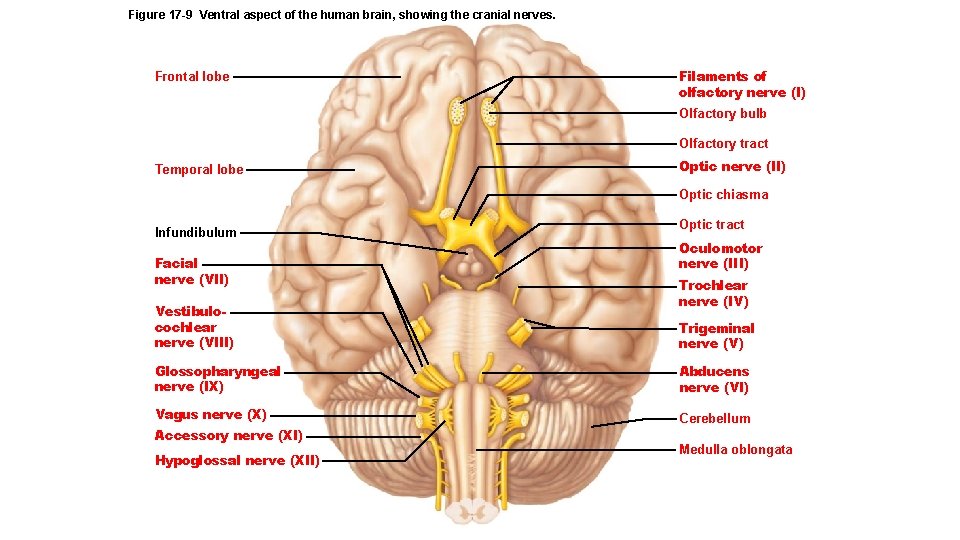
Figure 17 -9 Ventral aspect of the human brain, showing the cranial nerves. Frontal lobe Filaments of olfactory nerve (I) Olfactory bulb Olfactory tract Temporal lobe Optic nerve (II) Optic chiasma Infundibulum Facial nerve (VII) Vestibulocochlear nerve (VIII) Optic tract Oculomotor nerve (III) Trochlear nerve (IV) Trigeminal nerve (V) Glossopharyngeal nerve (IX) Abducens nerve (VI) Vagus nerve (X) Cerebellum Accessory nerve (XI) Hypoglossal nerve (XII) Medulla oblongata
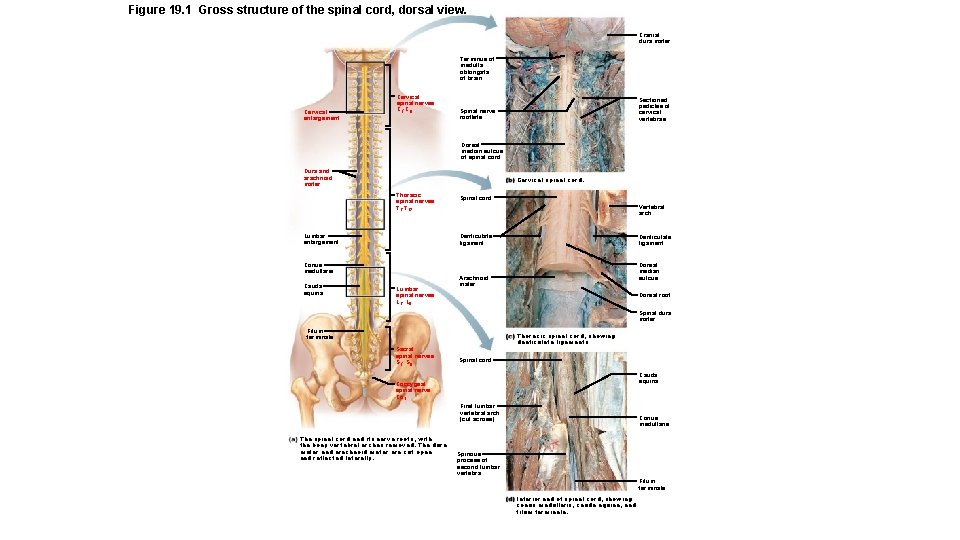
Figure 19. 1 Gross structure of the spinal cord, dorsal view. Cranial dura mater Terminus of medulla oblongata of brain Cervical enlargement Cervical spinal nerves C 1 -C 8 Sectioned pedicles of cervical vertebrae Spinal nerve rootlets Dorsal median sulcus of spinal cord Dura and arachnoid mater Cervical spinal cord. Thoracic spinal nerves T 1 -T 12 Lumbar enlargement Vertebral arch Denticulate ligament Conus medullaris Cauda equina Spinal cord Lumbar spinal nerves L 1 - L 5 Denticulate ligament Dorsal median sulcus Arachnoid mater Dorsal root Spinal dura mater Filum terminale Sacral spinal nerves S 1 - S 5 Thoracic spinal cord, showing denticulate ligaments Spinal cord Cauda equina Coccygeal spinal nerve Co 1 First lumbar vertebral arch (cut across) The spinal cord and its nerve roots, with the bony vertebral arches removed. The dura mater and arachnoid mater are cut open and reflected laterally. Conus medullaris Spinous process of second lumbar vertebra Filum terminale Inferior end of spinal cord, showing conus medullaris, cauda equina, and filum terminale.
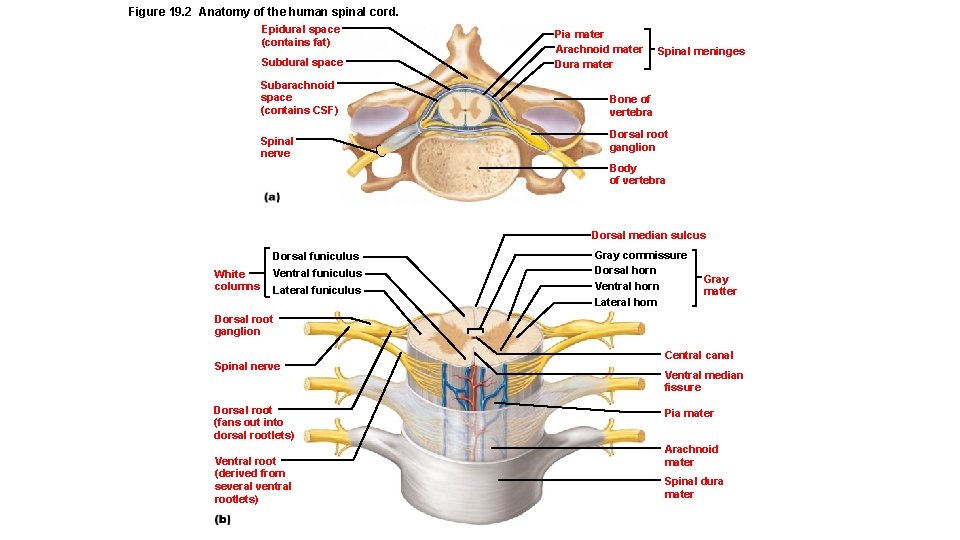
Figure 19. 2 Anatomy of the human spinal cord. Epidural space (contains fat) Subdural space Subarachnoid space (contains CSF) Spinal nerve Pia mater Arachnoid mater Dura mater Spinal meninges Bone of vertebra Dorsal root ganglion Body of vertebra Dorsal median sulcus Dorsal funiculus White columns Ventral funiculus Lateral funiculus Gray commissure Dorsal horn Ventral horn Lateral horn Gray matter Dorsal root ganglion Spinal nerve Dorsal root (fans out into dorsal rootlets) Ventral root (derived from several ventral rootlets) Central canal Ventral median fissure Pia mater Arachnoid mater Spinal dura mater
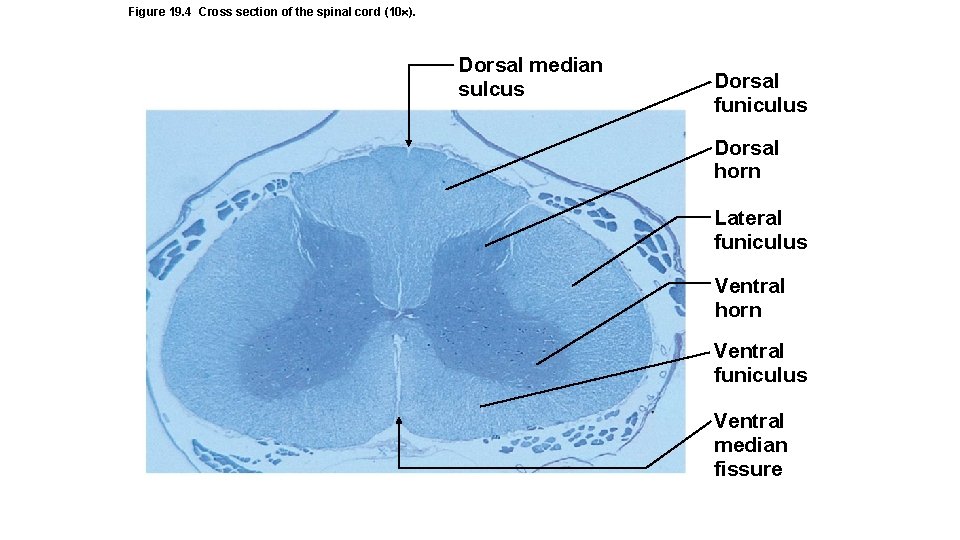
Figure 19. 4 Cross section of the spinal cord (10 ). Dorsal median sulcus Dorsal funiculus Dorsal horn Lateral funiculus Ventral horn Ventral funiculus Ventral median fissure
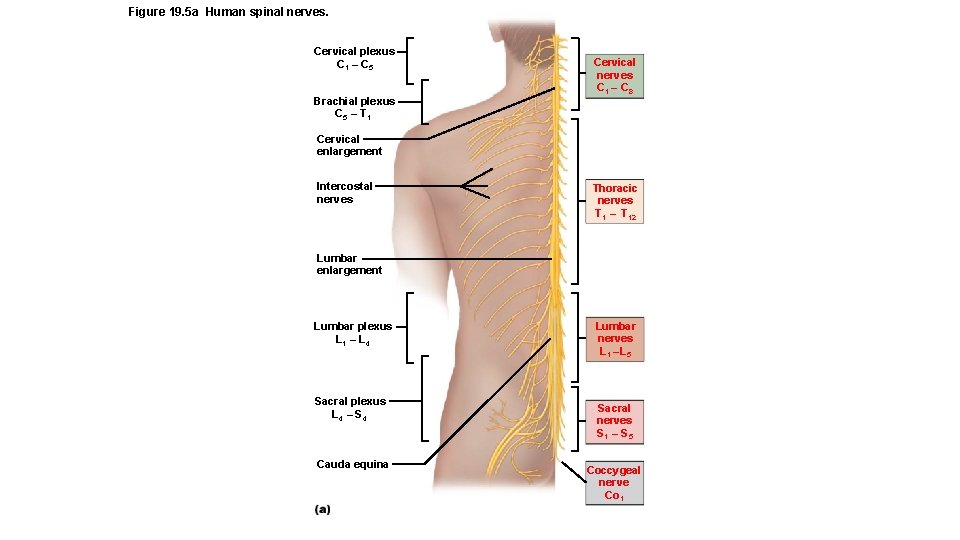
Figure 19. 5 a Human spinal nerves. Cervical plexus C 1 – C 5 Brachial plexus C 5 – T 1 Cervical nerves C 1 – C 8 Cervical enlargement Intercostal nerves Thoracic nerves T 1 – T 12 Lumbar enlargement Lumbar plexus L 1 – L 4 Sacral plexus L 4 – S 4 Cauda equina Lumbar nerves L 1 – L 5 Sacral nerves S 1 – S 5 Coccygeal nerve Co 1
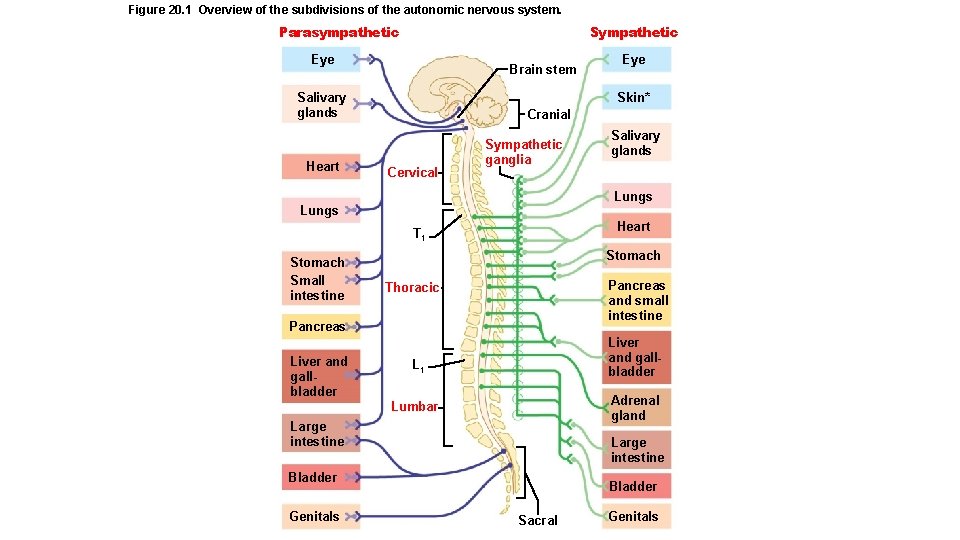
Figure 20. 1 Overview of the subdivisions of the autonomic nervous system. Parasympathetic Sympathetic Eye Brain stem Salivary glands Heart Skin* Cranial Cervical Sympathetic ganglia Heart T 1 Stomach Pancreas and small intestine Thoracic Pancreas Liver and gallbladder L 1 Adrenal gland Lumbar Large intestine Bladder Genitals Salivary glands Lungs Stomach Small intestine Eye Bladder Sacral Genitals
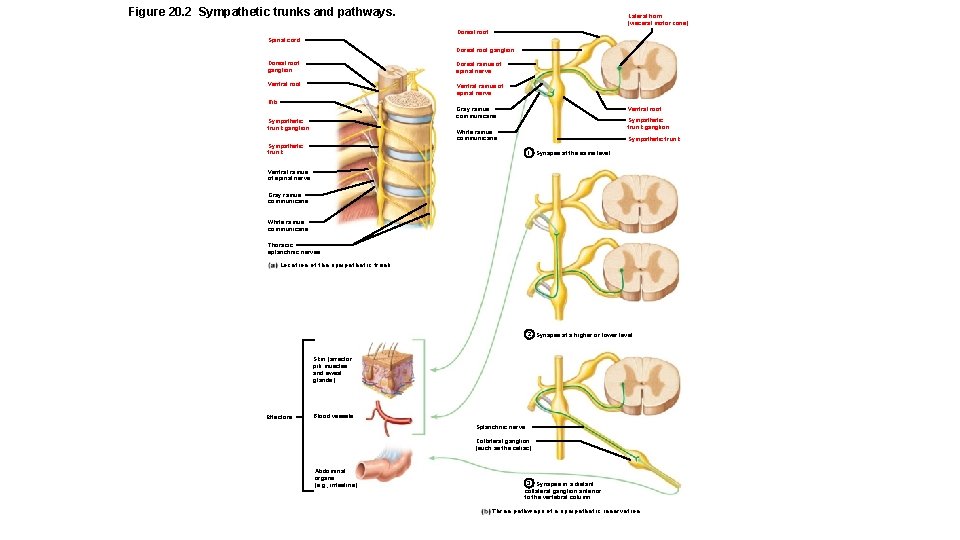
Figure 20. 2 Sympathetic trunks and pathways. Lateral horn (visceral motor zone) Dorsal root Spinal cord Dorsal root ganglion Dorsal ramus of spinal nerve Ventral root Ventral ramus of spinal nerve Rib Ventral root Gray ramus communicans Sympathetic trunk ganglion White ramus communicans Sympathetic trunk 1 Synapse at the same level Ventral ramus of spinal nerve Gray ramus communicans White ramus communicans Thoracic splanchnic nerves Location of the sympathetic trunk 2 Synapse at a higher or lower level Skin (arrector pili muscles and sweat glands) Effectors Blood vessels Splanchnic nerve Collateral ganglion (such as the celiac) Abdominal organs (e. g. , intestine) 3 Synapse in a distant collateral ganglion anterior to the vertebral column Three pathways of a sympathetic innervation
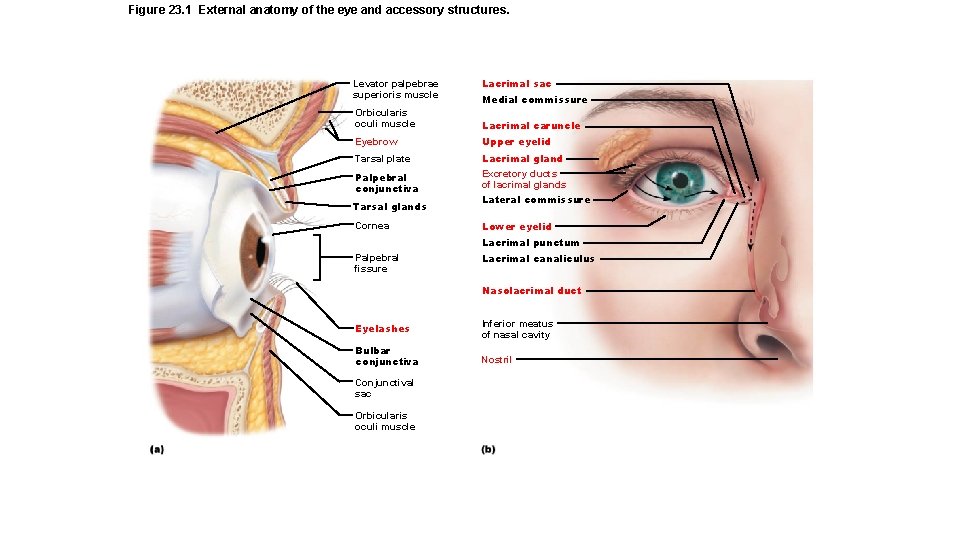
Figure 23. 1 External anatomy of the eye and accessory structures. Levator palpebrae superioris muscle Lacrimal sac Medial commissure Orbicularis oculi muscle Lacrimal caruncle Eyebrow Upper eyelid Tarsal plate Lacrimal gland Palpebral conjunctiva Excretory ducts of lacrimal glands Tarsal glands Cornea Lateral commissure Lower eyelid Lacrimal punctum Palpebral fissure Lacrimal canaliculus Nasolacrimal duct Eyelashes Inferior meatus of nasal cavity Bulbar conjunctiva Nostril Conjunctival sac Orbicularis oculi muscle
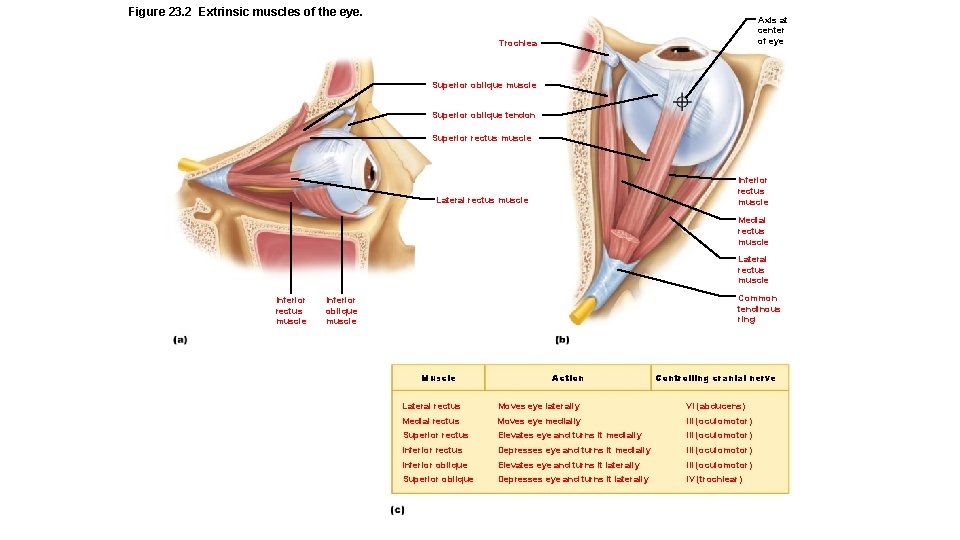
Figure 23. 2 Extrinsic muscles of the eye. Axis at center of eye Trochlea Superior oblique muscle Superior oblique tendon Superior rectus muscle Inferior rectus muscle Lateral rectus muscle Medial rectus muscle Lateral rectus muscle Inferior rectus muscle Common tendinous ring Inferior oblique muscle Muscle Action Controlling cranial nerve Lateral rectus Moves eye laterally VI (abducens) Medial rectus Moves eye medially III (oculomotor) Superior rectus Elevates eye and turns it medially III (oculomotor) Inferior rectus Depresses eye and turns it medially III (oculomotor) Inferior oblique Elevates eye and turns it laterally III (oculomotor) Superior oblique Depresses eye and turns it laterally IV (trochlear)
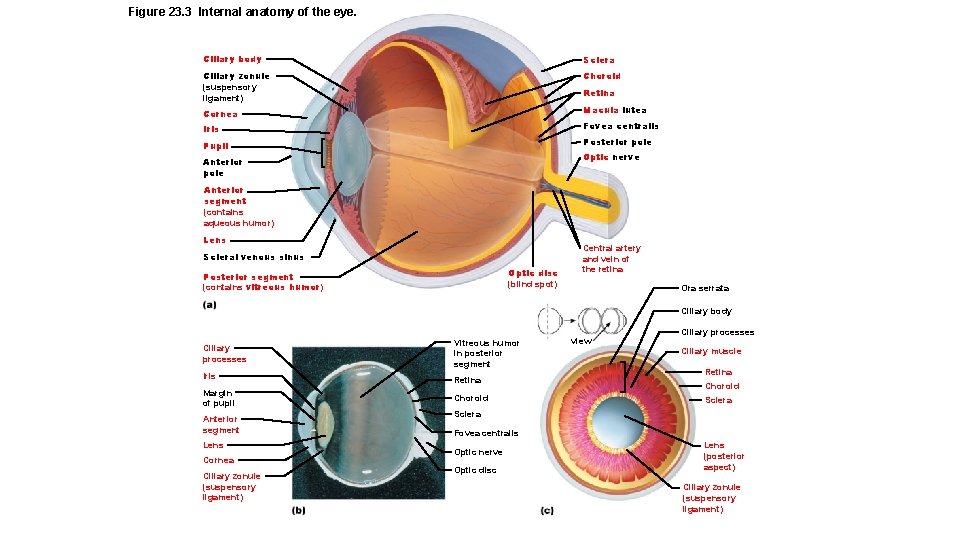
Figure 23. 3 Internal anatomy of the eye. Ciliary body Sclera Ciliary zonule (suspensory ligament) Choroid Retina Macula lutea Cornea Iris Fovea centralis Pupil Posterior pole Optic nerve Anterior pole Anterior segment (contains aqueous humor) Lens Scleral venous sinus Optic disc (blind spot) Posterior segment (contains vitreous humor) Central artery and vein of the retina Ora serrata Ciliary body Ciliary processes Vitreous humor in posterior segment Iris Retina Margin of pupil Choroid Anterior segment Lens Cornea Ciliary zonule (suspensory ligament) view Ciliary processes Ciliary muscle Retina Choroid Sclera Fovea centralis Optic nerve Optic disc Lens (posterior aspect) Ciliary zonule (suspensory ligament)
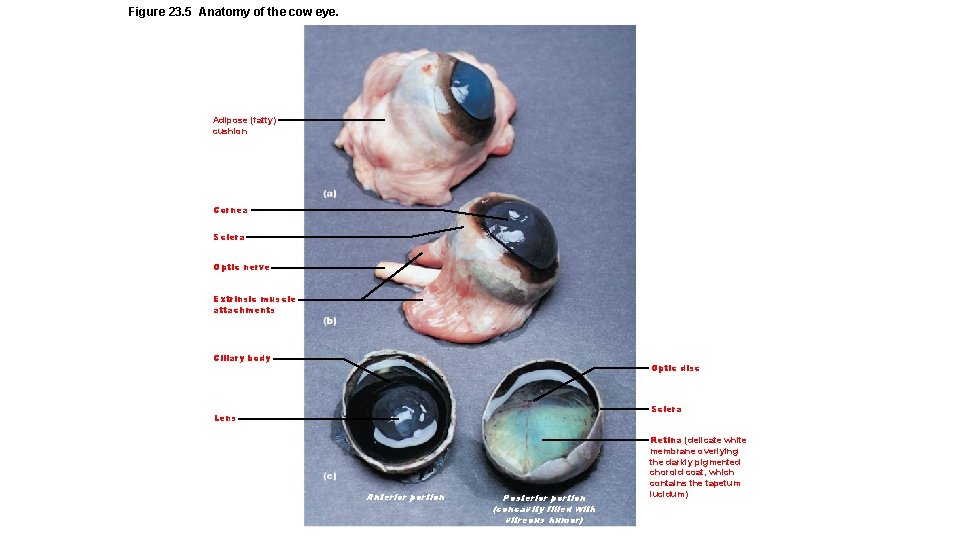
Figure 23. 5 Anatomy of the cow eye. Adipose (fatty) cushion Cornea Sclera Optic nerve Extrinsic muscle attachments Ciliary body Optic disc Sclera Lens Anterior portion Posterior portion (concavity filled with vitreous humor) Retina (delicate white membrane overlying the darkly pigmented choroid coat, which contains the tapetum lucidum)
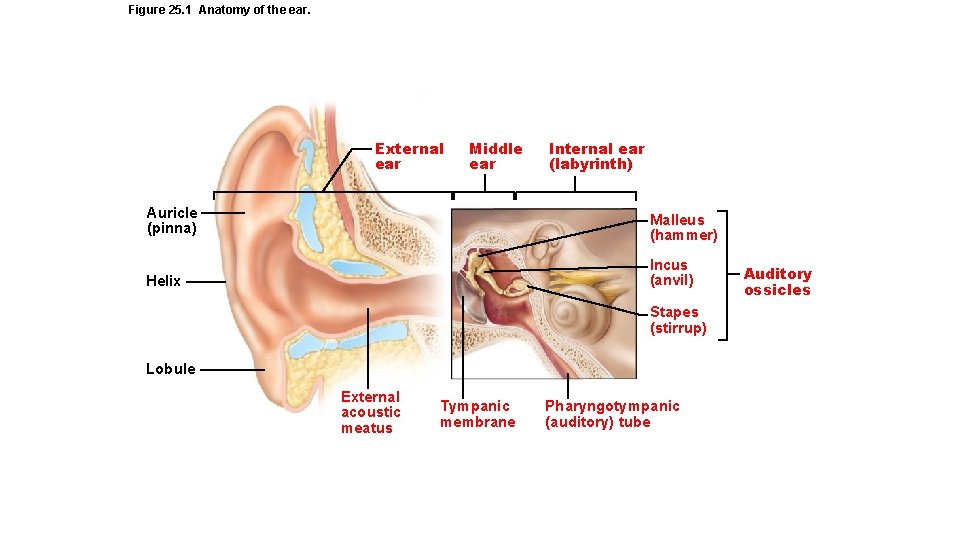
Figure 25. 1 Anatomy of the ear. External ear Middle ear Internal ear (labyrinth) Auricle (pinna) Malleus (hammer) Helix Incus (anvil) Stapes (stirrup) Lobule External acoustic meatus Tympanic membrane Pharyngotympanic (auditory) tube Auditory ossicles
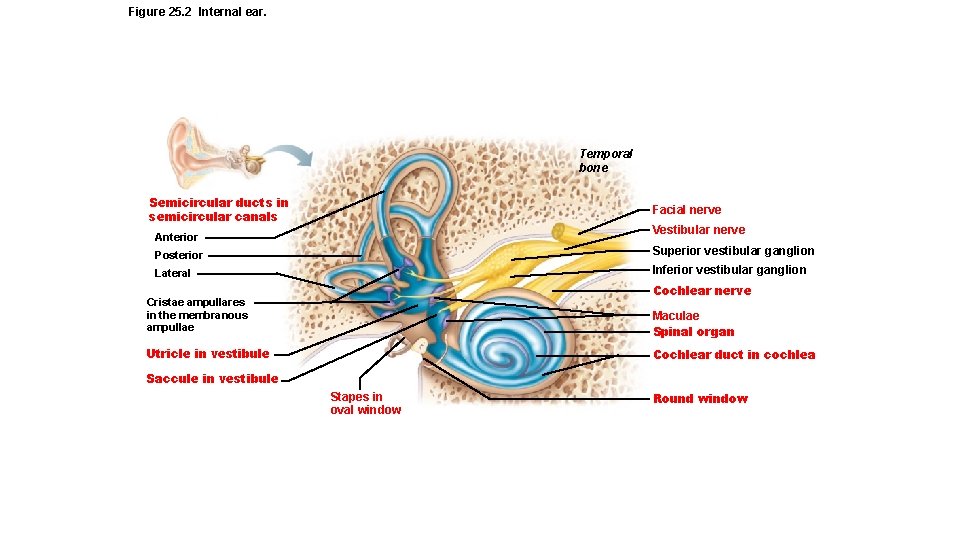
Figure 25. 2 Internal ear. Temporal bone Semicircular ducts in semicircular canals Facial nerve Vestibular nerve Anterior Posterior Superior vestibular ganglion Lateral Inferior vestibular ganglion Cochlear nerve Cristae ampullares in the membranous ampullae Maculae Spinal organ Utricle in vestibule Cochlear duct in cochlea Saccule in vestibule Stapes in oval window Round window
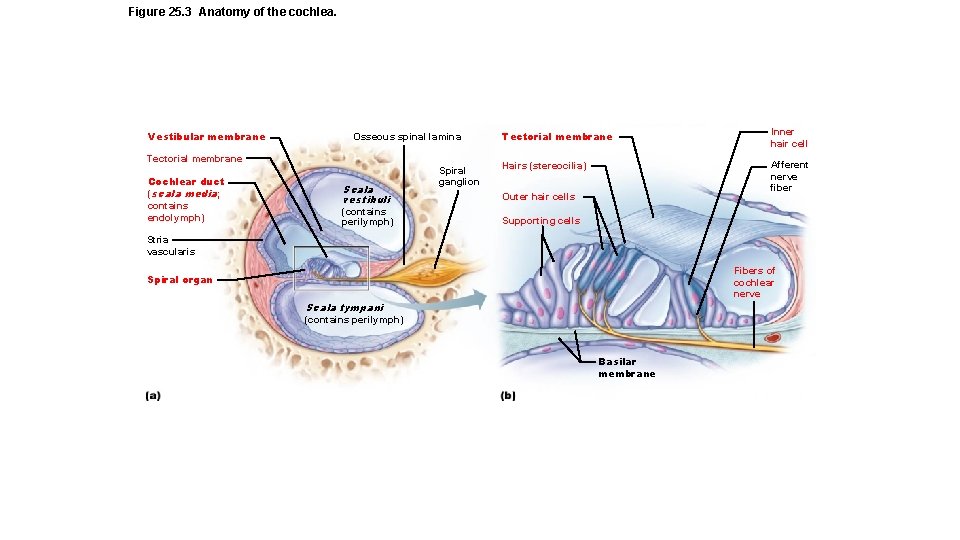
Figure 25. 3 Anatomy of the cochlea. Vestibular membrane Osseous spinal lamina Tectorial membrane Cochlear duct (scala media; contains endolymph) Scala vestibuli (contains perilymph) Spiral ganglion Tectorial membrane Inner hair cell Hairs (stereocilia) Afferent nerve fiber Outer hair cells Supporting cells Stria vascularis Fibers of cochlear nerve Spiral organ Scala tympani (contains perilymph) Basilar membrane
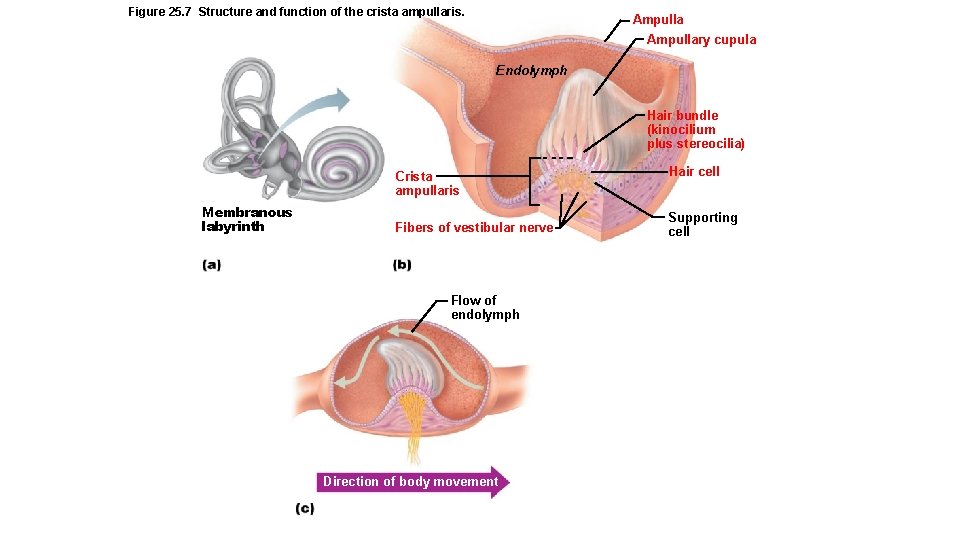
Figure 25. 7 Structure and function of the crista ampullaris. Ampullary cupula Endolymph Hair bundle (kinocilium plus stereocilia) Crista ampullaris Membranous labyrinth Fibers of vestibular nerve Flow of endolymph Direction of body movement Hair cell Supporting cell