
Figure 10 1 American Court System Back US
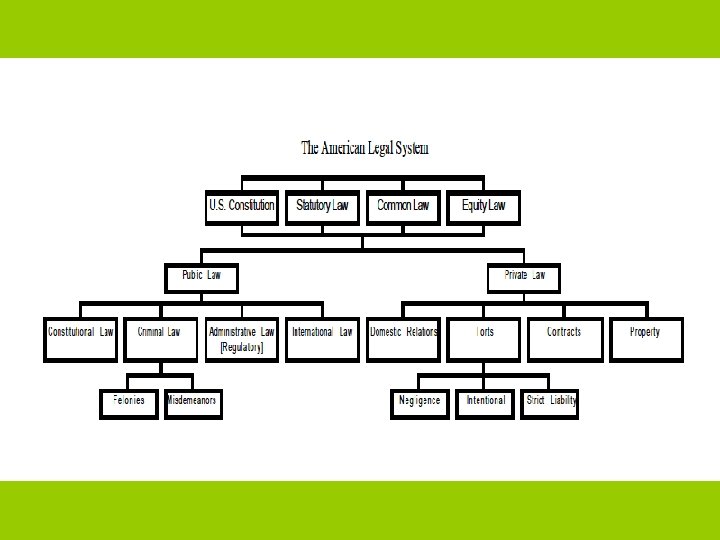

Figure 10. 1 - American Court System Back
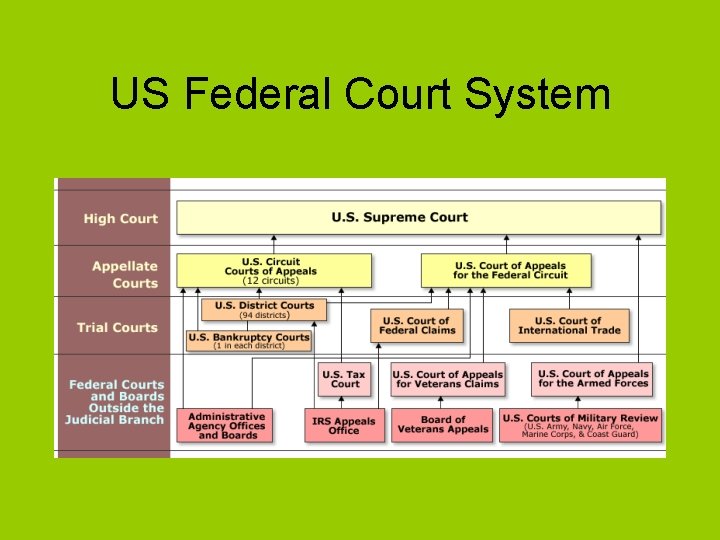
US Federal Court System
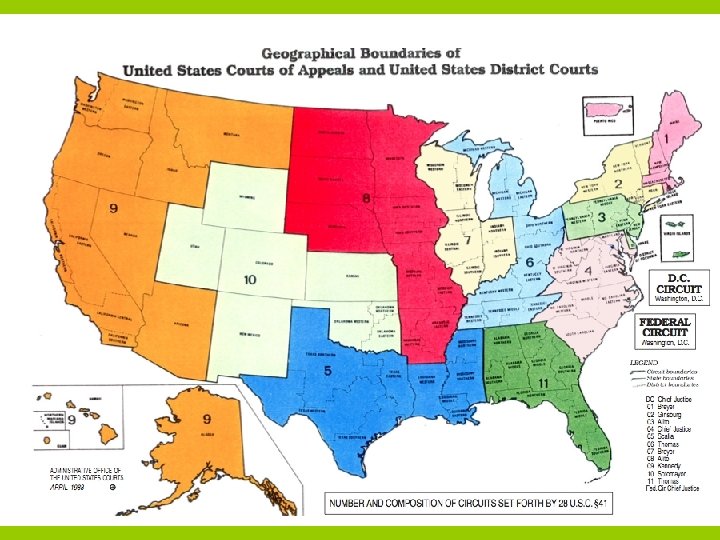
Judicial Selection Highly Political- Appointed by the President and approved the Senate. – i) District and Circuit Appointments » (1) Senatorial Courtesy – ii) Supreme Court » (1) President’s selection through Attorney’s General’s office and Party.
Judicial Selection Nomination Process- Highly Partisan (used for all federal Judicial nominations) – i)Justice Department and Senators advance names of candidates to President • (1) Investigation and background check • (a) Reagan- extreme “litmus test” of conservative ideology
Judicial Selection President limits selections and makes decision – (1) Nomination is sent to Senate Judiciary Committee – (2) ABA rates the candidate. – (3) Candidate makes “good will” visits to members of the Judiciary Committee – (4) Interest Groups take a position on candidate, lobbies senate and public. – (5) Senate Judiciary Committee » (a) Holds hearing on candidate » (b) Holds a vote on nominee (Recommend or Disapprove) – (6) Senate holds a floor vote on nominee.
Judicial Selection Power in process Senate Judiciary Committee Chairman • (i) May refuse to schedule a vote (personal veto) – 1. Senator Eastland- Mississippi- Chairman for 21 years. Actively kept African Americans off the Federal bench • (ii) Home state Senator may veto selection (Blue Slip) • (iii) Interest Groups – 1. Bork- National Television Campaign – 2. Thomas- NAACP campaign against approval
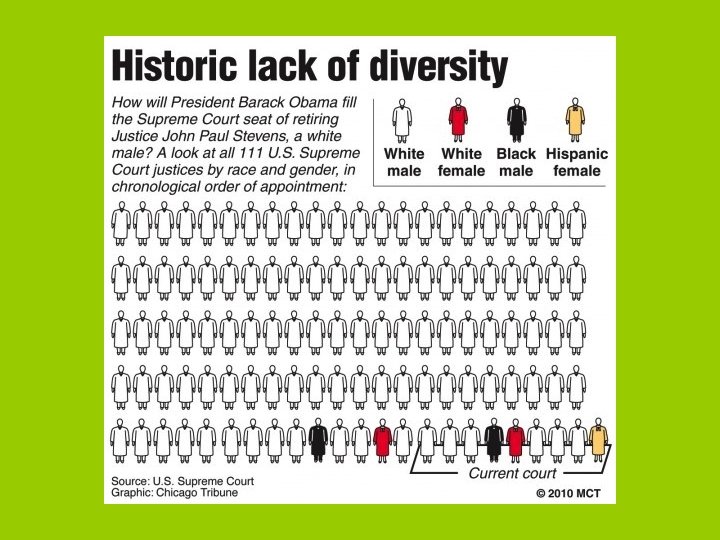
Judicial Selection Criteria for Judicial Selection – – a) Ideology b) Competence c) Political Patronage “Party Pie” d) Reward • (1) CA Governor Earl Warren was given Chief Justice for “delivering” CA during election – e) Religion • (1) Catholics are against Abortion- Scalia • (2) Jewish “Seat” on the Court- Brandeis, Frankfurter, Goldburg, Fortus, Ginsburg – f) Race, Gender, Ethnicity • i) Black “Seat “ Thurgood Marshall –Clarence Thomas • ii) Woman’s “Seat” Sandra Day O’ Conner, Ruth Bader Ginsburg
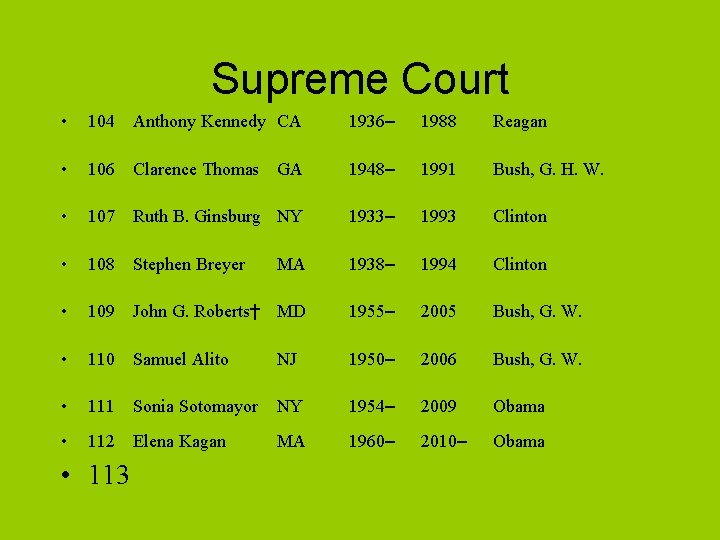
Supreme Court • 104 Anthony Kennedy CA 1936– 1988 Reagan • 106 Clarence Thomas GA 1948– 1991 Bush, G. H. W. • 107 Ruth B. Ginsburg NY 1933– 1993 Clinton • 108 Stephen Breyer MA 1938– 1994 Clinton • 109 John G. Roberts† MD 1955– 2005 Bush, G. W. • 110 Samuel Alito NJ 1950– 2006 Bush, G. W. • 111 Sonia Sotomayor NY 1954– 2009 Obama • 112 Elena Kagan MA 1960– 2010– Obama • 113
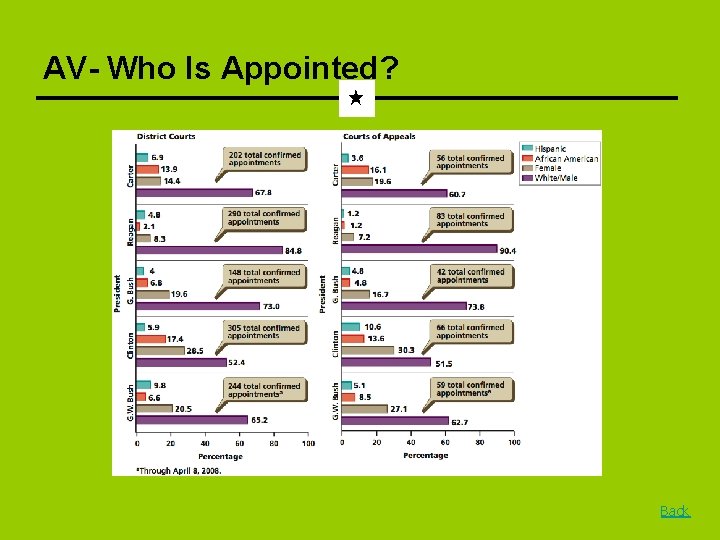
AV- Who Is Appointed? Back
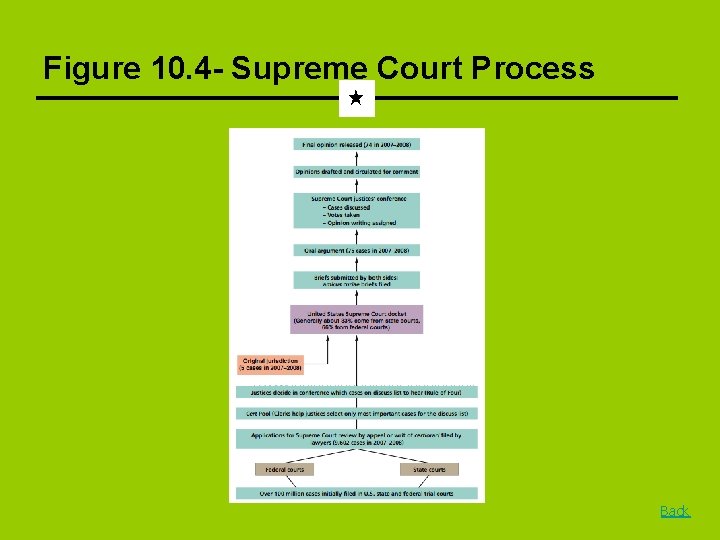
Figure 10. 4 - Supreme Court Process Back
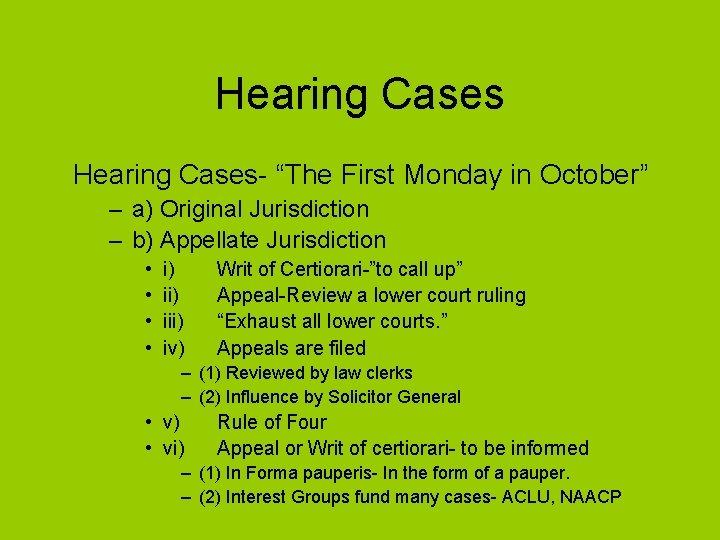
Hearing Cases- “The First Monday in October” – a) Original Jurisdiction – b) Appellate Jurisdiction • • i) iii) iv) Writ of Certiorari-”to call up” Appeal-Review a lower court ruling “Exhaust all lower courts. ” Appeals are filed – (1) Reviewed by law clerks – (2) Influence by Solicitor General • v) • vi) Rule of Four Appeal or Writ of certiorari- to be informed – (1) In Forma pauperis- In the form of a pauper. – (2) Interest Groups fund many cases- ACLU, NAACP
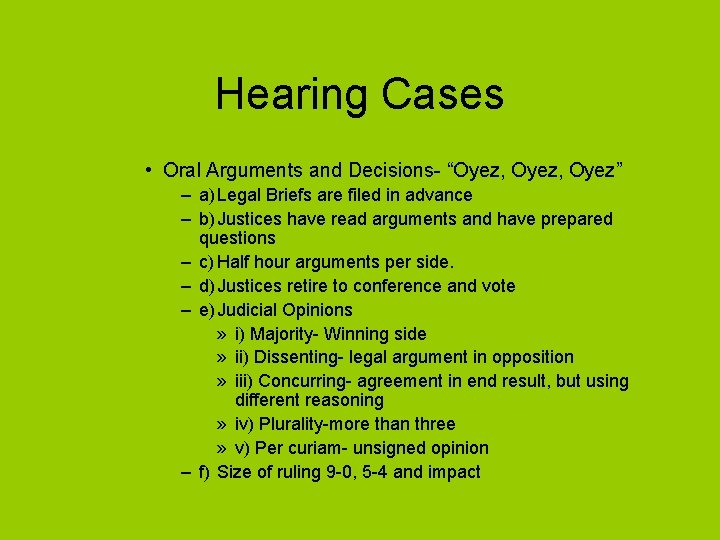
Hearing Cases • Oral Arguments and Decisions- “Oyez, Oyez” – a) Legal Briefs are filed in advance – b) Justices have read arguments and have prepared questions – c) Half hour arguments per side. – d) Justices retire to conference and vote – e) Judicial Opinions » i) Majority- Winning side » ii) Dissenting- legal argument in opposition » iii) Concurring- agreement in end result, but using different reasoning » iv) Plurality-more than three » v) Per curiam- unsigned opinion – f) Size of ruling 9 -0, 5 -4 and impact
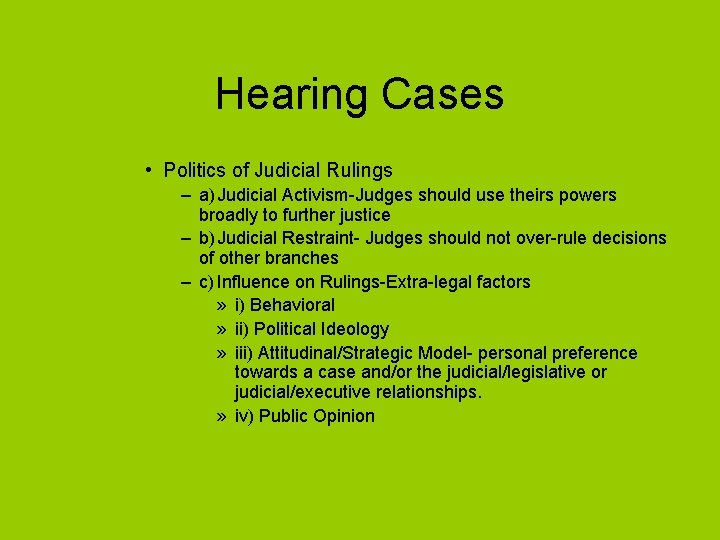
Hearing Cases • Politics of Judicial Rulings – a) Judicial Activism-Judges should use theirs powers broadly to further justice – b) Judicial Restraint- Judges should not over-rule decisions of other branches – c) Influence on Rulings-Extra-legal factors » i) Behavioral » ii) Political Ideology » iii) Attitudinal/Strategic Model- personal preference towards a case and/or the judicial/legislative or judicial/executive relationships. » iv) Public Opinion
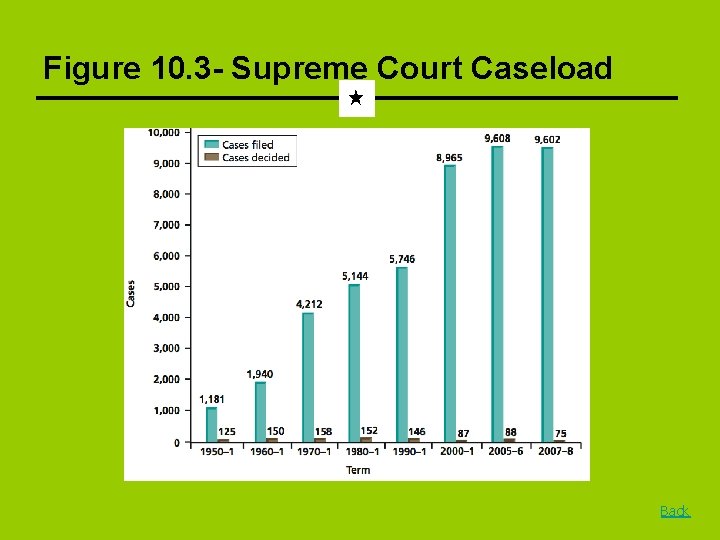
Figure 10. 3 - Supreme Court Caseload Back
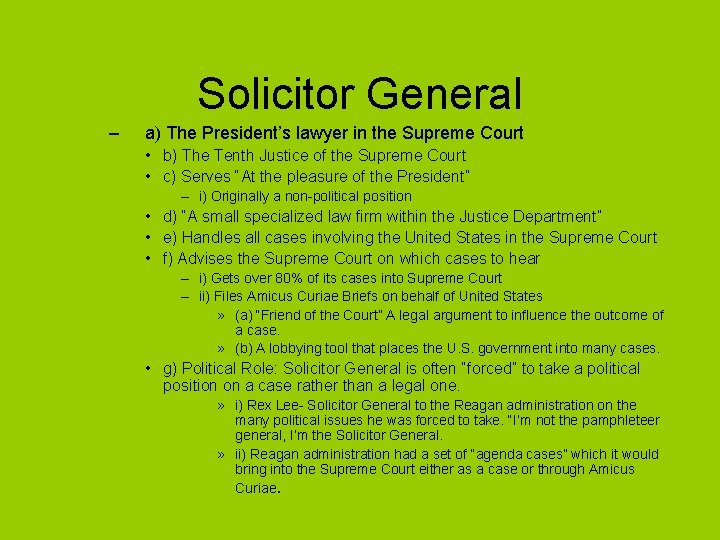
Solicitor General – a) The President’s lawyer in the Supreme Court • b) The Tenth Justice of the Supreme Court • c) Serves “At the pleasure of the President” – i) Originally a non-political position • d) “A small specialized law firm within the Justice Department” • e) Handles all cases involving the United States in the Supreme Court • f) Advises the Supreme Court on which cases to hear – i) Gets over 80% of its cases into Supreme Court – ii) Files Amicus Curiae Briefs on behalf of United States » (a) “Friend of the Court” A legal argument to influence the outcome of a case. » (b) A lobbying tool that places the U. S. government into many cases. • g) Political Role: Solicitor General is often “forced” to take a political position on a case rather than a legal one. » i) Rex Lee- Solicitor General to the Reagan administration on the many political issues he was forced to take. “I’m not the pamphleteer general, I’m the Solicitor General. » ii) Reagan administration had a set of “agenda cases” which it would bring into the Supreme Court either as a case or through Amicus Curiae.
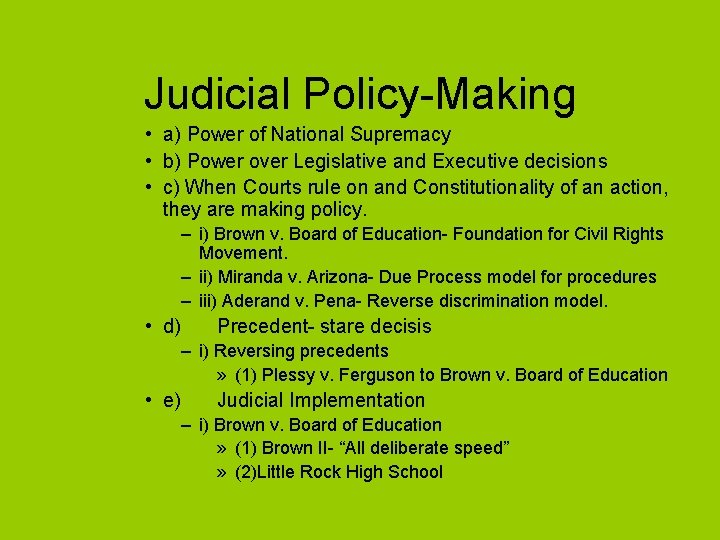
Judicial Policy-Making • a) Power of National Supremacy • b) Power over Legislative and Executive decisions • c) When Courts rule on and Constitutionality of an action, they are making policy. – i) Brown v. Board of Education- Foundation for Civil Rights Movement. – ii) Miranda v. Arizona- Due Process model for procedures – iii) Aderand v. Pena- Reverse discrimination model. • d) Precedent- stare decisis – i) Reversing precedents » (1) Plessy v. Ferguson to Brown v. Board of Education • e) Judicial Implementation – i) Brown v. Board of Education » (1) Brown II- “All deliberate speed” » (2)Little Rock High School
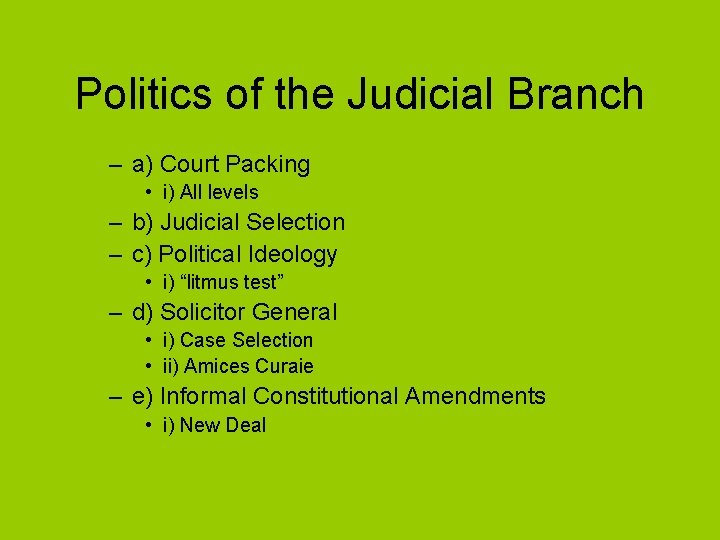
Politics of the Judicial Branch – a) Court Packing • i) All levels – b) Judicial Selection – c) Political Ideology • i) “litmus test” – d) Solicitor General • i) Case Selection • ii) Amices Curaie – e) Informal Constitutional Amendments • i) New Deal
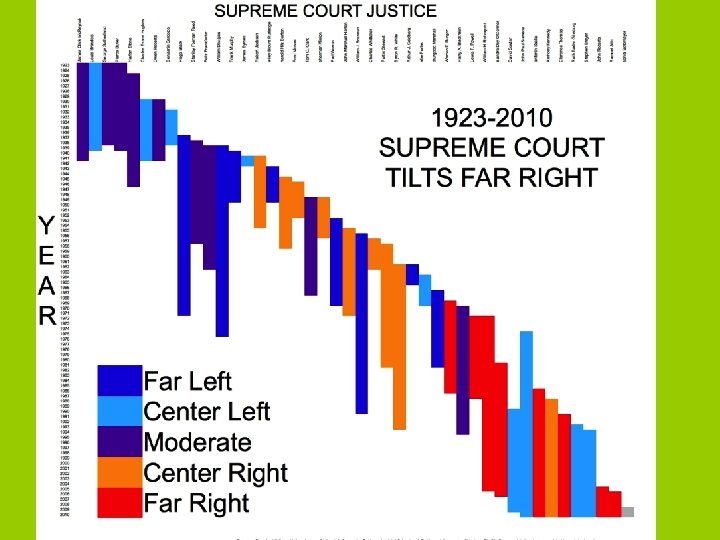
Politics of the Judicial Branch – f) Alliances and Policy-Making • i) Legislative-Judicial Laws made by Congress will be upheld by the Courts • ii) Executive- Judicial Administrative actions made by the Executive Branch will be upheld. • (a) Anti-Trust Law Changed by the “Chicago School” Judges • (b) Political Capital- Changes in the Courts come at “no cost” to the President • (i) Brown v. Board advanced Civil Rights and did not cost the President votes. – g) Judicial Devolution and New Federalism • i) Implementation of new judicial interpretation through the courts. (Conservative Judicial Activism)
Judicial Strategy 1) How to change law in America – a) Single Party wins White House and Senate. – b) Appoint ideological judges to the federal bench. • i) Supreme Court • ii) D. C. Circuit Court • iii) Target Circuit Courts – c) Senate Judiciary Committee approves appointments. – d) Solicitor General “selects” agenda cases to be brought before the court. – e) Executive Branch issues new “rules” in Administrative agencies – f) Ideological Court rules favorably in these cases. • i) New policy is implemented
- Slides: 23