
Figure 1 Total charges for common rate structures

- Slides: 6
Figure 1. Total charges for common rate structures Water Price Structuers 1
Figure 2. Prices for common rate structures Water Price Structuers 2
Figure 3. Seasonal (peak load) rate structure Water Price Structuers 3
Figure 4. Customer-specific rate structures Price phigh plow Qbudget = f(HH size, lot area, etc. ) Quantity Water Price Structuers 4
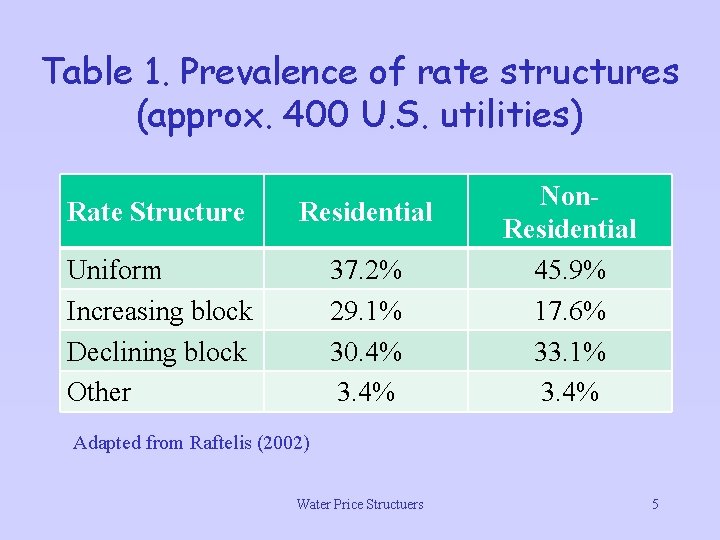
Table 1. Prevalence of rate structures (approx. 400 U. S. utilities) Rate Structure Residential Uniform Increasing block Declining block Other 37. 2% 29. 1% 30. 4% 3. 4% Non. Residential 45. 9% 17. 6% 33. 1% 3. 4% Adapted from Raftelis (2002) Water Price Structuers 5
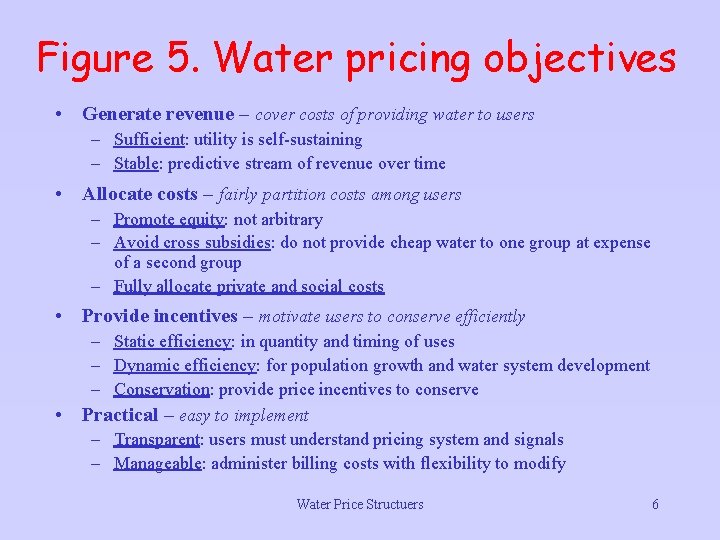
Figure 5. Water pricing objectives • Generate revenue – cover costs of providing water to users – Sufficient: utility is self-sustaining – Stable: predictive stream of revenue over time • Allocate costs – fairly partition costs among users – Promote equity: not arbitrary – Avoid cross subsidies: do not provide cheap water to one group at expense of a second group – Fully allocate private and social costs • Provide incentives – motivate users to conserve efficiently • – Static efficiency: in quantity and timing of uses – Dynamic efficiency: for population growth and water system development – Conservation: provide price incentives to conserve Practical – easy to implement – Transparent: users must understand pricing system and signals – Manageable: administer billing costs with flexibility to modify Water Price Structuers 6