
Figure 1 nbsp Classification of coxsackievirus 16 A
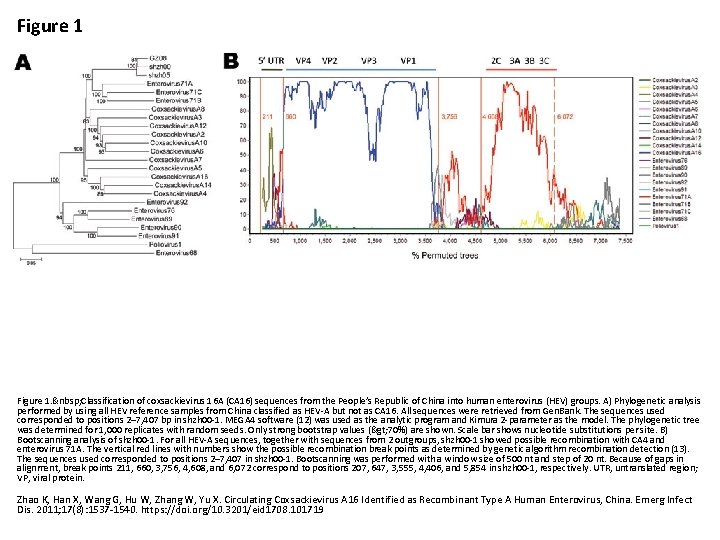
Figure 1. Classification of coxsackievirus 16 A (CA 16) sequences from the People’s Republic of China into human enterovirus (HEV) groups. A) Phylogenetic analysis performed by using all HEV reference samples from China classified as HEV-A but not as CA 16. All sequences were retrieved from Gen. Bank. The sequences used corresponded to positions 2– 7, 407 bp in shzh 00 -1. MEGA 4 software (12) was used as the analytic program and Kimura 2 -parameter as the model. The phylogenetic tree was determined for 1, 000 replicates with random seeds. Only strong bootstrap values (> 70%) are shown. Scale bar shows nucleotide substitutions per site. B) Bootscanning analysis of shzh 00 -1. For all HEV-A sequences, together with sequences from 2 outgroups, shzh 00 -1 showed possible recombination with CA 4 and enterovirus 71 A. The vertical red lines with numbers show the possible recombination break points as determined by genetic algorithm recombination detection (13). The sequences used corresponded to positions 2– 7, 407 in shzh 00 -1. Bootscanning was performed with a window size of 500 nt and step of 20 nt. Because of gaps in alignment, break points 211, 660, 3, 756, 4, 608, and 6, 072 correspond to positions 207, 647, 3, 555, 4, 406, and 5, 854 in shzh 00 -1, respectively. UTR, untranslated region; VP, viral protein. Zhao K, Han X, Wang G, Hu W, Zhang W, Yu X. Circulating Coxsackievirus A 16 Identified as Recombinant Type A Human Enterovirus, China. Emerg Infect Dis. 2011; 17(8): 1537 -1540. https: //doi. org/10. 3201/eid 1708. 101719
- Slides: 1