
Figurative Language Taking Words Beyond Their Literal Meaning
Figurative Language: Taking Words Beyond Their Literal Meaning Time 4 Writing provides these teachers materials to teachers and parents at no cost. More presentations, handouts, interactive online exercises, and video lessons are freely available at Time 4 Writing. com. Consider linking to these resources from your school, teacher, or homeschool educational site. The rules: These materials must maintain the visibility of the Time 4 Writing trademark and copyright information. They can be copied and used for educational purposes. They are not for resale. Want to give us feedback? We'd like to hear your views: info@time 4 writing. com Copyright 2012 www. time 4 writing. com/free-writing-resources Copyright 2012
What is figurative language? • words or expressions, called “figures of speech, ” that have a different intended meaning from their literal interpretation • the opposite of literal language, in which words match their definition Copyright 2012 www. time 4 writing. com/free-writing-resources Copyright 2012
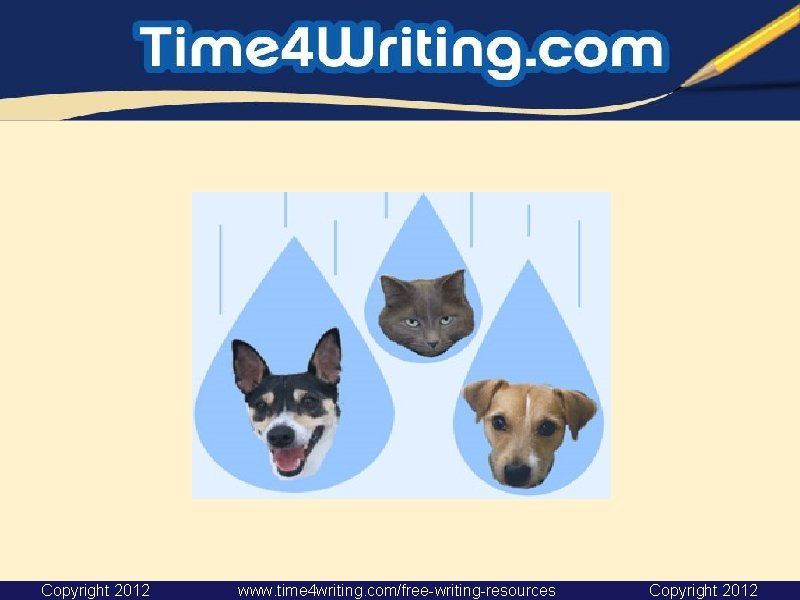
Why use Figurative Language? - to play with a word's literal meaning - to make writing more creative and fun - to allow a reader to visualize a scene For example, the idiom: "It's raining cats and dogs. " Copyright 2012 www. time 4 writing. com/free-writing-resources Copyright 2012
Copyright 2012 www. time 4 writing. com/free-writing-resources Copyright 2012
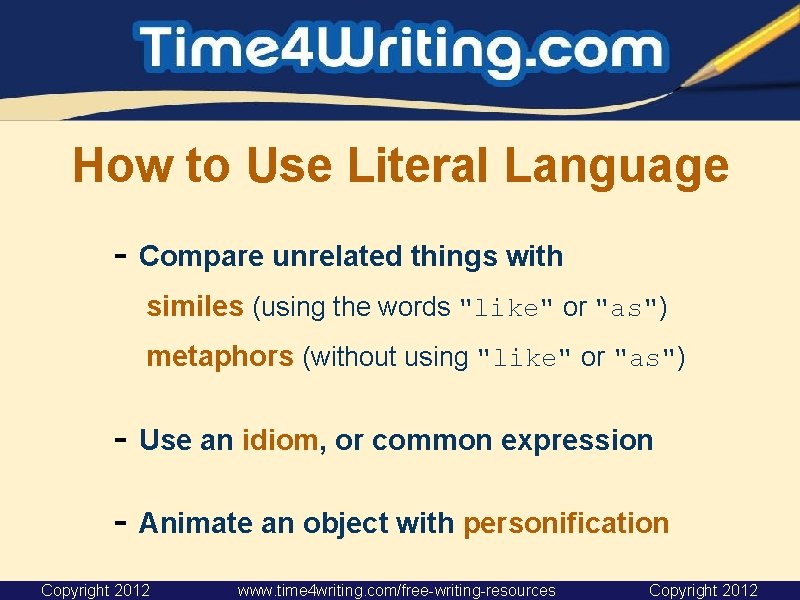
How to Use Literal Language - Compare unrelated things with similes (using the words "like" or "as") metaphors (without using "like" or "as") - Use an idiom, or common expression - Animate an object with personification Copyright 2012 www. time 4 writing. com/free-writing-resources Copyright 2012
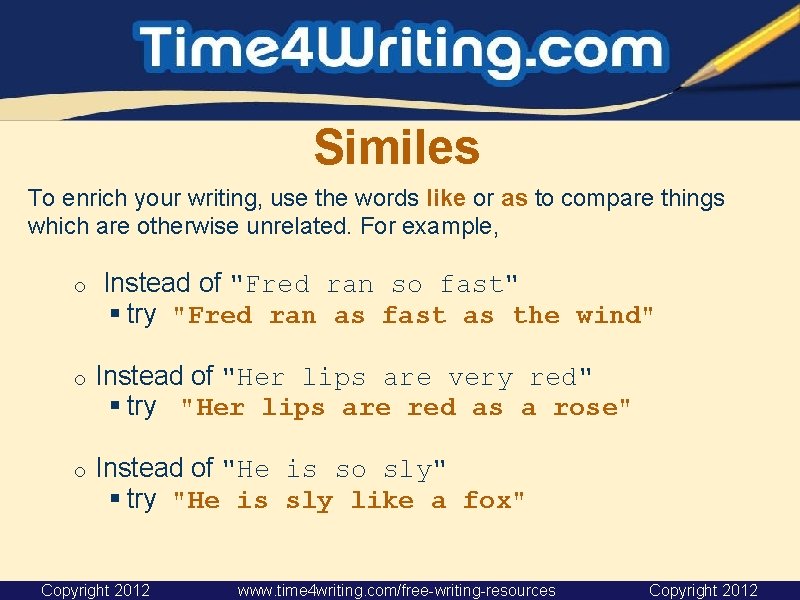
Similes To enrich your writing, use the words like or as to compare things which are otherwise unrelated. For example, o Instead of "Fred ran so fast" § try "Fred ran as fast as the wind" o Instead of "Her lips are very red" § try "Her lips are red as a rose" o Instead of "He is so sly" § try "He is sly like a fox" Copyright 2012 www. time 4 writing. com/free-writing-resources Copyright 2012
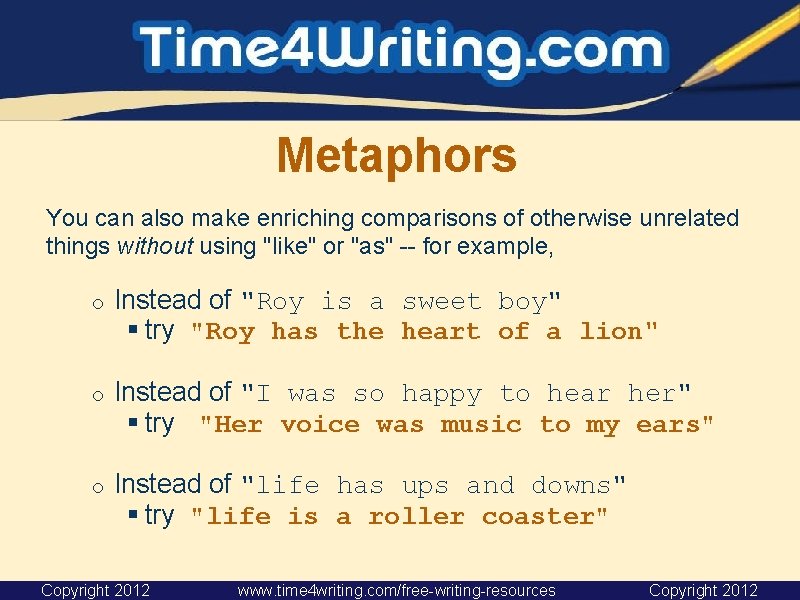
Metaphors You can also make enriching comparisons of otherwise unrelated things without using "like" or "as" -- for example, o Instead of "Roy is a sweet boy" § try "Roy has the heart of a lion" o Instead of "I was so happy to hear her" § try "Her voice was music to my ears" o Instead of "life has ups and downs" § try "life is a roller coaster" Copyright 2012 www. time 4 writing. com/free-writing-resources Copyright 2012

Idioms are expressions used by a particular group of people with a meaning that is only known through common use -- for example: Idiom Meaning … a blessing in disguise An event that seems negative but ends up being positive … a chip on the shoulder Not able to let go of a bad experience … costs an arm and a leg expensive … running against the clock Running out of time Copyright 2012 www. time 4 writing. com/free-writing-resources Copyright 2012
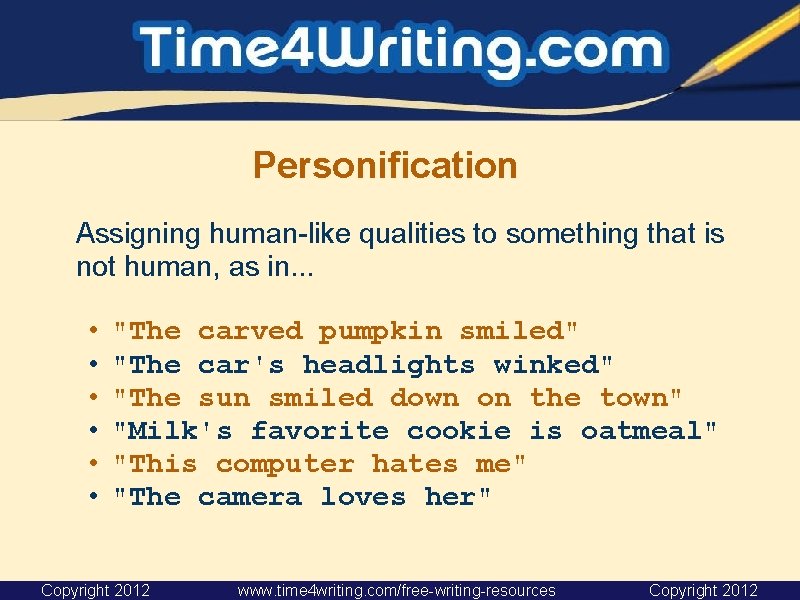
Personification Assigning human-like qualities to something that is not human, as in. . . • "The carved pumpkin smiled" • "The car's headlights winked" • "The sun smiled down on the town" • "Milk's favorite cookie is oatmeal" • "This computer hates me" • "The camera loves her" Copyright 2012 www. time 4 writing. com/free-writing-resources Copyright 2012
Why use Figurative Language? - to play with a word's literal meaning - to make writing more creative and fun - to allow a reader to visualize a scene These will help you do just that! similes metaphors idioms personification Copyright 2012 www. time 4 writing. com/free-writing-resources Copyright 2012
The end. More free WRITING SKILLS resources: • Starting with a Grabber • Ending with a Cliffhanger • Developing Typing Skills • Painting a Word Picture Eight-week WRITING SKILLS courses: • Elementary School • Middle School • High School Copyright 2012 www. time 4 writing. com/free-writing-resources Copyright 2012
- Slides: 11