
Figurative Language More ways to make your writing
- Slides: 13
Figurative Language More ways to make your writing beefy!
Why “beef” up your writing? • Figurative language enhances description in narrative writing. • Figurative language allows readers to enter the story because you are SHOWING them instead of TELLING them.
Alliteration • The use of the same sound at the beginning of a group of words • The repetition of the first consonant – Stan the strong surfer saved several swimmers on Saturday. – Tiny Tommy takes toy trucks to Timmy’s on Tuesdays.
Onomatopoeia • HUH? !? ! • Words that sound like things that they describe (basically, words that are sounds) – Swish, swish – Bam! Wash! Bash! Shazzam! – Chug, chug – Moo! Meow!
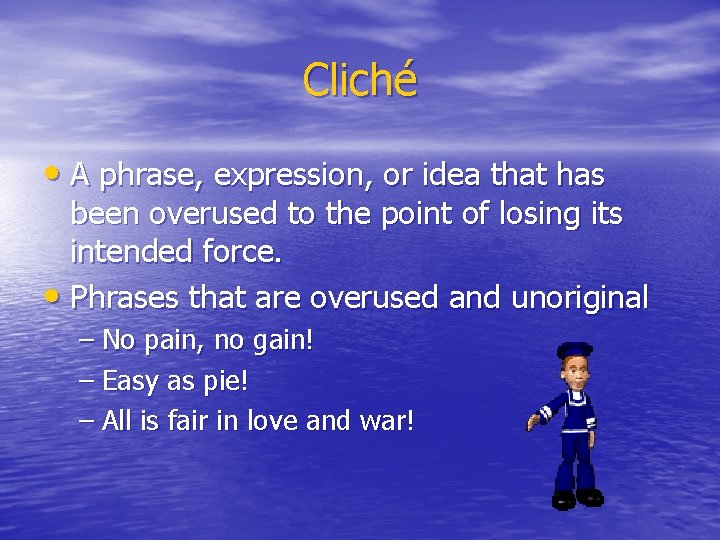
Cliché • A phrase, expression, or idea that has been overused to the point of losing its intended force. • Phrases that are overused and unoriginal – No pain, no gain! – Easy as pie! – All is fair in love and war!
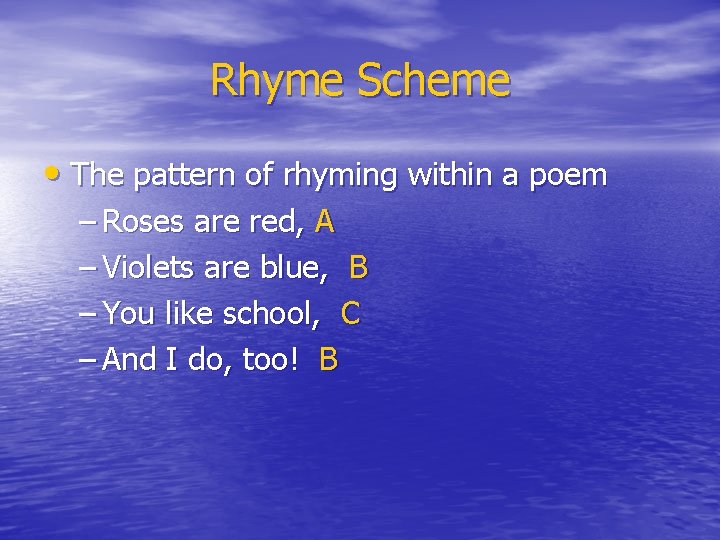
Rhyme Scheme • The pattern of rhyming within a poem – Roses are red, A – Violets are blue, B – You like school, C – And I do, too! B
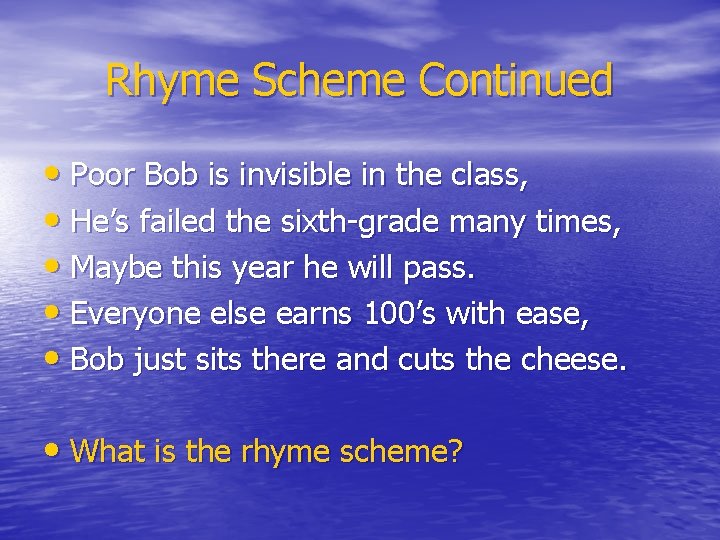
Rhyme Scheme Continued • Poor Bob is invisible in the class, • He’s failed the sixth-grade many times, • Maybe this year he will pass. • Everyone else earns 100’s with ease, • Bob just sits there and cuts the cheese. • What is the rhyme scheme?
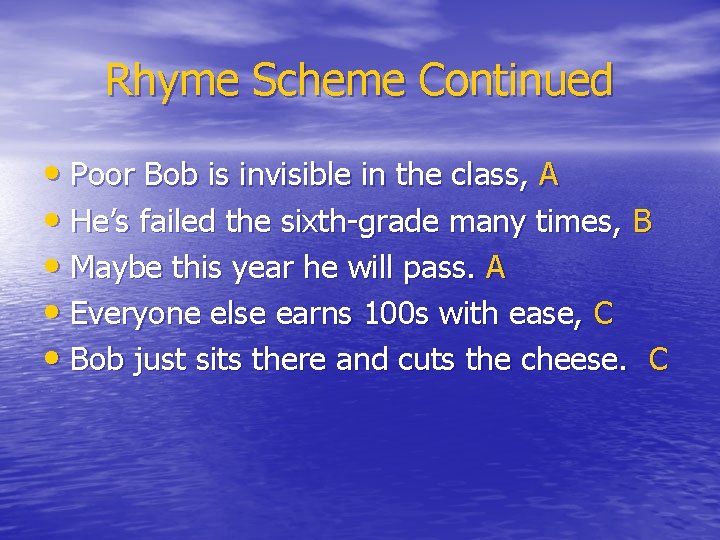
Rhyme Scheme Continued • Poor Bob is invisible in the class, A • He’s failed the sixth-grade many times, B • Maybe this year he will pass. A • Everyone else earns 100 s with ease, C • Bob just sits there and cuts the cheese. C
Personification • Gives human characteristics and traits to animals or inanimate objects • To compare something that is not human as if it were human – The flowers danced in the wind. – The friendly gates welcomed us. – The Earth coughed and choked in all of the pollution.
Hyperbole • A gross exaggeration, something that could never happen – The wind blew a million miles an hour. – My yard is an ocean! – He was so angry that I thought his head might explode!
Simile • Compares two unlike things using “like” or “as” – You look like a beautiful flower. – He was sneaky as a snake. – I was hungry as a horse! – You run like a rabbit. – She is happy as a clam!
Metaphor • Compares two unlike things without the use of “like” or “as” – Life is a highway. – She was a fish in the water! – The clown was a feather floating away.
Sorry! • No music clips for the powerpoint uploaded on the blog! Trust me, they won’t work unless you have the songs downloaded on your computer