
Figurative Language Literary Devices In Poetry Describe the
Figurative Language & Literary Devices In Poetry
Describe the colour of this slide. It is hard to do without comparing it to something else. Watch This!: Flocabulary - Figurative Language (2: 52 mins): http: //www. youtube. com/watch? v=OPj. Ai. Ubdl 14
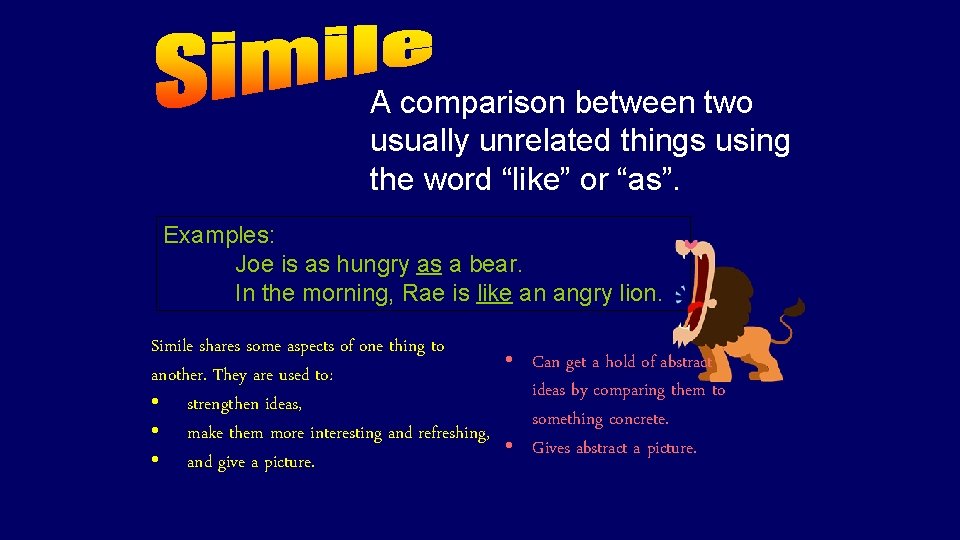
A comparison between two usually unrelated things using the word “like” or “as”. Examples: Joe is as hungry as a bear. In the morning, Rae is like an angry lion. Simile shares some aspects of one thing to • Can get a hold of abstract another. They are used to: ideas by comparing them to • strengthen ideas, something concrete. • make them more interesting and refreshing, • Gives abstract a picture. • and give a picture.
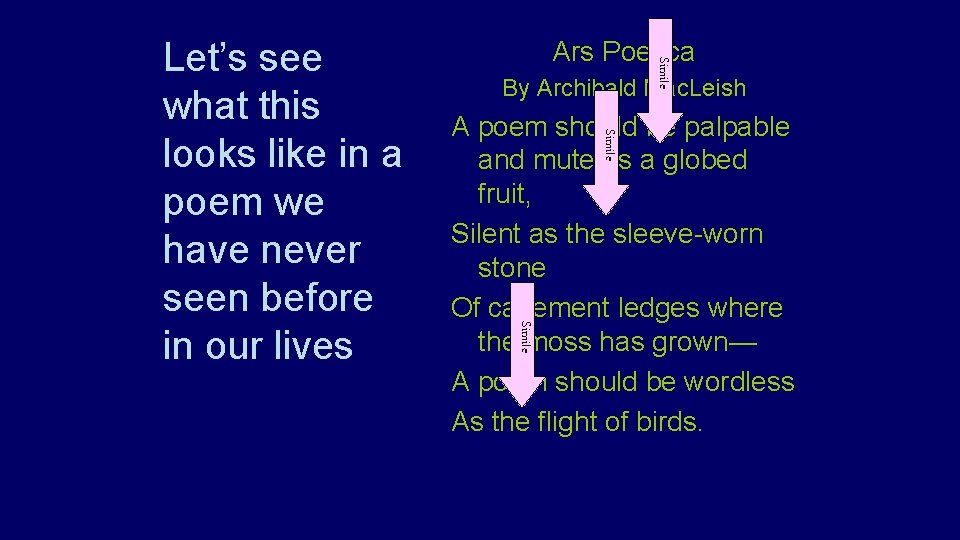
Simile Ars Poetica By Archibald Mac. Leish Simile A poem should be palpable and mute as a globed fruit, Silent as the sleeve-worn stone Of casement ledges where the moss has grown— A poem should be wordless As the flight of birds. Simile Let’s see what this looks like in a poem we have never seen before in our lives

An implied comparison between two usually unrelated things. Examples: Lenny is a snake. Ginny is a mouse when it comes to standing up for herself. The difference between a simile and a metaphor is that a simile requires either “like” or “as” to be included in the comparison, and a metaphor requires that neither be used.
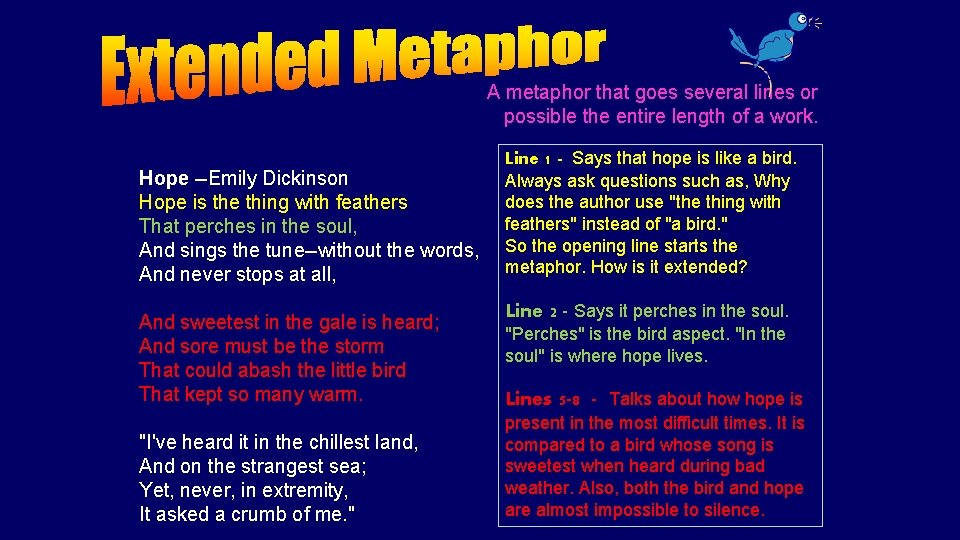
A metaphor that goes several lines or possible the entire length of a work. Hope --Emily Dickinson Hope is the thing with feathers That perches in the soul, And sings the tune--without the words, And never stops at all, And sweetest in the gale is heard; And sore must be the storm That could abash the little bird That kept so many warm. "I've heard it in the chillest land, And on the strangest sea; Yet, never, in extremity, It asked a crumb of me. " Line 1 - Says that hope is like a bird. Always ask questions such as, Why does the author use "the thing with feathers" instead of "a bird. " So the opening line starts the metaphor. How is it extended? Line 2 - Says it perches in the soul. "Perches" is the bird aspect. "In the soul" is where hope lives. Lines 5 -8 - Talks about how hope is present in the most difficult times. It is compared to a bird whose song is sweetest when heard during bad weather. Also, both the bird and hope are almost impossible to silence.
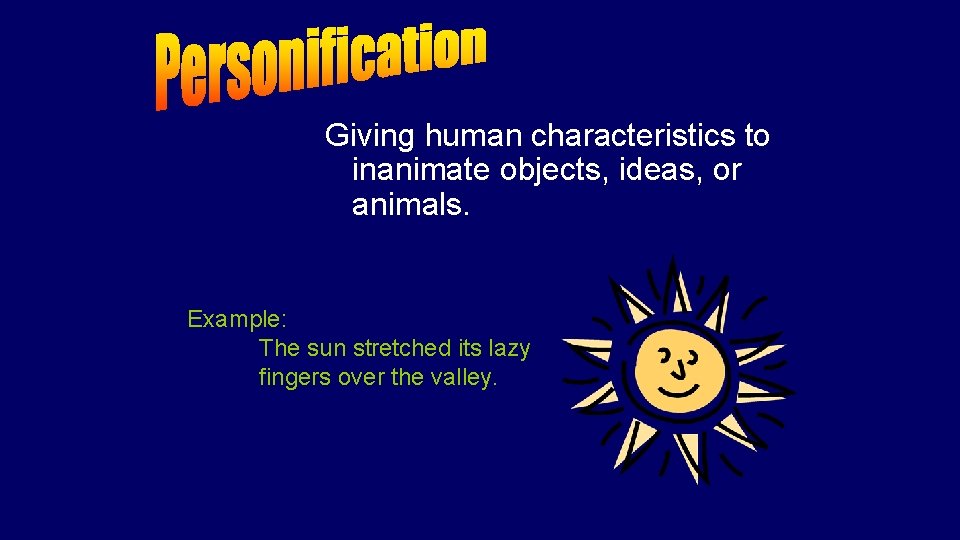
Giving human characteristics to inanimate objects, ideas, or animals. Example: The sun stretched its lazy fingers over the valley.

Animate or inanimate objects are addressed as if they were present or alive. Example: “Death be not proud!”
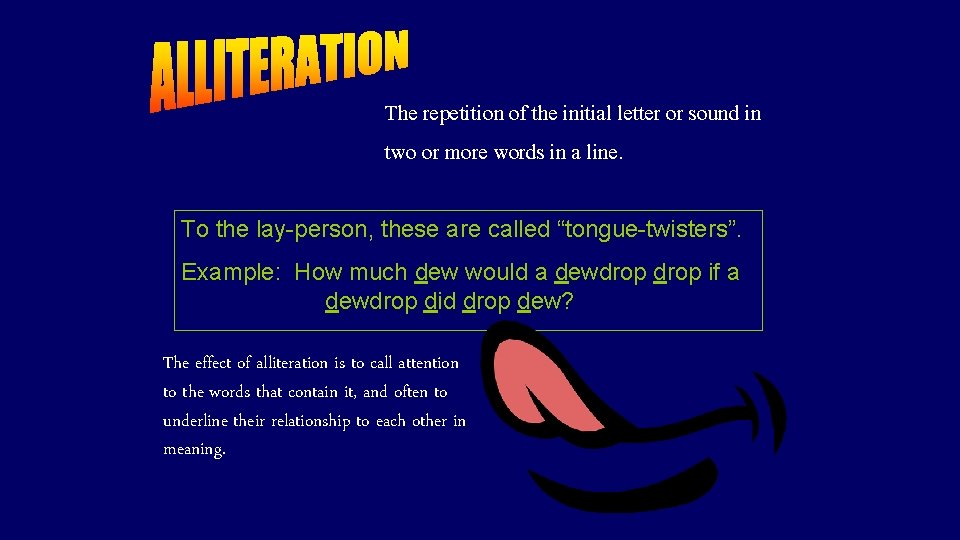
The repetition of the initial letter or sound in two or more words in a line. To the lay-person, these are called “tongue-twisters”. Example: How much dew would a dewdrop if a dewdrop did drop dew? The effect of alliteration is to call attention to the words that contain it, and often to underline their relationship to each other in meaning.
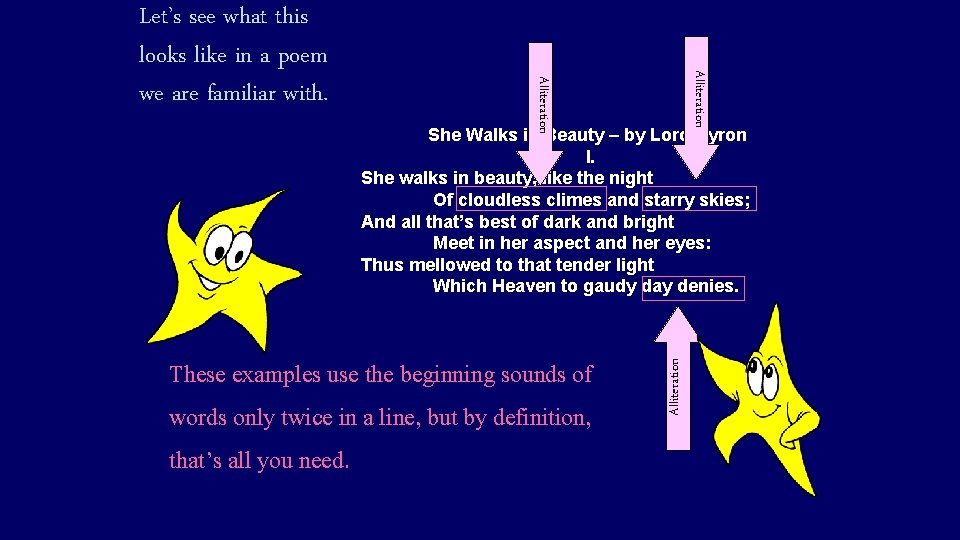
Alliteration Let’s see what this looks like in a poem we are familiar with. These examples use the beginning sounds of words only twice in a line, but by definition, that’s all you need. Alliteration She Walks in Beauty – by Lord Byron I. She walks in beauty, like the night Of cloudless climes and starry skies; And all that’s best of dark and bright Meet in her aspect and her eyes: Thus mellowed to that tender light Which Heaven to gaudy day denies.
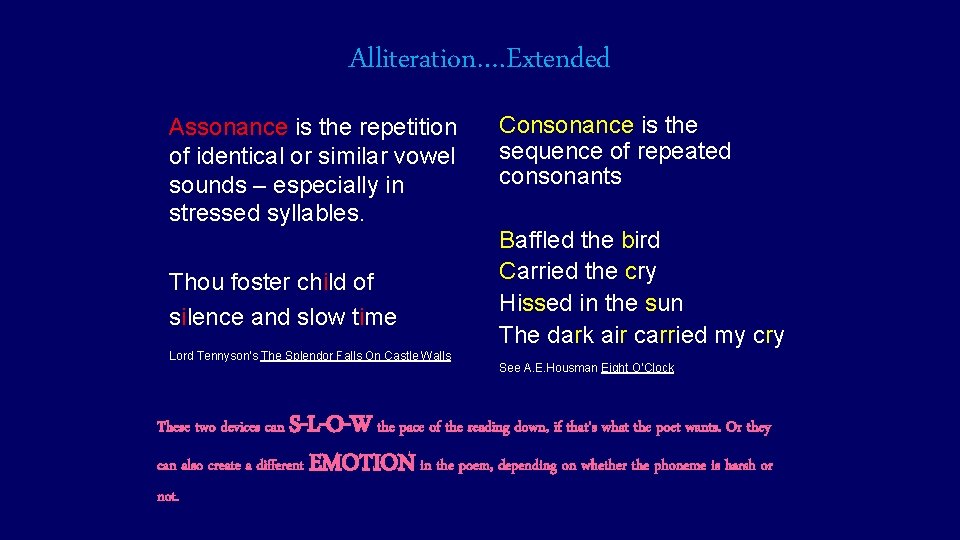
Alliteration…. Extended Assonance is the repetition of identical or similar vowel sounds – especially in stressed syllables. Thou foster child of silence and slow time Lord Tennyson’s The Splendor Falls On Castle Walls Consonance is the sequence of repeated consonants Baffled the bird Carried the cry Hissed in the sun The dark air carried my cry See A. E. Housman Eight O’Clock S-L-O-W the pace of the reading down, if that’s what the poet wants. Or they can also create a different EMOTION in the poem, depending on whether the phoneme is harsh or These two devices can not.
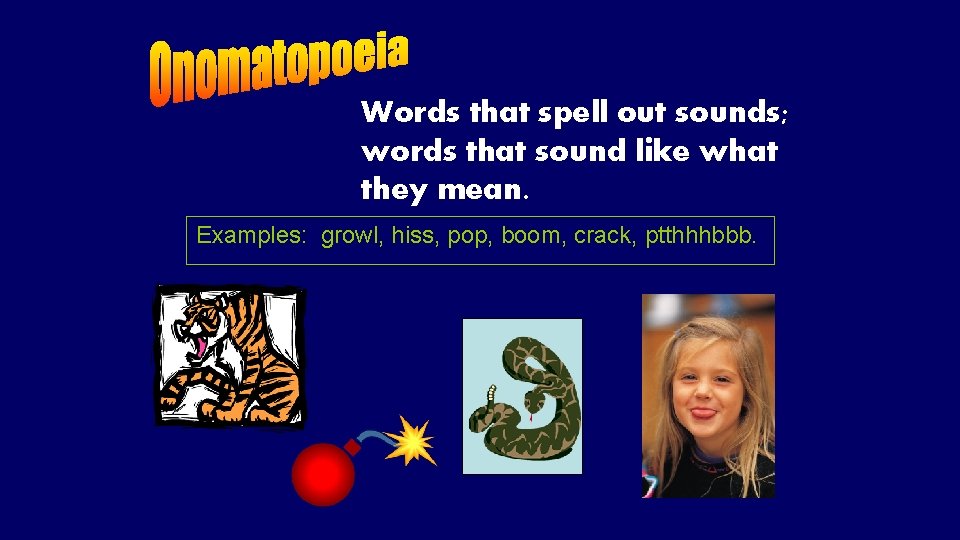
Words that spell out sounds; words that sound like what they mean. Examples: growl, hiss, pop, boom, crack, ptthhhbbb.
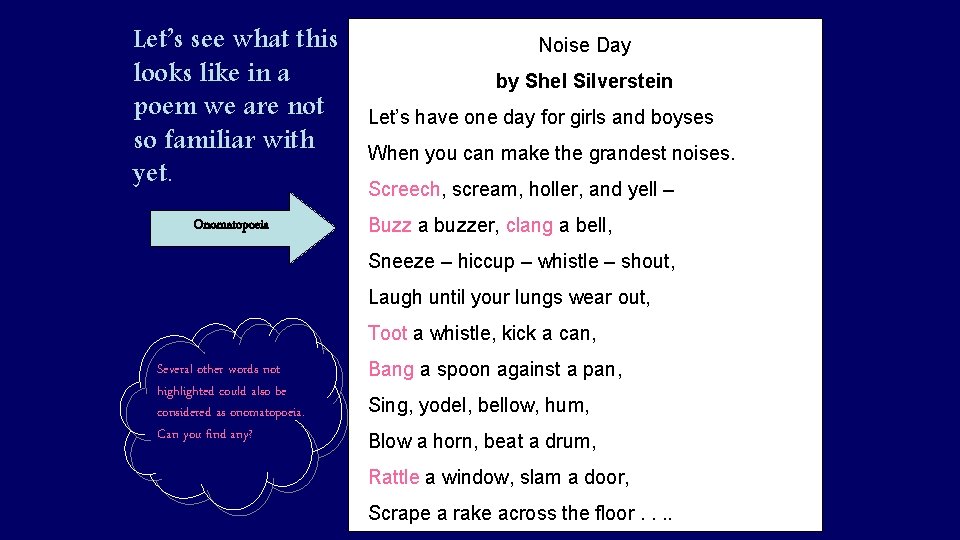
Let’s see what this looks like in a poem we are not so familiar with yet. Onomatopoeia Noise Day by Shel Silverstein Let’s have one day for girls and boyses When you can make the grandest noises. Screech, scream, holler, and yell – Buzz a buzzer, clang a bell, Sneeze – hiccup – whistle – shout, Laugh until your lungs wear out, Toot a whistle, kick a can, Several other words not highlighted could also be considered as onomatopoeia. Can you find any? Bang a spoon against a pan, Sing, yodel, bellow, hum, Blow a horn, beat a drum, Rattle a window, slam a door, Scrape a rake across the floor. .
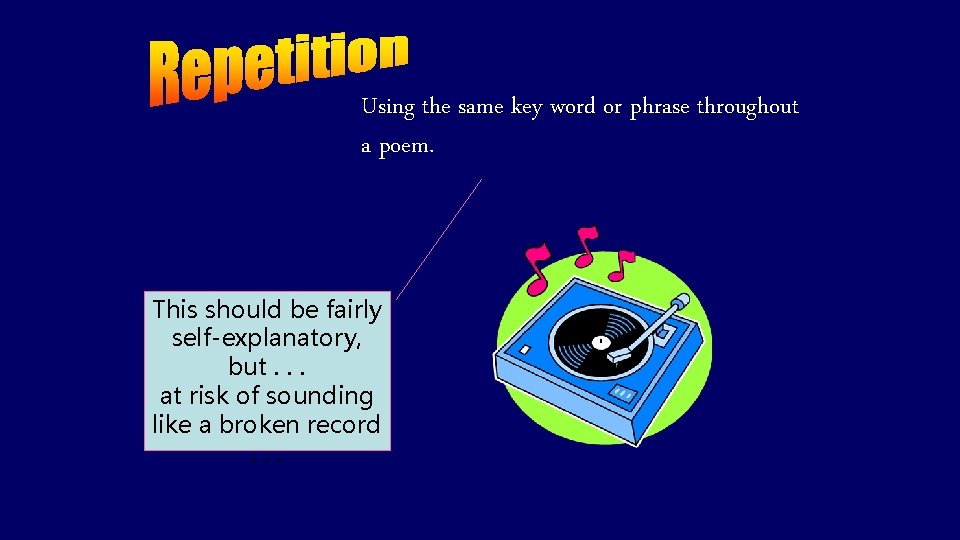
Using the same key word or phrase throughout a poem. This should be fairly self-explanatory, but. . . at risk of sounding like a broken record. . .
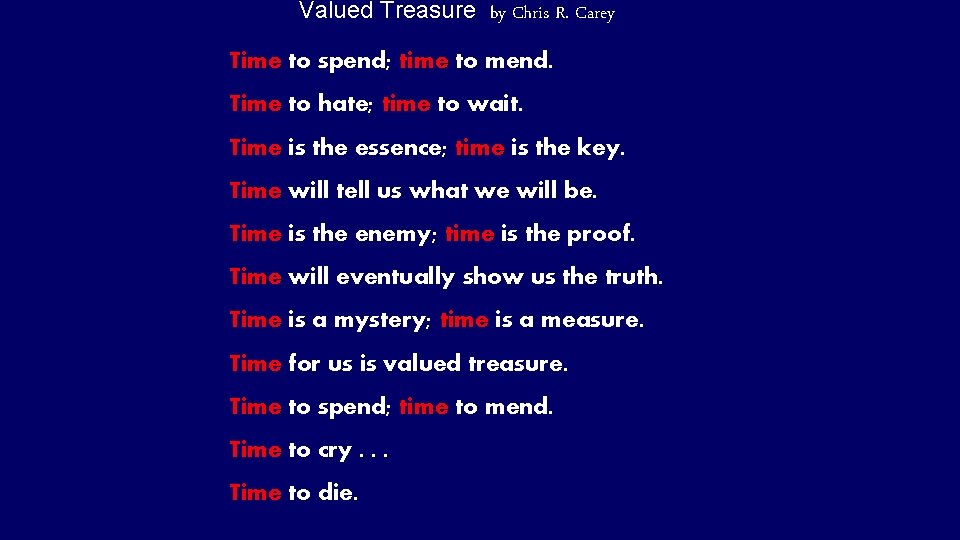
Valued Treasure by Chris R. Carey Time to spend; time to mend. Time to hate; time to wait. Time is the essence; time is the key. Time will tell us what we will be. Time is the enemy; time is the proof. Time will eventually show us the truth. Time is a mystery; time is a measure. Time for us is valued treasure. Time to spend; time to mend. Time to cry. . . Time to die.
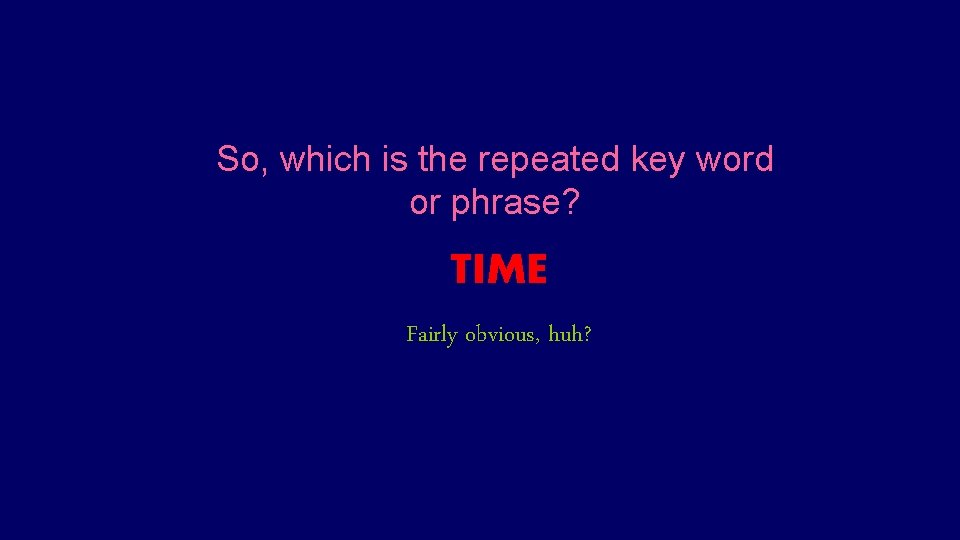
So, which is the repeated key word or phrase? TIME Fairly obvious, huh?
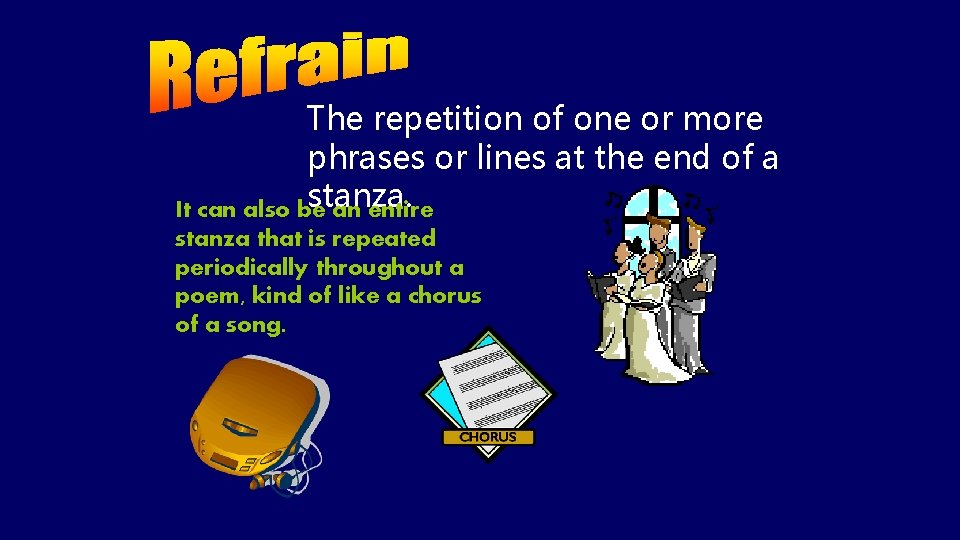
The repetition of one or more phrases or lines at the end of a stanza. It can also be an entire stanza that is repeated periodically throughout a poem, kind of like a chorus of a song.
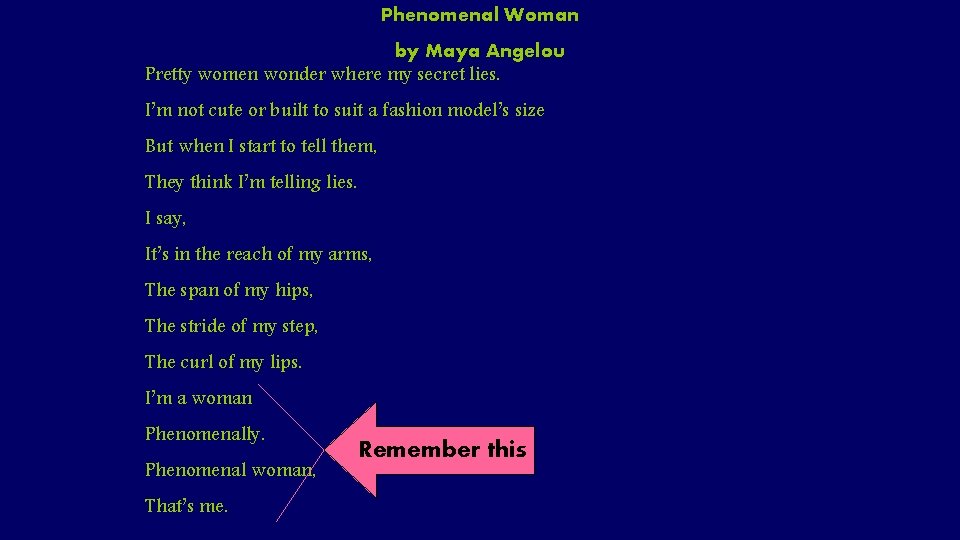
Phenomenal Woman by Maya Angelou Pretty women wonder where my secret lies. I’m not cute or built to suit a fashion model’s size But when I start to tell them, They think I’m telling lies. I say, It’s in the reach of my arms, The span of my hips, The stride of my step, The curl of my lips. I’m a woman Phenomenally. Phenomenal woman, That’s me. Remember this
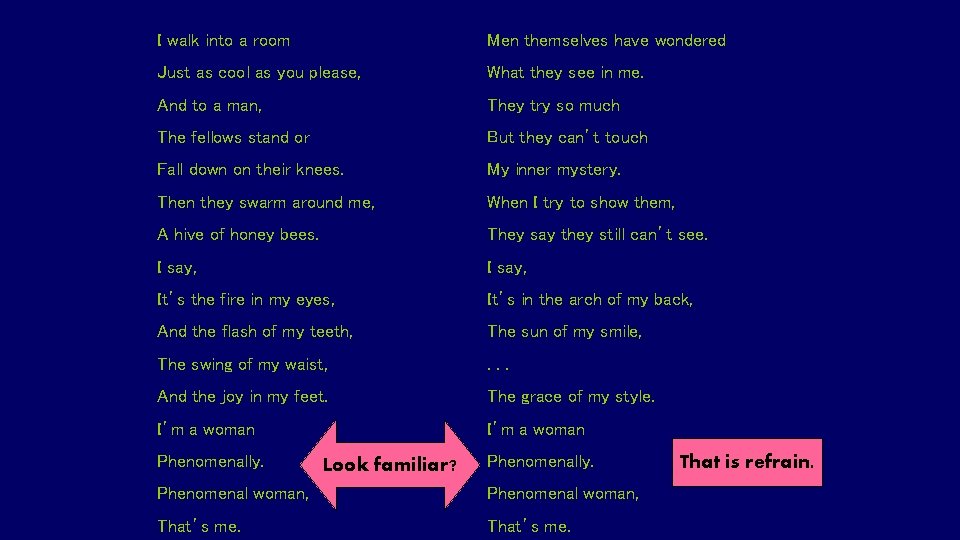
I walk into a room Men themselves have wondered Just as cool as you please, What they see in me. And to a man, They try so much The fellows stand or But they can’t touch Fall down on their knees. My inner mystery. Then they swarm around me, When I try to show them, A hive of honey bees. They say they still can’t see. I say, It’s the fire in my eyes, It’s in the arch of my back, And the flash of my teeth, The sun of my smile, The swing of my waist, . . . And the joy in my feet. The grace of my style. I’m a woman Phenomenally. Look familiar? Phenomenally. Phenomenal woman, That’s me. That is refrain.
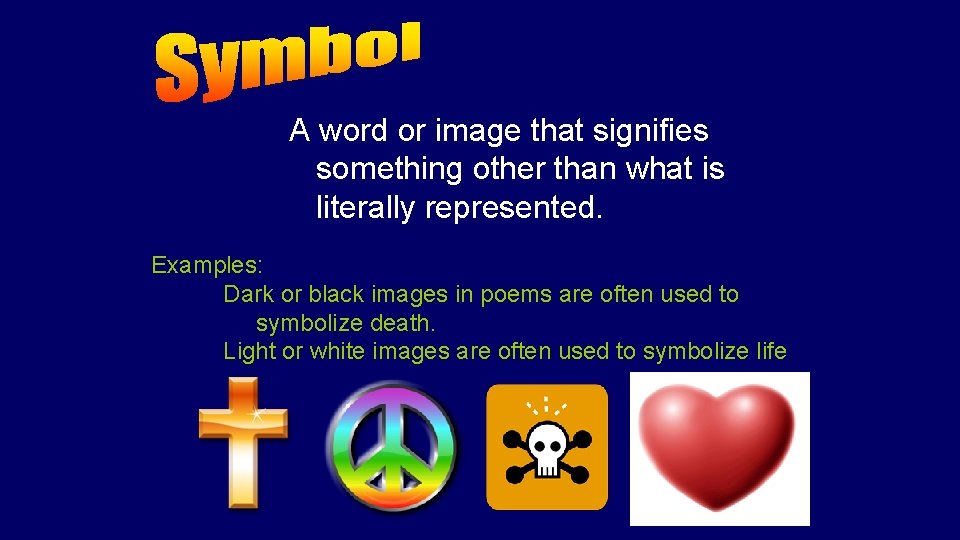
A word or image that signifies something other than what is literally represented. Examples: Dark or black images in poems are often used to symbolize death. Light or white images are often used to symbolize life.
What do you see? What do you hear? What do you smell? What do you taste? What do you feel? Using words to create a vivid picture in the reader’s mind. Take a minute to describe an emotion using your senses using the vivid sensory details form your memory. As a starting point, give the emotion a color for the sense of sight. Then say how it sounds, feels, smells, and tastes. Model: (emotion) is (a color) It sounds like… It feels like… It smells like… It tastes like…
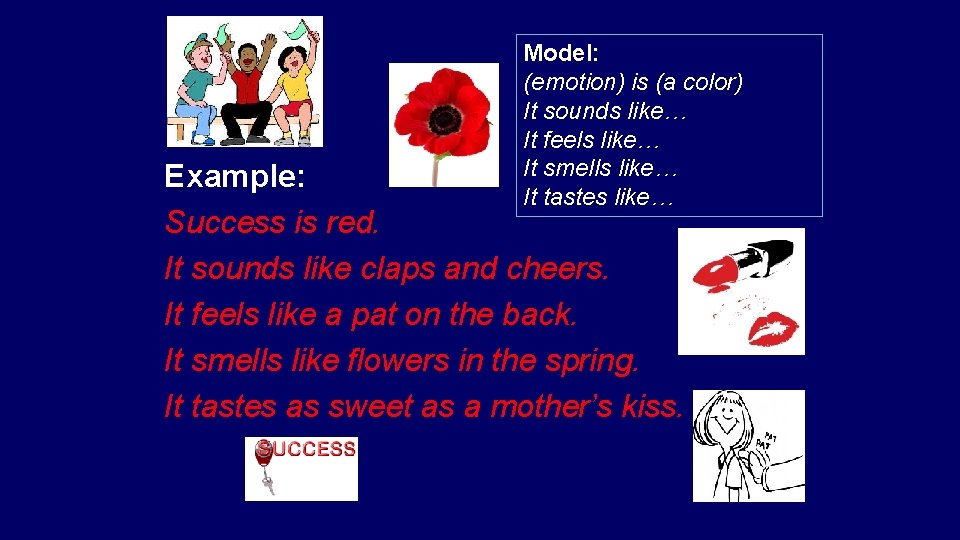
Model: (emotion) is (a color) It sounds like… It feels like… It smells like… It tastes like… Example: Success is red. It sounds like claps and cheers. It feels like a pat on the back. It smells like flowers in the spring. It tastes as sweet as a mother’s kiss.
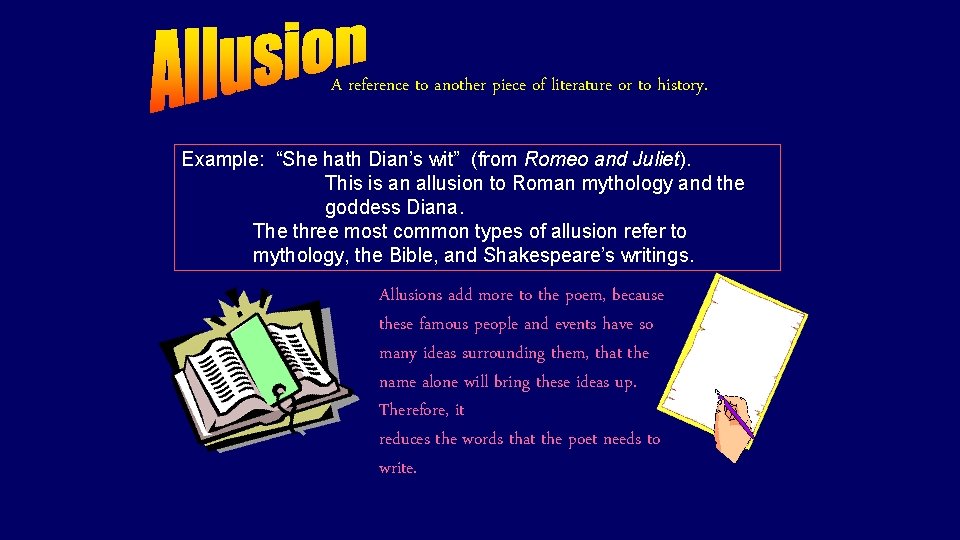
A reference to another piece of literature or to history. Example: “She hath Dian’s wit” (from Romeo and Juliet). This is an allusion to Roman mythology and the goddess Diana. The three most common types of allusion refer to mythology, the Bible, and Shakespeare’s writings. Allusions add more to the poem, because these famous people and events have so many ideas surrounding them, that the name alone will bring these ideas up. Therefore, it reduces the words that the poet needs to write.
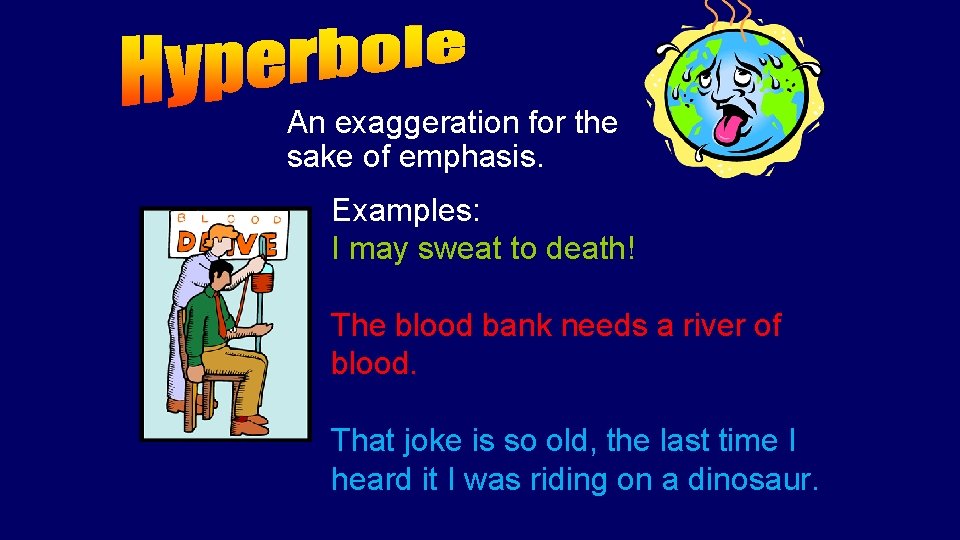
An exaggeration for the sake of emphasis. Examples: I may sweat to death! The blood bank needs a river of blood. That joke is so old, the last time I heard it I was riding on a dinosaur.
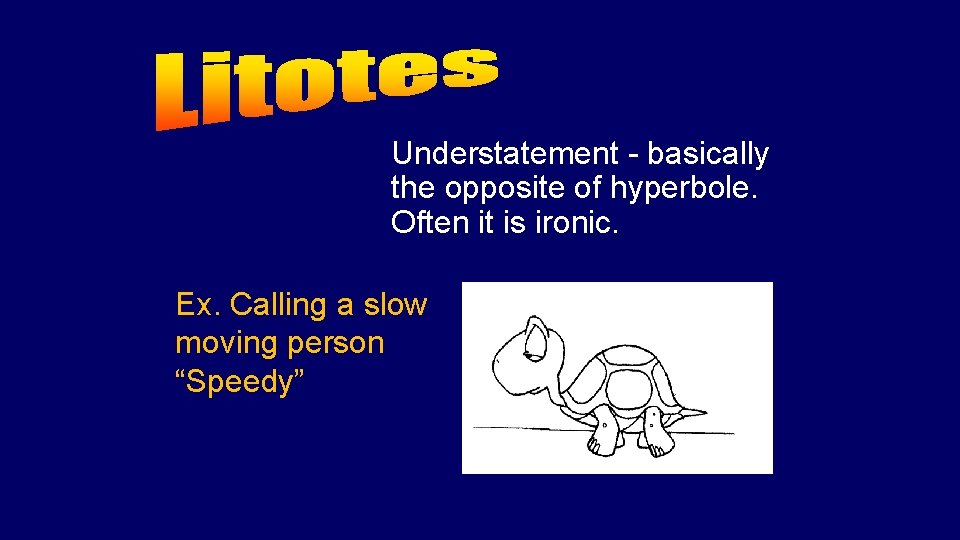
Understatement - basically the opposite of hyperbole. Often it is ironic. Ex. Calling a slow moving person “Speedy”
The use of words that have a harsh or discordant sound due to the presence of letters such as c, k, g, b, and p ex. clobber, squawk, guttural Jabberwocky by Lewis Carroll 'Twas brillig, and the slithy toves Did gyre and gimble in the wabe; All mimsy were the borogoves, And the mome raths outgrabe. "A Westward Wind" by Winston Churchill's (1912) “Lick, crack, sick, hack. The beggar harried her open back. Crash, bang, clang!! We want no parlay with you and your grisly gang who work your wicked will. ” Cacophony is a technique which was used by the famous poet and author Lewis Carroll makes use of cacophony in the poem 'Jabberwocky' by using an unpleasant spoken sound created by clashing consonants. The word cacophony originates from the Greek word meaning "bad sound". The term in poetry refers to the use of words that combine sharp, harsh, hissing, or unmelodious sounds.
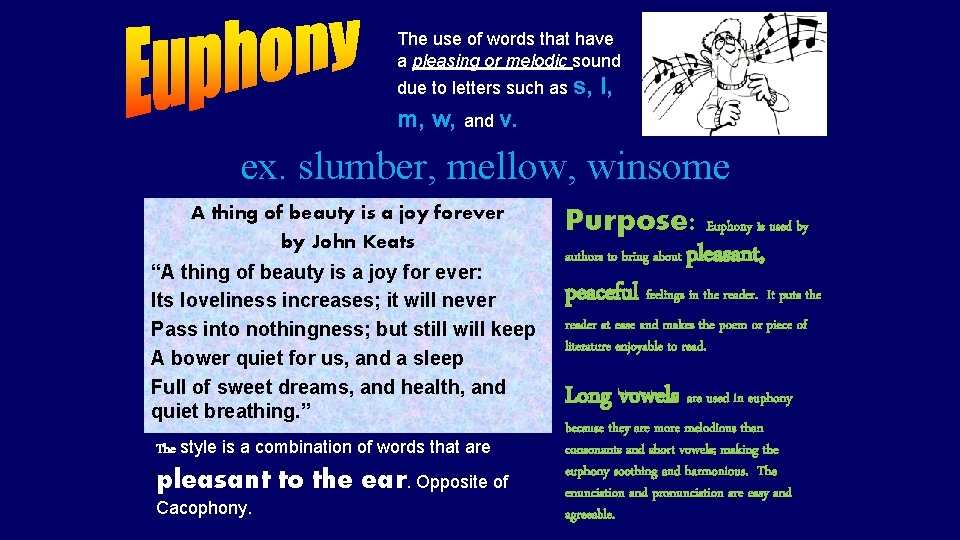
The use of words that have a pleasing or melodic sound due to letters such as s, l, m, w, and v. ex. slumber, mellow, winsome A thing of beauty is a joy forever by John Keats “A thing of beauty is a joy for ever: Its loveliness increases; it will never Pass into nothingness; but still will keep A bower quiet for us, and a sleep Full of sweet dreams, and health, and quiet breathing. ” The style is a combination of words that are . pleasant to the ear. Opposite of Cacophony. Purpose: Euphony is used by authors to bring about pleasant, peaceful feelings in the reader. It puts the reader at ease and makes the poem or piece of literature enjoyable to read. Long vowels are used in euphony because they are more melodious than consonants and short vowels; making the euphony soothing and harmonious. The enunciation and pronunciation are easy and agreeable.
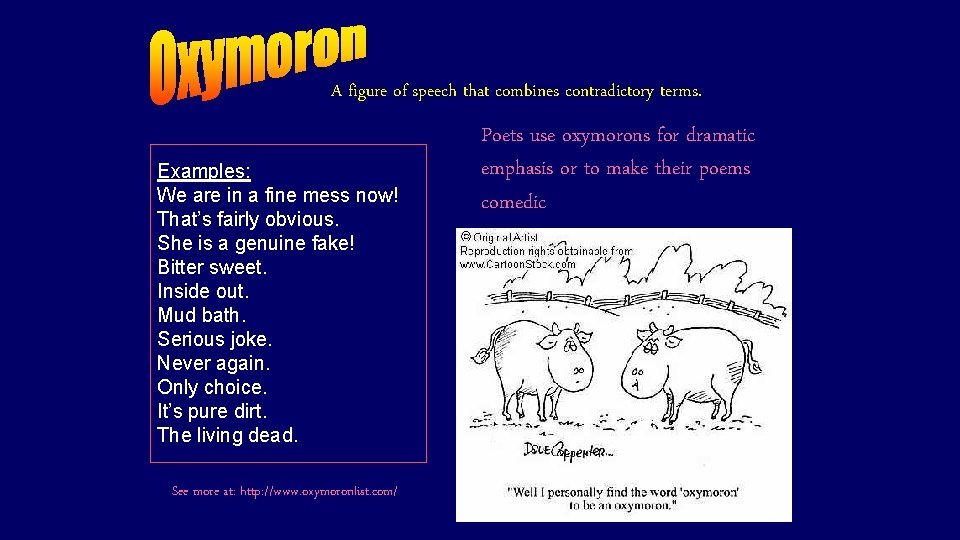
A figure of speech that combines contradictory terms. Examples: We are in a fine mess now! That’s fairly obvious. She is a genuine fake! Bitter sweet. Inside out. Mud bath. Serious joke. Never again. Only choice. It’s pure dirt. The living dead. See more at: http: //www. oxymoronlist. com/ Poets use oxymorons for dramatic emphasis or to make their poems comedic
Men work together whether they work together or apart. - Robert An absurd or self-contradictory statement. Frost When two things are both true, but one should contradict the other. Very closely related to an oxymoron but at the most basic Examples: level, a paradox is a statement Jumbo shrimp. I'm a compulsive liar- am I lying when I say that? that is self contradictory If you didn't get this message, call me. because it often contains two Drowning in the fountain of eternal life. statements that are both true, but in general, cannot both be true at the same time. (Labyrinth) Sarah's Certain Death Riddle (2: 11 mins): http: //www. youtube. com/watch? v=2 dgmgub 8 m. Hw
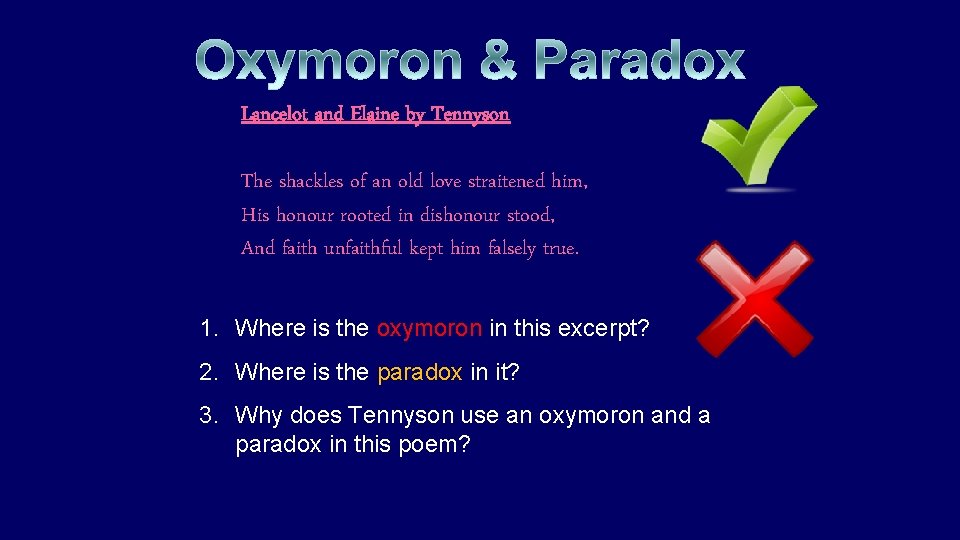
Lancelot and Elaine by Tennyson The shackles of an old love straitened him, His honour rooted in dishonour stood, And faith unfaithful kept him falsely true. 1. Where is the oxymoron in this excerpt? 2. Where is the paradox in it? 3. Why does Tennyson use an oxymoron and a paradox in this poem?
Figurative Language Game Show! Watch This! Figurative Language Game Show! (11: 44 mins): http: //www. youtube. com/watch? v=4 Ue. RBAmev. A#t=21
Closure: Exit Slip 1. What are five key concepts you learned in this power point. 2. Answer the following questions for the poem “Sick” by Shel Silverstein 1. What is the Rhyme Scheme 2. The obvious theme is “being sick” pick out another theme. 3. Identify at least 5 forms of figurative language 3. Write a short poem that has paradox in it and another short poem that has an oxymoron in it. (minimum 4 lines each)
Sick by Shel Silverstein “I cannot go to school today, ” Said little Peggy Ann Mc. Kay. I have the measles and the mumps, A gash, a rash and purple bumps. My mouth is wet, my throat is dry, I’m going blind in my right eye. My tonsils are as big as rocks, I’ve counted sixteen chicken pox. And there’s one more—that’s seventeen, And don’t you think my face looks green? My leg is cut, my eyes are blue— It might be instamatic flue. I cough and sneeze and gasp and choke, I’m sure that my left leg is broken— My hips hurt when I move my chin, My belly button’s caving in, My back is wrenched, my ankle’s sprained, My ‘pendix pains each time it rains. My nose is cold, my toes are numb, I have a silver in my thumb. My neck is stiff, my voice is weak, I hardly whisper when I speak. My tongue is filling up my mouth, I think my hair is falling out. My elbow’s bent, my spine ain’t straight, My temperature is one-o-eight. My brain is shrunk, I cannot hear, There is a hole inside my ear. I have a hangnail, and my hart is—what? What’s that you say? You say today is… Saturday? G’bye, I’m going out to play!”
- Slides: 33