
Figurative Language LANGUAGE FEATURES Andrew Newbound 2013 Figurative
Figurative Language LANGUAGE FEATURES © Andrew Newbound 2013
Figurative Language Metaphor Similes Personification Describing Words ie. adverbs and adjectives © Andrew Newbound 2013
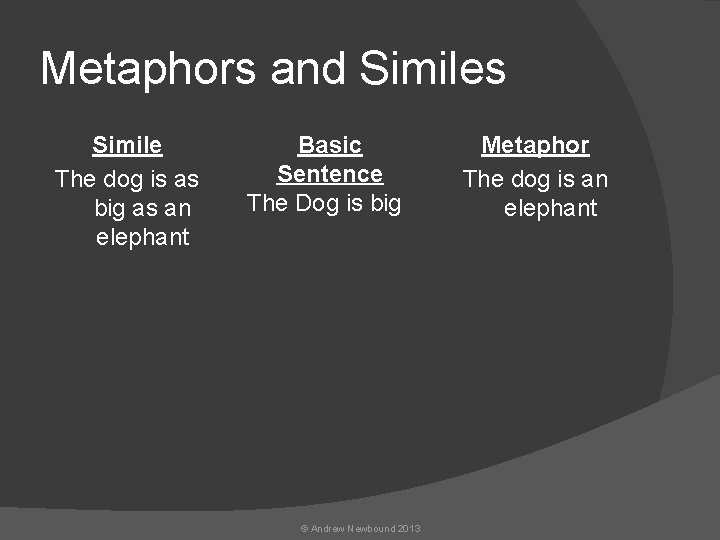
Metaphors and Similes Simile The dog is as big as an elephant Basic Sentence The Dog is big © Andrew Newbound 2013 Metaphor The dog is an elephant

Grammar – Nouns and Verbs Nouns Names of People, Places and Things Collective Nouns Names of groups of things E. g. Mob of Kangaroos, School of Fish Verbs Doing words If you can do it – it’s a verb © Andrew Newbound 2013
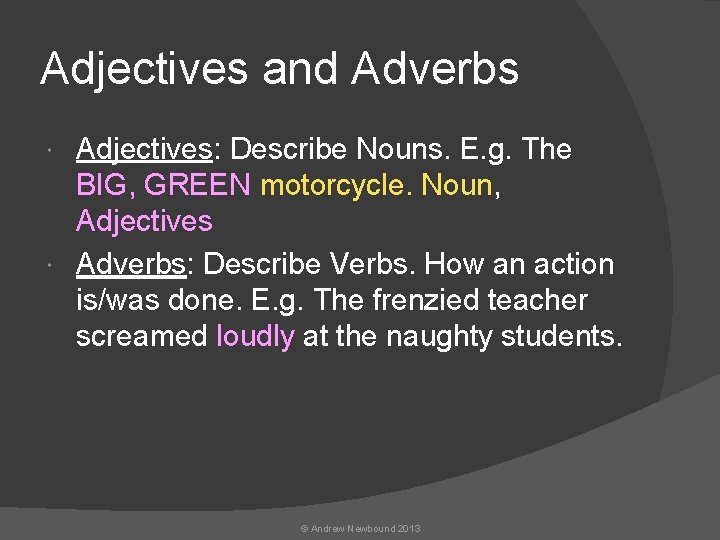
Adjectives and Adverbs Adjectives: Describe Nouns. E. g. The BIG, GREEN motorcycle. Noun, Adjectives Adverbs: Describe Verbs. How an action is/was done. E. g. The frenzied teacher screamed loudly at the naughty students. © Andrew Newbound 2013
Pronouns Replace Nouns I You They Me Everyone Someone © Andrew Newbound 2013
First, Second and Third Person First Person: When the writers talk about themselves. Word/s: I, me, myself etc. Autobiographies Second Person: Aimed directly at the audience. Word/s: ‘You’. E. g. “Are YOU listening? ” Advertising, giving directions Third Person: Write about other people. Word/s: he, she, they, him etc. © Andrew Newbound 2013
Visual Texts Analyse Advertising – Language & Layout Features Language Features: Poetry Terms E. g. similes, metaphors etc. Layout Features: Set out. E. g. dot points, headings, text boxes etc. Visuals & Graphics: E. g. Pictures, Symbols, Logos © Andrew Newbound 2013
Homophones and Homonyms Words that sound the same but are spelt differently E. g. There, Their, They’re Words that are spelt the same but means different things. The bow is the front of a boat / I tied a bow in my hair. Dog lead / Lead pencil Homophones Homonyms © Andrew Newbound 2013
There, Their, They’re There – Place Their – Ownership They’re – Short for they are © Andrew Newbound 2013
Level of Language Colloquial Language (Informal) Friends Slang Contractions Abbreviations Formal Job interview Slang Contractions Abbreviations © Andrew Newbound 2013
Jargon Group of Words Associated With A Topic Golf (Par, Iron, Eagle, Birdie) Horse Riding (Canter, Gallop, Gymkhana) Football (Centre, Drop Kick, Forward Pass) Basketball (Full Court Press, Dribbling) Dancing (Avant, Aplomb, Coda) Surfing (Old School, Rip, Lame) Soccer (Leage, Offensive Team, Open) © Andrew Newbound 2013
Persuasive Language Pushy Advertising To See Your Opinion Letters To The Editor Newspaper Articles Essays © Andrew Newbound 2013
Juxtaposition Place 2 objects side by side to show different they are. A good character and a bad character in a story to show different they are. © Andrew Newbound 2013
Tone And Mood The manner in which a text is written. Words that describe it are also used to describe speaking. Depressing, Excited, Over-joyed, Comical Lines of text Overall feeling of a piece of writing. Describing words (see tone) Overall text Tone Mood © Andrew Newbound 2013
Style The way a writer uses words and punctuation to create their own style. Sometimes you can read a piece of writing and you can guess who it is by. © Andrew Newbound 2013
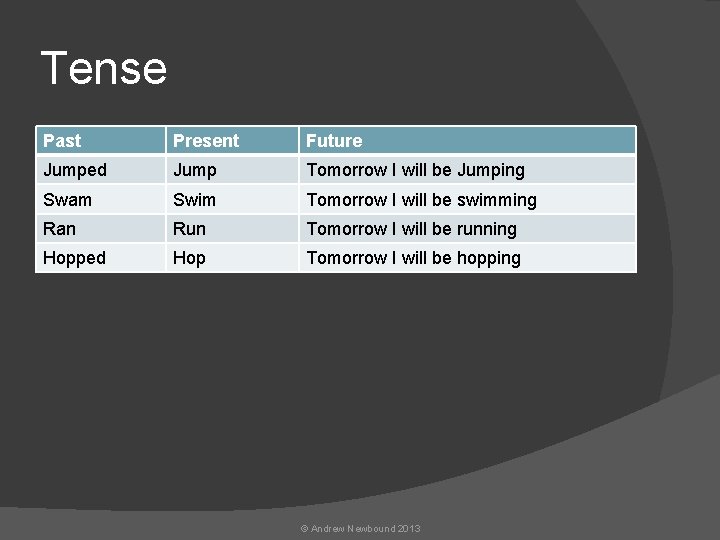
Tense Past Present Future Jumped Jump Tomorrow I will be Jumping Swam Swim Tomorrow I will be swimming Ran Run Tomorrow I will be running Hopped Hop Tomorrow I will be hopping © Andrew Newbound 2013
Personification � A personification is a figure of speech that gives an inanimate object or abstract idea human traits and qualities, such as emotions, desires, sensations, physical gestures and speech. � � � The flowers were suffering from intense heat. The teddy bear sat slumped on the bed, looking sadly at its feet This web browser really loves to crash US Defends Sale of Ports Company to Arab Nation Microsoft embarrassed one final time over SP 2 © Andrew Newbound 2013
Synonym � � � Synonyms are different words with identical or at least similar meanings baby and infant petty crime and misdemeanour student and pupil buy and purchase pretty and attractive sick and ill quickly and speedily on and upon freedom and liberty dead and deceased © Andrew Newbound 2013
Antonym (Opposite) short and tall dead and alive near and far war and peace increase and decrease © Andrew Newbound 2013
Apostrophe (‘ ’) Ownership: Jonathon's truck. Replacement: It is – It’s (not to be confused with Its (it owns)) © Andrew Newbound 2013
Pun A pun (or paronomasia) is a phrase that deliberately exploits confusion between similar-sounding words for humorous or rhetorical effect. © Andrew Newbound 2013
![Punctuation Marks � apostrophe ( ’ ' ) brackets (( )), ([ ]), ({](http://slidetodoc.com/presentation_image_h2/107ab19eca1c1ae6aef348d7b85a6f3a/image-23.jpg "Punctuation Marks � apostrophe ( ’ ' ) brackets (( )), ([ ]), ({")
Punctuation Marks � apostrophe ( ’ ' ) brackets (( )), ([ ]), ({ }), (< >) colon ( : ) comma ( , ) dashes ( ‒, –, —, ― ) ellipsis ( …, . . . ) exclamation mark ( ! ) full stop (. ) guillemets ( « » ) hyphen ( -, ‐ ) question mark ( ? ) quotation marks ( ‘ ’, “ ” ) semicolon ( ; ) slash/stroke ( / ) solidus ( ⁄ ) © Andrew Newbound 2013
Purpose, Audience, Context Purpose (why it was created) ○ To persuade (Advertisement) ○ Argue (Letters to the editor, Re: petrel prices) ○ Inform (teach. E. g. science textbook) Audience (people aimed at) ○ Men, Women, children, mothers ○ E. g. Daddy Day Care Context (Time it was writtten ○ War Poem (1917) ○ Video Game (2008) © Andrew Newbound 2013
Ambiguity Someone fails to convey the intended message Causes Double meaning No clear subject for pronoun Expression/phase is misplaced A phrase beginning with an ‘ing’ word does not relate to any identifiable person/thing A phrase beginning with an ‘ing’ word is not placed as closely as possible to the person/thing to which it relates © Andrew Newbound 2013
Tautology The needles repetition of an idea or statement is called tautology E. g. The car reversed backwards out of the mud © Andrew Newbound 2013
Idioms Sayings/expressions used in everyday speech E. g. My friend gave me a cold shoulder ○ Friend ignored you © Andrew Newbound 2013
Circumlocution Speaking or writing in a roundabout/longwinded way Characteristically using an unnecessary amount of words E. g. The person on foot became the recipient of contusions occasioned by a car and himself impacting Means The pedestrian was bruised in a car accident © Andrew Newbound 2013
Euphemism Using a pleasant word to replace a word that has an unpleasant, offensive or harsh connotations. E. g. Comfort station & restroom Both mean public toilet © Andrew Newbound 2013
Objective & Subjective Objective Non-emotive Subjective Emotive © Andrew Newbound 2013
Analogy Comparison demonstrating similarity Two apples plus three apples equals five apples Makes explaining easier Referring to what reader knows © Andrew Newbound 2013
Appropriation Take parts of another story E. g. My Achilles heel Some stories are appropriated because they hold truths about the human condition They are good stories so why not market them © Andrew Newbound 2013
Buzz Words Used in advertising to help sell a product/image E. g. Free, special, bonus Audience feels they are getting something for nothing © Andrew Newbound 2013
Connotation Feelings or emotions suggested by a word or a phrase Home: Warmth Loving Security Not textbook definition: a place of residence To convey images © Andrew Newbound 2013
Ellipsis … 3 dots which signify one or more words have been left out If you don’t do this, I will … Using a quote from a text To create suspense © Andrew Newbound 2013
Epigram A concise saying usually witty, imaginative, clever, sharp, to the point Character is a like a photograph: it develops in darkness Sayings that are easy to remember and get us thinking © Andrew Newbound 2013
Innuendo To indirectly say something – implying He said he liked dogs. Emphasis on liked indicates he hates dogs Usually applies to negative references. Implies mean ‘stuff’ about someone but not held © Andrew Newbound 2013
Irony The meaning that the audience is to understand differs from the ‘real’ meaning Cute dog you have there. Said to the man who has an ugly, salivating, vicious dog Accountable Provides humour Highlights contradiction © Andrew Newbound 2013
Malapropism Using a word that sounds similar, but is the incorrect word used in context Howard be thy name (instead of hallowed) To create humour To show ignorance or lack of education © Andrew Newbound 2013
Paradox A contradiction that contains truth/opinion You’ve got to be cruel to be kind It can be startling and grabs our attention. No everything in society is logical © Andrew Newbound 2013
Satire Text that ridicules human beings with the intention of bringing about change The Simpson’s Positive humour Amusement makes us more receptive to the message/ideas the composer is examining © Andrew Newbound 2013
Enjambment Comma/full stop is not at the end of the line and the line runs on to the next line © Andrew Newbound 2013
By-line The name of the writer of the piece, usually written immediately after the headline, but sometimes at the bottom of the piece © Andrew Newbound 2013
Empathy Being able to feel how someone else feels © Andrew Newbound 2013
Motif A recurring subject/theme in a work of art, music or literature. A motif can be an object or image which is constantly mentioned in the text © Andrew Newbound 2013
Emotive Language specifically chosen to evoke an emotional response from the reader/listener Evoke = create in emotional way Provoke = create response in a physical way © Andrew Newbound 2013
Cumulation The building of words (attributes) having a similar meaning © Andrew Newbound 2013
Prose Writing without a regular, metrical rhythm That is, a pattern of stressed and unstressed syllables in a line Contrast with verse Writing WITH a regular rhythm Some poetry is written this way Often a cadence (rhythm) to some prose Not just regular © Andrew Newbound 2013
Cadence Rise and fall in pitch; volume and tonal sounds of a voice © Andrew Newbound 2013
- Slides: 49