
Figurative Language Elements of Style English Metaphors What
- Slides: 16
Figurative Language. Elements of Style English
Metaphors – What is a metaphor? ? ? – A metaphor is a comparison that shows how two things that are not alike in most ways are similar in one important way. – Metaphors are a way to describe something. – Authors use them to make their writing more interesting or entertaining.
Examples of Metaphors – Mrs. Keyes is a walking textbook for social studies information! – Our old cat, a bolt of lightning, always caught it’s prey. – The drummer was a beast and played with so much energy.
Simile vs. Metaphor – UNLIKE similes, which use the words “as” or “like” to make a comparison, METAPHORS STATE THAT SOMETHING IS SOMETHING ELSE. – If Johnny wasn’t such a hog, we would have more pizza.
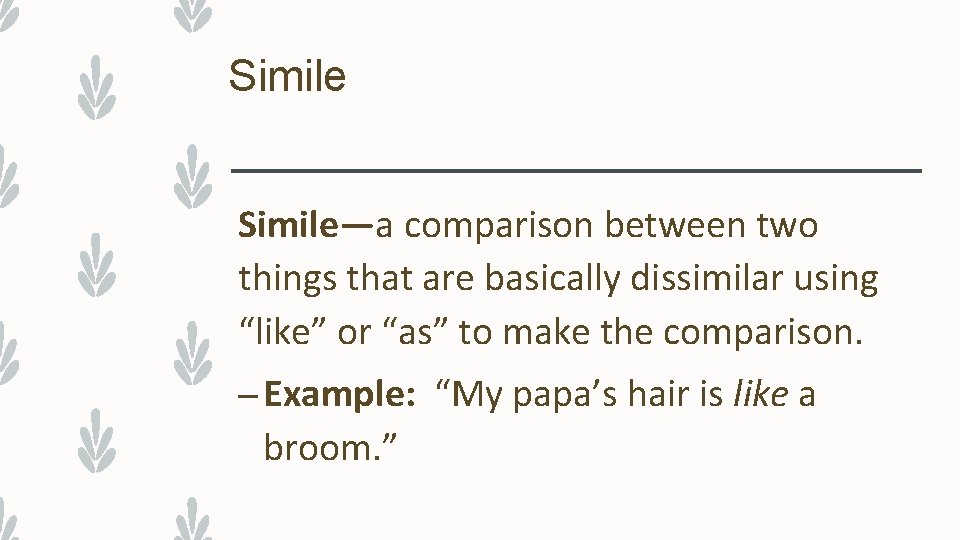
Simile—a comparison between two things that are basically dissimilar using “like” or “as” to make the comparison. – Example: “My papa’s hair is like a broom. ”
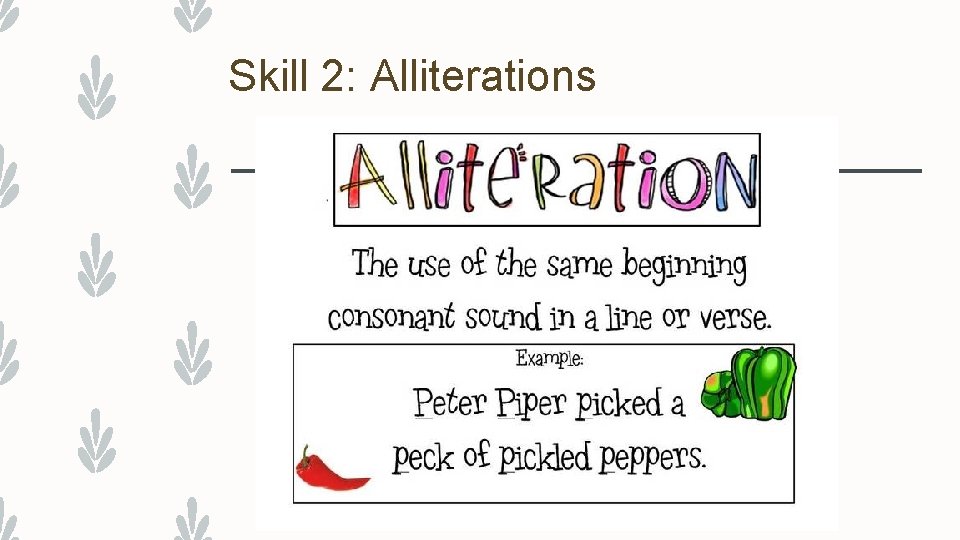
Skill 2: Alliterations
Alliteration – Alliteration occurs when a series of words in a row (or close to a row) have the same first consonant sound. For example, “She sells seashells down by the sea-shore” or “Peter Piper Picked a Peck of Pickled Peppers” are both alliterative phrases
Alliteration Examples – Jesse’s jaguar is jumping and jiggling jauntily. – Walter walked wearily while wondering where Wally was. – Mike’s microphone made much music. – Ralph’s reindeer rose rapidly and ran round the room.
Personification – Personification is a figure of speech in which a thing, an idea or an animal is given human attributes. The non-human objects are portrayed in such a way that we feel they have the ability to act like human beings.
Personification Examples – Look at my car. She is a beauty, isn’t it so? – The wind whispered through dry grass. – The flowers danced in the gentle breeze. – Time and tide waits for none. – The fire swallowed the entire forest.
Sensory Details – Sensory Details: sight, sound, touch, smell, taste
Repetition—the act of repeating words or phrases for dramatic effect – Example: In “Hairs, ” the words “hair, ” “holding you, ” and “rain” are repeated.
Hyperbole – Hyperbole is the use of exaggeration as a rhetorical device or figure of speech. – Some common examples: – I am so hungry I could eat a horse. – I had a ton of chores to do.
Hyperbole Examples – A thousand tears were shed as the victory slipped through his hands. – I had to wait an eternity in the line at the deli. – My skin was as dry as the Sahara after I went into the ocean. – ****Create 2 of your own hyperboles*****
Skill 3: Allusion – An allusion is a figure of speech that refers to a place, person, or something that happened. – This can be real or imaginary and may refer to anything. – The reference can be direct or may be inferred, and can broaden the reader’s understanding. – Ex. With the strength of Hercules, he hurled both men onto his back and carried them to safety.
Allusion Examples – “I was surprised his nose was not growing like Pinocchio’s. ” This refers to the story of Pinocchio, where his nose grew whenever he told a lie. – “When she lost her job, she acted like a Scrooge, and refused to buy anything that wasn’t necessary. ” Scrooge was an extremely stingy character from Charles Dickens’, A Christmas Carol. – “He was a real Romeo with the ladies. ” Romeo was a character in Shakespeare’s play, Romeo and Juliet, and was very romantic in expressing his love for Juliet.