
FIGURATIVE LANGUAGE AND THE SCARLET IBIS ENGLISH I
FIGURATIVE LANGUAGE AND “THE SCARLET IBIS” ENGLISH I
FLASH REVIEW • A short story is a piece of writing that is shorter than a novel. • So far, we have learned about four literary elements that are found in short stories: • Plot: What happens during a story • 5 Parts: Exposition, Rising Action, Climax, Falling Action, Resolution • Characterization: The information an author gives you regarding characters in a short story • Implicit/Explicit characterization, Static/ Dynamic character • Setting: When and where a story takes place • When: Time of day, time of year, and time in history • Where: Specific and general setting • Mood: How the story makes the audience feel • Emotions, not just “happy” or “sad”
FIGURATIVE/LITERAL LANGUAGE • Literal is real, figurative is imaginary! • Literal language occurs when words function exactly as described. • Example 1: The car is red. • Example 2: The Eagles won the football game. • Figurative language occurs when the author wants to paint an image in the reader’s mind. The author uses words that have an implied (or alternate) meaning. • Example 1: I’ve got your back. • Example 2: Let’s go chill!
FIGURATIVE LANGUAGE: SIMILE • A simile is a comparison of two objects using the words “like” or “as. ” • Example 1: Anna is as busy as a bee. • Example 2: Harry and Jimmy are like two peas in a pod.
FIGURATIVE LANGUAGE: SIMILE • Note: Using “like” or “as” in a sentence does not create a simile! A comparison must be made. • Not a simile: I like candy. • Simile: Mandy is sweet like candy.
FIGURATIVE LANGUAGE: METAPHOR • A metaphor is a comparison made without using “like” or “as. ” • Example 1: All the world is a stage. • Example 2: Men are dogs.
FIGURATIVE LANGUAGE: PERSONIFICATION • Personification occurs when human traits are given to objects or ideas. • Example 1: The sunlight danced upon the water. • Example 2: She is a graceful swan.
FIGURATIVE LANGUAGE: HYPERBOLE • A hyperbole uses exaggeration to show a strong feeling or effect. • Example 1: All hands on deck! • Example 2: My next class is a million miles away.
FIGURATIVE LANGUAGE: ONOMATOPOEIA • An onomatopoeia occurs when you use a word that “makes” a sound. • Example 1: Oink • Example 2: Buzz • Example 3: Pop
FIGURATIVE LANGUAGE: IDIOM • An idiom is a saying that isn’t meant to be taken literally. • Example 1: You are the apple of my eye. • Example 2: I wear my heart on my sleeve.
FIGURATIVE LANGUAGE: ALLITERATION • Alliteration occurs when a sentence or phrase begins with the same letter or sound. • Tongue twisters often use alliteration! • Example 1: She sells seashells by the sea shore. • Example 2: Peter Piper picked a peck of pickled peppers.
WHY USE FIGURATIVE LANGUAGE? • Figurative language is also known as descriptive language or poetic language. • Figurative language helps the writer paint a picture in the reader’s mind. This is called imagery.
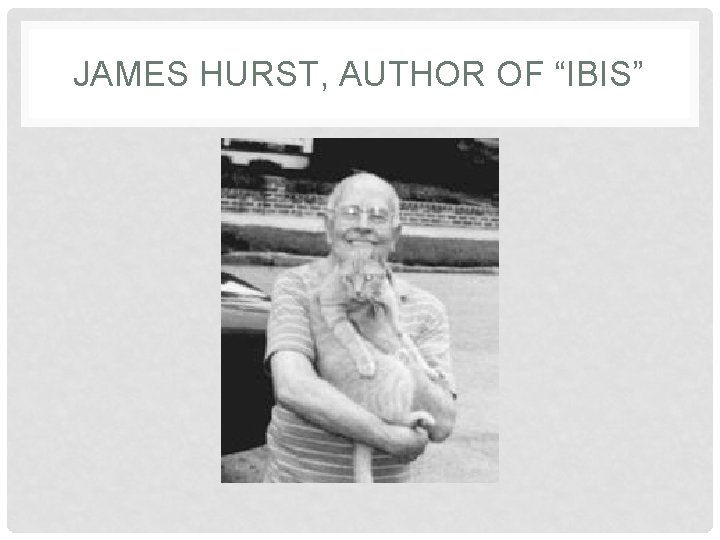
JAMES HURST, AUTHOR OF “IBIS”
WHO IS JAMES HURST? • James Hurst was born on January 1, 1922 near Jacksonville, North Carolina. • He attended Booker T. Washington high school in Atlanta, Georgia. • After graduating from high school, Hurst attended North Carolina State College where he studied chemical engineering. • After serving in the military during World War II, Hurst decided to become an opera singer and studied at the Julliard School of Music in New York. • Hurst decided to leave his singing career behind to become a banker in New York. Hurst enjoyed writing plays and short stories in his spare time.
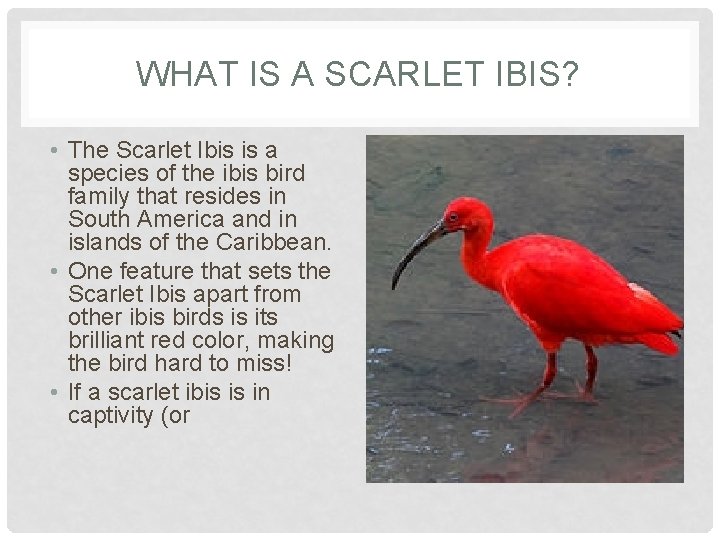
WHAT IS A SCARLET IBIS? • The Scarlet Ibis is a species of the ibis bird family that resides in South America and in islands of the Caribbean. • One feature that sets the Scarlet Ibis apart from other ibis birds is its brilliant red color, making the bird hard to miss! • If a scarlet ibis is in captivity (or
RESOURCES • http: //d. gr-assets. com/authors/1254247775 p 5/59410. jpg • http: //resources. waza. org/files/images/w(415)h(252)c(1) q(90)/ee 8 fc 35 ad 33889 e 4 e 8228 e 54 c 4221419. jpg
- Slides: 16