
Fighting WWI Treaty of Versailles Enduring Understandings 1
- Slides: 10
Fighting WWI – Treaty of Versailles Enduring Understandings 1. Nationalism, imperialism, militarism, and alliances propelled the industrialized nations into a devastating world war. 2. Advancement of technology changed the nature of global conflict and cooperation. 3. Cooperation among nations may not necessarily be fair for all parties. 1. Review events of WWI by plotting the key events on a timeline – color code Eastern Front, Western Front, Southern and rest of the world 2. Complete page 15 – graphically organize understanding of how the war ended with the Treaty of Versailles. 3. Compare how the Treaty of Versailles compared with the Congress of Vienna and the lessons to be learned from the differences by completing page 16. 4. Work with groups on storybook
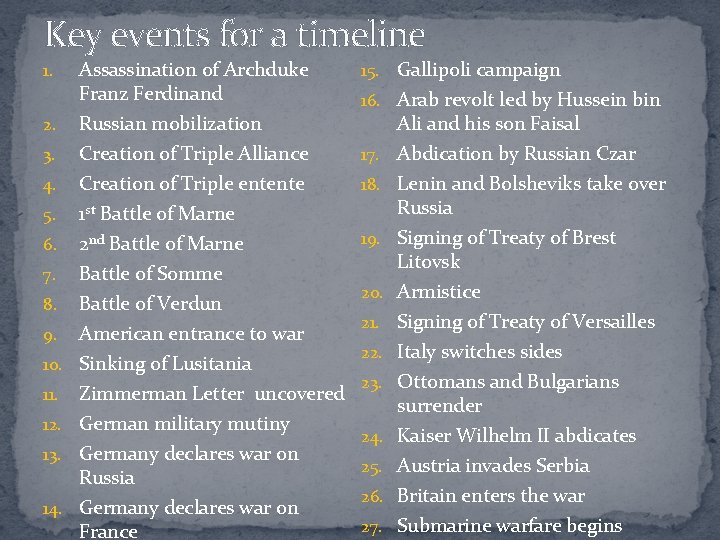
Key events for a timeline 1. 2. 3. 4. 5. 6. 7. 8. 9. 10. 11. 12. 13. 14. Assassination of Archduke Franz Ferdinand Russian mobilization Creation of Triple Alliance Creation of Triple entente 1 st Battle of Marne 2 nd Battle of Marne Battle of Somme Battle of Verdun American entrance to war Sinking of Lusitania Zimmerman Letter uncovered German military mutiny Germany declares war on Russia Germany declares war on France 15. Gallipoli campaign 16. Arab revolt led by Hussein bin 17. 18. 19. 20. 21. 22. 23. 24. 25. 26. 27. Ali and his son Faisal Abdication by Russian Czar Lenin and Bolsheviks take over Russia Signing of Treaty of Brest Litovsk Armistice Signing of Treaty of Versailles Italy switches sides Ottomans and Bulgarians surrender Kaiser Wilhelm II abdicates Austria invades Serbia Britain enters the war Submarine warfare begins
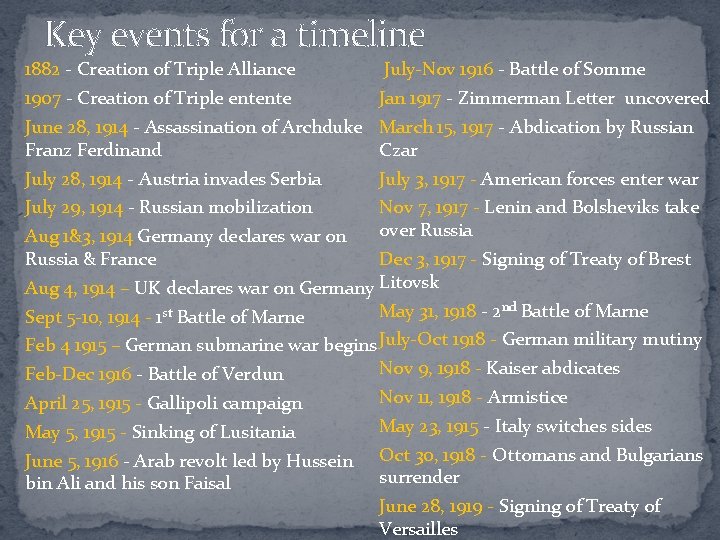
Key events for a timeline 1882 - Creation of Triple Alliance July-Nov 1916 - Battle of Somme 1907 - Creation of Triple entente Jan 1917 - Zimmerman Letter uncovered June 28, 1914 - Assassination of Archduke March 15, 1917 - Abdication by Russian Franz Ferdinand Czar July 28, 1914 - Austria invades Serbia July 3, 1917 - American forces enter war July 29, 1914 - Russian mobilization Nov 7, 1917 - Lenin and Bolsheviks take over Russia Aug 1&3, 1914 Germany declares war on Russia & France Dec 3, 1917 - Signing of Treaty of Brest Aug 4, 1914 – UK declares war on Germany Litovsk Sept 5 -10, 1914 - 1 st Battle of Marne May 31, 1918 - 2 nd Battle of Marne April 25, 1915 - Gallipoli campaign Nov 11, 1918 - Armistice Feb 4 1915 – German submarine war begins July-Oct 1918 - German military mutiny Nov 9, 1918 - Kaiser abdicates Feb-Dec 1916 - Battle of Verdun May 5, 1915 - Sinking of Lusitania June 5, 1916 - Arab revolt led by Hussein bin Ali and his son Faisal May 23, 1915 - Italy switches sides Oct 30, 1918 - Ottomans and Bulgarians surrender June 28, 1919 - Signing of Treaty of Versailles
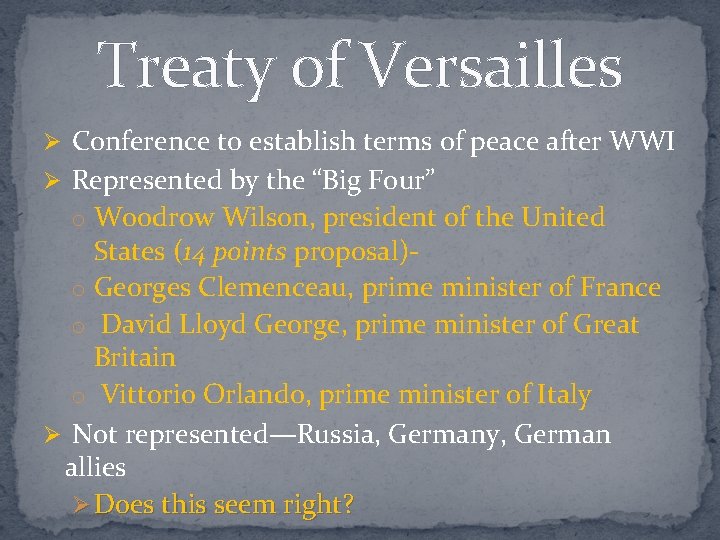
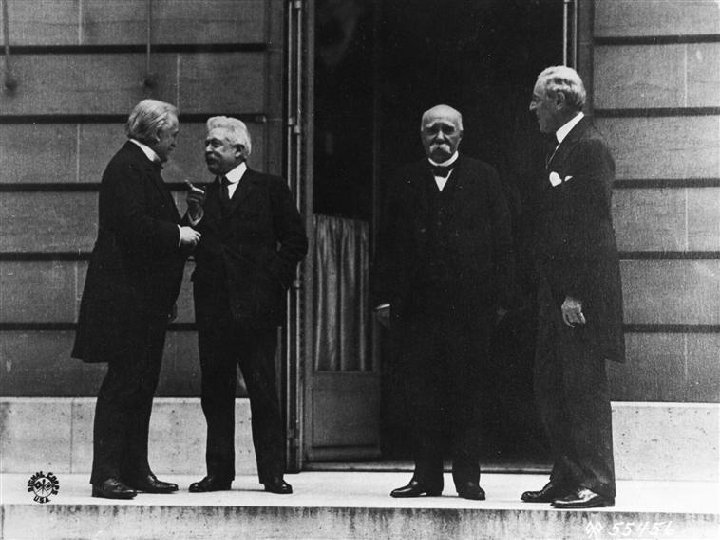
Treaty of Versailles Ø Conference to establish terms of peace after WWI Ø Represented by the “Big Four” o Woodrow Wilson, president of the United States (14 points proposal)o Georges Clemenceau, prime minister of France o David Lloyd George, prime minister of Great Britain o Vittorio Orlando, prime minister of Italy Ø Not represented—Russia, Germany, German allies Ø Does this seem right?
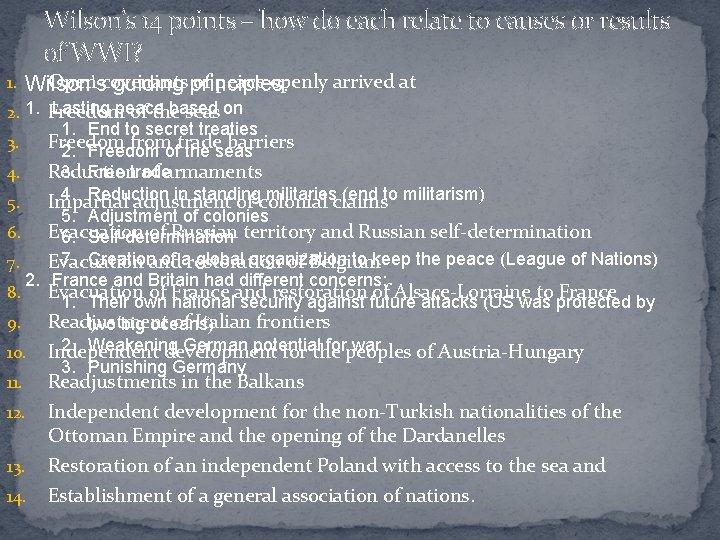
Wilson’s 14 points – how do each relate to causes or results of WWI? 1. Open covenants of peace openly arrived at Wilson’s guiding principles: Lasting peace based 2. 1. Freedom of the seas on 1. End to secret treaties 3. Freedom fromoftrade barriers 2. Freedom the seas 3. Free trade 4. Reduction of armaments 4. Reduction in standing militariesclaims (end to militarism) 5. Impartial adjustment of colonial 5. Adjustment of colonies 6. Evacuation of Russian territory and Russian self-determination 6. Self-determination 7. Creationand of arestoration global organization to keep the peace (League of Nations) 7. Evacuation of Belgium 2. France and Britain had different concerns: 8. Evacuation of France and restoration of Alsace-Lorraine to France 1. Their own national security against future attacks (US was protected by 9. Readjustment of Italian frontiers two big oceans) 2. Weakening German potential forpeoples war 10. Independent development for the of Austria-Hungary 3. Punishing Germany 11. Readjustments in the Balkans 12. 13. 14. Independent development for the non-Turkish nationalities of the Ottoman Empire and the opening of the Dardanelles Restoration of an independent Poland with access to the sea and Establishment of a general association of nations.
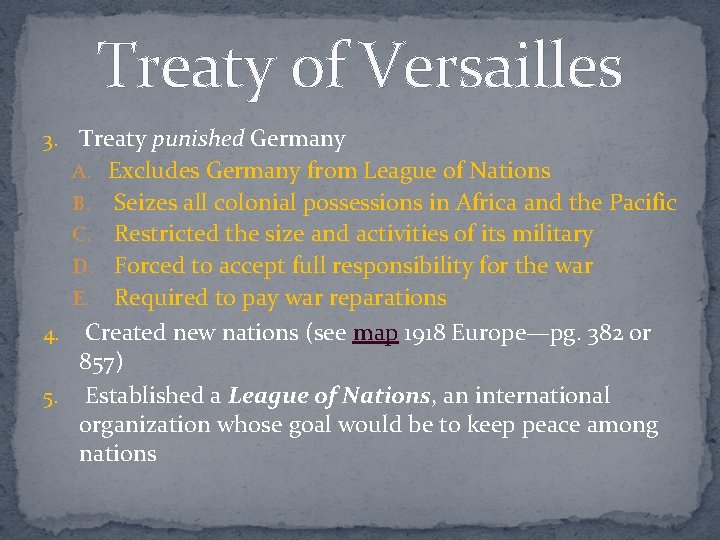
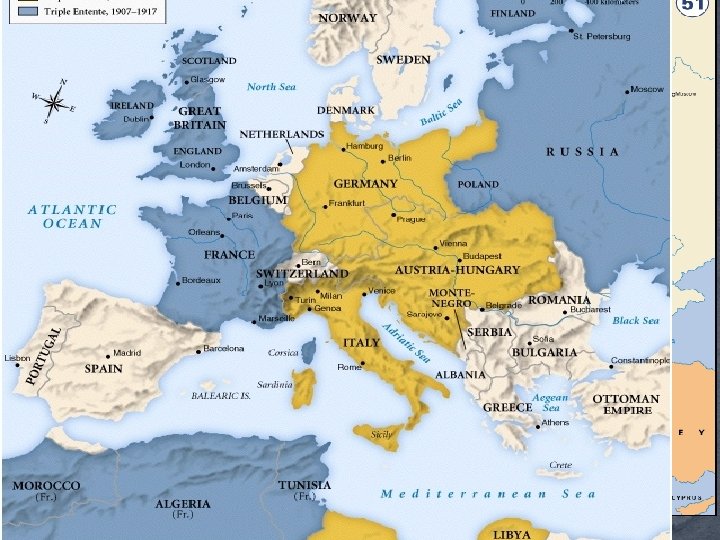
Treaty of Versailles Treaty punished Germany A. Excludes Germany from League of Nations B. Seizes all colonial possessions in Africa and the Pacific C. Restricted the size and activities of its military D. Forced to accept full responsibility for the war E. Required to pay war reparations 4. Created new nations (see map 1918 Europe—pg. 382 or 857) 5. Established a League of Nations, an international organization whose goal would be to keep peace among nations 3.
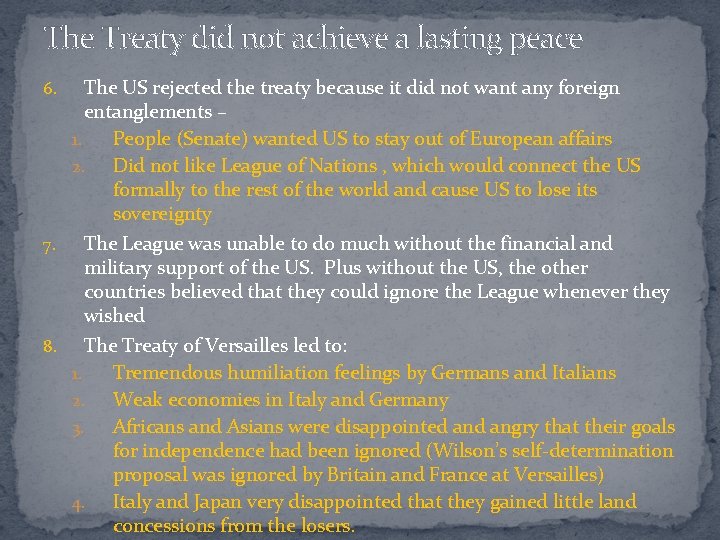
The Treaty did not achieve a lasting peace The US rejected the treaty because it did not want any foreign entanglements – 1. People (Senate) wanted US to stay out of European affairs 2. Did not like League of Nations , which would connect the US formally to the rest of the world and cause US to lose its sovereignty 7. The League was unable to do much without the financial and military support of the US. Plus without the US, the other countries believed that they could ignore the League whenever they wished 8. The Treaty of Versailles led to: 1. Tremendous humiliation feelings by Germans and Italians 2. Weak economies in Italy and Germany 3. Africans and Asians were disappointed angry that their goals for independence had been ignored (Wilson’s self-determination proposal was ignored by Britain and France at Versailles) 4. Italy and Japan very disappointed that they gained little land concessions from the losers. 6.
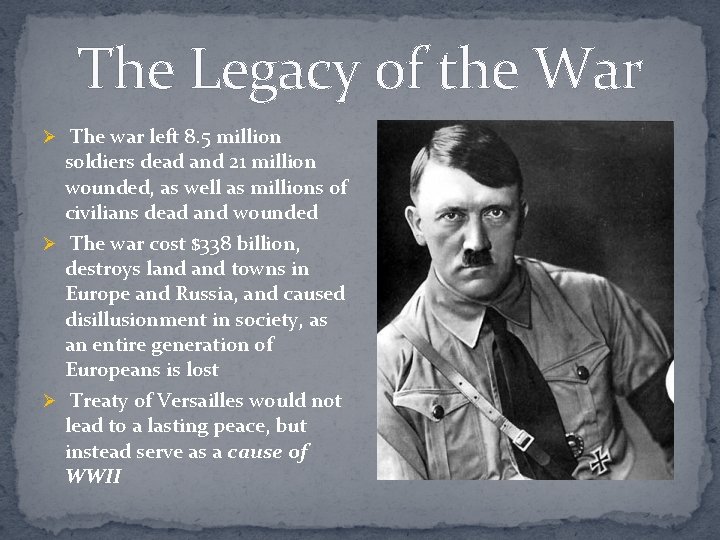
The Legacy of the War Ø The war left 8. 5 million soldiers dead and 21 million wounded, as well as millions of civilians dead and wounded Ø The war cost $338 billion, destroys land towns in Europe and Russia, and caused disillusionment in society, as an entire generation of Europeans is lost Ø Treaty of Versailles would not lead to a lasting peace, but instead serve as a cause of WWII