
Fighter Planes Basic Idea Fighter aircraft aircraft designed
Fighter Planes

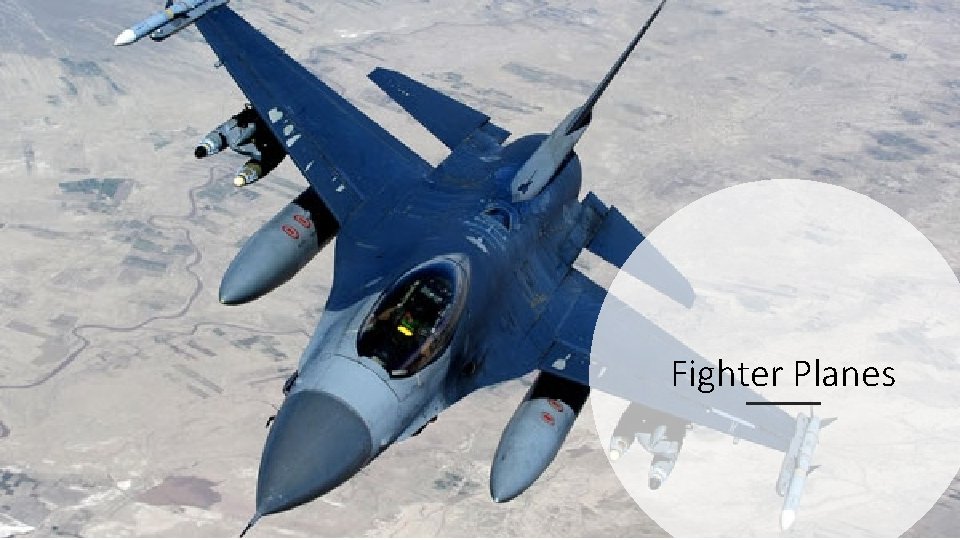
Basic Idea • Fighter aircraft, aircraft designed primarily to secure control of essential airspace by destroying enemy aircraft in combat. Fighters must be capable of the highest possible performance in order to be able to outfly and outmaneuver opposing fighters. Above all, they must be armed with specialized weapons capable of hitting and destroying enemy aircraft.
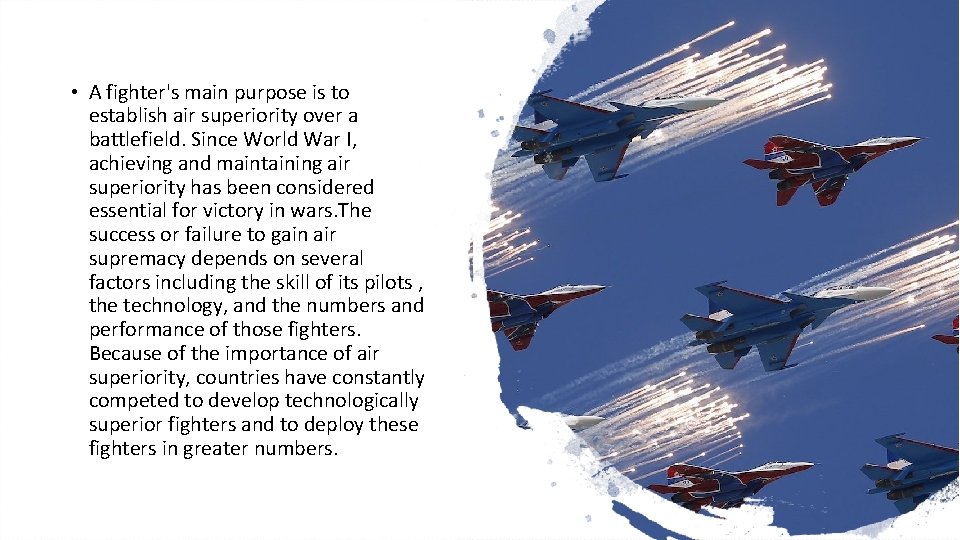
• A fighter's main purpose is to establish air superiority over a battlefield. Since World War I, achieving and maintaining air superiority has been considered essential for victory in wars. The success or failure to gain air supremacy depends on several factors including the skill of its pilots , the technology, and the numbers and performance of those fighters. Because of the importance of air superiority, countries have constantly competed to develop technologically superior fighters and to deploy these fighters in greater numbers.
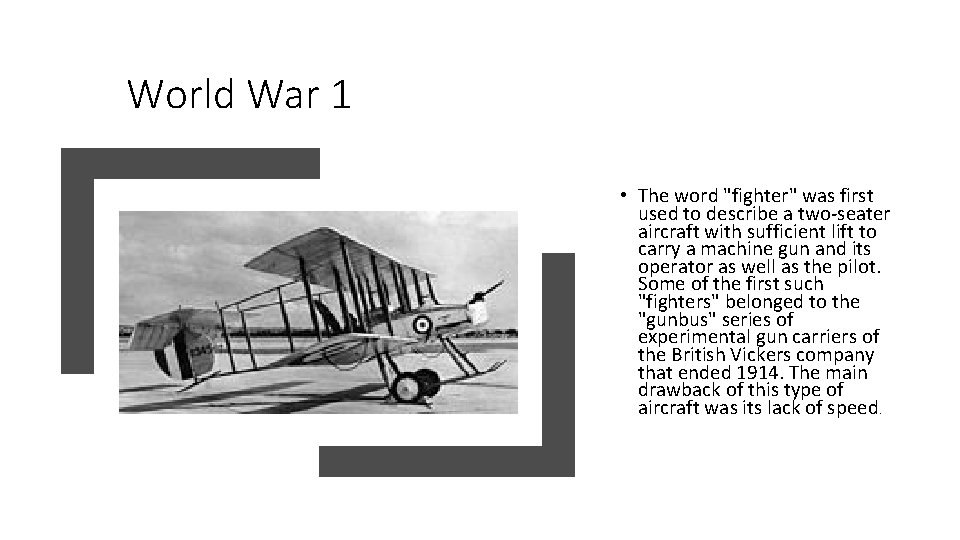
World War 1 • The word "fighter" was first used to describe a two-seater aircraft with sufficient lift to carry a machine gun and its operator as well as the pilot. Some of the first such "fighters" belonged to the "gunbus" series of experimental gun carriers of the British Vickers company that ended 1914. The main drawback of this type of aircraft was its lack of speed.
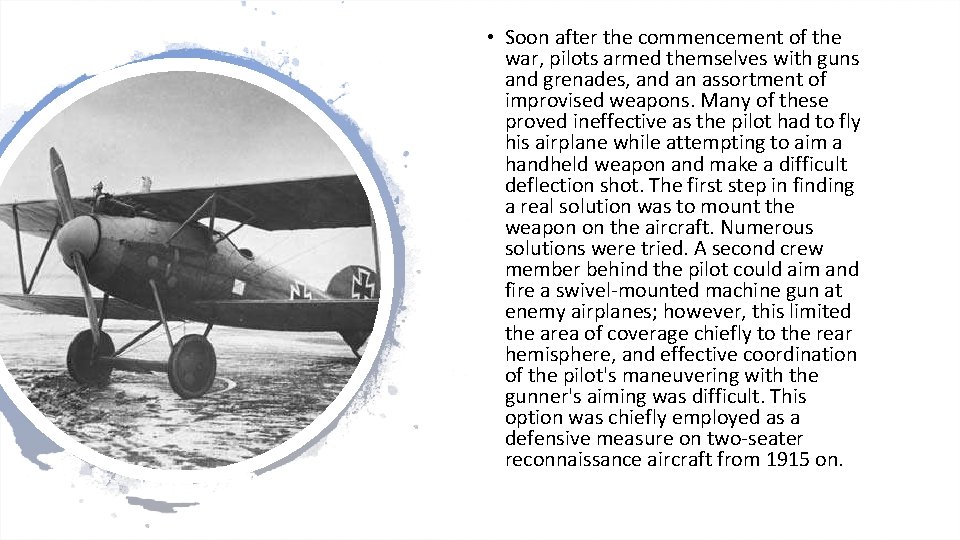
• Soon after the commencement of the war, pilots armed themselves with guns and grenades, and an assortment of improvised weapons. Many of these proved ineffective as the pilot had to fly his airplane while attempting to aim a handheld weapon and make a difficult deflection shot. The first step in finding a real solution was to mount the weapon on the aircraft. Numerous solutions were tried. A second crew member behind the pilot could aim and fire a swivel-mounted machine gun at enemy airplanes; however, this limited the area of coverage chiefly to the rear hemisphere, and effective coordination of the pilot's maneuvering with the gunner's aiming was difficult. This option was chiefly employed as a defensive measure on two-seater reconnaissance aircraft from 1915 on.
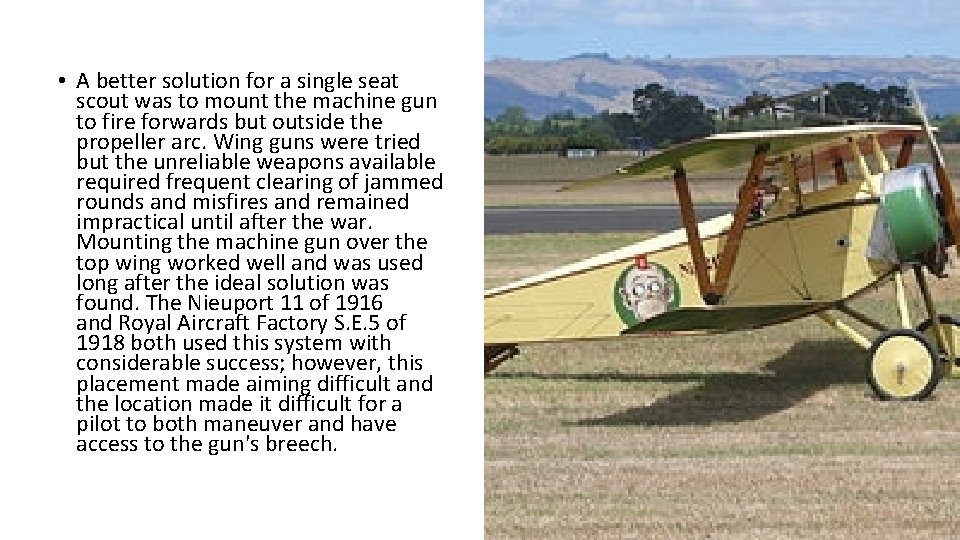
• A better solution for a single seat scout was to mount the machine gun to fire forwards but outside the propeller arc. Wing guns were tried but the unreliable weapons available required frequent clearing of jammed rounds and misfires and remained impractical until after the war. Mounting the machine gun over the top wing worked well and was used long after the ideal solution was found. The Nieuport 11 of 1916 and Royal Aircraft Factory S. E. 5 of 1918 both used this system with considerable success; however, this placement made aiming difficult and the location made it difficult for a pilot to both maneuver and have access to the gun's breech.
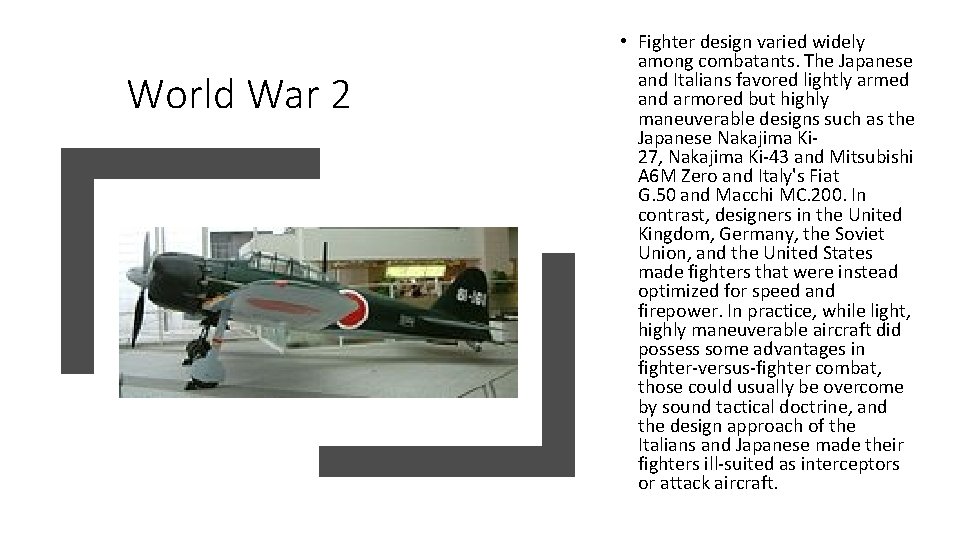
World War 2 • Fighter design varied widely among combatants. The Japanese and Italians favored lightly armed and armored but highly maneuverable designs such as the Japanese Nakajima Ki 27, Nakajima Ki-43 and Mitsubishi A 6 M Zero and Italy's Fiat G. 50 and Macchi MC. 200. In contrast, designers in the United Kingdom, Germany, the Soviet Union, and the United States made fighters that were instead optimized for speed and firepower. In practice, while light, highly maneuverable aircraft did possess some advantages in fighter-versus-fighter combat, those could usually be overcome by sound tactical doctrine, and the design approach of the Italians and Japanese made their fighters ill-suited as interceptors or attack aircraft.
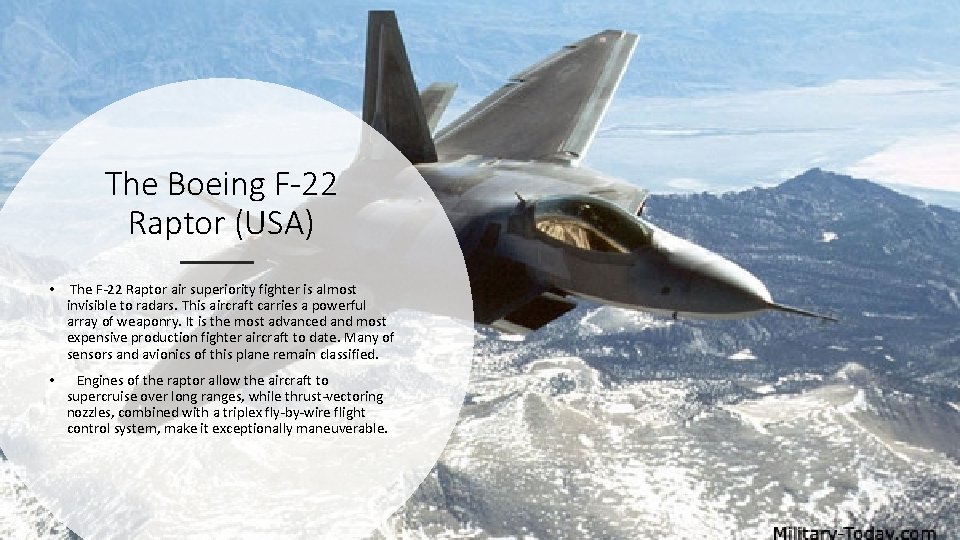
The Boeing F-22 Raptor (USA) • The F-22 Raptor air superiority fighter is almost invisible to radars. This aircraft carries a powerful array of weaponry. It is the most advanced and most expensive production fighter aircraft to date. Many of sensors and avionics of this plane remain classified. • Engines of the raptor allow the aircraft to supercruise over long ranges, while thrust-vectoring nozzles, combined with a triplex fly-by-wire flight control system, make it exceptionally maneuverable.
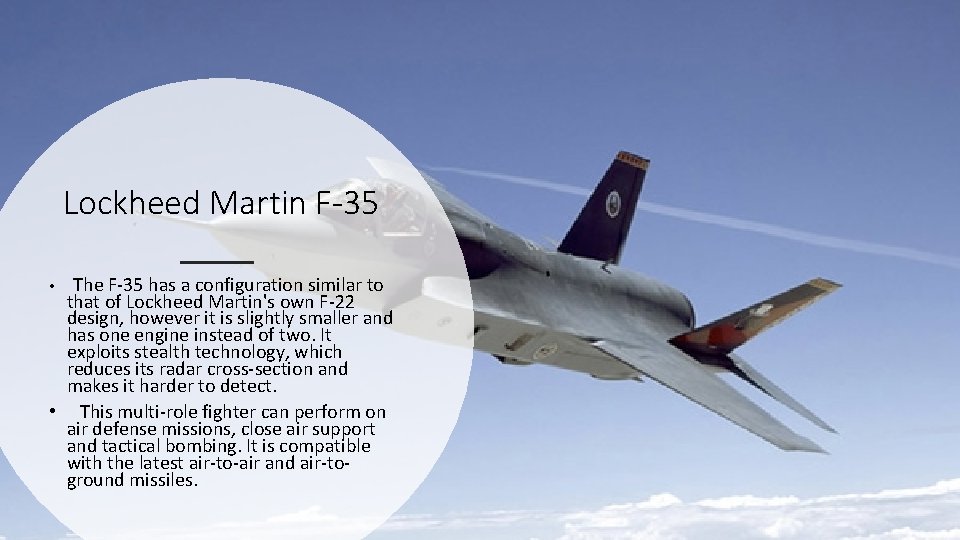
Lockheed Martin F-35 The F-35 has a configuration similar to that of Lockheed Martin's own F-22 design, however it is slightly smaller and has one engine instead of two. It exploits stealth technology, which reduces its radar cross-section and makes it harder to detect. • This multi-role fighter can perform on air defense missions, close air support and tactical bombing. It is compatible with the latest air-to-air and air-toground missiles. •
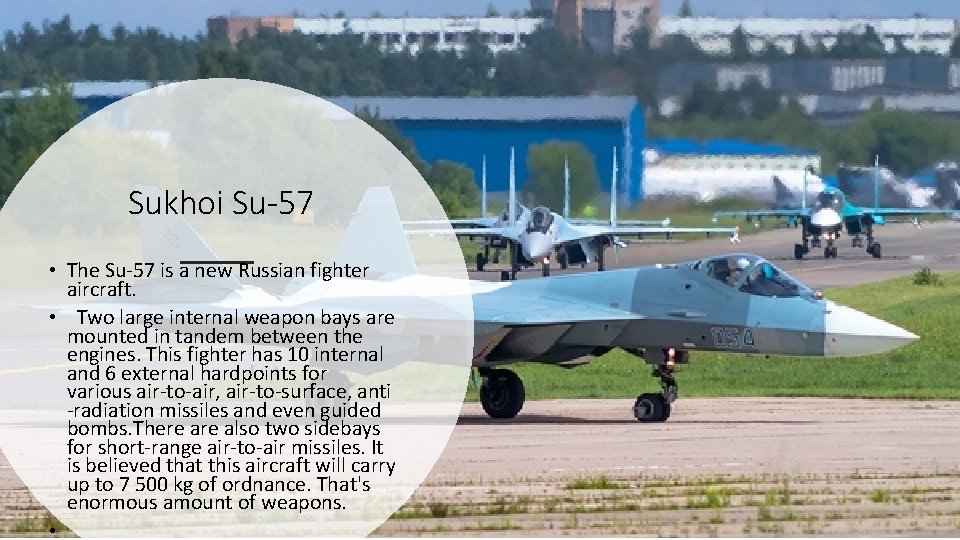
Sukhoi Su-57 • The Su-57 is a new Russian fighter aircraft. • Two large internal weapon bays are mounted in tandem between the engines. This fighter has 10 internal and 6 external hardpoints for various air-to-air, air-to-surface, anti -radiation missiles and even guided bombs. There also two sidebays for short-range air-to-air missiles. It is believed that this aircraft will carry up to 7 500 kg of ordnance. That's enormous amount of weapons. •
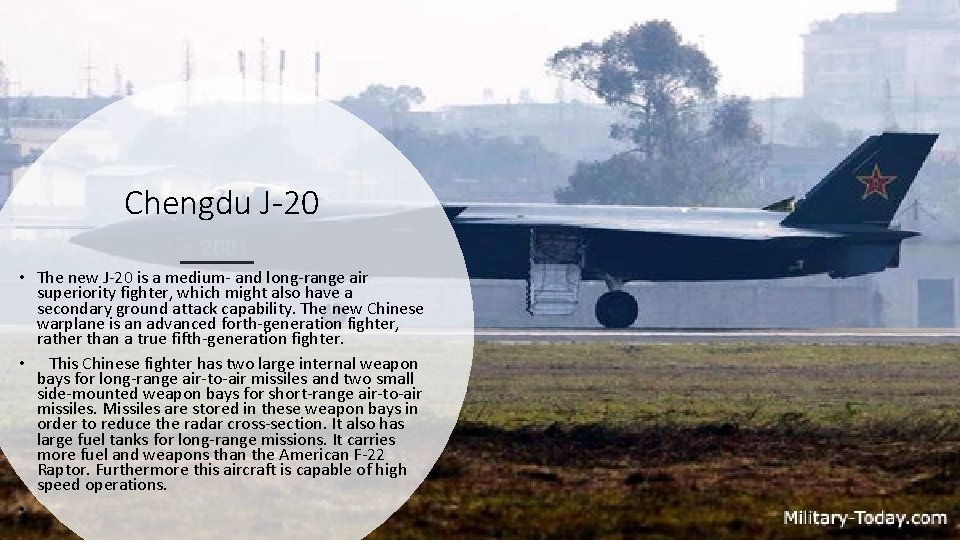
Chengdu J-20 • The new J-20 is a medium- and long-range air superiority fighter, which might also have a secondary ground attack capability. The new Chinese warplane is an advanced forth-generation fighter, rather than a true fifth-generation fighter. • This Chinese fighter has two large internal weapon bays for long-range air-to-air missiles and two small side-mounted weapon bays for short-range air-to-air missiles. Missiles are stored in these weapon bays in order to reduce the radar cross-section. It also has large fuel tanks for long-range missions. It carries more fuel and weapons than the American F-22 Raptor. Furthermore this aircraft is capable of high speed operations. •
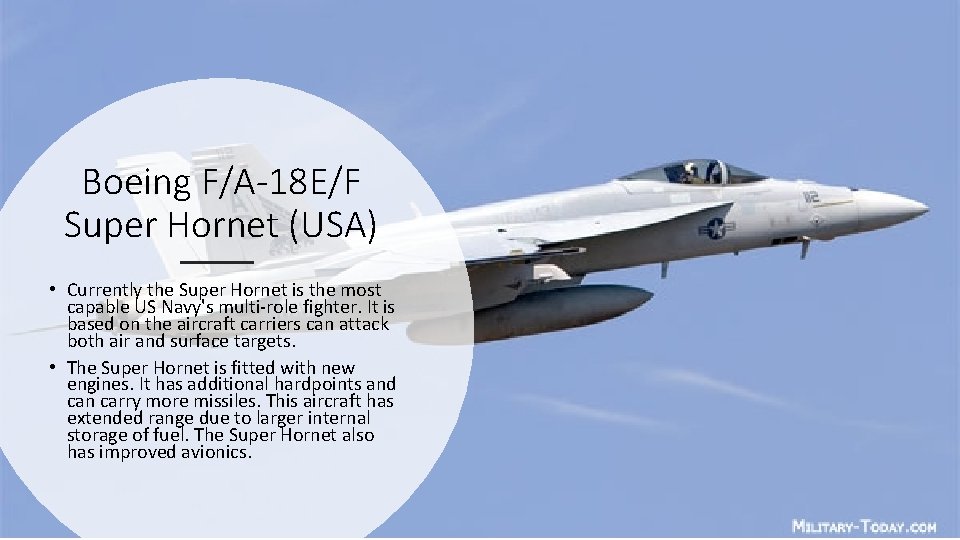
Boeing F/A-18 E/F Super Hornet (USA) • Currently the Super Hornet is the most capable US Navy's multi-role fighter. It is based on the aircraft carriers can attack both air and surface targets. • The Super Hornet is fitted with new engines. It has additional hardpoints and can carry more missiles. This aircraft has extended range due to larger internal storage of fuel. The Super Hornet also has improved avionics.

Sources • en. Wikipedia. com • Britannica. com
- Slides: 14