
Fig 9 Summary of serotonin actions on spikeevoked
- Slides: 1
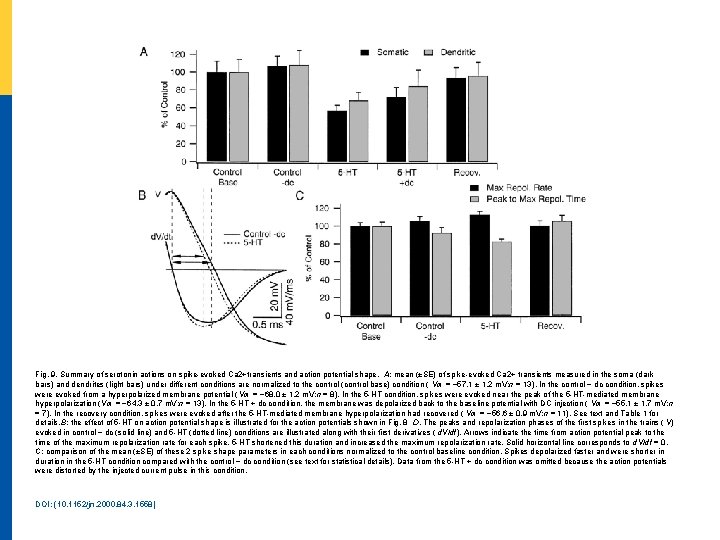
Fig. 9. Summary of serotonin actions on spike-evoked Ca 2+transients and action potential shape. A: mean (±SE) of spike-evoked Ca 2+ transients measured in the soma (dark bars) and dendrites (light bars) under different conditions are normalized to the control (control base) condition ( Vm = − 57. 1 ± 1. 2 m. V; n = 13). In the control − dc condition, spikes were evoked from a hyperpolarized membrane potential ( Vm = − 68. 0 ± 1. 2 m. V; n = 8). In the 5 -HT condition, spikes were evoked near the peak of the 5 -HT-mediated membrane hyperpolarization (Vm = − 64. 3 ± 0. 7 m. V; n = 13). In the 5 -HT + dc condition, the membrane was depolarized back to the baseline potential with DC injection ( Vm = − 55. 1 ± 1. 7 m. V; n = 7). In the recovery condition, spikes were evoked after the 5 -HT-mediated membrane hyperpolarization had recovered ( Vm = − 56. 6 ± 0. 9 m. V; n = 11). See text and Table 1 for details. B: the effect of 5 -HT on action potential shape is illustrated for the action potentials shown in Fig. 8 D. The peaks and repolarization phases of the first spikes in the trains ( V) evoked in control − dc (solid line) and 5 -HT (dotted line) conditions are illustrated along with their first derivatives ( d. V/dt). Arrows indicate the time from action potential peak to the time of the maximum repolarization rate for each spike. 5 -HT shortened this duration and increased the maximum repolarization rate. Solid horizontal line corresponds to d. V/dt = 0. C: comparison of the mean (±SE) of these 2 spike shape parameters in each conditions normalized to the control baseline condition. Spikes depolarized faster and were shorter in duration in the 5 -HT condition compared with the control − dc condition (see text for statistical details). Data from the 5 -HT + dc condition was omitted because the action potentials were distorted by the injected current pulse in this condition. DOI: (10. 1152/jn. 2000. 84. 3. 1558)