
Fig 8 Neuronal circuit models for investigating the
- Slides: 1
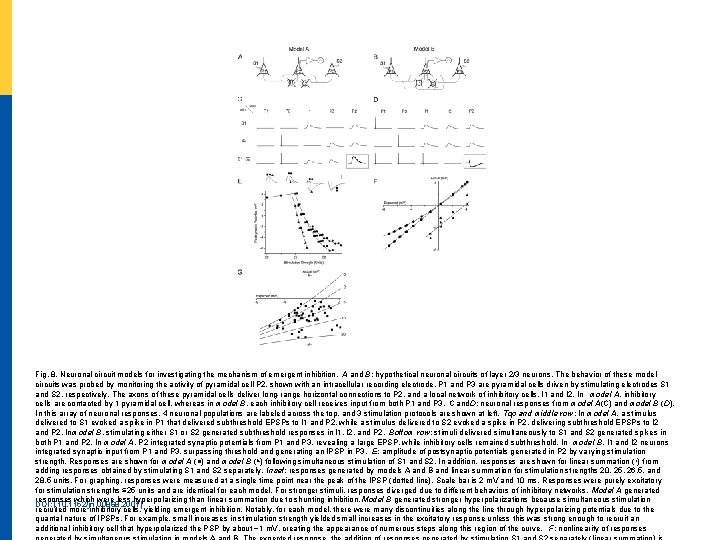
Fig. 8. Neuronal circuit models for investigating the mechanism of emergent inhibition. A and B: hypothetical neuronal circuits of layer 2/3 neurons. The behavior of these model circuits was probed by monitoring the activity of pyramidal cell P 2, shown with an intracellular recording electrode. P 1 and P 3 are pyramidal cells driven by stimulating electrodes S 1 and S 2, respectively. The axons of these pyramidal cells deliver long-range horizontal connections to P 2, and a local network of inhibitory cells, I 1 and I 2. In model A, inhibitory cells are contacted by 1 pyramidal cell, whereas in model B, each inhibitory cell receives input from both P 1 and P 3. C and. D: neuronal responses from model A(C) and model B (D). In this array of neuronal responses, 4 neuronal populations are labeled across the top, and 3 stimulation protocols are shown at left. Top and middle row: In model A, a stimulus delivered to S 1 evoked a spike in P 1 that delivered subthreshold EPSPs to I 1 and P 2, while a stimulus delivered to S 2 evoked a spike in P 2, delivering subthreshold EPSPs to I 2 and P 2. Inmodel B, stimulating either S 1 or S 2 generated subthreshold responses in I 1, I 2, and P 2. Bottom row: stimuli delivered simultaneously to S 1 and S 2 generated spikes in both P 1 and P 2. In model A, P 2 integrated synaptic potentials from P 1 and P 3, revealing a large EPSP, while inhibitory cells remained subthreshold. In model B, I 1 and I 2 neurons integrated synaptic input from P 1 and P 3, surpassing threshold and generating an IPSP in P 3. E: amplitude of postsynaptic potentials generated in P 2 by varying stimulation strength. Responses are shown for model A (●) and model B (▴) following simultaneous stimulation of S 1 and S 2. In addition, responses are shown for linear summation (▪) from adding responses obtained by stimulating S 1 and S 2 separately. Inset: responses generated by models A and B and linear summation for stimulation strengths 20, 25, 26. 5, and 28. 5 units. For graphing, responses were measured at a single time point near the peak of the IPSP (dotted line). Scale bar is 2 m. V and 10 ms. Responses were purely excitatory for stimulation strengths ≤ 25 units and are identical for each model. For stronger stimuli, responses diverged due to different behaviors of inhibitory networks. Model A generated responses which were less hyperpolarizing than linear summation due to shunting inhibition. Model B generated stronger hyperpolarizations because simultaneous stimulation DOI: (10. 1152/jn. 00868. 2001) recruited more inhibitory cells, yielding emergent inhibition. Notably, for each model, there were many discontinuities along the line through hyperpolarizing potentials due to the quantal nature of IPSPs. For example, small increases in stimulation strength yielded small increases in the excitatory response unless this was strong enough to recruit an additional inhibitory cell that hyperpolarized the PSP by about − 1 m. V, creating the appearance of numerous steps along this region of the curve. F: nonlinearity of responses