
Fig 4 Presteadystate currents associated with SVCT 1
- Slides: 1
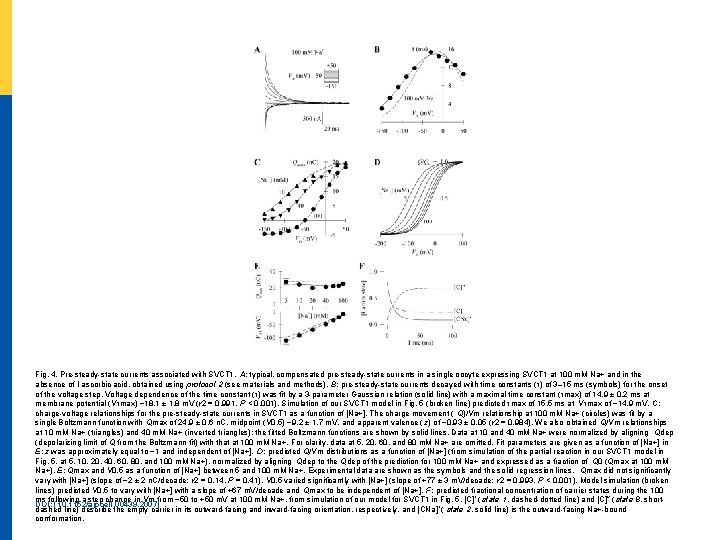
Fig. 4. Pre-steady-state currents associated with SVCT 1. A: typical, compensated pre-steady-state currents in a single oocyte expressing SVCT 1 at 100 m. M Na+ and in the absence of l-ascorbic acid, obtained using protocol 2 (see materials and methods). B: pre-steady-state currents decayed with time constants (τ) of 3– 15 ms (symbols) for the onset of the voltage step. Voltage dependence of the time constant (τ) was fit by a 3 -parameter Gaussian relation (solid line) with a maximal time constant (τmax) of 14. 9 ± 0. 2 ms at membrane potential (Vτmax) − 18. 1 ± 1. 8 m. V (r 2 = 0. 991, P < 0. 001). Simulation of our SVCT 1 model in Fig. 5 (broken line) predicted τmax of 15. 5 ms at Vτmax of − 14. 9 m. V. C: charge-voltage relationships for the pre-steady-state currents in SVCT 1 as a function of [Na+]. The charge movement ( Q)/Vm relationship at 100 m. M Na+ (circles) was fit by a single Boltzmann function with Qmax of 24. 9 ± 0. 6 n. C, midpoint ( V 0. 5) − 9. 2 ± 1. 7 m. V, and apparent valence ( z) of − 0. 93 ± 0. 05 (r 2 = 0. 984). We also obtained Q/Vm relationships at 10 m. M Na+ (triangles) and 40 m. M Na+ (inverted triangles); the fitted Boltzmann functions are shown by solid lines. Data at 10 and 40 m. M Na+ were normalized by aligning Qdep (depolarizing limit of Q from the Boltzmann fit) with that at 100 m. M Na+. For clarity, data at 5, 20, 60, and 80 m. M Na+ are omitted. Fit parameters are given as a function of [Na+] in E; z was approximately equal to − 1 and independent of [Na+]. D: predicted Q/Vm distributions as a function of [Na+] (from simulation of the partial reaction in our SVCT 1 model in Fig. 5, at 5, 10, 20, 40, 60, 80, and 100 m. M Na+), normalized by aligning Qdep to the Qdep of the prediction for 100 m. M Na+ and expressed as a fraction of Q 0 (Qmax at 100 m. M Na+). E: Qmax and V 0. 5 as a function of [Na+] between 5 and 100 m. M Na+. Experimental data are shown as the symbols and the solid regression lines. Qmax did not significantly vary with [Na+] (slope of − 2 ± 2 n. C/decade; r 2 = 0. 14, P = 0. 41). V 0. 5 varied significantly with [Na+] (slope of +77 ± 3 m. V/decade; r 2 = 0. 993, P < 0. 001). Model simulation (broken lines) predicted V 0. 5 to vary with [Na+] with a slope of +67 m. V/decade and Qmax to be independent of [Na+]. F: predicted fractional concentration of carrier states during the 100 ms following a step change in Vm from − 50 to +50 m. V at 100 m. M Na+, from simulation of our model for SVCT 1 in Fig. 5. [C]′ ( state 1, dashed-dotted line) and [C]″ ( state 8, short. DOI: (10. 1152/ajpcell. 00439. 2007) dashed line) describe the empty carrier in its outward-facing and inward-facing orientation, respectively, and [CNa]′ ( state 2, solid line) is the outward-facing Na+-bound conformation.