
Fig 10 11 Energy of electron e Excited
- Slides: 16
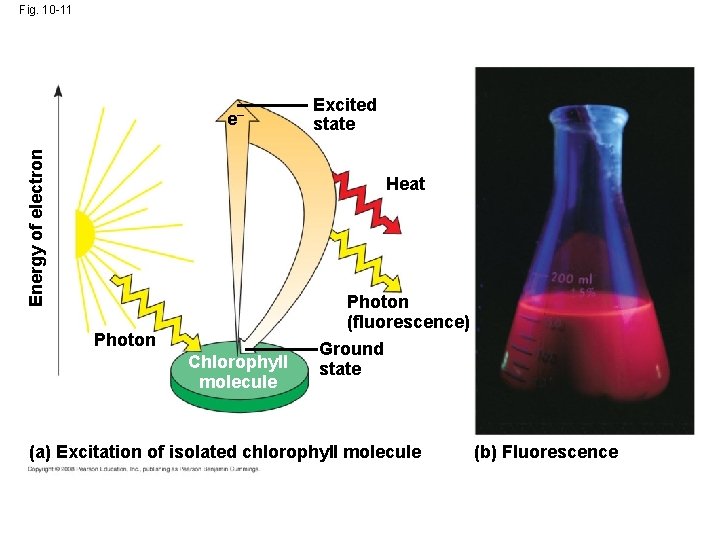
Fig. 10 -11 Energy of electron e– Excited state Heat Photon (fluorescence) Photon Chlorophyll molecule Ground state (a) Excitation of isolated chlorophyll molecule (b) Fluorescence
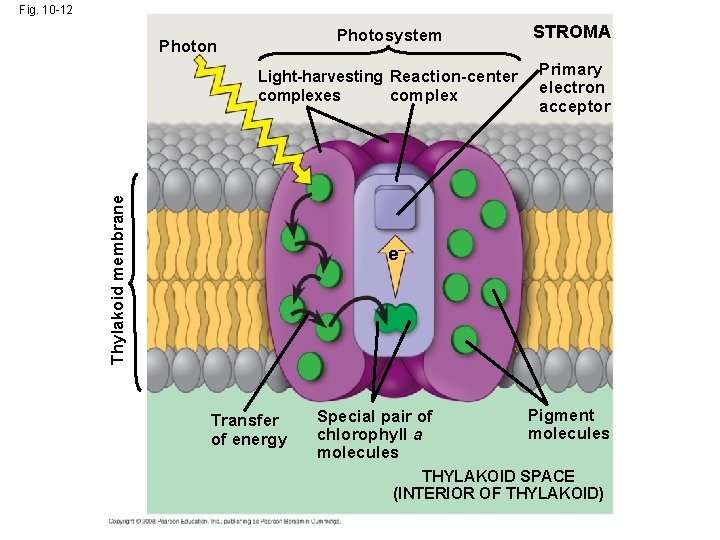
Fig. 10 -12 Photosystem STROMA Light-harvesting Reaction-center complexes Primary electron acceptor Thylakoid membrane Photon e– Transfer of energy Special pair of chlorophyll a molecules Pigment molecules THYLAKOID SPACE (INTERIOR OF THYLAKOID)
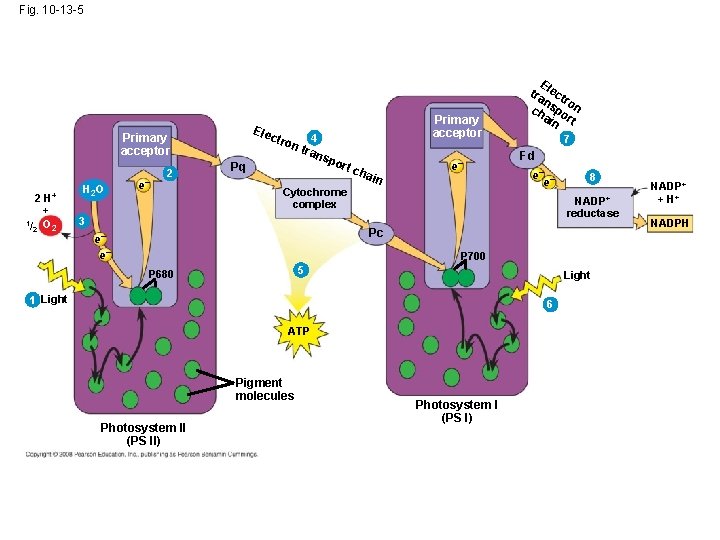
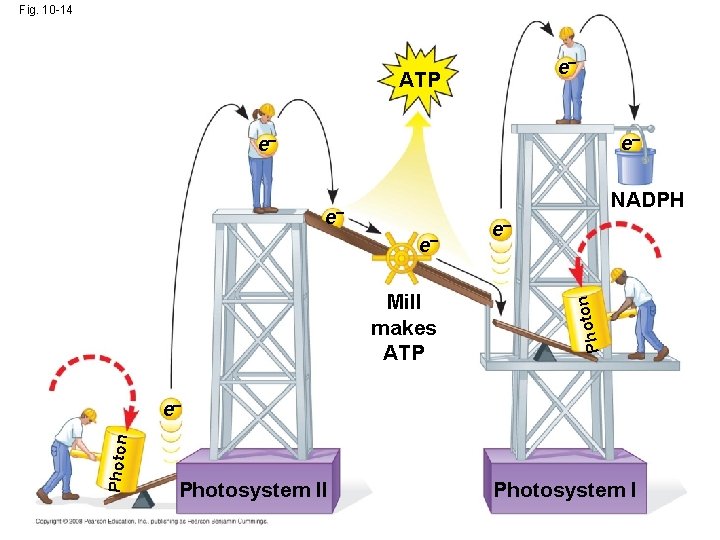
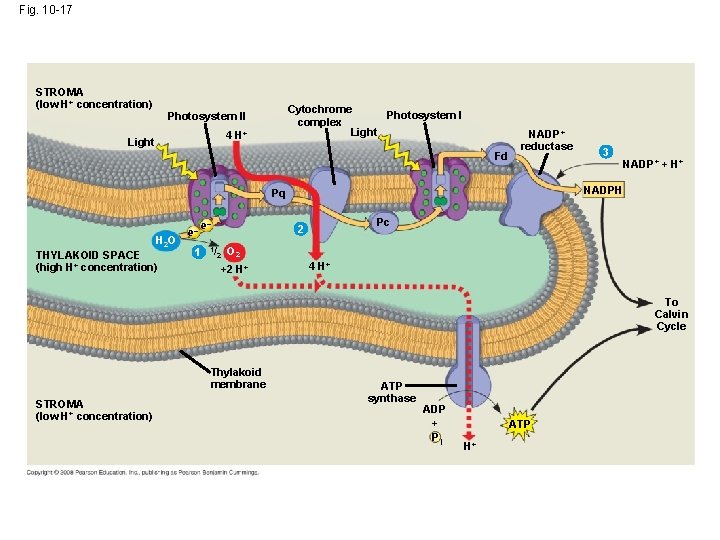
Linear Electron Flow • During the light reactions, there are two possible routes for electron flow: cyclic and linear • Linear electron flow, the primary pathway, involves both photosystems and produces ATP and NADPH using light energy Copyright © 2008 Pearson Education, Inc. , publishing as Pearson Benjamin Cummings
Fig. 10 -13 -5 Ele c Primary acceptor 2 H+ + 1/ O 2 2 H 2 O e– 2 tron Pq Primary acceptor 4 tran spo rt c hai e– n Cytochrome complex 3 E tra lect n ro ch spo n ain rt 7 Fd e– e– 8 NADP+ reductase Pc e– e– P 700 5 P 680 Light 1 Light 6 ATP Pigment molecules Photosystem II (PS II) Photosystem I (PS I) NADP+ + H+ NADPH
Fig. 10 -14 e– ATP e– e– NADPH Mill makes ATP n e– e– Photon e– Photosystem II Photosystem I
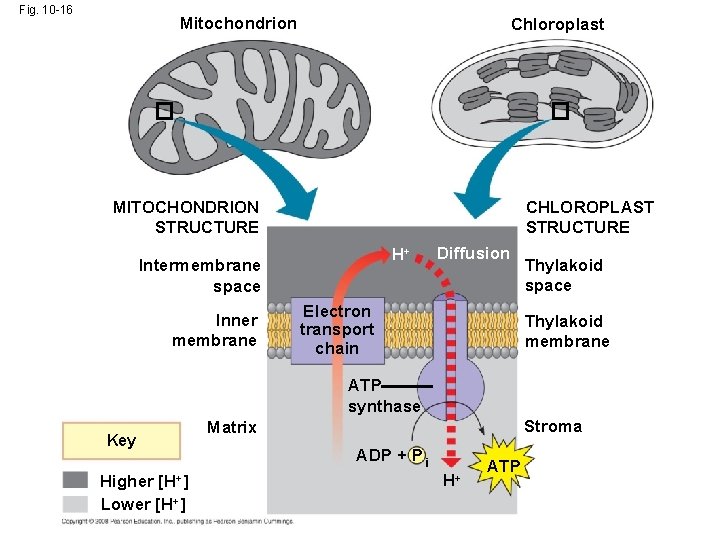
Fig. 10 -16 Mitochondrion Chloroplast MITOCHONDRION STRUCTURE CHLOROPLAST STRUCTURE H+ Intermembrane space Inner membrane Diffusion Electron transport chain Thylakoid space Thylakoid membrane ATP synthase Stroma Matrix Key ADP + P i [H+] Higher Lower [H+] H+ ATP
Fig. 10 -17 STROMA (low H+ concentration) Cytochrome Photosystem I complex Light Photosystem II 4 H+ Light Fd NADP+ reductase H 2 O THYLAKOID SPACE (high H+ concentration) 1 e– Pc 2 1/ 2 NADP+ + H+ NADPH Pq e– 3 O 2 +2 H+ 4 H+ To Calvin Cycle Thylakoid membrane STROMA (low H+ concentration) ATP synthase ADP + Pi ATP H+
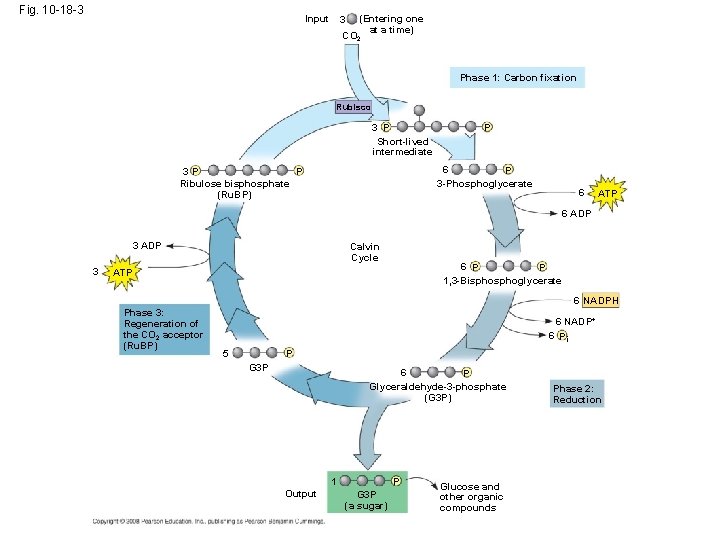
Concept 10. 3: The Calvin cycle uses ATP and NADPH to convert CO 2 to sugar • The Calvin cycle, like the citric acid cycle, regenerates its starting material after molecules enter and leave the cycle • The cycle builds sugar from smaller molecules by using ATP and the reducing power of electrons carried by NADPH Copyright © 2008 Pearson Education, Inc. , publishing as Pearson Benjamin Cummings
Fig. 10 -18 -3 Input 3 (Entering one at a time) CO 2 Phase 1: Carbon fixation Rubisco 3 P Short-lived intermediate P 6 P 3 -Phosphoglycerate 3 P P Ribulose bisphosphate (Ru. BP) 6 ATP 6 ADP 3 Calvin Cycle 6 P P 1, 3 -Bisphoglycerate ATP 6 NADPH Phase 3: Regeneration of the CO 2 acceptor (Ru. BP) 6 NADP+ 6 Pi P 5 G 3 P 6 P Glyceraldehyde-3 -phosphate (G 3 P) 1 Output P G 3 P (a sugar) Glucose and other organic compounds Phase 2: Reduction
Concept 10. 4: Alternative mechanisms of carbon fixation have evolved in hot, arid climates • Dehydration is a problem for plants, sometimes requiring trade-offs with other metabolic processes, especially photosynthesis • On hot, dry days, plants close stomata, which conserves H 2 O but also limits photosynthesis • The closing of stomata reduces access to CO 2 and causes O 2 to build up • These conditions favor a seemingly wasteful process called photorespiration Copyright © 2008 Pearson Education, Inc. , publishing as Pearson Benjamin Cummings
Photorespiration: An Evolutionary Relic? • In most plants (C 3 plants), initial fixation of CO 2, via rubisco, forms a three-carbon compound • In photorespiration, rubisco adds O 2 instead of CO 2 in the Calvin cycle • Photorespiration consumes O 2 and organic fuel and releases CO 2 without producing ATP or sugar Copyright © 2008 Pearson Education, Inc. , publishing as Pearson Benjamin Cummings
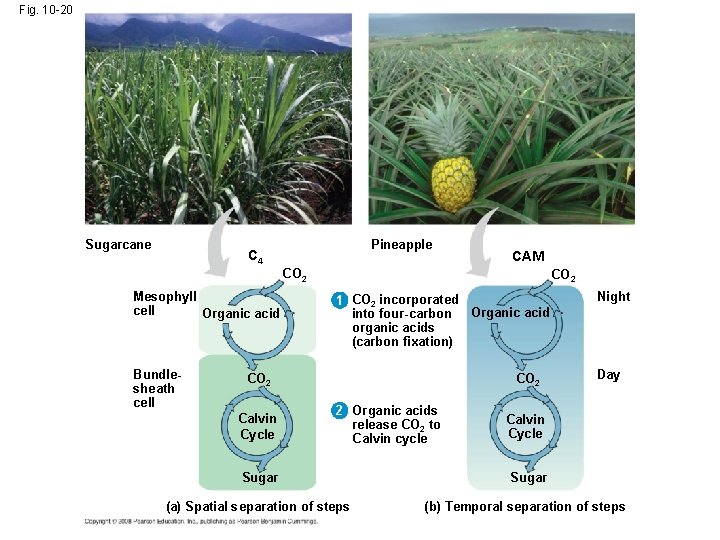
C 4 Plants • C 4 plants minimize the cost of photorespiration by incorporating CO 2 into four-carbon compounds in mesophyll cells • This step requires the enzyme PEP carboxylase • PEP carboxylase has a higher affinity for CO 2 than rubisco does; it can fix CO 2 even when CO 2 concentrations are low • These four-carbon compounds are exported to bundle-sheath cells, where they release CO 2 that is then used in the Calvin cycle Copyright © 2008 Pearson Education, Inc. , publishing as Pearson Benjamin Cummings
CAM Plants • Some plants, including succulents, use crassulacean acid metabolism (CAM) to fix carbon • CAM plants open their stomata at night, incorporating CO 2 into organic acids • Stomata close during the day, and CO 2 is released from organic acids and used in the Calvin cycle Copyright © 2008 Pearson Education, Inc. , publishing as Pearson Benjamin Cummings
Fig. 10 -20 Sugarcane Pineapple C 4 CAM CO 2 Mesophyll cell Organic acid Bundlesheath cell CO 2 1 CO 2 incorporated into four-carbon Organic acid organic acids (carbon fixation) CO 2 Calvin Cycle CO 2 2 Organic acids release CO 2 to Calvin cycle Night Day Calvin Cycle Sugar (a) Spatial separation of steps (b) Temporal separation of steps
You should now be able to: 1. Describe the structure of a chloroplast 2. Describe the relationship between an action spectrum and an absorption spectrum 3. Trace the movement of electrons in linear electron flow 4. Trace the movement of electrons in cyclic electron flow Copyright © 2008 Pearson Education, Inc. , publishing as Pearson Benjamin Cummings
5. Describe the similarities and differences between oxidative phosphorylation in mitochondria and photophosphorylation in chloroplasts 6. Describe the role of ATP and NADPH in the Calvin cycle 7. Describe the major consequences of photorespiration 8. Describe two important photosynthetic adaptations that minimize photorespiration Copyright © 2008 Pearson Education, Inc. , publishing as Pearson Benjamin Cummings