
Fig 1 Atrial Fibrillation Oral Anticoagulation Card for
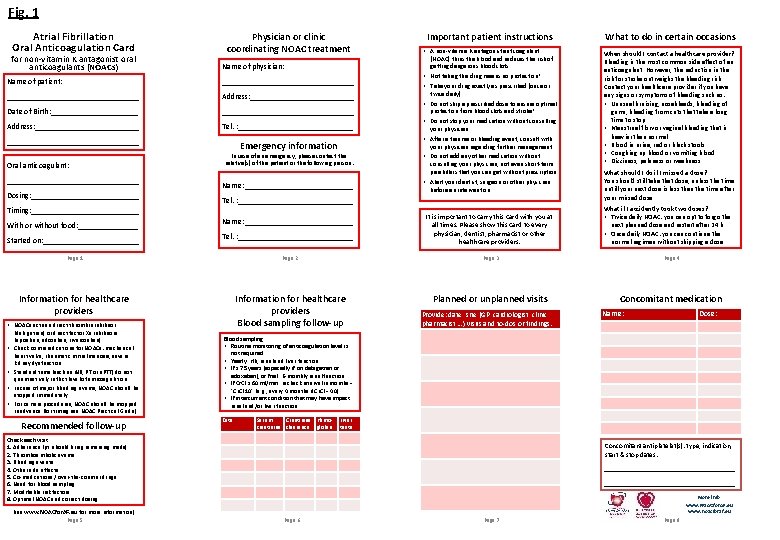
Fig. 1 Atrial Fibrillation Oral Anticoagulation Card for non-vitamin K antagonist oral anticoagulants (NOACs) Physician or clinic coordinating NOAC treatment Name of physician: Name of patient: _________________________________ Address: _____________ Date of Birth: ____________________________ Address: _____________ Tel. : _________________________________ Oral anticoagulant: _________________ Dosing: ______________ Started on: ____________ Emergency information • • Not taking the drug means no protection! • Take your drug exactly as prescribed (once or twice daily). • Do not skip a prescribed dose to ensure optimal protection from blood clots and stroke! • Do not stop your medication without consulting your physician regarding further management In case of an emergency, please contact the relative(s) of the patient or the following person: Name: ______________ • Do not add any other medication without consulting your physician, not even short-term painkillers that you can get without prescription. • Alert your dentist, surgeon or other physician before an intervention. Tel. : _______________ Name: ______________ Tel. : _______________ It is important to carry this card with you at all times. Please show this card to every physician, dentist, pharmacist or other healthcare providers. What to do in certain occasions When should I contact a healthcare provider? Bleeding is the most common side effect of an anticoagulant. However, the reduction in the risk for stroke outweighs the bleeding risk. Contact your healthcare provider if you have any signs or symptoms of bleeding such as: • Unusual bruising, nosebleeds, bleeding of gums, bleeding from cuts that take a long time to stop • Menstrual flow or vaginal bleeding that is heavier than normal • Blood in urine, red or black stools • Coughing up blood or vomiting blood • Dizziness, paleness or weakness What should I do if I missed a dose? You should still take that dose, unless the time untill your next dose is less than the time after your missed dose. What if I accidently took two doses? • Twice daily NOAC: you can opt to forgo the next planned dose and restart after 24 h. • Once daily NOAC: you can continue the normal regimen without skipping a dose. Page 1 Page 2 Page 3 Page 4 Information for healthcare providers Blood sampling follow-up Planned or unplanned visits Concomitant medication • NOACs act as a direct thrombin inhibitor • (NOAC) thins the blood and reduces the risk of getting dangerous blood clots. • After a trauma or bleeding event, consult with Timing: ______________ With or without food: ________ Important patient instructions • A non-vitamin K antagonist anticoagulant (dabigatran) or direct factor Xa inhibitors (apixaban, edoxaban, rivaroxaban). Check contraindications for NOACs: mechanical heart valve; rheumatic mitral stenosis; severe kidney dysfunction. Standard tests (such as INR, PT or a. PTT) do not quantitatively reflect level of anticoagulation. In case of major bleeding events, NOAC should be stopped immediately. For certain procedures, NOAC should be stopped in advance (for timing see NOAC Practical Guide). Recommended follow-up Provide: date, site (GP, cardiologist, clinic, pharmacist, …) visits and to-dos or findings. Dose: Blood sampling: • Routine monitoring of anticoagulation level is not required • Yearly: Hb, renal and liver function • If ≥ 75 years (especially if on dabigatran or edoxaban), or frail: 6 -monthly renal function • If Cr. Cl ≤ 60 ml/min: recheck interval in months = "Cr. Cl: 10" (e. g. , every 4 months if Cr. Cl = 40) • If intercurrent condition that may have impact: renal and/or liver function Date Serum Creatinine Hemocreatinine clearance globin Liver tests Check each visit: 1. Adherence (pt. should bring remaining meds) 2. Thromboembolic events 3. Bleeding events 4. Other side effects 5. Co-medications / over-the-counter drugs 6. Need for blood sampling 7. Modifiable risk factors 8. Optimal NOAC and correct dosing (see www. NOACfor. AF. eu for more information) Page 5 Name: Concomitant antiplatelet(s): type, indication, start & stop dates: _________________________________ More info: www. NOACfor. AF. eu www. noacforaf. eu Page 6 Page 7 Page 8

Last intake: - 24 h Resumption: 3 -5 h - 12 h (default) NOAC Factors to shorten interruption - High CHA 2 DS 2 -VASc Score (≥ 3) - No heparin i. v. prior to 1 st TSP - Operator experience - Imaging for transseptal puncture - Large LA AF ablation (target ACT 300 – 350 s) Fig. 3 NOAC (Rule out tamponade and other major bleeding prior to restarting) Factors to lengthen interruption - Low CHA 2 DS 2 -VASc Score (≤ 2) - Heparin i. v. prior to 1 st TSP - Limited operator experience - No imaging for transseptal puncture - Normal size LA -Reduced renal function ** Rule out LA / LAA thrombus prior to ablation if ≥ 36 hours without NOAC **
- Slides: 2