
Fifth year students 2132020 BACTERIOLOGICAL EXAMINATION OF WATER

Fifth year students 21*3*2020 BACTERIOLOGICAL EXAMINATION OF WATER
Detection of the extent of fecal pollution Detection of coliform group � Detection of fecal streptococci � Detection of Colstridium welchii �
Detection of Coliform group Presuptive coliform test (Most probable number) � Ejkman test (differrntial test) �
Presumtive coliform test(Most probable number) MPN is most commonly applied for quality testing of water to ensure whether the water is safe or not in terms of bacteria present in it. A group of bacteria commonly referred as fecal coliforms act as an indicator fecal contamination of water. .
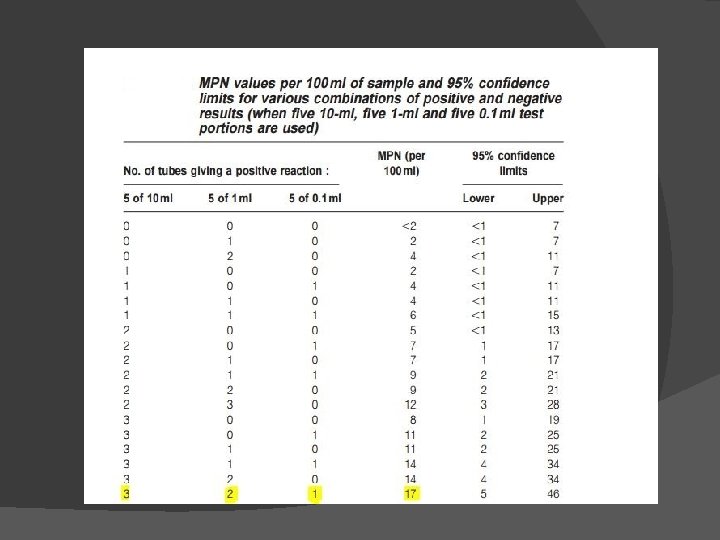
Principle Water to be tested is diluted serially and inoculated in lactose broth, coliforms if present in water utilize the lactose present in the medium to produce acid and gas. The presence of acid is indicated by color change of the medium and the presence of gas is detected as gas bubbles collected in the inverted durham tube present in the medium. The number of total coliforms is determined by counting the number of tubes giving positive reaction (i. e both color change and gas production) and comparing the pattern of positive results (the number of tubes showing growth at each dilution) with standard statistical tables
MPN test is performed in 3 steps Presumptive test Confirmatory test Completed test
Presumptive test Requirements : Medium: Lactose broth or Mac Conkey Broth or Lauryl tryptose (lactose) broth Glasswares: Test tubes of various capacities (20 ml, 10 ml, 5 ml), Durham tube Others: Sterile pipettes Preparation of the Medium Prepare medium (either mac conkey broth or Lactose broth)in single and double strength concentration. : Dispense the double strength medium in 5 tubes (10 ml in each tube) and single strength medium in 10 tubes (10 ml in each tube)and add an durham tube in inverted position.
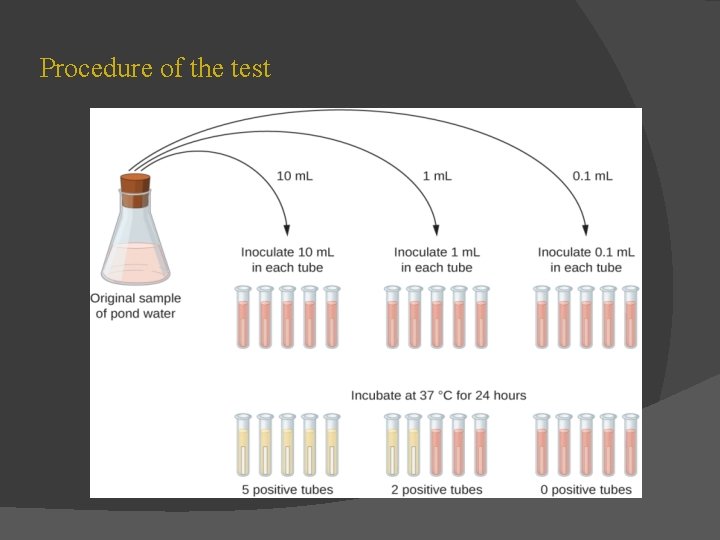
Procedure of the test
• Take 5 tubes of double strength and 10 tubes of single strength for each water sample to be tested. • Using a sterile pipette add 10 ml of water to 5 tubes containing 10 ml double strength medium. • Similarly add 1 ml of water to 5 tubes containing 10 ml single strength medium and 0. 1 ml water to remaining 5 tubes containing 10 ml single strength medium. • Incubate all the tubes at 37°C for 24 hrs. If no tubes appear positive re-incubate up to 48 hrs. • Compare the number of tubes giving positive reaction to a standard chart and record the number of bacteria present in it. • For example: a water sample tested shows a result of 3– 2– 1 (3 × 10 ml positive, 2 × 1 ml positive, 1 × 0. 1 ml positive) gives an MPN value of 17, i. e. the water sample contains an estimated 17 coliforms per 100 ml
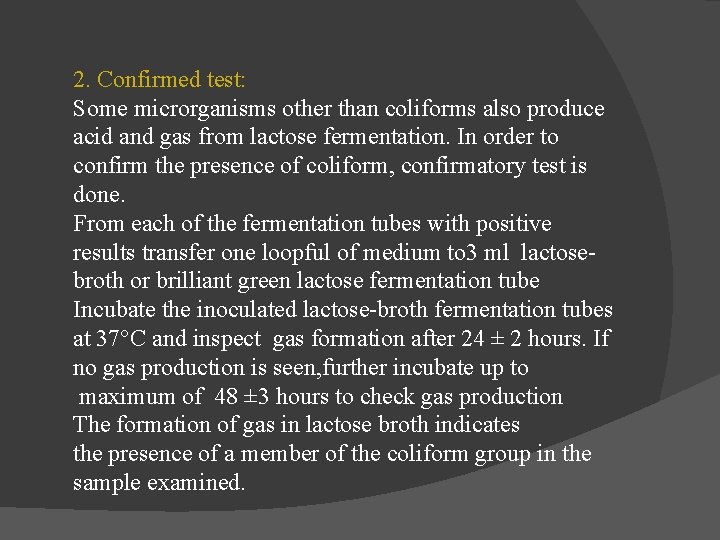
2. Confirmed test: Some microrganisms other than coliforms also produce acid and gas from lactose fermentation. In order to confirm the presence of coliform, confirmatory test is done. From each of the fermentation tubes with positive results transfer one loopful of medium to 3 ml lactosebroth or brilliant green lactose fermentation tube Incubate the inoculated lactose-broth fermentation tubes at 37°C and inspect gas formation after 24 ± 2 hours. If no gas production is seen, further incubate up to maximum of 48 ± 3 hours to check gas production The formation of gas in lactose broth indicates the presence of a member of the coliform group in the sample examined.
3. Completed test: Since some of the positive results from the confirmatory test may be false, it is desirable to do completed tests. For this inoculum from each positive tube of the confirmatory test is streaked on a plate of EMB or Endo agar. Coliforms produce colonies with greenish metallic sheen
Ejkman test � For the differrntiation between typical and atypical coliform bacteria , sub-culturing the positive presumptive cultures into fresh tubes containing 5 ml Mac. Conkey bile salt broth with durham tubes and incubating them for 24 to 48 hr in a thermostatically controlled water bath at 44∙C. � If acid and gas are produced this indicates that the coliform bacteria are of typical type
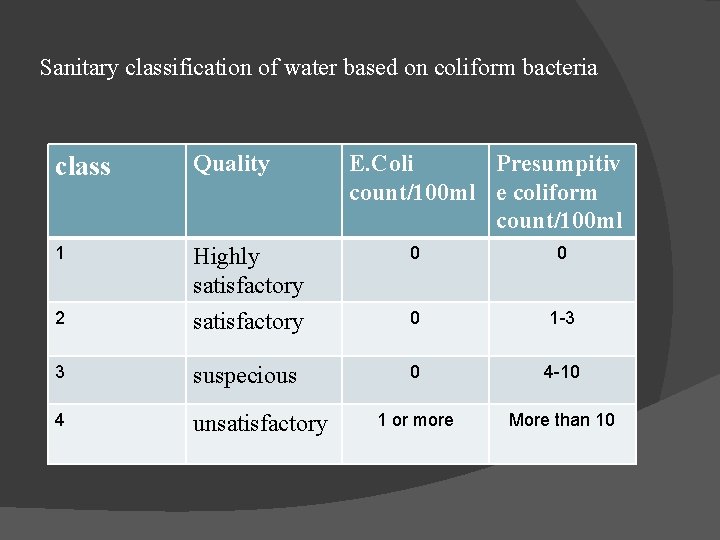
Sanitary classification of water based on coliform bacteria class Quality E. Coli Presumpitiv count/100 ml e coliform count/100 ml 1 Highly satisfactory 0 0 2 satisfactory 0 1 -3 3 suspecious 0 4 -10 4 unsatisfactory 1 or more More than 10
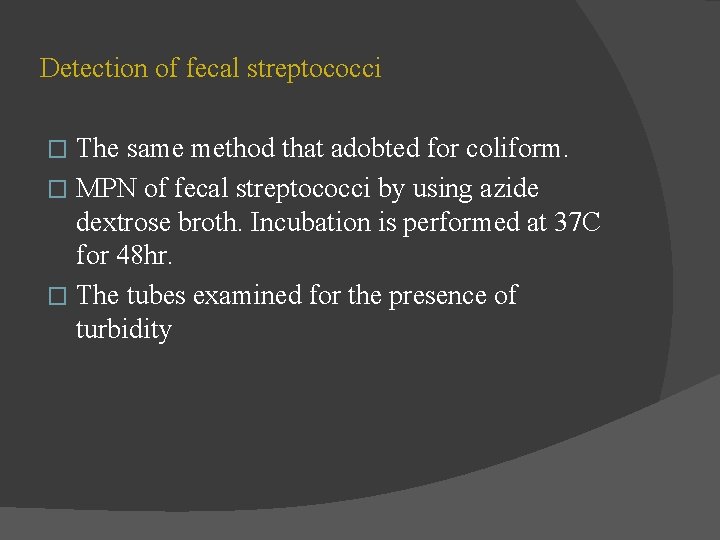
Detection of fecal streptococci The same method that adobted for coliform. � MPN of fecal streptococci by using azide dextrose broth. Incubation is performed at 37 C for 48 hr. � The tubes examined for the presence of turbidity �
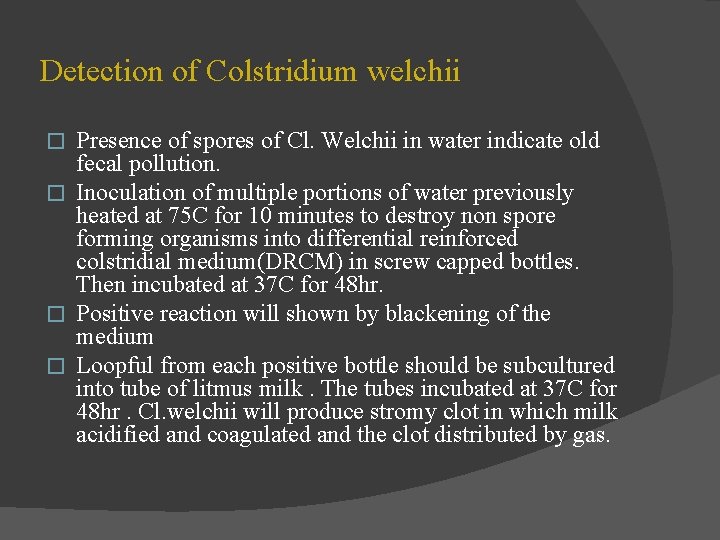
Detection of Colstridium welchii Presence of spores of Cl. Welchii in water indicate old fecal pollution. � Inoculation of multiple portions of water previously heated at 75 C for 10 minutes to destroy non spore forming organisms into differential reinforced colstridial medium(DRCM) in screw capped bottles. Then incubated at 37 C for 48 hr. � Positive reaction will shown by blackening of the medium � Loopful from each positive bottle should be subcultured into tube of litmus milk. The tubes incubated at 37 C for 48 hr. Cl. welchii will produce stromy clot in which milk acidified and coagulated and the clot distributed by gas. �

Thank you
- Slides: 17