
Fifth SI Edition CHAPTER 11 MECHANICS OF MATERIALS
- Slides: 31
Fifth SI Edition CHAPTER 11 MECHANICS OF MATERIALS Ferdinand P. Beer E. Russell Johnston, Jr. John T. De. Wolf Energy Methods David F. Mazurek Lecture Notes: J. Walt Oler Texas Tech University © 2009 The Mc. Graw-Hill Companies, Inc. All rights reserved.
Fifth Edition MECHANICS OF MATERIALS Beer • Johnston • De. Wolf • Mazurek Contents Strain Energy Density Elastic Strain Energy for Normal Stresses Strain Energy For Shearing Stresses Sample Problem 11. 2 Strain Energy for a General State of Stress Impact Loading Example 11. 06 Example 11. 07 Design for Impact Loads Work and Energy Under a Single Load Deflection Under a Single Load © 2009 The Mc. Graw-Hill Companies, Inc. All rights reserved. Sample Problem 11. 4 Work and Energy Under Several Loads Castigliano’s Theorem Deflections by Castigliano’s Theorem Sample Problem 11. 5 2
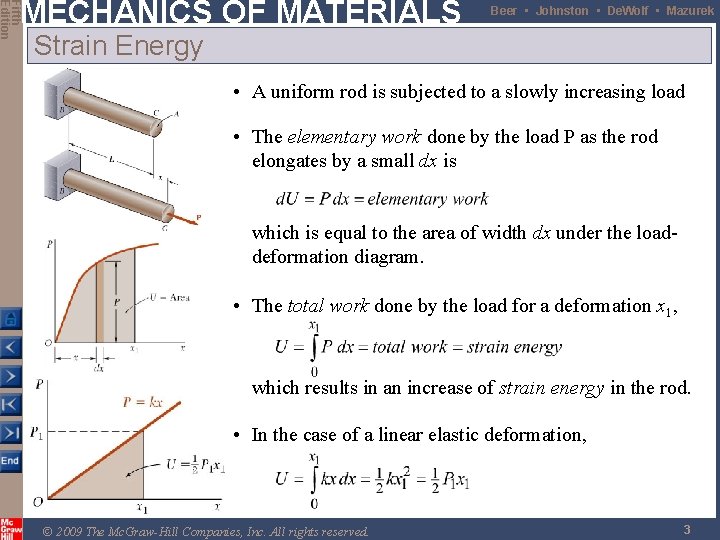
Fifth Edition MECHANICS OF MATERIALS Beer • Johnston • De. Wolf • Mazurek Strain Energy • A uniform rod is subjected to a slowly increasing load • The elementary work done by the load P as the rod elongates by a small dx is which is equal to the area of width dx under the loaddeformation diagram. • The total work done by the load for a deformation x 1, which results in an increase of strain energy in the rod. • In the case of a linear elastic deformation, © 2009 The Mc. Graw-Hill Companies, Inc. All rights reserved. 3
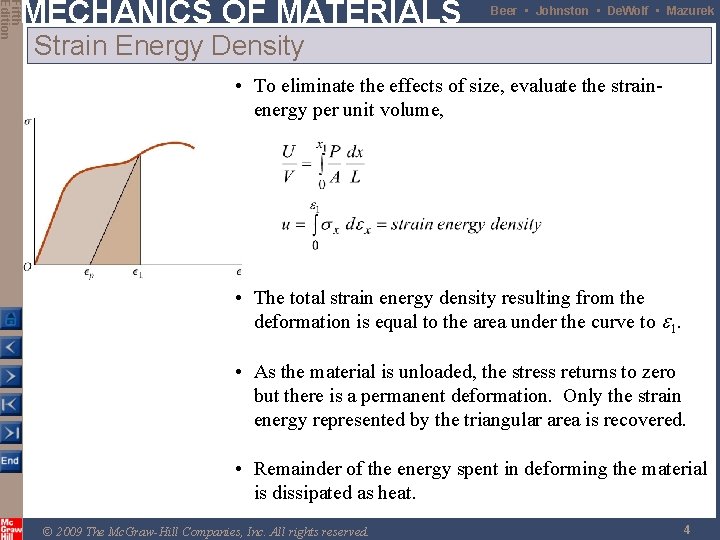
Fifth Edition MECHANICS OF MATERIALS Beer • Johnston • De. Wolf • Mazurek Strain Energy Density • To eliminate the effects of size, evaluate the strainenergy per unit volume, • The total strain energy density resulting from the deformation is equal to the area under the curve to e 1. • As the material is unloaded, the stress returns to zero but there is a permanent deformation. Only the strain energy represented by the triangular area is recovered. • Remainder of the energy spent in deforming the material is dissipated as heat. © 2009 The Mc. Graw-Hill Companies, Inc. All rights reserved. 4
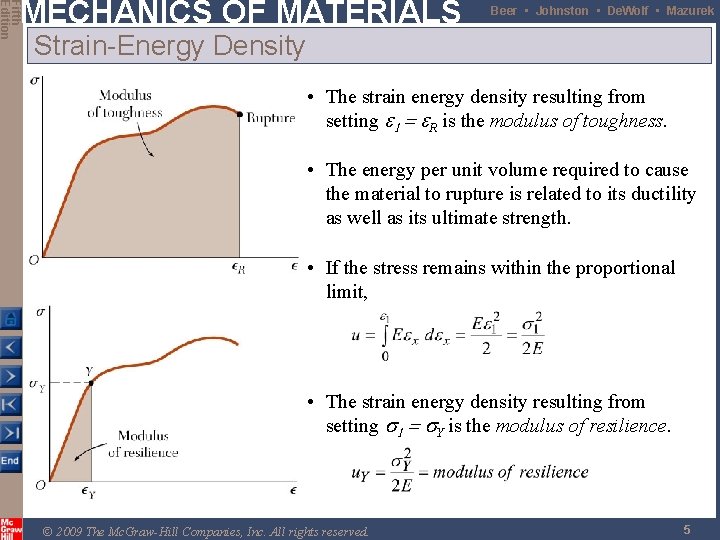
Fifth Edition MECHANICS OF MATERIALS Beer • Johnston • De. Wolf • Mazurek Strain-Energy Density • The strain energy density resulting from setting e 1 = e. R is the modulus of toughness. • The energy per unit volume required to cause the material to rupture is related to its ductility as well as its ultimate strength. • If the stress remains within the proportional limit, • The strain energy density resulting from setting s 1 = s. Y is the modulus of resilience. © 2009 The Mc. Graw-Hill Companies, Inc. All rights reserved. 5
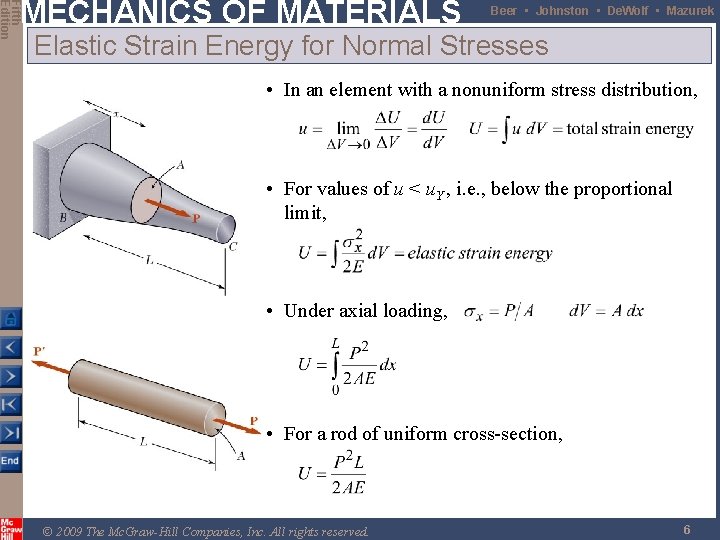
Fifth Edition MECHANICS OF MATERIALS Beer • Johnston • De. Wolf • Mazurek Elastic Strain Energy for Normal Stresses • In an element with a nonuniform stress distribution, • For values of u < u. Y , i. e. , below the proportional limit, • Under axial loading, • For a rod of uniform cross-section, © 2009 The Mc. Graw-Hill Companies, Inc. All rights reserved. 6
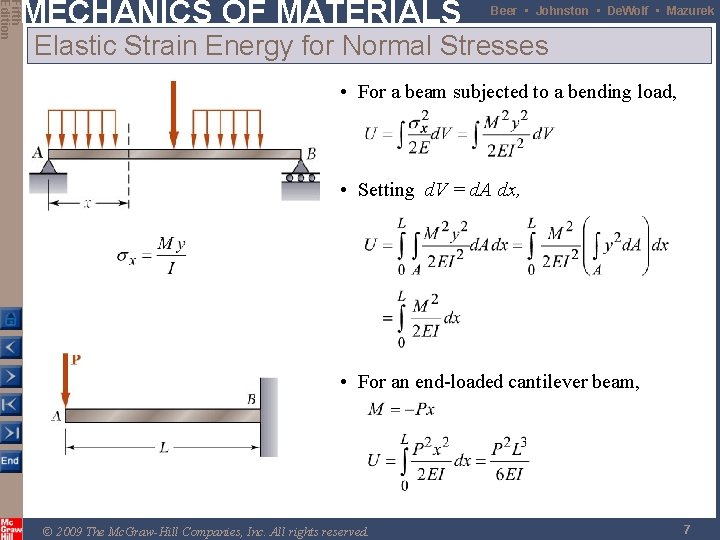
Fifth Edition MECHANICS OF MATERIALS Beer • Johnston • De. Wolf • Mazurek Elastic Strain Energy for Normal Stresses • For a beam subjected to a bending load, • Setting d. V = d. A dx, • For an end-loaded cantilever beam, © 2009 The Mc. Graw-Hill Companies, Inc. All rights reserved. 7
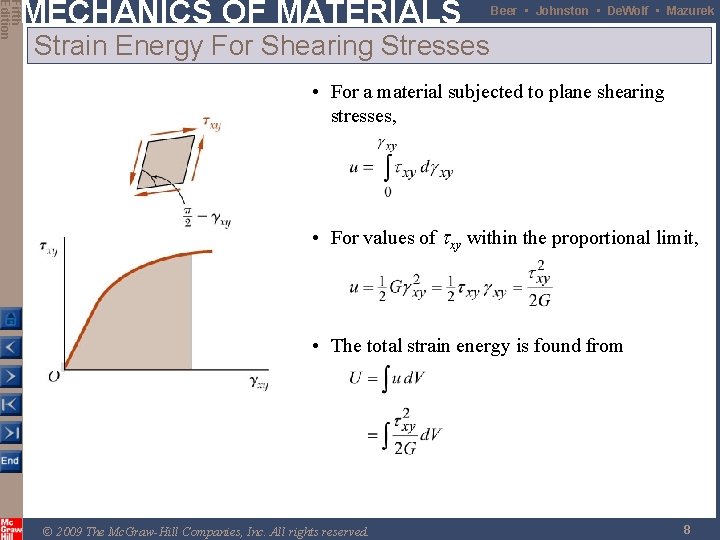
Fifth Edition MECHANICS OF MATERIALS Beer • Johnston • De. Wolf • Mazurek Strain Energy For Shearing Stresses • For a material subjected to plane shearing stresses, • For values of txy within the proportional limit, • The total strain energy is found from © 2009 The Mc. Graw-Hill Companies, Inc. All rights reserved. 8
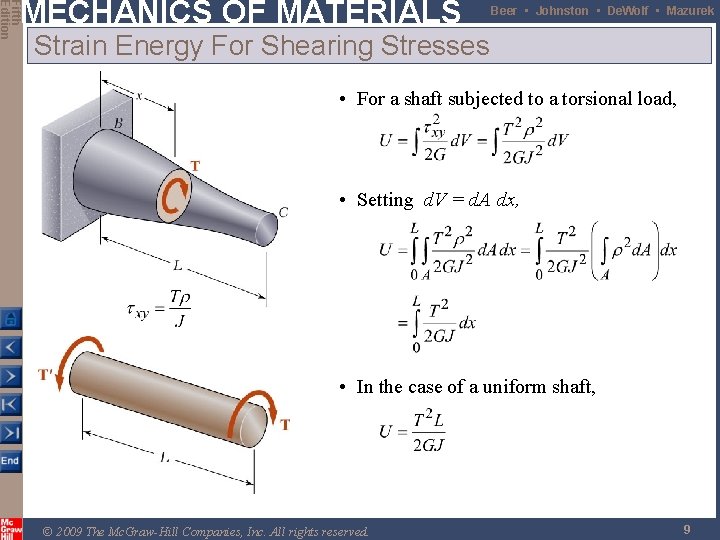
Fifth Edition MECHANICS OF MATERIALS Beer • Johnston • De. Wolf • Mazurek Strain Energy For Shearing Stresses • For a shaft subjected to a torsional load, • Setting d. V = d. A dx, • In the case of a uniform shaft, © 2009 The Mc. Graw-Hill Companies, Inc. All rights reserved. 9
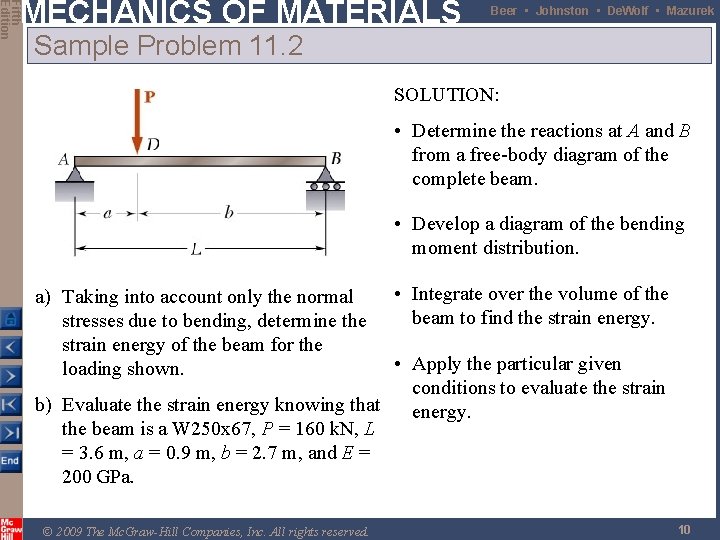
Fifth Edition MECHANICS OF MATERIALS Beer • Johnston • De. Wolf • Mazurek Sample Problem 11. 2 SOLUTION: • Determine the reactions at A and B from a free-body diagram of the complete beam. • Develop a diagram of the bending moment distribution. a) Taking into account only the normal stresses due to bending, determine the strain energy of the beam for the loading shown. • Integrate over the volume of the beam to find the strain energy. • Apply the particular given conditions to evaluate the strain b) Evaluate the strain energy knowing that energy. the beam is a W 250 x 67, P = 160 k. N, L = 3. 6 m, a = 0. 9 m, b = 2. 7 m, and E = 200 GPa. © 2009 The Mc. Graw-Hill Companies, Inc. All rights reserved. 10
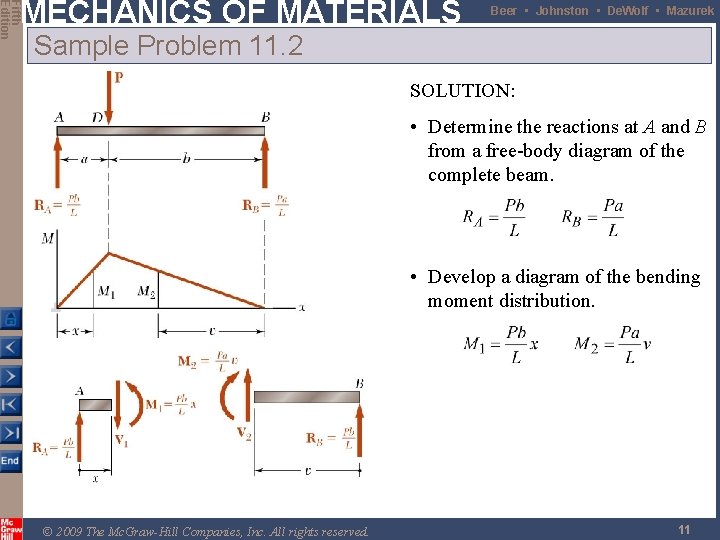
Fifth Edition MECHANICS OF MATERIALS Beer • Johnston • De. Wolf • Mazurek Sample Problem 11. 2 SOLUTION: • Determine the reactions at A and B from a free-body diagram of the complete beam. • Develop a diagram of the bending moment distribution. © 2009 The Mc. Graw-Hill Companies, Inc. All rights reserved. 11
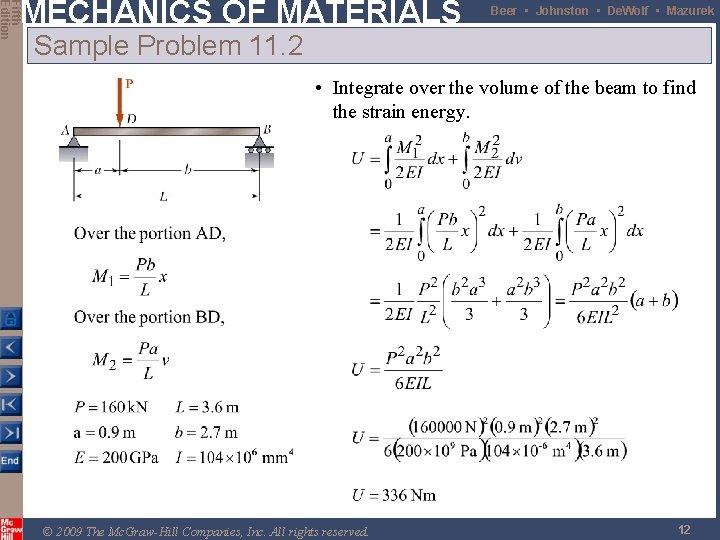
Fifth Edition MECHANICS OF MATERIALS Beer • Johnston • De. Wolf • Mazurek Sample Problem 11. 2 • Integrate over the volume of the beam to find the strain energy. © 2009 The Mc. Graw-Hill Companies, Inc. All rights reserved. 12
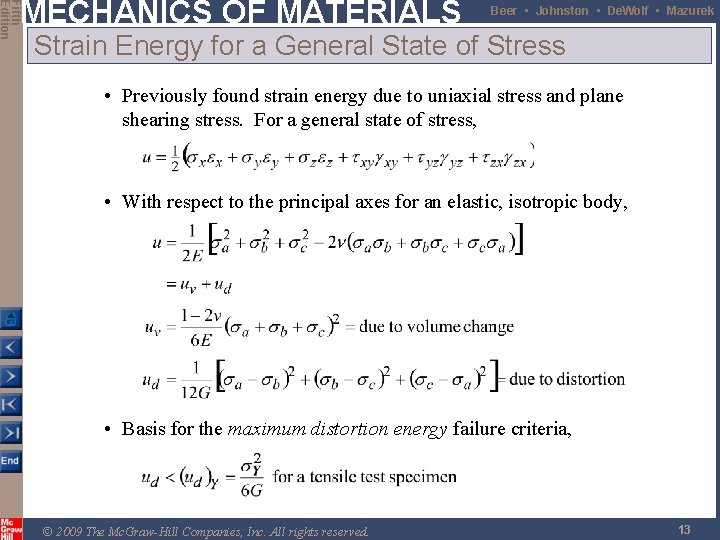
Fifth Edition MECHANICS OF MATERIALS Beer • Johnston • De. Wolf • Mazurek Strain Energy for a General State of Stress • Previously found strain energy due to uniaxial stress and plane shearing stress. For a general state of stress, • With respect to the principal axes for an elastic, isotropic body, • Basis for the maximum distortion energy failure criteria, © 2009 The Mc. Graw-Hill Companies, Inc. All rights reserved. 13
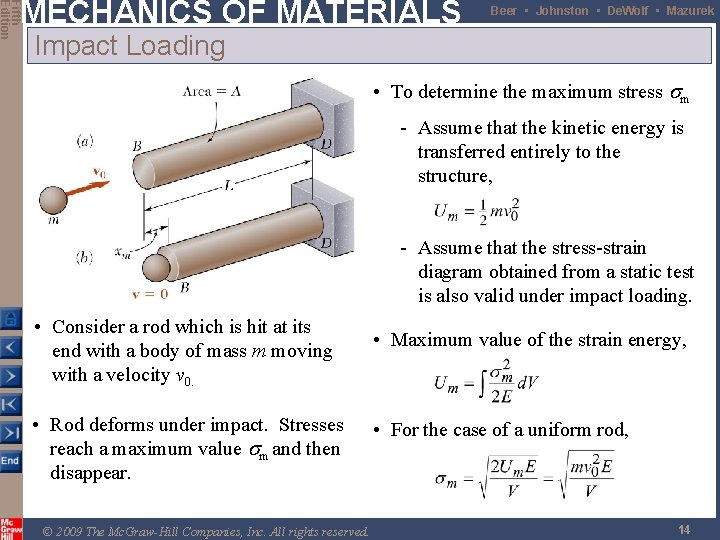
Fifth Edition MECHANICS OF MATERIALS Beer • Johnston • De. Wolf • Mazurek Impact Loading • To determine the maximum stress sm - Assume that the kinetic energy is transferred entirely to the structure, - Assume that the stress-strain diagram obtained from a static test is also valid under impact loading. • Consider a rod which is hit at its end with a body of mass m moving with a velocity v 0. • Rod deforms under impact. Stresses reach a maximum value sm and then disappear. © 2009 The Mc. Graw-Hill Companies, Inc. All rights reserved. • Maximum value of the strain energy, • For the case of a uniform rod, 14
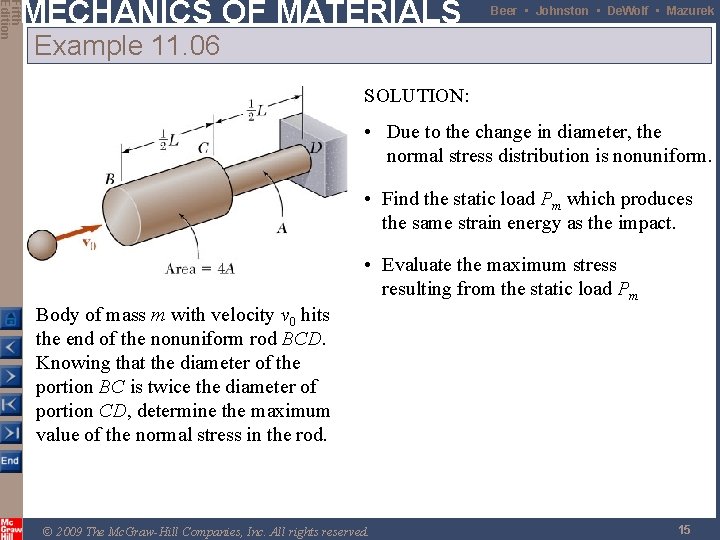
Fifth Edition MECHANICS OF MATERIALS Beer • Johnston • De. Wolf • Mazurek Example 11. 06 SOLUTION: • Due to the change in diameter, the normal stress distribution is nonuniform. • Find the static load Pm which produces the same strain energy as the impact. • Evaluate the maximum stress resulting from the static load Pm Body of mass m with velocity v 0 hits the end of the nonuniform rod BCD. Knowing that the diameter of the portion BC is twice the diameter of portion CD, determine the maximum value of the normal stress in the rod. © 2009 The Mc. Graw-Hill Companies, Inc. All rights reserved. 15
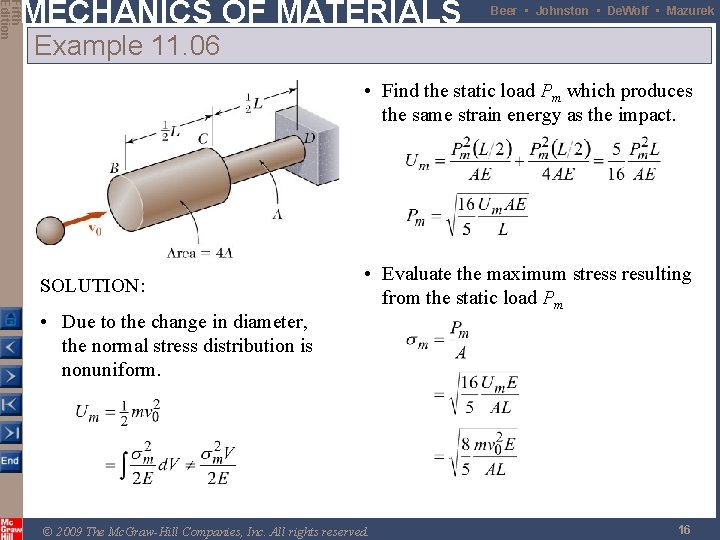
Fifth Edition MECHANICS OF MATERIALS Beer • Johnston • De. Wolf • Mazurek Example 11. 06 • Find the static load Pm which produces the same strain energy as the impact. SOLUTION: • Due to the change in diameter, the normal stress distribution is nonuniform. • Evaluate the maximum stress resulting from the static load Pm © 2009 The Mc. Graw-Hill Companies, Inc. All rights reserved. 16
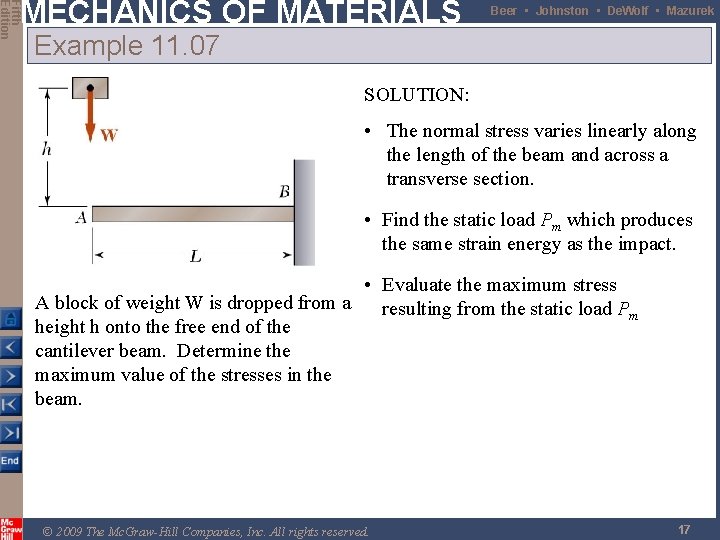
Fifth Edition MECHANICS OF MATERIALS Beer • Johnston • De. Wolf • Mazurek Example 11. 07 SOLUTION: • The normal stress varies linearly along the length of the beam and across a transverse section. • Find the static load Pm which produces the same strain energy as the impact. • Evaluate the maximum stress A block of weight W is dropped from a resulting from the static load Pm height h onto the free end of the cantilever beam. Determine the maximum value of the stresses in the beam. © 2009 The Mc. Graw-Hill Companies, Inc. All rights reserved. 17
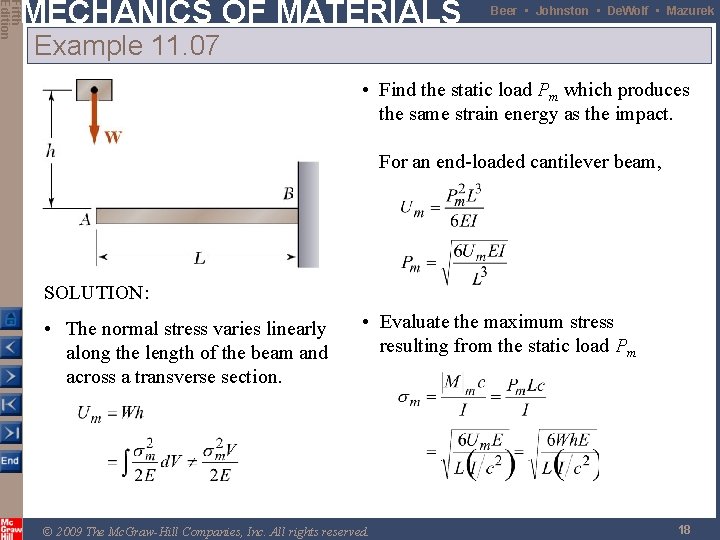
Fifth Edition MECHANICS OF MATERIALS Beer • Johnston • De. Wolf • Mazurek Example 11. 07 • Find the static load Pm which produces the same strain energy as the impact. For an end-loaded cantilever beam, SOLUTION: • The normal stress varies linearly along the length of the beam and across a transverse section. • Evaluate the maximum stress resulting from the static load Pm © 2009 The Mc. Graw-Hill Companies, Inc. All rights reserved. 18
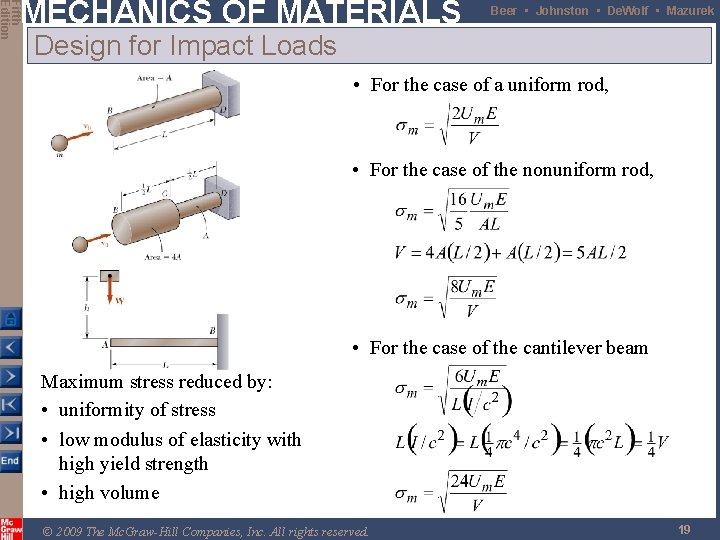
Fifth Edition MECHANICS OF MATERIALS Beer • Johnston • De. Wolf • Mazurek Design for Impact Loads • For the case of a uniform rod, • For the case of the nonuniform rod, • For the case of the cantilever beam Maximum stress reduced by: • uniformity of stress • low modulus of elasticity with high yield strength • high volume © 2009 The Mc. Graw-Hill Companies, Inc. All rights reserved. 19
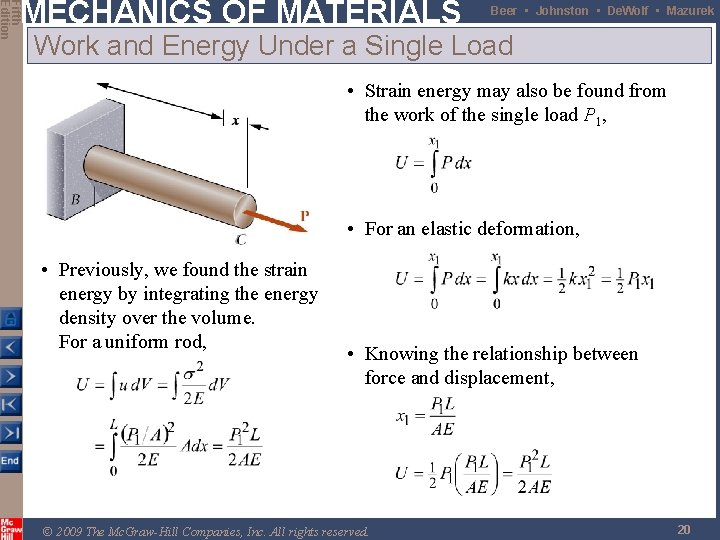
Fifth Edition MECHANICS OF MATERIALS Beer • Johnston • De. Wolf • Mazurek Work and Energy Under a Single Load • Strain energy may also be found from the work of the single load P 1, • For an elastic deformation, • Previously, we found the strain energy by integrating the energy density over the volume. For a uniform rod, • Knowing the relationship between force and displacement, © 2009 The Mc. Graw-Hill Companies, Inc. All rights reserved. 20
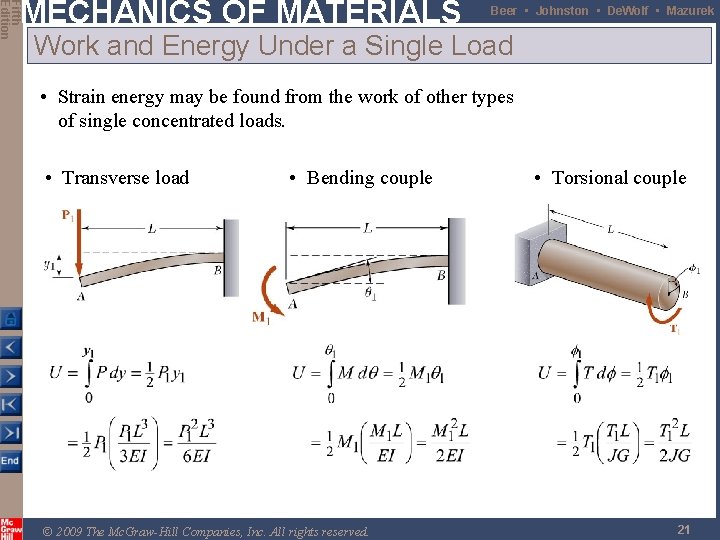
Fifth Edition MECHANICS OF MATERIALS Beer • Johnston • De. Wolf • Mazurek Work and Energy Under a Single Load • Strain energy may be found from the work of other types of single concentrated loads. • Transverse load • Bending couple © 2009 The Mc. Graw-Hill Companies, Inc. All rights reserved. • Torsional couple 21
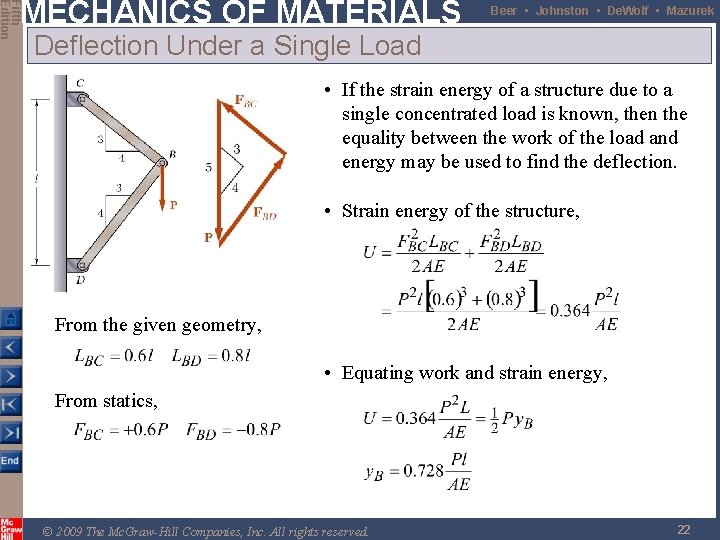
Fifth Edition MECHANICS OF MATERIALS Beer • Johnston • De. Wolf • Mazurek Deflection Under a Single Load • If the strain energy of a structure due to a single concentrated load is known, then the equality between the work of the load and energy may be used to find the deflection. • Strain energy of the structure, From the given geometry, • Equating work and strain energy, From statics, © 2009 The Mc. Graw-Hill Companies, Inc. All rights reserved. 22
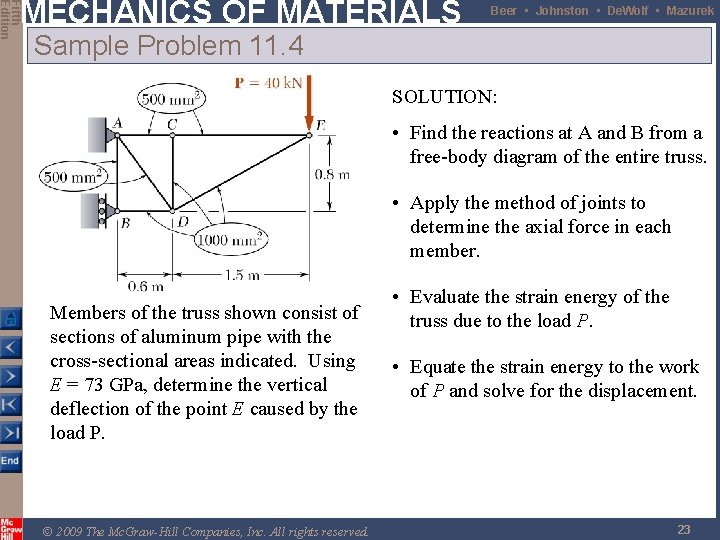
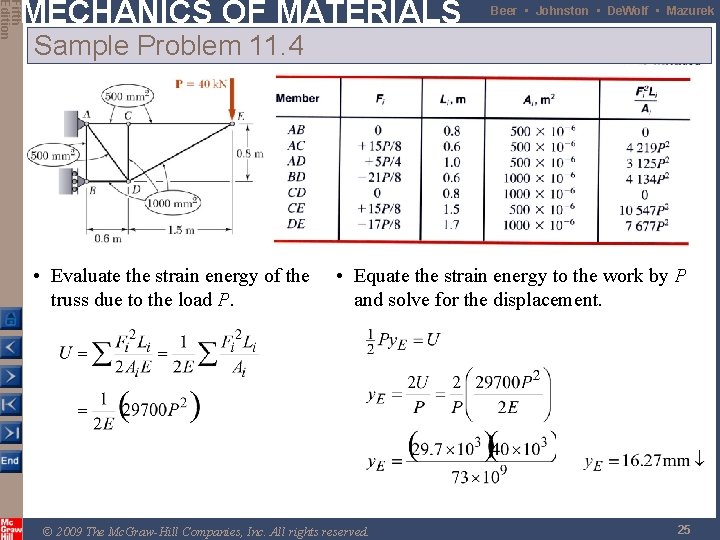
Fifth Edition MECHANICS OF MATERIALS Beer • Johnston • De. Wolf • Mazurek Sample Problem 11. 4 SOLUTION: • Find the reactions at A and B from a free-body diagram of the entire truss. • Apply the method of joints to determine the axial force in each member. Members of the truss shown consist of sections of aluminum pipe with the cross-sectional areas indicated. Using E = 73 GPa, determine the vertical deflection of the point E caused by the load P. © 2009 The Mc. Graw-Hill Companies, Inc. All rights reserved. • Evaluate the strain energy of the truss due to the load P. • Equate the strain energy to the work of P and solve for the displacement. 23
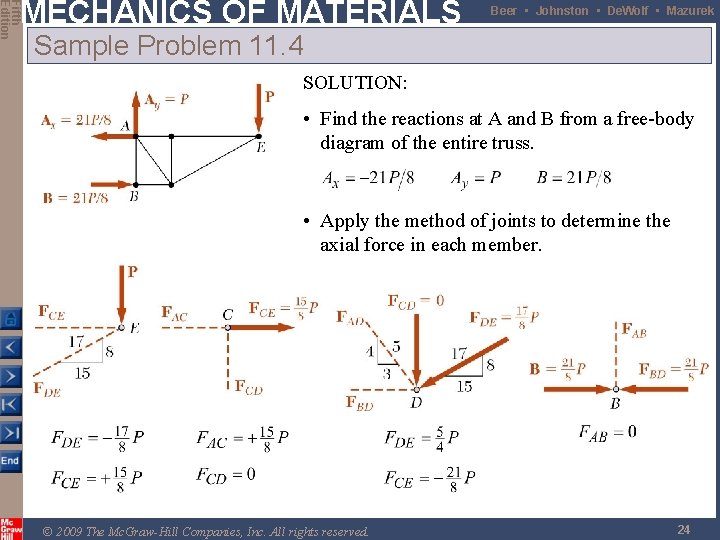
Fifth Edition MECHANICS OF MATERIALS Beer • Johnston • De. Wolf • Mazurek Sample Problem 11. 4 SOLUTION: • Find the reactions at A and B from a free-body diagram of the entire truss. • Apply the method of joints to determine the axial force in each member. © 2009 The Mc. Graw-Hill Companies, Inc. All rights reserved. 24
Fifth Edition MECHANICS OF MATERIALS Beer • Johnston • De. Wolf • Mazurek Sample Problem 11. 4 • Evaluate the strain energy of the truss due to the load P. • Equate the strain energy to the work by P and solve for the displacement. © 2009 The Mc. Graw-Hill Companies, Inc. All rights reserved. 25
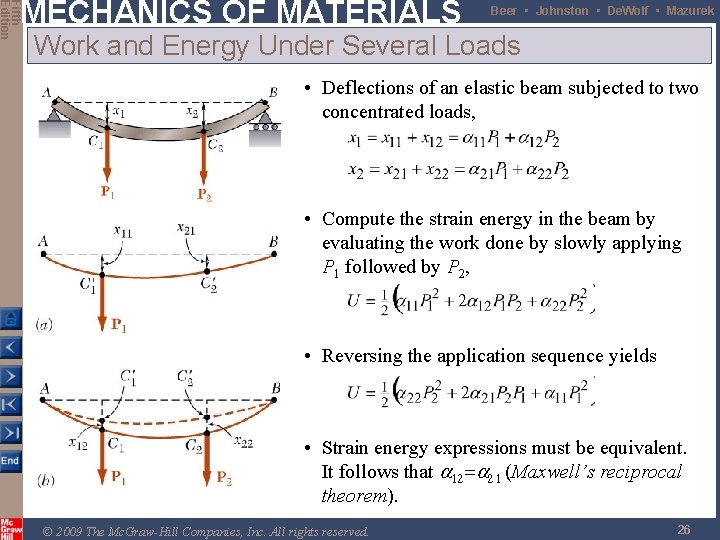
Fifth Edition MECHANICS OF MATERIALS Beer • Johnston • De. Wolf • Mazurek Work and Energy Under Several Loads • Deflections of an elastic beam subjected to two concentrated loads, • Compute the strain energy in the beam by evaluating the work done by slowly applying P 1 followed by P 2, • Reversing the application sequence yields • Strain energy expressions must be equivalent. It follows that a 12=a 21 (Maxwell’s reciprocal theorem). © 2009 The Mc. Graw-Hill Companies, Inc. All rights reserved. 26
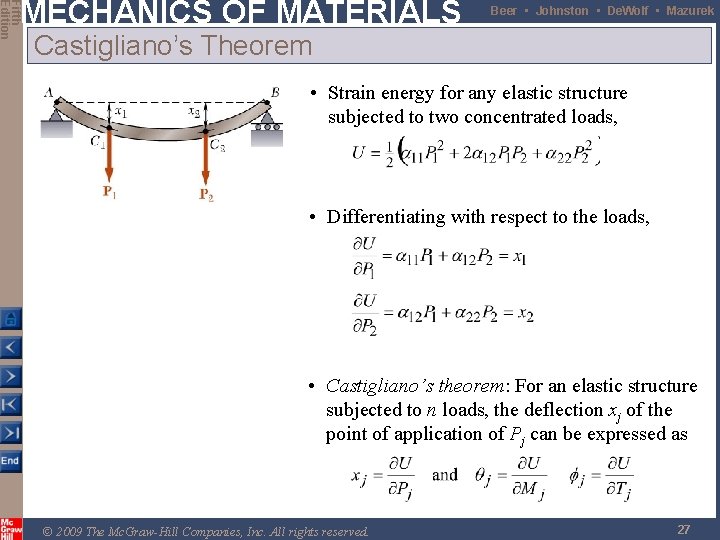
Fifth Edition MECHANICS OF MATERIALS Beer • Johnston • De. Wolf • Mazurek Castigliano’s Theorem • Strain energy for any elastic structure subjected to two concentrated loads, • Differentiating with respect to the loads, • Castigliano’s theorem: For an elastic structure subjected to n loads, the deflection xj of the point of application of Pj can be expressed as © 2009 The Mc. Graw-Hill Companies, Inc. All rights reserved. 27
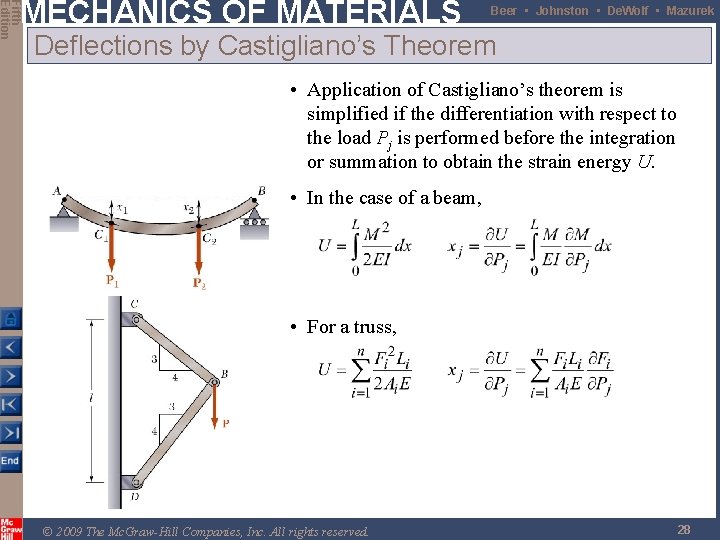
Fifth Edition MECHANICS OF MATERIALS Beer • Johnston • De. Wolf • Mazurek Deflections by Castigliano’s Theorem • Application of Castigliano’s theorem is simplified if the differentiation with respect to the load Pj is performed before the integration or summation to obtain the strain energy U. • In the case of a beam, • For a truss, © 2009 The Mc. Graw-Hill Companies, Inc. All rights reserved. 28
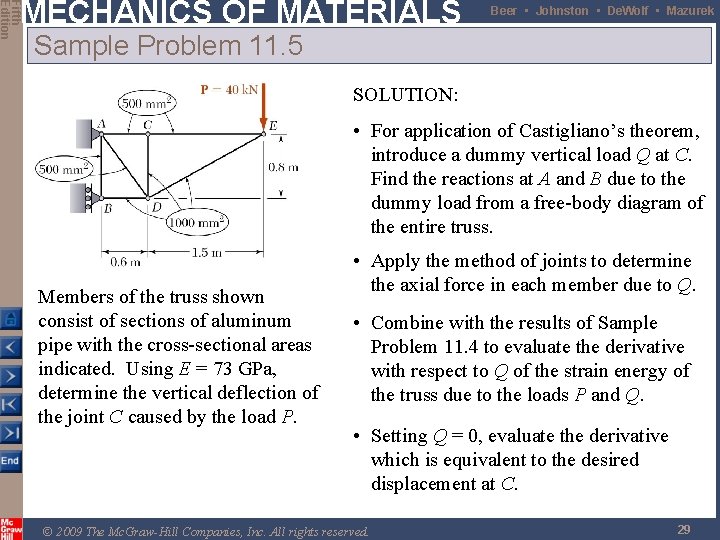
Fifth Edition MECHANICS OF MATERIALS Beer • Johnston • De. Wolf • Mazurek Sample Problem 11. 5 SOLUTION: • For application of Castigliano’s theorem, introduce a dummy vertical load Q at C. Find the reactions at A and B due to the dummy load from a free-body diagram of the entire truss. Members of the truss shown consist of sections of aluminum pipe with the cross-sectional areas indicated. Using E = 73 GPa, determine the vertical deflection of the joint C caused by the load P. • Apply the method of joints to determine the axial force in each member due to Q. • Combine with the results of Sample Problem 11. 4 to evaluate the derivative with respect to Q of the strain energy of the truss due to the loads P and Q. • Setting Q = 0, evaluate the derivative which is equivalent to the desired displacement at C. © 2009 The Mc. Graw-Hill Companies, Inc. All rights reserved. 29
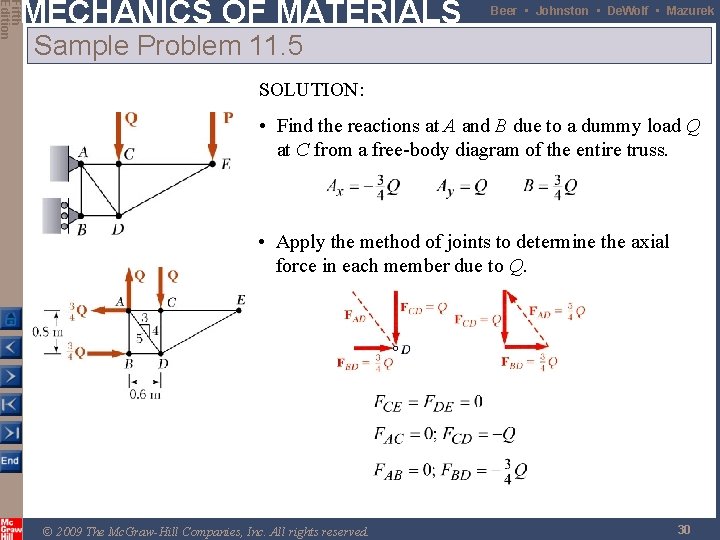
Fifth Edition MECHANICS OF MATERIALS Beer • Johnston • De. Wolf • Mazurek Sample Problem 11. 5 SOLUTION: • Find the reactions at A and B due to a dummy load Q at C from a free-body diagram of the entire truss. • Apply the method of joints to determine the axial force in each member due to Q. © 2009 The Mc. Graw-Hill Companies, Inc. All rights reserved. 30
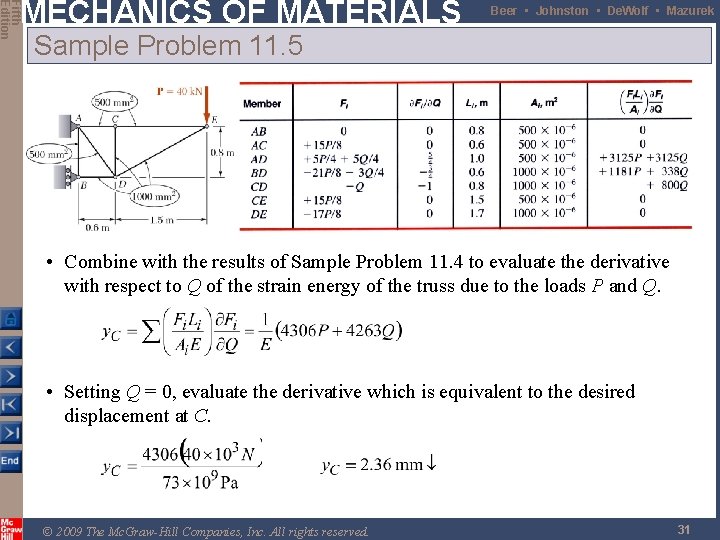
Fifth Edition MECHANICS OF MATERIALS Beer • Johnston • De. Wolf • Mazurek Sample Problem 11. 5 • Combine with the results of Sample Problem 11. 4 to evaluate the derivative with respect to Q of the strain energy of the truss due to the loads P and Q. • Setting Q = 0, evaluate the derivative which is equivalent to the desired displacement at C. © 2009 The Mc. Graw-Hill Companies, Inc. All rights reserved. 31