
Fifth Grade Math WELCOME TO THE FLIPPED CLASSROOM

- Slides: 19
Fifth Grade Math: WELCOME TO THE FLIPPED CLASSROOM
Math Notebook Write your name on the front of your notebook in permanent marker. On the first page: Use expressions and equations to describe yourself in numbers. Glue in the Table of Contents
Math Notebook Write your name on the front of your notebook in permanent marker. On the first page: Use expressions (22 x 20) and equations(22 x 20 = 440) to describe yourself in numbers. Glue in the Table of Contents
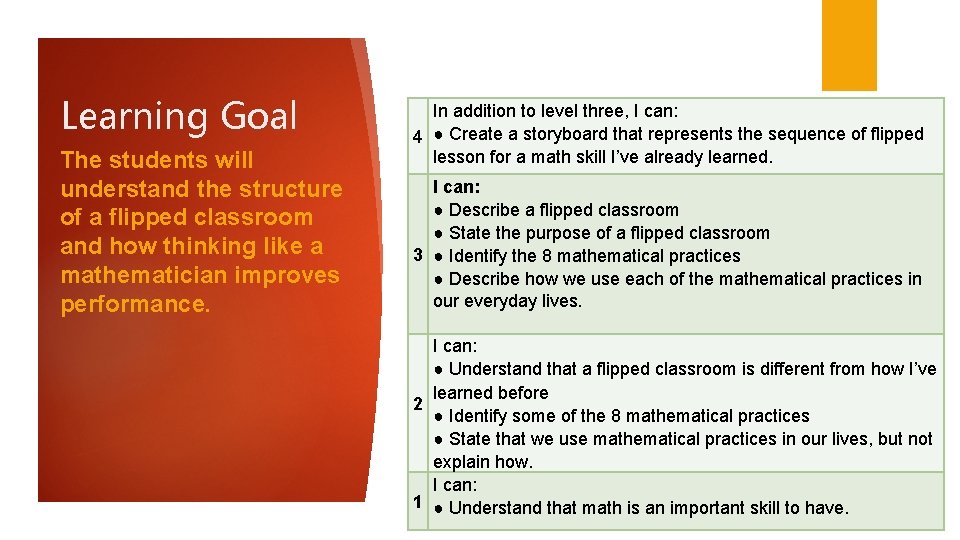
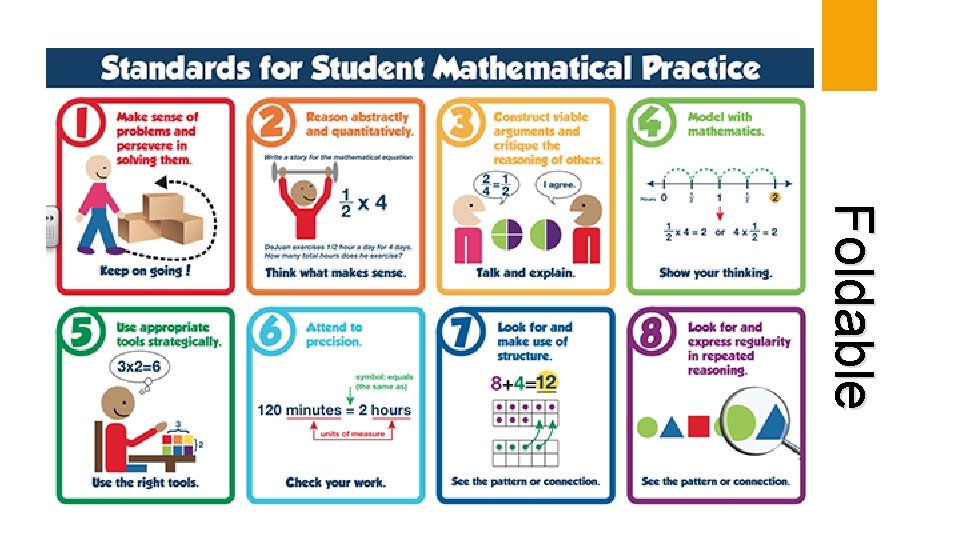
Learning Goal The students will understand the structure of a flipped classroom and how thinking like a mathematician improves performance. In addition to level three, I can: 4 ● Create a storyboard that represents the sequence of flipped lesson for a math skill I’ve already learned. I can: ● Describe a flipped classroom ● State the purpose of a flipped classroom 3 ● Identify the 8 mathematical practices ● Describe how we use each of the mathematical practices in our everyday lives. I can: ● Understand that a flipped classroom is different from how I’ve learned before 2 ● Identify some of the 8 mathematical practices ● State that we use mathematical practices in our lives, but not explain how. I can: 1 ● Understand that math is an important skill to have.
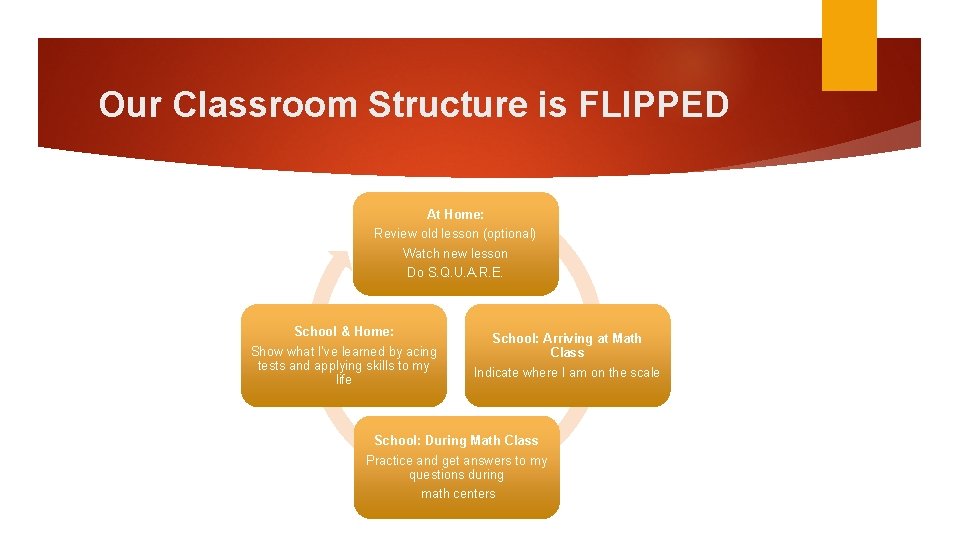
Our Classroom Structure is FLIPPED At Home: Review old lesson (optional) Watch new lesson Do S. Q. U. A. R. E. School & Home: Show what I’ve learned by acing tests and applying skills to my life School: Arriving at Math Class Indicate where I am on the scale School: During Math Class Practice and get answers to my questions during math centers
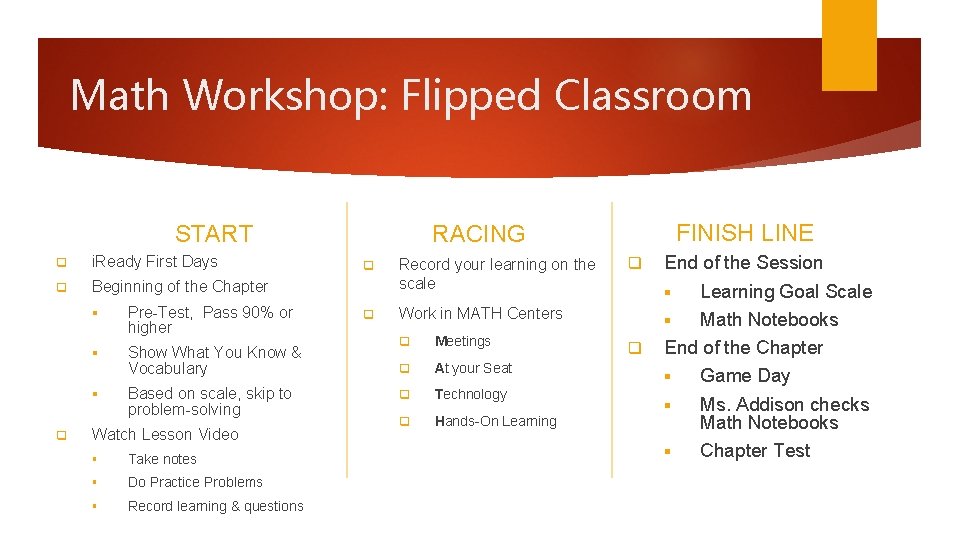
Math Workshop: Flipped Classroom START q i. Ready First Days q Beginning of the Chapter § Pre-Test, Pass 90% or higher § Show What You Know & Vocabulary § q Based on scale, skip to problem-solving Watch Lesson Video § Take notes § Do Practice Problems § Record learning & questions FINISH LINE RACING q Record your learning on the scale q Work in MATH Centers q Meetings q At your Seat q Technology q Hands-On Learning q q End of the Session § Learning Goal Scale § Math Notebooks End of the Chapter § Game Day § Ms. Addison checks Math Notebooks § Chapter Test
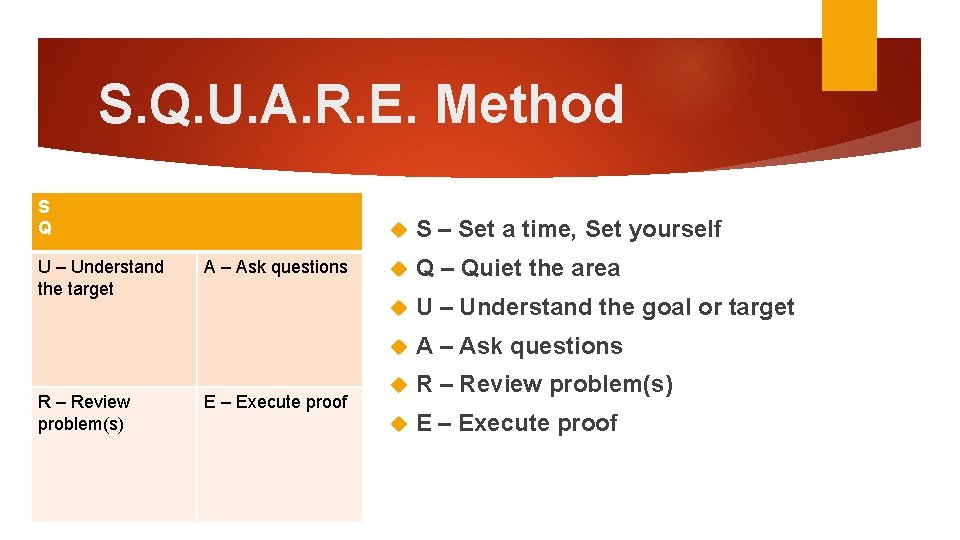
S. Q. U. A. R. E. Method S Q U – Understand the target R – Review problem(s) A – Ask questions E – Execute proof S – Set a time, Set yourself Q – Quiet the area U – Understand the goal or target A – Ask questions R – Review problem(s) E – Execute proof
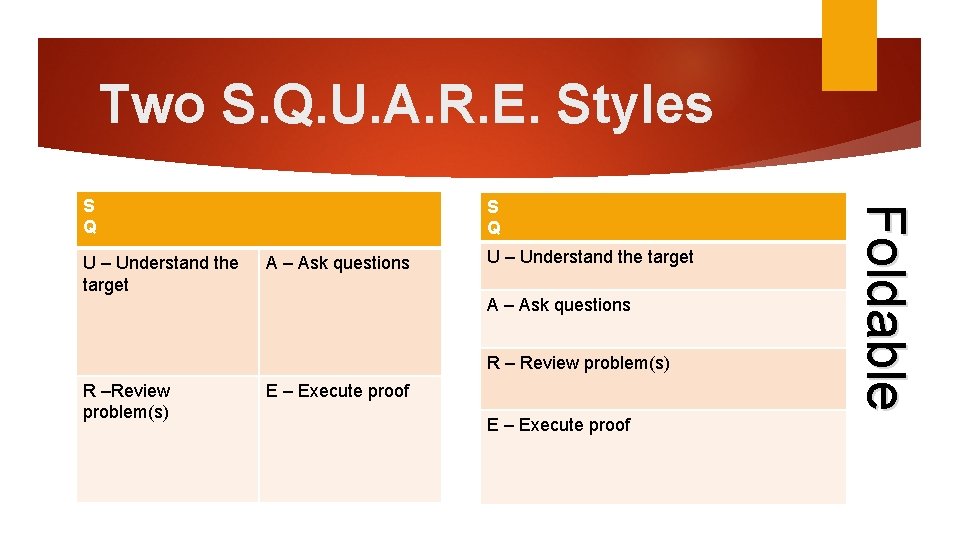
Two S. Q. U. A. R. E. Styles U – Understand the target S Q A – Ask questions U – Understand the target A – Ask questions R – Review problem(s) R –Review problem(s) E – Execute proof Foldable S Q
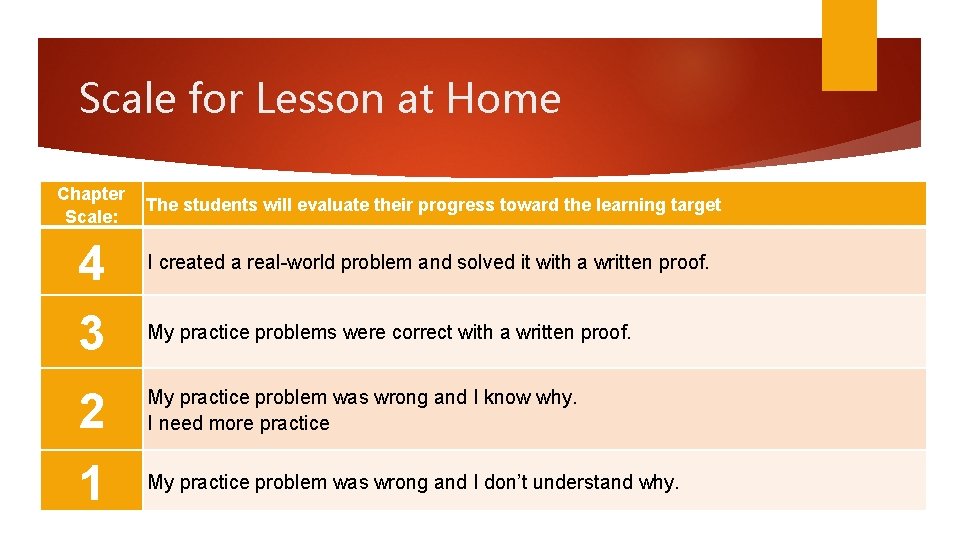
Scale for Lesson at Home Chapter Scale: 4 3 2 1 The students will evaluate their progress toward the learning target I created a real-world problem and solved it with a written proof. My practice problems were correct with a written proof. My practice problem was wrong and I know why. I need more practice My practice problem was wrong and I don’t understand why.
Foldable
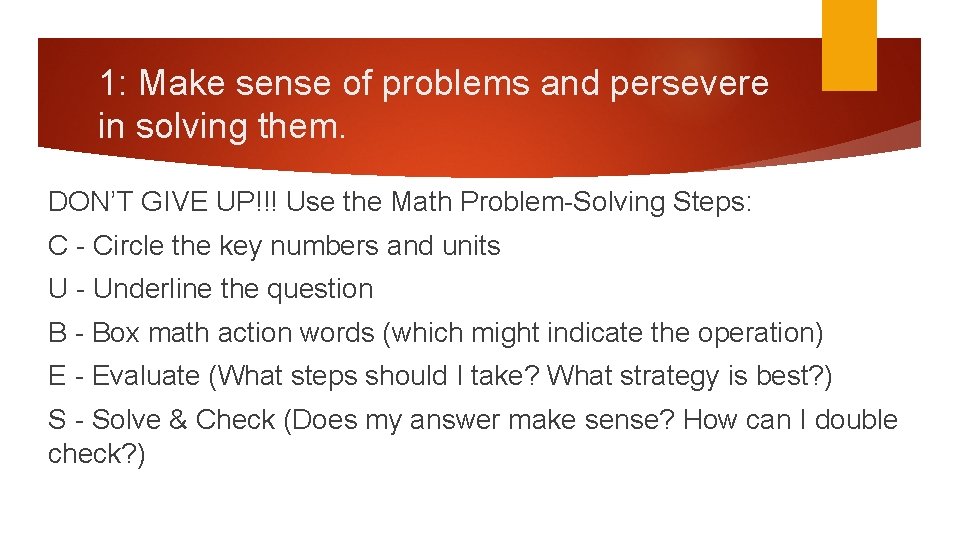
1: Make sense of problems and persevere in solving them. DON’T GIVE UP!!! Use the Math Problem-Solving Steps: C - Circle the key numbers and units U - Underline the question B - Box math action words (which might indicate the operation) E - Evaluate (What steps should I take? What strategy is best? ) S - Solve & Check (Does my answer make sense? How can I double check? )
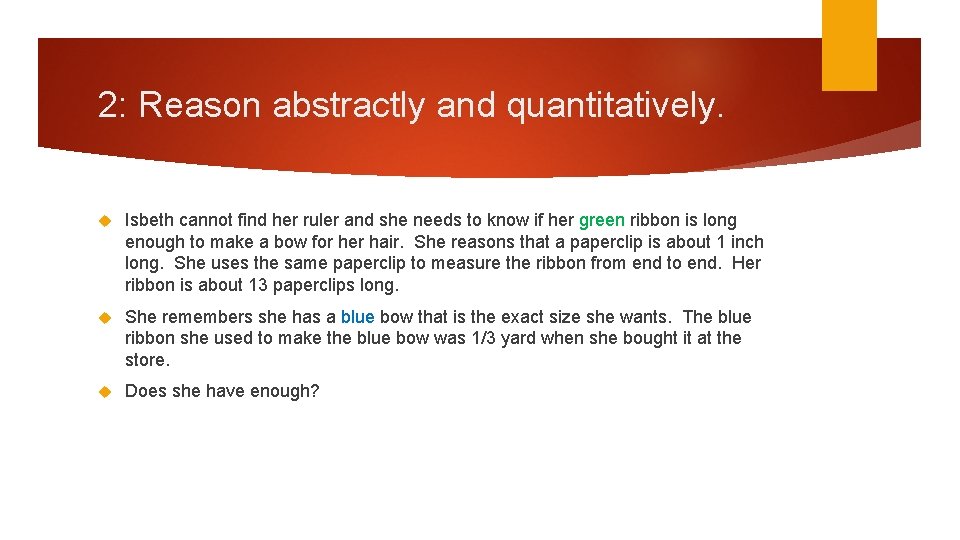
2: Reason abstractly and quantitatively. Isbeth cannot find her ruler and she needs to know if her green ribbon is long enough to make a bow for her hair. She reasons that a paperclip is about 1 inch long. She uses the same paperclip to measure the ribbon from end to end. Her ribbon is about 13 paperclips long. She remembers she has a blue bow that is the exact size she wants. The blue ribbon she used to make the blue bow was 1/3 yard when she bought it at the store. Does she have enough?
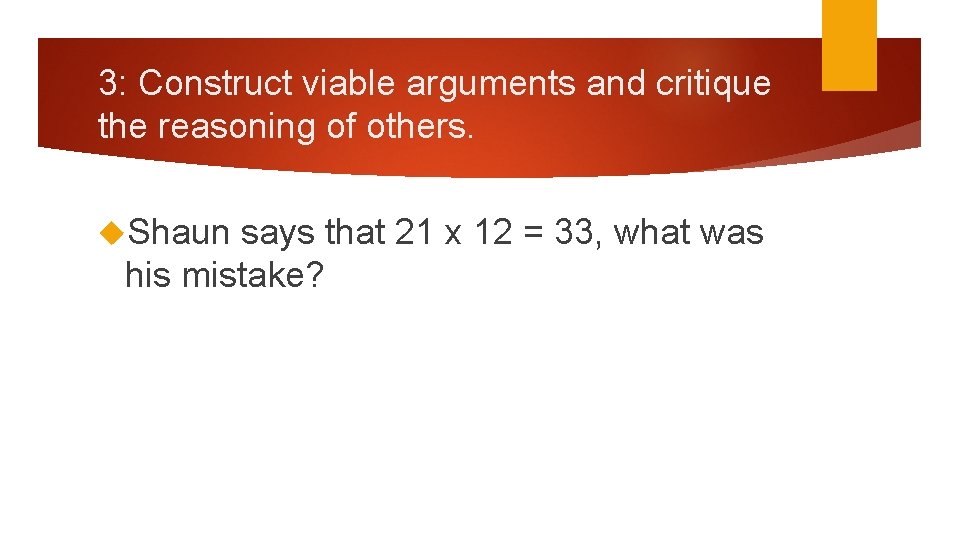
3: Construct viable arguments and critique the reasoning of others. Shaun says that 21 x 12 = 33, what was his mistake?
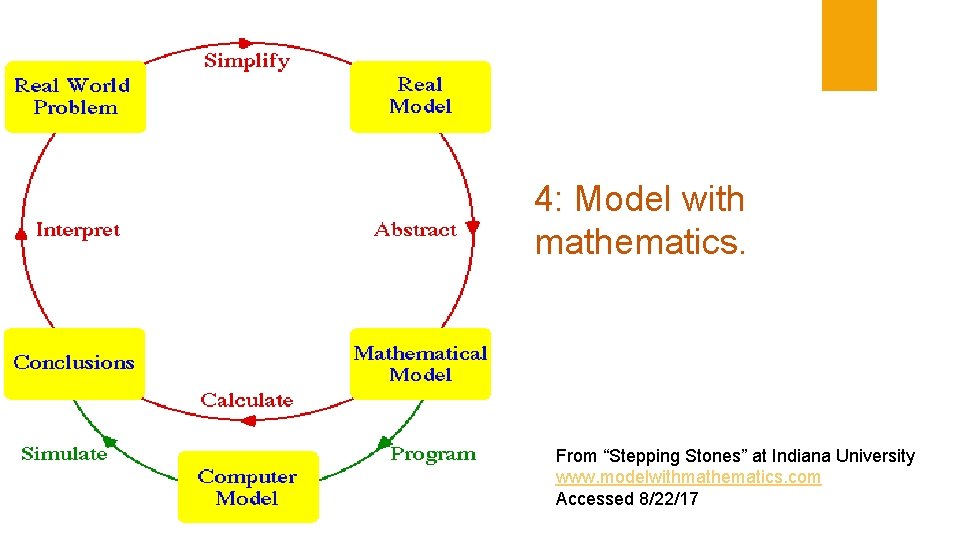
4: Model with mathematics. From “Stepping Stones” at Indiana University www. modelwithmathematics. com Accessed 8/22/17
5: Use appropriate tools strategically. What are some tools a mathematician might use?
6: Attend to precision. Read problems carefully Write using math vocabulary to explain their reasoning Speak Draw using math vocabulary to explain their reasoning models using math symbols and language
7: Look for and make use of structure. What do you notice about the structure of a triangle? What do you notice about the structure of a balanced equation?
8: Look for and express regularity in repeated reasoning. Matthew wants to share 25 cupcakes with 10 other people. He writes an expression: 25 ÷ 11 He understands that he using REPEATED SUBTRACTION or REPEATED ADDITION (11 x? =25) to figure out how much each person will get
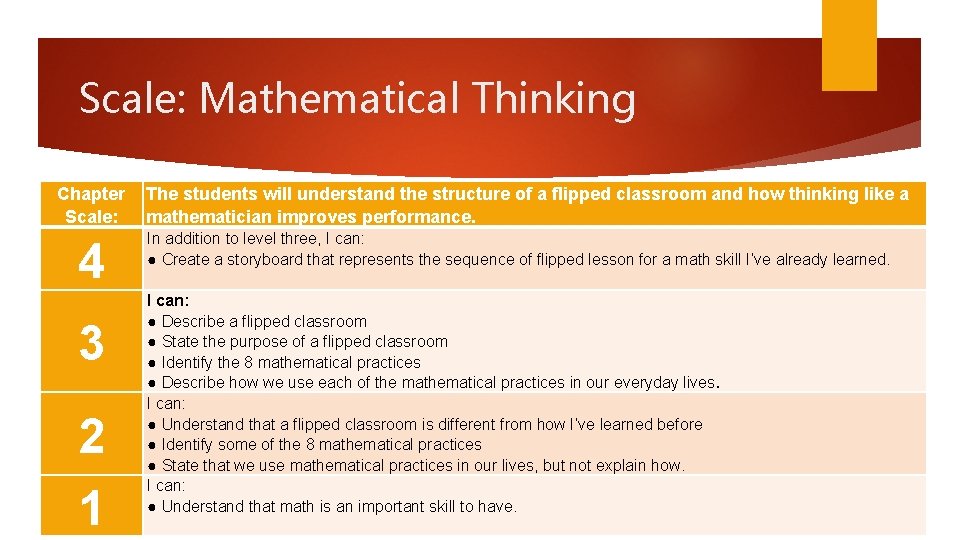
Scale: Mathematical Thinking Chapter Scale: 4 3 2 1 The students will understand the structure of a flipped classroom and how thinking like a mathematician improves performance. In addition to level three, I can: ● Create a storyboard that represents the sequence of flipped lesson for a math skill I’ve already learned. I can: ● Describe a flipped classroom ● State the purpose of a flipped classroom ● Identify the 8 mathematical practices ● Describe how we use each of the mathematical practices in our everyday lives. I can: ● Understand that a flipped classroom is different from how I’ve learned before ● Identify some of the 8 mathematical practices ● State that we use mathematical practices in our lives, but not explain how. I can: ● Understand that math is an important skill to have.